

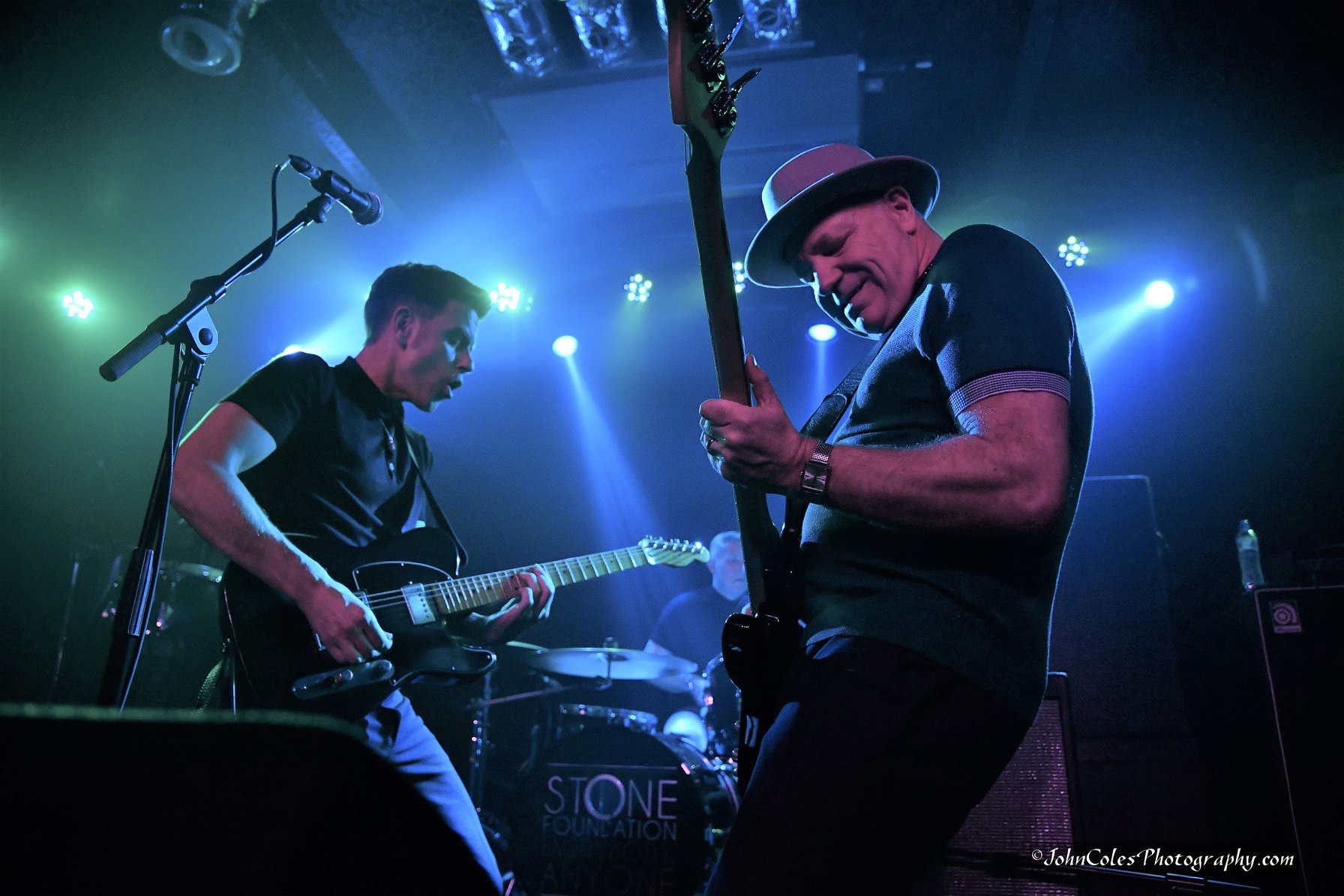
Neil Sheasby was at home in Atherstone when I caught up with him earlier this week, having a breather between live commitments with Stone Foundation, the Midlands soul band he co-founded with namesake Neil Jones a quarter of a century ago.
Sheas was back with family before the first of the acclaimed outfit’s final three shows of another busy year, set to return to the capital for a two-night stint at Islington’s Assembly Hall this weekend (Friday, November 24th, and Saturday, November 25th), before what’s become something of an end of year knees-up closer to his roots, playing Nuneaton’s Queen’s Hall (Saturday, December 9th).
But on this occasion, we talked music books too, him saying kind things about my Slade biography, and me reciprocating about his latest publication, the entertaining and insightful Bass Notes: Life and Times on the Road with Stone Foundation, an abridged collection of diary entries from Sheas’ popular online column of the same name.
In Horace Panter’s foreword for Bass Notes, the Specials legend suggests his bass-playing compadre captures ‘not just the glamour and the mundanity of touring as a band, but the friendships and the things that forge those friendships; the shared frustrations and passions that can make eight grown men rise from their beds before dawn to sit in a cramped van and drive halfway across Europe to perform on a stage not much bigger than the surface area of a baby grand piano at a small club in an unpronounceable town 50km south-west of Heidelberg. And then travel all the way home again. Not only that, but over again the following weekend.’
The 2 Tone stalwart, aka (to coin a phrase) Sir Horace Gentleman, goes back a fair bit with Stone Foundation, supplying cover art for the To Find the Spirit and A Life Unlimited LPs in 2014 and 2015 respectively, a link going back to a support slot for Sheas and co. in late 2011 on a memorable Specials reunion tour. And Horace sees Neil’s collection of diary notes as a ‘story of righteous toil’, one portraying Stone Foundation ‘from the ground up, warts and all.’
I was a little late to the Stone Foundation party. It was only when Paul Weller started recording with them in 2017 that I properly sat up and took notice. I think the gorgeous ‘Your Balloon is Rising’ was the key moment that made me seek out their back catalogue and move forward with them from there. Somehow, that earlier Specials link passed me by. I always loved the headliners, but… well, put it down to the fact that having a young family kept me out of the loop for a while. I would dearly have loved to catch Terry Hall and all back then, but the opportunity never arose.
In that sense, Bass Notes gives me the chance to fill in a few gaps. I’d soon grow to love Sheas’ social media despatches from the SF frontline, admiring today’s interviewee’s honest, colourful, sometimes funny, often refreshingly matter of fact accounts of life on the road. And here we have edited highlights from the period from late 2011 to the end of 2022, just over 11 years of the band’s 25-year odyssey but also their most successful stint, a chance meeting with Specials drummer John Bradbury having provided a springboard to a latter-years success story.
With Stone Foundation it always seems to have been about 100 per cent commitment and plenty of grit, toil and determination. But we all need that lucky break taking us to that next level. And what seemed at the time to be a wrong turn at the Fiddler’s Elbow, Camden, in 2011 proved to be the portal to the next phase of an amazing journey.

From the glamour of supporting Paul Weller at the Royal Albert Hall (not a million miles from the Albert Hall, Long Street, Atherstone, where Sheas’ contemporaries queued for their dole money back in the day, and where the band held their Small Town Soul LP launch in 2008) to playing on a staircase in a Spanish hotel, he’s experienced more than his fair share of peaks and troughs with Stone Foundation. And Bass Notes documents all the fun and the fear of a hard grafting touring band, those factors growing with each album.
The book covers more than 120 shows, up and down England, Scotland, Wales and Ireland, and around mainland Europe too, mostly Spain and Germany, and even Japan on four separate trips between 2014 and 2017. And each entry provides (as his publisher points out) ‘a window into the humour, love, a wistfulness and an honesty of Neil’s days in a splitter van, travelling with his band of brothers.’
Along the way, we also get to understand a little more about those bandmates too, and get a feeling of the people they meet – famous and not so famous – and the all that unfolds outside those stage times, from budget hotel stays to the monotony of the road and service station visits, spare hours thumbing through record racks or meeting old and new friends, and an insider’s view of regarding all those treasured venues that provide the fabric of our live experiences, but aren’t always what they seem to be, while sampling the good and potentially bad and ugly nights, and the band’s sense of achievement at keeping it all together or pulling it off in the face of adversity, despite stinking colds, general fatigue, and what have you.
And for all those experiences, there are still the occasional butterflies, endearing me more to the band, those occasional down to earth shared fears resonating. And then you can factor in the unwinding in pubs and clubs, that primary love of this chosen career coming over throughout.
Starting with those career-changing three weeks with The Specials, we get on to the link with the afore-mentioned Weller – a chance to record at his Black Barn studio in early 2016 leading to so much more – and the likes of Doctor Robert, Graham Parker, Mick Talbot, Steve White, Melba Moore, Carleen Anderson, Shirley Jones, Kathryn Williams, Hamish Stuart, Bettye LaVette, William Bell, the now departed Nolan Porter, and many other musical luminaries (even Peter Capaldi), in a compelling read… just like those original Facebook notes that turned so many of us deeper into this band’s on stage, in the studio, and behind the scenes existence, ultimately shedding light on what life really is like on the road in the modern era.
When we caught up this week, Sheas had just had his first weekend off in a couple of months, after various UK and mainland European dates in another winning year.
“It’s been great. I’ve really loved it. And that’s not always the case. I enjoy the gigs but it’s everything that comes with it, you know – the travelling and all that, being three to a room or whatever. That can be a ball ache, but I’ve got to say it’s been brilliant, I’ve loved this tour.”
That’s something that comes over in Bass Notes, in this format and in the Facebook version we’ve come to know and love. And sometimes it’s those bonding experiences with bandmates that make you, like when you were all in the same room in a hostel at the time of appearing in Brighton, supporting The Specials in late 2011. Could you go back to all that again?
“God almighty. I’d go back to the gigs, but not the hostel! Dear me, it was grim. But needs must, sometimes. If you want to make it work, if you want to carry a big band, you’ve got to budget yourselves, especially back then when we weren’t getting so much money. You have to cut your cloth accordingly.”

Those are surely the moments that bring you together as a band, a proper collective. Those grim shared experiences where you really find out if this is what you want to do with your life.
“Sure, yeah. A bit like us in Japan, where you look around and think, ‘We make that noise and people come here, people on the other side of the world are interested. It’s crazy.’ That can spur you forwards.”
Talking of ‘pinch me’ moments, what would the 13-year-old Neil Sheasby who caught The Specials live in the summer of 1981 (an anti-racism show at the Butts Stadium in Coventry, also featuring Hazel O’Connor and The Bureau) make of Horace Panter – who also happens to have designed a couple of your records – writing a foreword for your second book, a dozen years after a chance encounter with John Bradbury saw him take you under his wing, providing you with that big break?
I’m guessing you’ll mention that 100% effort, drive and determination – as your record label name suggests – but we still need an element of luck or fate. And that’s what you had at a key moment in Camden, getting to meet John.
“Good luck, fortune, yeah, and that night particularly it was. These were the early days of the Internet and he was just searching, under the pretence it was going to be a Northern Soul night he was starting in London. And he probably did have that in mind. But he walked in, and it was just fortune that the night he had off – and he lived up the road from the Fiddler’s Elbow – we were playing and were the first thing that came up on his search. And in his mind what he really wanted was one of the choices for the support for the tour. He wanted a soul band rather than a ska band. And there we were.
“As I say in the book, my default setting was JB’s Allstars, rather than The Specials, so I was asking how Bill Hurley and Drew Barfield were and what they were up to. He was like, ‘Fucking hell, you remember all that?’ We just kind of bonded, y’know.”
I’ve found, interviewing musical heroes, a bit of added research, seeking out rare nuggets to ask about rather than the same mundane questions most regional journalists might ask, can be the difference that inspires a brilliant interview, sometimes with the toughest of customers and people bored with the whole notion of interviews. And it seems you took a similar approach.
“Yeah, common ground. Absolutely, and thankfully we did our thing and he got it. It all unfolded and transpired that this was what he wanted to do, take us out, and that did change everything. For example, we’d never really played Scotland before, yet there we were at the SECC, and then we could go back to Glasgow and sell something like King Tut’s Wah Wah Hut when we went back.

“All of a sudden, 10% to 20% of that crowd is going to get what you do, so we’re forever thankful for that. Everyone focuses on the Weller thing now, but that was a big, big full circle for me as well, from being a kid. Lynval {Golding} came into the dressing room, we were talking, and I told him I was at the Rock against Racism gig they played with The Bureau at the Butts. He said, ‘God, man, we done it for the kids like you!’ It steers your path, really – your consciousness of racism or political stance. It influences you. That was 2011, but even at the time was, ‘Bloody hell, that’s mad!”
Seeing as you mention steadily climbing percentages, in March 2012 you talk about playing Uncle Tom’s Cabin, Blackpool’s ska and soul festival, and meeting a fella from Skelmersdale who tells you he’s coming back with 20 or so of his family for a show at The Cavern in a few months.
“Yeah, and I was in Liverpool last weekend, and they were still there, that same group, still bringing more people. It’s mad!”
Word-of-mouth publicity clearly still counts for something. But it must be hard to keep motivated, all these years on. Like me, you’re a family man. It must be bloody hard saying goodbye to your better half, heading off for weeks at a time on tour.
“Yeah, on the flip side of that coin, I am under their feet for about six months, not gigging, so they’re equally keen to get rid of me, probably! But yeah, it can be. Funnily enough, we just got the tour dates for next year. We’ve been thrashing that out with the promoter. I’ve just put them in my diary, and the first thing I think, when I look, is, ‘I’m missing Sonny’s game there, when he’s playing that week. Then there’s the chance to see Lowell or Mason {his other lads}, but you’ve got to get out there and do it, because if you don’t go out and gig, you’re not really a full-blown musician.
“I don’t think it would suit us to just be a recording band. Our thing is that live arena, and I like touring at this time of year. People are ready to come out again, we’ve seen that on the last tour. Post-lockdown, people have now got past that, and it’s been really good, man. But it is a balance. Every year, we ask, ‘Shall we press the pause button?’ But there’s always something that makes me think there’s still gas in the tank.”
Reaching that 25-year milestone must have made you wonder what’s next. You need those moments that drag you back out there again, to carry on upwards and onwards.
“Yeah, new songs really. I probably wouldn’t do it if it’s just nostalgia, churning out everything you’ve done, reflecting. It’s more like, ‘We’ve got loads of new songs, we’ve got another album here!’ I’m excited by that, so it’s, ‘Let’s get that done, then gig them!’ As long as that keeps happening, I feel relevant, we’ve got an audience, and people are interested in what we’re doing, it sails on.”

And this from a band that… well, in the early stages of Bass Notes you refer to the band as ‘not so young soul rebels.’ And that was a dozen years ago. Those of us brought up on John Peel and all that know age is largely irrelevant – it’s whatever floats your boat and inspires you. But there must be times when you see younger bands coming through and question your relevance to a scene.
“I don’t think the age thing is as bad as it used to be. If I look back to when we were growing up, it’s like, ‘Fuck me, I couldn’t imagine being in a band at 56.’ It’d be horrendous! No way. But we started Stone Foundation when I was 30. So even then, I felt old. But I don’t now. That doesn’t really come into play. As long as we’ve got something to say, we’re still ‘aving it. It’s good, it’s keeping me interested, so I’ll do it. And I think the last album, Outside Looking In, was my favourite. I thought that was really good.”
From where Bass Notes starts in late 2011, it’s not just you and Neil Jones still there. There’s Phil Ford and Ian Arnold too. Four of the original seven.
“Just changing brass sections, really. That’s what that was. If you look back 25 years, there’s only me and Neil left, although Phil was in my previous bands. Yeah, it’s nice. I loathe to use the word comfortable, because it shouldn’t be comfortable, but they feel like the right people to get our ideas and be around us.”
These published diaries start in 2011. Were you keeping good notes before?
“Not band-wise. I kept a personal diary for a few years before. After I lost Hammy, getting back to the Boys Dreaming Soul subject… when I lost him, I was trying to process it, and I was struggling for about six months or so after that. It was down to Zoe actually, the Pinnacle rep that used to come in the record shop I was working in. She’d lost her brother in a motorcycle accident. She said, ‘You writer quite well, you want to keep a diary. If you’re feeling down and you’re grieving, write things down, day by day, it really just comes out of you. It will be therapeutic.
“So I did. I decided to keep a diary, just mundane bollocks, writing down what the day had done. It could be the most boring thing, but I just kept them privately, getting into the flow, and I was enjoying it. It worked for me, and that coincided with John coming in and putting us on The Specials’ tour, and I thought, ‘This is never going to happen again. This is it. This is really unique. So I’m going to write a diary of this and publish them on Facebook.’ Just for myself and the band, day by day, writing in the moment. And of course, everyone loved them, and I never stopped doing them for the next 15 years or however long it’s been now.”
For those yet to read Boys Dreaming Soul, I should explain that Paul Hanlon, aka Hammy, who died after a long battle with cancer in late 2001, aged just 34, was an integral part of Sheas’ formative years, featuring in his first two bands, The in Crowd and Dance Stance. In his words, the pair were ‘an instant mash, a team, a partnership right from the off, a formidable double act,’ describing his friend as ‘an archetypal Boy About Town, the local Face.’

You can be blatantly, often refreshingly honest about people you come across in this music business and around the industry, I ventured. For instance, you talk about the relative merits of writer Paolo Hewitt, a good friend of yours, and influential director Shane Meadows, before a slating of the actor, Neil Morrissey. It’s clear at times you’ve not tried to tone these entries down since.
“Not really. Some things I probably keep to myself, but… I’m writing in the moment, and that’s what happened that night. That was the headline news, and it did change the atmosphere. But I thought it was funny as well.”
While there are plenty of poignant and deeper moments, and appreciations of the music you love, there’s also attention to detail and lots of laughs, including the sort of road tales I imagine the band will still be talking about down the pub a few years down the line, reflecting on this or that tour. I wonder though, if you look back at that rehearsal room 12 years ago, on the eve of the Specials tour, do you still recognise yourself as a band? Are you still the same people, the core of you in that band?
“Yeah, pretty much. I think so. We were prepared for the opportunity. That’s what I always say. That’s what we did back then, and that’s what we do now. You never know what’s around the corner. We always kept ourselves on our toes and made sure we put the work in, and if anything like that – the opportunity with that tour or when Paul {Weller} came knocking and whatever else transpires with the band – we’re always ready. And I recognise that in 2011 as much as I do in 2023.”
Talking of those early days, I hadn’t realised you were playing Porthtowan’s Mount Pleasant Eco Park as early as 2012. There’s no mention of Haircut One Hundred guitarist Graham Jones at that point (there is later), despite his long link with that part of the world, and the fact he’s been a fan for many moons, as you are of his band.
“I didn’t have contact with him then. I’d always talked to Les (Nemes, bass}, but with Graham that was probably a few years later. I didn’t realise he was living there then. And they were completely quiet then. I think they got together just after that for a gig at Cadogan Hall that I went to in London. And it was lovely to see them {playing live recently} again.”
You also mention it was in Porthtowan that Wendy May came down to see you. Another fan, as it turns out, with a further full circle element as you were a regular at her dance nights back in the day.
“Yes, once we got talking, I realised, ‘Oh, you’re Wendy from the Locomotion!’ I went to loads of them nights at the Town and Country Club. That was again an instant match, and we’ve stayed friends ever since.”
There’s one, in particular, I recall. Usually, we’d have been back away across London to the South-East, getting on for 40 miles, but I stuck around after a James Taylor Quartet gig at that venue (now The Forum) for the Locomotion, having read about her love of good soul and being a fan of her band, the Boothill Foot-Tappers, back in the day.
“It’s quite possible I’d have been at that. But 40 miles? I was in the bloody Midlands. Miles away!”
Fair point. And I’d be surprised if our paths hadn’t crossed, not least as we were born 11 days apart and had fairly similar musical influences and inspirations, despite 125 miles or so between us. And on that front, I’m sad to say that when you talk about losing your Dad in late October 1988, that turns out to have been on my 21st birthday. I can only imagine how devastating that was, losing him at such a key time in your life.
That led to Sheas deflecting my question, understandably, instead remarking on a photo I’d just shared on social media – me with my Dad (now 11 years gone), Easter ’76, taken in the front garden of our rural Surrey council house when I was eight, us sat on the front lawn, him holding my orange football, me in an orange top that I felt made me as good a player as Johan Cruyff (my geography was always good, not least because of football, but I came unstuck in thinking Barcelona was part of Holland, as Cruyff played for them both back then). And my Dad – 42 then – is chewing on his pipe, Condor Long Cut in the bowl, just as it was for my Grandad. And that rekindles a memory from Neil.
“I used to go to the football with my Dad, We’d go to lots of matches, every Saturday, wherever that may be. I always remember blokes smoking pipes then, the smell of pipe smoke always in the ground. I used to love that, but it just disappeared over the next decade, after that generation.
“And that ball he’s holding, I’m assuming it’s one of those old orange plastic balls, like Woolworth’s used to sell. They were the best, weighted perfectly. Not too heavy or the light ones that would just blow away. They were perfect. I love all that.”
Back to now, and you’ve mentioned these final dates of the year, and are clearly working on something for 2024. Are there new songs on the way?
“We’ve been writing quite a bit, but we’ve only just done demos, so we’re going to go in the studio and start recording in, I think, February. We’re going back to our rehearsal space first, in January, to whip through all the ideas we’ve got, then start recording properly, which means it may come out at the end of 2024, maybe even 2025. But it’s happening.

“There’s going to be a new record for sure, and we’ll see where it takes us. Then we’ve a few dates starting to be announced for Spring. Then we’ll be into May and June and the festival season, doing a few things around then. And it seems every year it’s October, November, December, working on a big tour.
“We’re very keen to get back to forward facing, playing new music. We’ll try a few things out on the road this year, as well as keeping the old ones ticking over. It’s a good time for us. I’m really enjoying it, I feel optimistic, ready to go again, and I’m really excited about it.”
I mentioned The Specials and Paul Weller, then Paolo Hewitt, the boys from Haircut One Hundred, Wendy May, and so on, and there are plenty of kindred spirits out there, ones you’ve sought out that you didn’t know personally at the start of this amazing journey, including Stone Foundation documentary filmmakers Mark Baxter and Lee Cogswell.
“I don’t know about having sought them out. I think they’ve gravitated towards us! People came to us and got into our thing. And we just feel like, you know, we have common ground. Just like mates. The same interests, I suppose.”
I was surprised that Lee – who first crossed paths with Mark Baxter on the set of a promo video for ‘To Find the Spirit’ – was filming you as early as late 2011. I guess you’d known him a while by then.
“I didn’t, but he was just around the corner in town – Atherstone. It was Richard Atkins filming for us then. He was doing a bit for Rich. He’s younger than us, but we just got on, then thought it was handy, him being local, as Rich was in Bristol. So we thought we’d use Lee for a few things, and our friendship blossomed.”
And when did you last catch up with Paul Weller?
“We saw him in Milan, supporting him on the tour. And he was in good spirits, out on the road. He’s got a new record coming next year and seems really excited and buoyed by that. I think he may be turning up next week. You can never say for sure, but… Then we’re back in the {Black} Barn early next year. Whether he’s around or not, I don’t know. But…”

He’s probably got a dulcimer or something he feels needs playing on some track or other.
“I’m sure he’ll be involved. Yeah, he’s great.”
And finishing where we started, with The Specials, you clearly had a good working relationship and forged a friendship with John Bradbury. You also mentioned Lynval Golding, and there’s plenty in the book about Roddy Byers. How about Terry Hall? In light of his departure just before Christmas last year, did you ever feel you got to know him?
“Not really. He kept himself to himself. He was the most private one of the lot. And you respect that. When you’re on tour with people, you don’t want to be in their faces. If they want to talk to you, they’ll come to you. You knew the ones who would be really open… like Lynval and John.
“I think they were having their own little dramas as well, that was a bit weird, but Terry was a funny guy, and we did have those moments when he’d speak to us. He was lovely, but yeah, he was quite guarded, kept himself to himself. Mainly we spoke about football. As a massive Man U fan, there was a connection he had with Jonesy. Once he found out I was Leeds, he’d give me a bit of all that!”
It’s odd to think Roddy was still part of the band then. Clearly there were more fallouts to come.
“Yeah, and you felt like banging their heads together, because the sum was obviously bigger than the parts. Each one of them would take turns to come into the dressing room, having the craic with us. And you just wanted them to get on together. But on stage, the chemistry and magic was there, and that tension probably added to the great spectacle on that tour.”
And with that, Sheas was away, albeit not without a further book recommendation, having started the conversation praising Wild! Wild! Wild! A People’s History of Slade (Spenwood Books, 2023), ending it by mentioning Kevin Armstrong’s Absolute Beginner (Jawbone, 2023), covering the journeyman London guitarist’s years as a sideman with the likes of David Bowie and Iggy Pop, Sheas revelling in its ‘great stories of rock ‘n’ roll excesses.’ Just like a night out with Stone Foundation, eh.

For this website’s April 2022 interview with Neil Sheasby, head here. For our 2017 feature/interview with Sheas, head here. And for our 2020 feature/interview with Stone Foundation’s Neil Jones, try here.
WriteWyattUK’s impression of Stone Foundation supported by Steve Brookes at Guildford’s Boileroom in late 2021 is here. And this site’s take on Stone Foundation at Gorilla in Manchester in late 2019 is here.
Bass Notes: Life and Times on the Road with Stone Foundation by Neil Sheasby is available now from Soul DeepBooks via www.souldeep.co.uk and all good bookshops. And for ticket details for all Stone Foundation shows and more about the band and their releases, head here.


 writewyattuk