

I love reading around a subject while writing, and work on my book about The Jam has me not only returning to or finally delving into various other publications about the band, but also reliving the years around which they were together (1972 to 1982) and immersing myself in extra background concerning a Surrey patch barely half a dozen miles from my own Guildford roots.
And among the best biographies, appreciations, and invaluable first-hand accounts, I’ve devoured two books that until now sat on the shelf unread, finally thinking the moment was right.
My better half and I became foster carers in 2022, another key reason why I felt the time had come to tackle Paolo Hewitt’s memoir of his Woking children’s home days, The Looked After Kid and its follow-up, We All Shine On. And it’s fair to say both publications truly nail the subject – providing an extra layer of understanding to something I felt I already knew plenty about, a few key points on our own recent bumpy journey making more sense.
It’s not the right place to go into detail, but we’ve been on numerous county council-run courses regarding children in care and how to learn from all that and add your own positive life experiences to the mix, so as to best pass on some of that learning and understanding to less fortunate young people who miss out on basic building blocks along the rocky way.
We’ve spent valuable time getting to grips with the realities of all that, enriched by it all, and – for all the low points – gaining so much from the experience. Yet I felt I learned a little more from a skilled writer who’s been there and knows the subject so well, a Looked After Kid who somehow found his way out of the wild, wild wood, as an old friend might have put it.
In many ways, I reckon I’ve been the lucky one. Brought up in a solid working-class family with very little money to spare but always lots of love to go around, with plenty of friends and family I could count on. Paolo’s own background was much harder, personal circumstances and the bigger system letting him down time and again. However, he ultimately beat the odds, I feel, making his own positive impact, proving his own sense of worth and finding that love for himself.
For all our disparate beginnings, we have much in common, from shared geography to the cultural and sporting influences that inspired us going forward. Music and football clearly had a pull on us, and alongside Paolo’s enduring passion for all things Tottenham Hotspur and SSC Napoli, there’s a nostalgic appreciation of Woking FC too, his grounding there long before I became a late-Eighties Kingfield regular. As for the music, he first properly got to know The Jam just as they were making their first successful forays on the London scene and pretty soon followed suit, getting to know the chief songwriter along the way, a friendship developing. It seems it was rarely a cosy relationship. Complicated might be a better word. But there was plenty of love too, and he saw in the Weller family dynamic something missing from his own upbringing.
In a sense, Paolo – who turned 66 this week, just under seven weeks after a certain Paul Weller – got the writer’s life I felt I craved in my teens. I finally went down the regional journalism line in my late 20s after several years of office jobs and working for weekends, travel and holidays, until then making do with penning my own fanzines and scribbling away on the novels and scripts while going large on life experiences. Paolo’s own path took in the halcyon late Seventies, Eighties and Nineties days of the Melody Maker, the NME and further afield, writing on many subjects dear to my own heart. But there was always something else there driving him, and it would take him a long time to get to grips with his past and his beginnings.

And despite the picture I paint of my own relatively safe and certainly contented upbringing, I often wonder if Paolo’s early fate could have been mine. I revisit key parts of my mum’s life story, going back to Reading, Berkshire (notably losing her mum to TB when she was barely five, her dad soon marrying again, ultimately keeping the family together) and see a girl who could so easily have ended up in care and in an orphanage, maybe even shipped across the Commonwealth, possibly landing with non-deserving foster or adoptive parents. I also revisit key parts of my dad’s early years in Woking, and there are further elements there. From his days as a steam loco fireman through to 30-plus years as a postman and beyond, I think he was acutely aware that the break-up of his parents’ marriage might well have seen his destiny change for the worse. But here were a couple who stayed together long enough for him to find his own way. In fact, love overcame in both cases, my folks taking that on with their own family, the fate of us five Wyatt children (and the nine grandchildren and three great-grandchildren that followed) testament to that.
Other parts of Paolo’s Burbank books similarly resonate, such as the tale of his good friend Des, who has a close link to a long-time friend of mine (and fellow Woking FC fan). I’ve since learned that Des had some of his happier later years in the village I grew up in. Then there are Paolo’s words about the first children’s home he knew, in the next village to my own, where I was meeting schoolmates around the Jam breakthrough years, not so long after his days there. Small world, and all that.
Back on the Woking front, so much of what I equate the town with today (my family links go back to the 1890s, my dad and Wyatt grandparents born and brought up there, my nan still on Arnold Road a century later) is encapsulated in Paul Weller’s songwriting. For me, songs like ‘Saturday’s Kids’, ‘That’s Entertainment’, ‘Town Called Malice’, ‘Liza Radley’, ‘Tales From The Riverbank’ and ‘Wasteland’ (without even delving beyond 1982) couldn’t be about anywhere else. Yet they clearly resonate with so many more outside our bubble (and I get that, in the way so many songs resonate with me that were written in – off the top of my head – Birmingham, Coventry, Liverpool, London, Manchester, Norwich, Sheffield, Wolverhampton, Belfast, Derry, Cardiff, Edinburgh, Glasgow, New York, Toronto, Brisbane, Melbourne, Sydney, Te Awamutu…). Maybe it’s what Paolo called in our recent conversation (not without affection), ‘that small town mentality’. And while there’s very little about the rise of The Jam in The Looked After Kid and We All Shine On, those books are also integral in revealing more about a Place I Love – for all its negatives – and have got to know fairly well.
As for Paolo’s autobiographical forays into writing about the care system, they’ve served to make more sense of my own recent involvement on the edge of all that, giving added understanding as to what we’re occasionally dealing with, and that alone proves those publications invaluable for anyone wanting to grasp what it was like to grow up in care in the Sixties and Seventies. In fact, in any era.
It was only recently that we spoke for the first time, and for two blokes who’d never met there was a lot of reminiscing about old times and new, mostly drawn around similar influences, inspirations and mutual friends and acquaintances. Paolo is more geared towards scriptwriting these days, partly in recognition of realisation that so few authors make a living from their craft today. But we talked openly about all manner of things, not least on football, including recollections of Ken Oram and the Woking FC link (Paolo has his own blighted past with Woking FC, as readers of The Looked After Kid may recall) to Chelsea player turned trainer Harry Medhurst, Paolo’s championing of Spurs striker Martin Chivers in a brief audience with Peter Osgood as a kid, Alan Mullery and Jimmy Greaves’ fear of Millwall fans, and legendary cult hero Robin Friday (who he reckons he saw play at Woking in Hayes days… or hazy days, maybe), who had many of his best sporting moments at Elm Park, Reading, less than a five-minute walk from my mum’s childhood home.
Many of you will know Paolo co-wrote The Greatest Footballer You Never Saw: The Robin Friday Story with Oasis bass player Paul McGuigan (Mainstream Publishing, 1998), and later helped Martin Chivers with his autobiography, Big Chiv: My Goals In Life (Vision Sports, 2009). In fact, he mentions the latter in But We All Shine On, a side-story I feel neatly sums up that ‘living the dream’ mentality he has for his craft, recalling a first return to his children’s home in Woking, and the bedroom where he spent so much of his teen years.

He writes, ‘I looked at the wall on the right and remembered a picture I had hung on it of David Bowie. I recalled lying on the bed for hours looking at that pic of him as Ziggy Stardust, trying to work out what song he was playing at that exact moment in time, where he was, what he was thinking. I did the exact same thing with my poster of the Spurs centre forward, Martin Chivers.
‘In the picture, Martin was either receiving the ball or passing it. I spent hours wondering what game he was playing in and where the ball was going next, and was he about to score, and who was the opposition? I never did get the answer, but two years ago I met Chivers. My agent called me and said he wanted to write a biography and they were looking for a writer.
‘We met him at a hotel in London. I could hardly look at him. When my agent told him that he was a hero of mine, I actually blushed and looked away. I got to write the biography with him and throughout the whole time I spent with him in his car, I could never tell him about my past and what he meant to me.
‘Chivers once played for Southampton FC. In April 2009 we went there together to interview some of his old team-mates, get information. We caught the train from Waterloo. And it stopped at Woking. Burbank stood half a mile away. I could not believe it. For two minutes as Martin spoke, oblivious to my position I sat there thinking to myself, My God, if you had told me back in Burbank that at some point in my life I would be sat on a train in Woking with Martin Chivers, I would have thought you were mad.
‘As the train slowly slid out of the station I said a little prayer, one of thanks, one of gratitude, that life could be as wondrous as this. That book, his biography, started here in this bedroom.’
The day we spoke, Paolo’s young lad was at home, our conversation briefly curtailed as he made him a wrap for his lunch.
‘Jam or Brie?’ he asked.
‘Jam, please’ came a muffled voice in the background.
‘Well, there you go, Malcolm!’
There’s no getting away from it, is there.
‘There’s not, is there!’
Speaking of which, some subjects we steered clear of, other than conversational mentions of moments like him nipping upstairs to at Michael’s to see the band in the early days ‘with a disco underneath and a gambling club upstairs.’ Or Rick Buckler giving out Jam badges at the Nashville when they started making their big move on London. Or a brief mention of the ‘doddery old colonel’ who ran the Cotteridge Hotel in Woking, one of the band’s old drinking holes.

In response to mentions of the parts of town I knew best, he mentioned his own ’15-minute walk straight down the hill to Kingfield.’ But somewhere along the line there was a visit to the Civic Hall on my Guildford patch to see Dr Feelgood, Wilko Johnson’s guitar playing the inspiration needed for Paul to make that next step up (at a gig Paolo also attended).
In my 2002 edition of The Looked After Kid, a certain ‘PW’ – the musician who’s just released his latest solo album, 66, in a summer which will also mark that birthday milestone for Paolo – gets a dedication (referred to as ‘mio fratello’), but within a few years their friendship was behind them, something Paolo respectfully has no wish to air in public, despite this Cappuccino Kid being right up close and personal towards the end of the Jam years and into the Style Council era.
I stood little chance of getting Paolo to reveal much new there, on the record (so to speak), although not really for any other reason than he’s written so much in detail about the band already, starting in book form with authorised biography The Jam: A Beat Concerto (Omnibus Press / Riot Stories, 1983), before taking the story on in Paul Weller: The Changing Man (Bantam Press, 2007).
Both books I found indispensable. A Beat Concerto was the one I lapped up as a teen. In retrospect, it’s way too raw and came far too soon, the wounds still open. It certainly went down poorly with Bruce Foxton, judging by my correspondence with him in those years (part of which ended up in my first real interview for my Captains Log fanzine). Rick Buckler clearly felt the same way, and a decade later The Jam: Our Story (Castle Communications, 1993) saw a published response from the other two-thirds of The Jam that arguably re-opened those wounds, the Saxa to the fore.
As for The Changing Man, I do wonder if it’s healthy to write about someone you know so well. I’m sure Paolo has pondered on that. But for me, that biog and John Reed’s Paul Weller: My Ever Changing Moods (Omnibus Press, 1996) are so important in understanding the bigger picture. And there’s real insight on and love for the subject from Paolo, some of which was possibly overlooked by those seeking more salacious detail. As I said, complicated is the word, but I like to think Paolo and John’s books – written by insiders and outsiders, arguably – ultimately celebrate a unique talent and neatly examine where he came from and what makes him tick.
As for his Burbank books, I won’t go into too much detail (I am 22 and nine years, respectively, late with my reviews, after all), but in The Looked After Kid, Paolo re-examines his life from his 1958 arrival to his move to London and a writing career. It’s inspirational and heartening, and while it was probably lined up on bookshop shelves alongside more harrowing ‘Daddy, don’t’ books, it’s often funny, it’s entertaining, and it’s thought-provoking. As all good biographies should be, right? As Irvine Welsh put it, it’s ‘an uplifting story about refusing to give up on your dreams’.
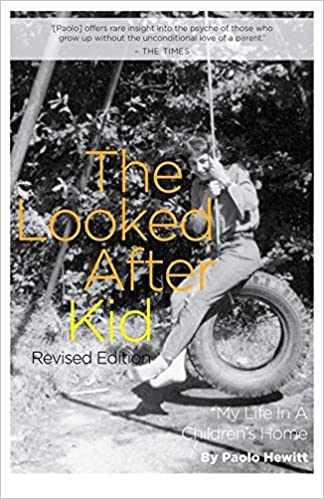
It was certainly a brave book to write, no doubt emotionally exhausting for its author, but with time to dwell on it and plenty of praise following, a follow-up was somehow inevitable. And But We All Shine On did that wonderfully, Paolo providing not only great writing but also sensitivity, tracking down a few fellow children’s home friends then asking them about their lives, with often revealing, extremely open responses. Again, words like inspirational, powerful and moving don’t quite do it justice. In the wrong hands, it could have seriously misfired, but once more, there’s humour and colour, and there are fully formed characters you feel real affinity with. As poet and writer Lemn Sissay put it, ‘With his pen Paolo projects light on the darkest path as he seeks the family that never was and unravels a tragic, comical, magical and moving story.’
It turns out that plans are afoot (fairly advanced) to bring The Looked After Kid to the stage next. Meanwhile, Paolo is busy with his own writing and research, three scripts currently in circulation (‘two film scripts and a TV pilot… one about a tailor, one about Little Italy, one about a ten-year-old boy living with an alcoholic mother.’). Then there’s a project he first previewed on social media a while back, one which on his 66th birthday yesterday, he revealed a few more details about. As the man himself put it, he’s ‘going live’. I’ll let him explain…
‘Using seven of my books (on Oasis, Steve Marriott, Robin Friday, and others) plus stories from my music press past, I am going to put together a reading and take it out to the people. I’m currently talking to venues in Buckinghamshire, London, Glasgow and Birmingham, sorting out ticket prices and sales as we speak. Very much looking forward to it as well. Going to put a lot into this.’
Sounds like another winner to me. Regarding the music press days, we’re talking a ‘collection of stories about my work on the music press, 1979-90,’ Lot of big names there – Prince, Springsteen, Strummer, The Specials, to name a few.’ He initially looked to crowdfunding and was ‘very moved by the response I got’, but reckons he was ‘too lazy, should have pushed it more.’ This time he’s determined to get there though.
That timeline stretches from November ’79, to be precise, and that will ring a bell for Jam fans, his review on the (almost) secret ‘John’s Boys gig at the Marquee early that month carried in the following edition of Melody Maker and leading to a commission for a feature-interview with the band themselves soon after around their Manchester Apollo double dates. And that’s what’s been keeping him busy in the British Library lately, seeking out his music press features, reacquainting himself with his past works. It will certainly include some impressive copy, judging by my own memory of the many impressive interviews carrying his byline in the years that followed.
We did touch a little more on his Burbank days in conversation, how it was ‘probably 20 kids and three staff’ then, but now ‘three kids and 20 staff,’ a change he heartily commends. And then there were the nuggets of advice on understanding the ‘looked after child’, or in current parlance, ‘the child looked after’ (the child always comes first, you see). Above all else, when he recalls those days in Woking, he reckons it mostly involves happy memories and laughter now, and voyages of discovery, not least about being turned on to new avenues in music and recalling the enduring friendships that were carved out back then.
Which somehow reminds me of Only Fools and Horses, the regulars reminiscing after a drink-fuelled reunion night out, back at the Trotters’ flat, self-proclaimed midfield dynamo Del Boy recalling the school football team they had in The Class of ‘62.
‘We had Denzil in goal, we had Monkey Harris left-back… we had camaraderie…’
And Trigger cuts in, ‘Was that the Italian boy?’
Here’s to the next chapter, Paolo. Looking forward to our next catch-up.

For the latest from Paolo Hewitt, head to his website here. Meanwhile, if you have a story to share about seeing The Jam back in the day, or would like to pen an appreciation of the band and the impact they made on your life, and you’d like to be included in Solid Bond In Your Heart: A People’s History of The Jam (introduced on these pages in this feature), please drop me a line via thedayiwasthere@gmail.com


 writewyattuk