

According to Chris Selby’s impressive Slade Live! online listings (linked here), 50 years ago yesterday, Noddy Holder, Jim Lea, Dave Hill and Don Powell were on the Continent, recording for Belgian TV show Chansons a la Carte.
Four days later, May 18th 1975, a day ahead of the Irish rollout of Slade in Flame, Noddy was among the special guests at a BBC Radio One fun day at the Mallory Park racetrack in Leicestershire, the day the Bay City Rollers proved to be the main attraction… and scarily so, as memorably recalled by legendary broadcaster John Peel in his posthumously-released Margrave of the Marshes memoir (Bantam Press, 2005) and more recently Daryl Easlea’s Whatever Happened to Slade? When the Whole World Went Crazee (Omnibus Press, 2023).
In both cases, it was chiefly about plugging new single ‘Thanks for the Memory (Wham Bam Thank You Mam)’, the band also (erm) memorably performing on the Rollers’ TV show, Shang a Lang, on June 2nd at Granada Studios, Manchester. By then that single, their 15th to chart in four busy years, had become their 13th top ten seven-inch hit, but it would prove to be their last until 1981. Soon they were headed back to America, the long spell away that followed (they wouldn’t return to the road on this side of the Atlantic until April 1977, by which time the homegrown live scene had changed immeasurably) starting in earnest with a show on June 12th at Kiel Auditorium in St Louis, Missouri, embarking upon a new decisive chapter in this iconic band’s quarter-century together.
Promotion for Slade in Flame was long behind them by then, but it was the film that never truly went away, ultimately proving more of a success than that sojourn in the United States… even if it took an age for the film to be properly recognised as anything resembling a classic of its genre. As Noddy Holder recently told Stephen Dalton in an interview for the British Film Institute (BFI) website, ‘It did dent our career, but it stands up strong now. After 50 years, people look on it in a totally different light. I don’t think our image any more overshadows the story, the script, and the music in the movie. It’s been looked on with fresh eyes in the last 10, 15 years or so.’
This year has certainly seen a major upturn in interest, the BFI’s remastering project giving Slade in Flame a fresh lease of life, leading to multiple events and screenings. And uber-fans Chris Selby and Ian Edmundson’s latest Noize Books and Recordings publication, Slade in Flame at 50, was out ahead of the pack and soon deemed an integral component of the golden anniversary celebrations.
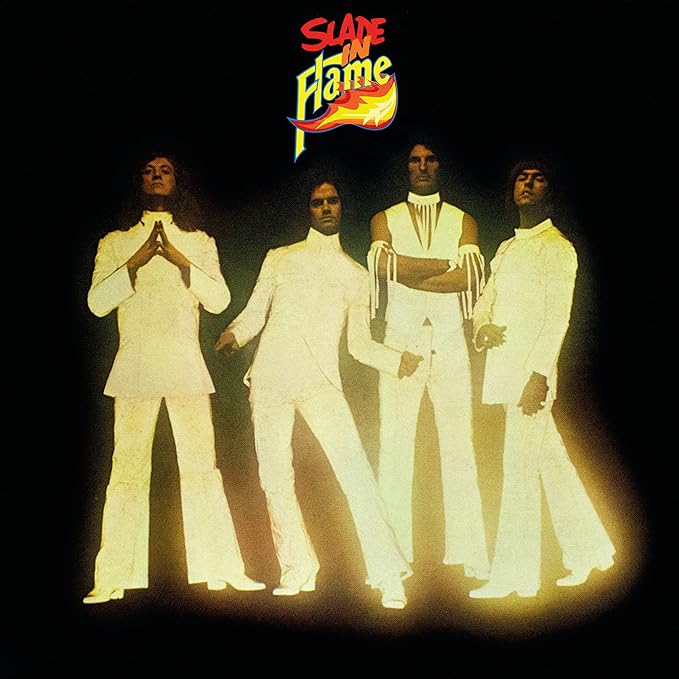
Coming in at 290-plus pages, many in full colour, it tackles in depth not only Richard Loncraine’s film but also the LP and its singles; John Pidgeon’s book, and Andrew Birkin’s film script. It carries cast and production crew profiles, tells in detail the story of the making of the film and looks at its locations, reprints original PR handouts and contemporary press reports, tells the tale of the London premiere and offers timelines of the LP, the film and the tour that followed, and provides detail of tour and film souvenirs and memorabilia, along with images from the film and more about the look (from the eye-catching guitars to the stage gear, including interviews with clothes designer Steve Megson and iconic photographer and long-time friend of the band Gered Mankowitz, who shot the sleeve art).
Then there are interviews with Tom Conti, reflecting on his breakthrough part as the band’s upmarket manager, Seymour, eight years before roles in Merry Christmas, Mister Lawrence and (in his first Oscar nomination for best actor) Reuben Reuben, his interview with Chris and Ian coming in the wake of his recent high-profile role, portraying Albert Einstein in Christopher Nolan’s acclaimed Oppenheimer.
There’s also an original press feature by reporter and long-time Slade fan Richard Cox (who first saw them in 1970, attended 1972’s landmark Great Western Festival show in Lincolnshire – the first time they properly shocked a neutral audience who may have written them off as pop lightweights – and got to know them well), who also reflects on his memories five decades on, as do many other fans. And then there’s a great first-hand piece with good friend of this site, Don Powell. Exhaustive is the word, I feel.
Chris, who like his musical heroes hails from the Black Country, and Ian, from Bolton, Lancashire (younger than Chris, but old enough for me to add that rather than Greater Manchester, those authority changes only coming into existence in 1974, while ‘Everyday’ was at its chart peak) have built up an impressive set of Slade-related publications in recent years, not least The Noize – the Slade Discography and Slade: Six Years on the Road. And it’s fair to say both glow with pride at the acclaim coming their way for the book, deemed ‘thoroughly researched’ and ‘a further reminder of the band’s brilliance’ by Paul Moody in Classic Rock and ‘forensically detailed’ by Stephen Dalton in a feature on the BFI’s own website. Meanwhile, Daryl Easlea adds in the book’s foreword, ‘Chris and Ian are two of the great Slade historians – cherish them and cherish this great book.’ Can’t say fairer than that.
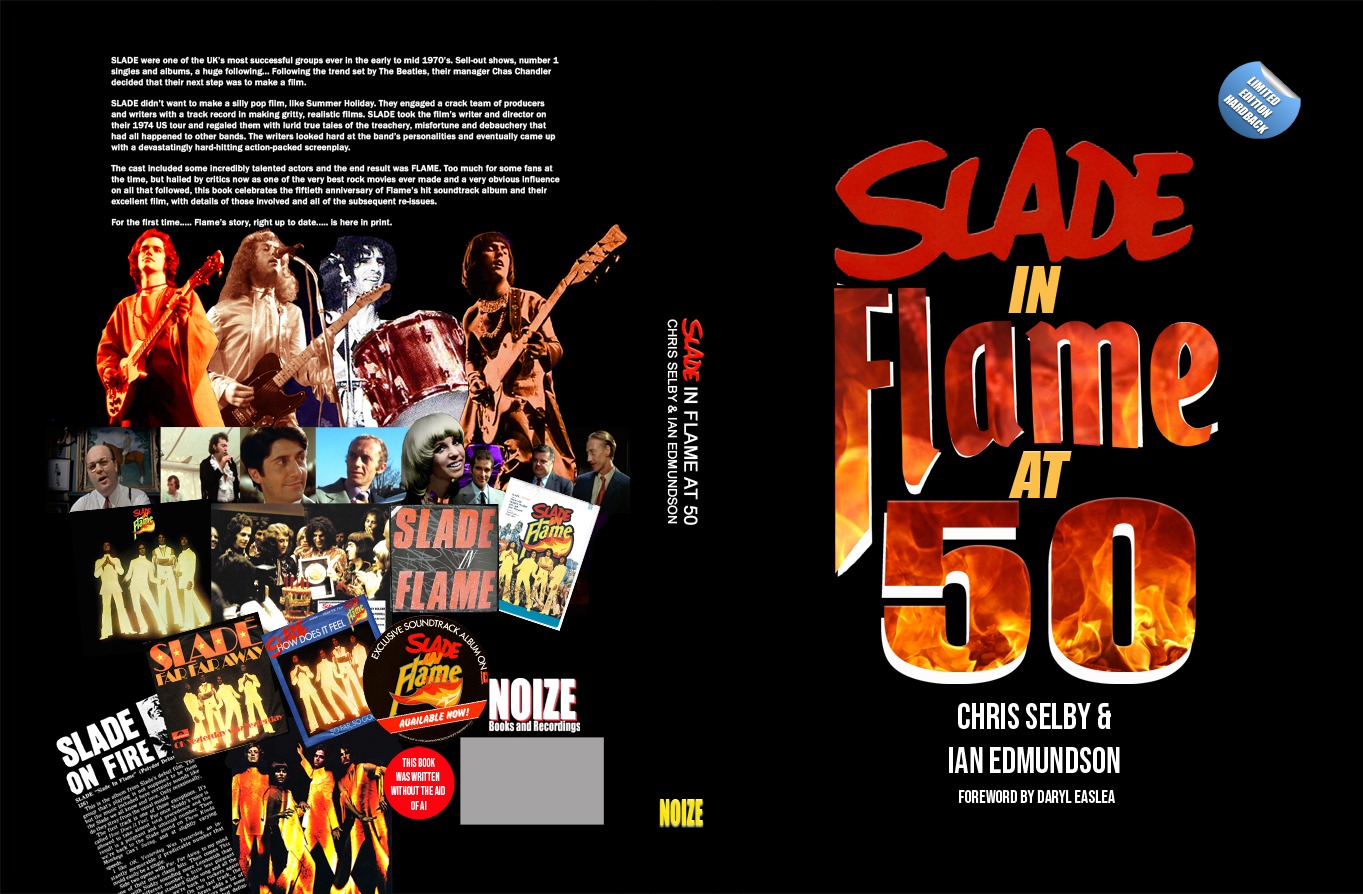
All good enough reason for me to set up a three-way video interview, first off congratulating the pair on the latest Noize production.
Ian: ‘A shiny book!’
I’m impressed. It looks grand – a lovely job, fellas. I guess it took a while to pull together, or did you have lots of material ready to go?
Ian: ‘The thing with Chris and me, how we got into doing the books was that I’d seen Robert Lawson’s Cheap Trick book {Still Competition: The Listener’s Guide to Cheap Trick}, and thought, ‘We’ll do a Slade book,’ so we wound up doing The Noize, our big book. But with everything we’ve done… we’re the people who never throw anything away! We’ve the crap of centuries here. Chris has these underground catacombs beneath his house where he’s got Noddy Holder’s afterbirth and everything. He used to live not very far from where Nod grew up…’
Chris: ‘Literally the next housing estate along, the senior school slap-bang in the middle. When anything happened, such as Slade topping the charts, we’d be down outside his mum’s.’
I love Chris’ tales and those of others from that area there in the right place at the right time for Slade’s emergence, many of them told in my book, Wild! Wild! Wild! A People’s History of Slade (Spenwood Books, 2023), including several about those young fans hanging around in the hope of seeing their local heroes on their frequent Black Country returns, seeing who might turn up, whose Roller it would be that day…
Chris: ‘Or Dave Hill’s Jensen – he’d go past the pig farm, past the gypsy farm, past the school, on to Nod’s. All very working class. We’d get on the 33 {bus}, go down, see Nod… sorry… Neville. ‘His name is Neville!’ His mum got really upset if you asked for Nod. It’s just the way it was.
‘With regard to the books, I got on board doing all the bits and pieces, then something came out… it was Nod’s first book, where he mentioned how the first ever gig {the classic four-piece} was April 1st, 1966. I thought, ‘This is fantastic…’ I went in the library, got the Observers… but no!’
I know where you’re coming from. As a keen family historian alongside my day job, I’ll often end up going down rabbit holes, browsing through regional newspaper archives (thankfully online these days rather than having to scrawl through endless microfiche rolls underground, as it was a few years ago). And I find it rather illuminating revisiting those daily and weekly columns, not just for features and news but also small ads for gigs in the corner of entertainment pages.

Regarding Slade, I spotted one in a Scottish newspaper in late 1969 or early 1970 where a venue announced a Slade show but self-censored itself in its listing, as if they’d been told ‘the name is no longer Ambrose Slade’ but wanted to ensure everyone knew it was the same band, so as to not miss out on ticket sales. And I’ve discovered lots of conflicting information, be that regarding Slade or several other name bands. It’s a bit of a minefield.
Chris: ‘Yes, ‘Slade… formerly Ambrose Slade’… or ‘formerly the ‘N Betweens’… that sort of thing. But that’s what got me into it, that mention of 1st April 1966. Recently there was a claim that they started even earlier that year. Something on EBay, a letter with a promo recording claiming they started in February… so again that changes the story. But yes, Noddy’s line was that they started on April Fool’s Day, and ‘we’ve been playing the fool ever since…’
Ian: ‘Well, you never let the truth get in the way of a good story, do you.’
But this time around I want to concentrate on Flame and the tour that followed, 50 years ago, with your latest book in mind. Daryl Easlea, in his foreword to Slade in Flame at 50 sums up neatly the appeal and cultural importance of the film, while touching on how it became a cult classic in time but not a hit on release, and how a sizable proportion of Slade’s core teen audience didn’t really get it. That gives me a chance to ask about your Flame experiences. How old were you, where did you see it, and did you go back more than once?
Chris: ‘It wasn’t being shown in Walsall, so I had to go into Birmingham. I think the support film was something like Our Man Flintstone. I could be wrong. A cartoon, a bit weird. And it just seemed to disappear once it had done its initial run. I don’t think it was retained for a second week. Nothing like that.’
As it meant a trip to Birmingham, I’m guessing you didn’t catch it more than once.
Chris: ‘No, not at all. I’d have been coming up to 19 at the time.’
Ian: ‘I was born in ‘58 so was coming up to my 17th birthday. I saw it at Bolton ABC. We had about three big cinemas in the town centre. I can’t remember what was supporting it. I seem to think it was a Monty Python film. The thing was, when I saw the film, I didn’t have these daft expectations that it was the story of Slade in any way – a documentary or some fly on the wall thing – because I’d read the paperback.
‘I went along, sat down, watched it, and enjoyed it. I thought it held together very well. I wasn’t surprised, because I’d read the book… and it sold 200,000 copies, allegedly. It certainly sold a lot of copies. So how did all these people, Slade fans at the time, not realise the book is a story? It’s not the story of Slade. I just couldn’t get how they got themselves into so much trouble with it. That doesn’t compute.’

My copy of John Pidgeon’s Slade in Flame book (Panther, 1975) still sits proudly alongside George Tremlett’s The Slade Story (Futura, 1975) on a shelf. My brother, seven years older and a massive Slade fan, had both on release, but photos had been cut out and I ended up buying my own copies in more recent years. I knew The Slade Story well, but can’t recall going back to Pidgeon’s paperback so much beyond my teen years, when its fairly graphic nature (if I remember correctly) appealed more.
Ian: ‘The book tells the story properly, and everybody who read it thought the film was going to be exactly the same. What tickles me is that people think they filmed things like {the mobsters} cutting Jack Daniels’ toes off, then decided to cut it out. They knew what wouldn’t get past the censors and knew what would have got the film an X certificate… so didn’t bother filming that.’
You would have known the songs well by the time the film came out.
Ian: ‘Yeah, I was good with the soundtrack.’
I love that LP (as does Noddy, calling it ‘probably our best’, with ‘Far, Far Away’ his favourite Slade single, as is the case for Don), although I didn’t have the context of seeing it at the time to examine how the band had moved on from what came before, for instance since Old, New Borrowed and Blue.
Ian: ‘It’s only really ‘How Does It Feel’ that is different. The added brass, the thing with Gonzalez. Apart from that, it’s not a lot different {from other Slade LPs}, except that Old New Borrowed and Blue was a patchwork quilt of leftover songs, because of Don’s accident.’
Daryl Easlea suggests in his Slade biography that if Led Zeppelin, Black Sabbath or David Bowie had made that film, it would have been far better received by their fan bases. Maybe the critics would have followed suit. It’s now seen as a cult success but was a slow burner on that front.
Ian: ‘Well, if you look at Slade, their relationship with the press was always pretty dreadful. Once they built them up, they spent the rest of their career knocking them down. So Slade making a film was like target practise for the press. They could have walked on water, brought Christ on in the cameo, and they would have still found fault with it.’
Thank God it wasn’t the dreadful, The Quite a Mess Experiment film script they were originally set to go with. Quite frankly, that sounded awful.

Chris: ‘Well, it was a real thing. They weren’t making it up. It does sound dreadful. ‘Oh, I know what we’ll do, we’ll kill off the lead guitarist within the first 10 minutes.’ Mind you, Dave’s wasn’t the best of the four little cameos in Flame. Jim, Don and Nod acquitted themselves pretty well, but Dave was a little bit more ‘school play nuance’ sort of thing.’
True… but we love him for it (this scribe having had the pleasure of a couple of interviews with Dave, currently working on plans for his band’s final UK Christmas tour as Slade, the most recent linked here).
Chris: ‘And with Don they went for an A Hard Day’s Night sort of vibe with Ringo, on the train…’
Ian: ‘Well, he got his scene where he walked off on his own, doing ‘This Boy’, walking round with his old boss by the canal.’
I love that Ringo scene and Don’s a decade later. And as opening sequences go, the ‘How Does It Feel?’ introductory scene – from the steelworks footage to Don’s arrival back home at the Park Hall flats after his sidecar lift home – takes some beating.
In my case, there was a sense of wonder when it got its small screen debut a few years later, not least at seeing Don and Jim, the quiet ones as I perceived them, talking on camera. Admittedly though, as a story it took me longer to appreciate Flame. In fact, while Ian was 17 and Chris was 19 when they first saw it, I’d not long reached the age of 20 when I caught Channel 4’s late-night TV premiere screening after the pubs closed on Saturday 12th December 1987.
That landed on my folks’ black and white set five years to the week after my sole live Slade sighting at Hammersmith Odeon. My diary records very little about the experience (I’d probably had a few, it was my mate, fellow Slade fan Alan’s 28th birthday, him having seen the film in Guildford first time around with my brother, both of them 15 at the time), but further investigations recently informed me that it was up against Alain Delon and Nathalie Baye in Bertrand Blier’s absurdist 1984 flick, Notre Histoire (BBC2), indoor bowls from Bournemouth (BBC1), and snooker from Northampton (LWT) in those four-channel days.
I didn’t have a telly in my room then, so it would have been a case of toast and a cuppa to keep me awake before my late-night armchair viewing, Stoker, Paul, Barry and Charlie brought to life in my mum and dad’s council house living room. Then at half one I’d have crept upstairs, just before the opening credits of The Edgar Wallace Mysteries.
I didn’t see it as a cinematic triumph back then, but certain scenes stayed with me, and I was quick to snap it up on its first DVD release in 2003, also loving Gary Crowley’s interview with Nod. And despite the desperate subject matter in places, I enjoy it more each time I revisit the film. Also, while I never had the soundtrack LP on vinyl, I had it taped from Alan’s copy, later buying the 2007 Salvo reissue, which still stands up to muster, I feel. As for the film, it’s every bit as iconic as the best UK rock ‘n’ roll films of that decade or any other, not least 1973’s That’ll Be the Day and 1979’s Quadrophenia.

Chris: ‘What was going on at the time was things like That’ll Be The Day, films with actors in that also included pop stars. David Essex was a musical theatre actor, and then they introduced Ringo Starr, Billy Fury, Keith Moon… just doing cameos. So for Flame to come along, a complete film with non-actors essentially, apart from the likes of Tom Conti and Alan Lake, was a huge thing to do – nobody else had done that. The Beatles just had their jumping up and down, running about, blah, blah, blah. Nobody else did anything like Flame. Go back to the Fifties and the rock ’n’ roll films were just that. But here you had non-actors taking the main roles.’
That’ll Be The Day was fairly dark as well.
Ian: ‘Yeah, and it was the same production company. They knew how to make a film.’
You also mention in the book Performance, chiefly because of Johnny Shannon’s hard man roles in both films, and that was another important film milestone, Mick Jagger playing a key role. That was something I saw for the first time around the same time as Flame, again on the box. And there are certainly correlations, not least that element of Get Carter type bleakness.
Chris: ‘There was also Led Zeppelin’s The Song Remains the Same in that era, a little later. I went to the pictures to see that, and it was the most boring film in the world, with 15-minute versions of something or other. The biggest band in the world, and they make this God-awful film, which nobody mentions… or they don’t seem to. That’s not a cult classic!’
Ian: ‘The thing with The Song Remains the Same, the music’s fabulous, but when you go poncing around in castles and climbing up cliff faces with druid outfits on, pop kids didn’t want that! And Peter Grant going round in his car pretending to be a gangster… If they’d done a straight concert film, that would have been perfect.’
Something else that strikes me and comes across in your book is that while glam rock was to some degree a rebirth of rock ‘n’ roll with spangly, sparkly clothes and make-up – I’m thinking of the likes of Mott the Hoople and Wizzard paying musical homage to those earlier days – it was perhaps a little early to reminisce about the Sixties. It was the Fifties being canonised elsewhere, We’d not long come out of that era, so maybe the premise of setting the film in the late Sixties backfired on Slade at the time.
Chris: ‘That was quite confusing. We knew it was supposed to be the late Sixties, but when you watch the film there’s nothing, really, that says, ‘this is 1968’ – nothing about the Apollo moon landings in the background, or anything like that. It could be any time. It could have been 1974. It could have been contemporary. Even the clothes weren’t particularly… Alan Lake in a velvet suit, that could have been 1970s.’
Yes, a very cabaret circuit / working men’s club look in his case. And talking of the look of the film, I’m pleased to see you gave valuable space in the book to Gered Mankowitz and Steve Megson. Because the look of the film is iconic.

Ian: ‘It is, and I like that they’ve managed on the remastered version to brighten it a bit, because everybody always said it’s a very dark film… literally. Too dark. But they’ve improved the picture quality, and I hope the BFI have managed that with what they’re doing. I imagine they’ll have made it absolutely pristine – the picture and the sound, which has never been good.’
I’m impressed with the pen pics of those involved, and not just the bigger names. And I enjoyed your interview with Tom Conti, although it struck me that you worked hard to get him to open up, prodding the memory banks.
Ian: ‘We planned our questions and put them in a logical order, but occasionally he went off on a bit of a tangent!’
True, but that’s how interviews tend to work.
Ian: ‘Yeah, and he said to us before we started, ‘I’m not going to be much use to you. I remember nothing about this. I was there but can hardly remember it.’ But he was great, and enthusiastic, and lovely to talk to. We asked about the BFI screening, and he said he’d been invited to the premiere, and told us he enjoyed our book, which was good. So, yeah, job well done there.’
It’s a fair assumption that making a movie was up there with cracking the US market for Slade, high on a list of priorities. Do you think that was mostly driven by Chas Chandler or the band?
Chris: ‘I’ve always thought they were following the {Brian} Epstein thing – have No.1s, make a film, do a stage thing – The Beatles did theirs, ’63-’64, basically a pantomime. They don’t talk about that often, but they were on stage somewhere in London for a couple of weeks, all dressed up. So there was a plan for Slade too – No.1 records, a No.1 album, then do a film, conquer America. Which they all did – Rolling Stones, everybody. But the American thing was a mistake, totally and utterly, and the film was a strange decision… but a good decision that they didn’t follow The Beatles with that idea of putting a show on or that sort of format. It’s a proper stand-alone film, and it’s not Help! or A Hard Day’s Night or That’ll Be the Day or Stardust.’
We get the impression – as Noddy has agreed – that if people wanted more of a biographical take on it all, they had to wait 20 years for Vic Reeves, Bob Mortimer, Pau Whitehouse and Mark Williams’ Slade in Residence for the BBC’s The Smell of Reeves and Mortimer.
Ian: ‘Ha!’
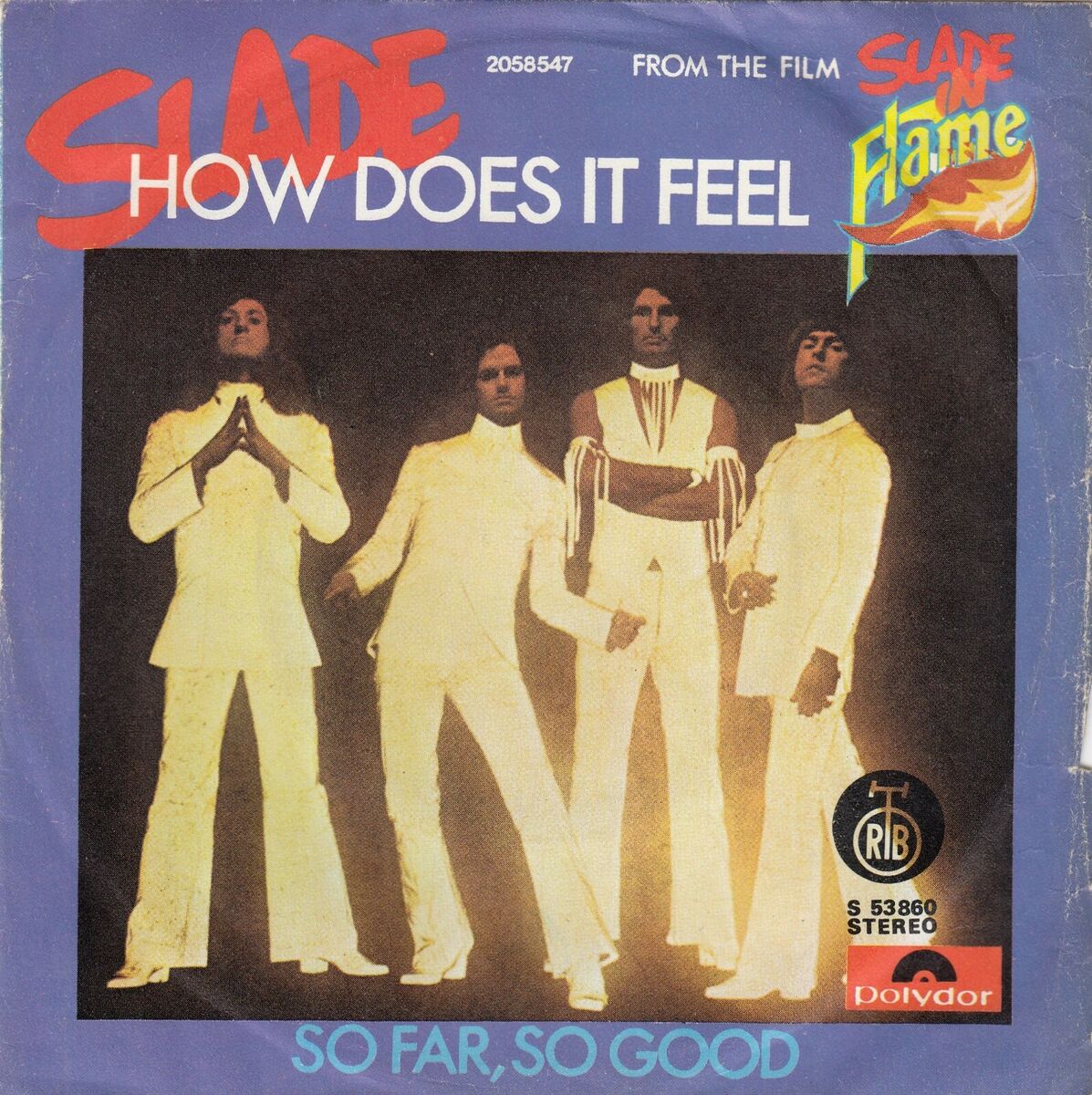
Chris: ‘Yes! But {as actors} they must have been very good, because we’ve all said this about Flame – there are no outtakes. Although I still think that pigeon was the greatest actor in it, because he crapped on Nod’s head the very first time. No retakes, no nothing. Fantastic! In any film, there would have been countless retakes. Chas must have been saying, ‘Right, that’s three quid we’ve spent, let the pigeon go!’
Yep, I never met Chas but fear he would have frightened me. Incidentally, I was surprised while researching Wild! Wild! Wild! To discover that the pigeon loft scene was filmed in Harlesden, North West London. Those look like iconic Northern shots to me, as many more were in the film.
Meanwhile, the introduction to your book steered me towards another rock ‘n’ roll movie of that era, Never Too Young To Rock, one I was far less aware of. And despite your less than rave review, I’m quite intrigued to see it. I watched the trailer and a promo video of the title track, that film starring various breakthrough mid-Seventies pop bands – from The Glitter Band to Mud.
Ian: ‘Never Too Young to Rock? I’m trying to remember it, confusing it with the dreadful Remember Me This Way. And all I remember of that is Gary Glitter smashing a coffee table up.’
Chris: ‘Yeah, I can see it now – The Rubettes and all that.’
Dig out the YouTube clip, and there’s a six-minute piece featuring the entire musical ensemble, together for the finale. I quite enjoyed it, but maybe because I was reminded of my love of ‘Remember You’re a Womble’ and all that as an impressionable lad.
Ian: ‘Nothing wrong with the Wombles. I’ve got their albums up there {pointing behind him on our video call}.’
Quite right too. Back to Flame though, and it strikes me now as odd that the LP (November 29th 1974) was out six weeks before the film’s Northern premiere at the Pavilion Theatre in Newcastle-upon-Tyne (January 12th 1975), with that a month before the London one at the Metropole in Victoria (February 13th), and the Scottish film rollout another month after that.
Ian: ‘They did a lot before the London premiere. They went round the regions first.’

I was delving in a bit more, not least in light of my better half’s cousin – whose dad was a press photographer – seeing the film in Cardiff, meeting the band at a BBC Radio Wales promo event (April 17th), where Slade were interviewed by (gulp) Jimmy Savile’s brother, Vince. It seems the band didn’t stick around for the film, but in the following print editions there were quotes from the band enticing fans to return for April 21st’s Capitol Theatre show, that just one of many promo events for the film and the following tour over a long period.
Chris: ‘Yes, they did the Glasgow one with the fire engine and all that, before the London one.’
Ian: ‘Glasgow was the one with the (horse-drawn) hearse.’
Chris: ‘There you go. So was London the one with the fire engine, where it was raining outside, the likes of The Sweet and everybody else inside, taking the mick out of them?’
It was, the guests also including Diana Dors with her husband, Alan Lake, who memorably portrayed Jack Daniels.
Returning to the music, I’m still in awe that Jim, who I felt privileged to chat to for an illuminating and open feature-interview in 2018 (linked here) was barely 13 when he wrote the bones of what became the film’s musical masterpiece, ‘How Does It Feel?’ I mean, we know what a fantastic musician he is, but that still impresses me. Genius.
Chris: ‘Yes, his family were musicians – his grandparents. I spoke to his mother about it, and she was absolutely appalled when he joined the ’N Betweens! God bless her. She told me ‘James’ was going to be a serious musician. He’d done all these exams and everything, then at the age of 16, he turns up {for the ’N Betweens audition}, gets the job. I’ve just had a text off him, by the way… he can just about use a phone!’
Marvellous. On a similar front, I assumed those iconic lines about the yellow lights down the Mississippi and all that on ‘Far, Far Away’ were down to Nod, as has often been repeated. Don Powell says it in this book too, while there’s a quote from a 2019 Louder Than Sound website interview in which Dave Hill also confirms that version. As you put it, ‘In the most widely heard version of how the song came to be, Noddy Holder was sat on the banks of the Mississippi with Chas Chandler and he has always said that he sang the first line of the song out loud, off the cuff. Chas stopped him from enjoying his drink and taking in the view, telling him he had the bare bones of a song, and to go and write the rest of the song down, before he forgot it. He would finish the song lyrics off, and, with Jim Lea adding a fantastic tune with some superb melodic touches, the group had yet another winner.’
However, you suggest there may be an alternative version of the truth, with this another song James Whild Lea lays claim to, Jim telling Planet Rock, also in 2019, ‘All I had was ‘I’ve seen the yellow lights go down the Mississippi, I’ve seen the bridges of the world and they’re for real’, so I said, ‘Go away and write something wistful, Nod’. And what did he come back with? ‘I’ve had a red light off me wrist without me even getting kissed’. I said ‘Nod, do you think they’ll play that on the radio?’ He went ‘Yeah, no-one’ll know’. And he was right. I was being cerebral and philosophical and Noddy brought the laddishness. That’s why the songs worked.’ Help me, lads. I’m confused now.
Chris: ‘When we were 12 and 13, we understood they wrote everything jointly, but… well, it’ll be interesting to see what Jim actually says in his book.’
Indeed. Something else that Daryl Easlea is currently involved with, working with Jim on his official (auto)biography. And with regard to the Flame LP, as I understand it, it was put together in the studio rather than on the road, arguably a glimpse of what was to come, post-1983, in the later days of the band when they were no longer touring – Jim crafting the songs on his own largely, having a far bigger part in making the record than on previous occasions, maybe?
Ian: ‘Of the 10 songs on the LP, three of them have brass, and a lot is made of that. But basically, it’s only ‘How Does It Feel?’ that is such a departure – it’s symphonic in parts, orchestral in parts. Apart from that, the album is almost pretty much a regular Slade album.’
As it turns out, one of the New Victoria Theatre shows in London was recorded for posterity, and both of you got to dates on that tour, not long before they headed to America.
Ian: ‘I saw them at Belle Vue in Manchester. They came out later for photographs, taken with all the trashed seats. We’d gone by then. I won’t pretend I can remember all the set. The thing for me, my overall impression, was, ‘Jesus, they were loud!’ That was my first, and it was everything I wanted them to be. They were fabulous. The Radio One show after that, the Insight thing, was marvellous. And the New Victoria Theatre gig was great, a lovely thing to have. It’s about time it came out.’
In fact, this scribe returned to that recording while putting finishing touches to this feature. Meanwhile, Ian writes in more depth on that landmark Belle Vue appearance in Wild! Wild! Wild!, a taster of which featured in my most recent Slade-related feature on these pages, linked here. And how about Chris (who first caught them live 55 years ago – in January 1970 at a Walsall community centre, as also recorded in my Slade book)?
‘It’d either be Birmingham or Wolverhampton. I saw them on every tour up until they finished. People will say, ‘I saw them 390 times’ and all that, but I saw them two or three times before ‘Get Down and Get With It’ got into the charts – community centres, baths, all that sort of thing. I love that all these people took the time to make notes of the setlists, take photographs, all that. But when I was old enough, I was off my head – I didn’t have a clue about the set! I was there, I enjoyed it, then had to get back home from wherever it was. That’s all I was worried about!’
Our web link dropped out at that point, so I didn’t get the chance to quiz Chris and Ian on last year’s novella, Whatever Happened to Flame? Based on the band Slade memorably played in the iconic 1975 film, the pair continue the story in a ‘fan fiction creation’ that makes for a lovely little read that makes you think exactly where the story may have gone from there. Unfortunately, if you didn’t get a copy, it was a limited-edition publication, so you may have to wait for the film rights to be sold and Slade in Flame 2 to go into production.
They are however working on a further edition of The Noize, and as Ian put it when we caught up this week, this one’s ‘the final version, out later this year’ and ‘will be spilt into two volumes, so that we can fit the kitchen sink in each one.’ Splendid. Can’t wait.
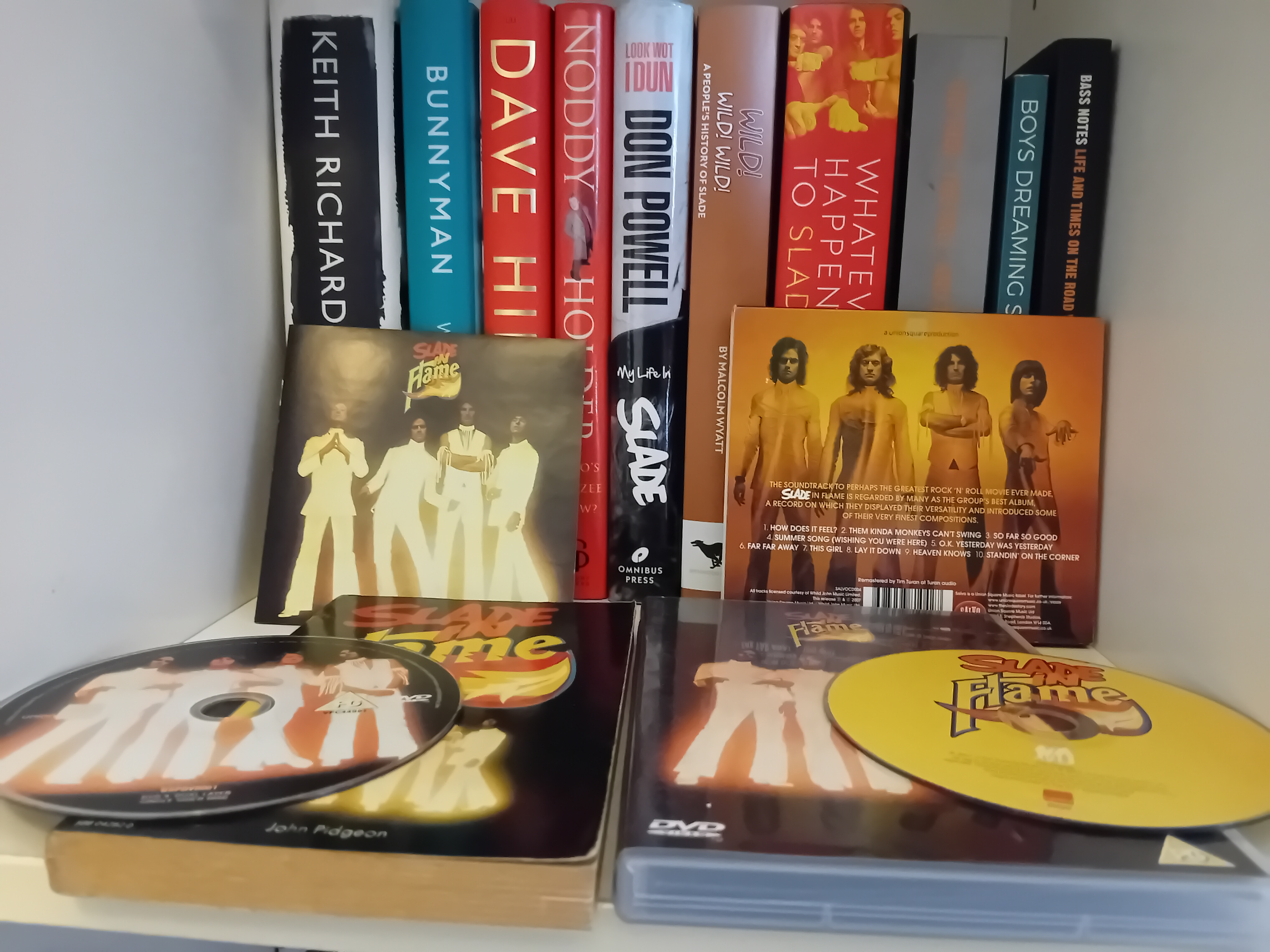
Slade in Flame at 50 is available to purchase now, with more details via Chris and Ian’s website and the Facebook and Instagram links for Noize Books and Recordings.
That also remains the case for Wild! Wild! Wild! A People’s History of Slade, on sale via Manchester-based publisher Spenwood Books via this link.
And for details of the remaining UK screening and event dates relating to the BFI-remastered cut of Slade in Flame, head here.


 writewyattuk