

It’s been a vintage year for Paul Weller-related publications, and I can’t believe eight months have now passed since the release of my own love letter in print to Paul, Bruce Foxton and much-missed Rick Buckler, Solid Bond In Your Heart: A People’s History of The Jam (Spenwood Books).
With the (whisper it) Christmas market in mind, I should mention that there are still a few hardback copies available, and if you’re looking for further Weller-flavoured written product, if only to drop a couple of timely hints to loved ones, there are a few more impressive new books to be tracked down.
This week alone saw a copy of the heavily soulful, super-ambitious Sartorial 65: Paul Weller Style – Five Decades of Cool land at West Cornwall’s WriteWyattUK HQ, a true contender for the crème de la crème of coffee table books, lovingly assembled by Nick Keen alongside daughter Harriet, Alf Button and Jason Disley. And that weighty wonder, seemingly right out of Cafe Bleu or maybe Our Favourite Shop next door, arrived shortly after further word from Stuart Deabill, co-author (with Ian Snowball) of 2012’s Thick As Thieves: Personal Situations with The Jam and 2020’s Soul Deep: Adventures with The Style Council, regarding In the Shadow of the Sun: Paul Weller & the Nineties, penned with Steve Rowland (also involved with Soul Deep) and Paul’s sister, Nicky Weller, currently on pre-release and set to land in Spring 2026.
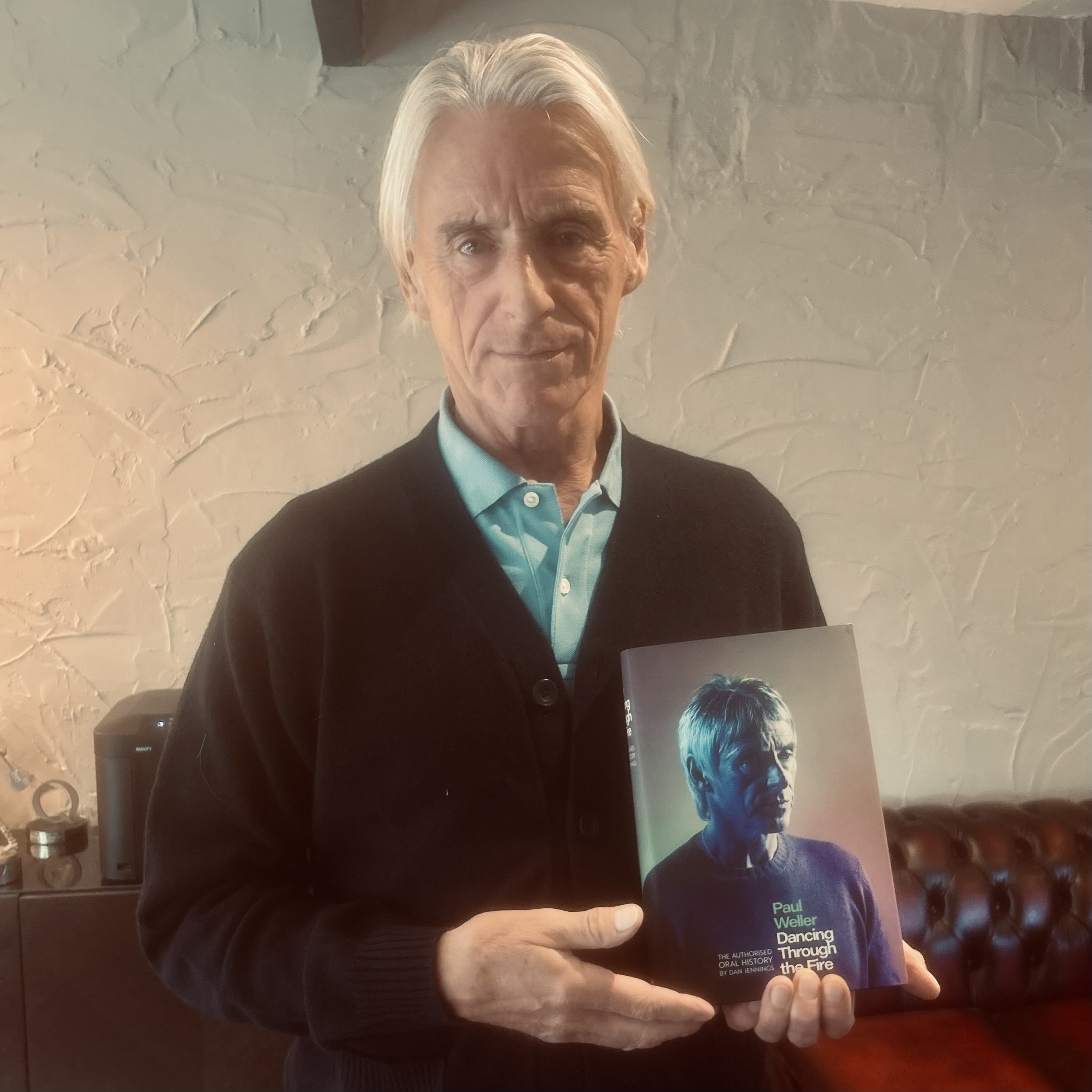
While it might appear odd for this scribe to help spread the word about rivals of sorts in an era where spare cash is somewhat hard to come by, what unifies us all is an overriding love for Weller’s many musical projects and vehicles down the years, from The Jam onwards. And I feel it would be churlish to do anything but highlight those publications and another receiving plenty of rightful acclaim lately, Dan Jennings’ rather splendid Paul Weller: Dancing Through the Fire – the Authorised Oral History.
As Weller himself put it, ‘Nearly 50 years in music? How is that possible? When Dan mentioned that he’d interviewed over 250 people for this, I didn’t even know that I knew that many people… but he’s done it in a way that shows that it’s more than just about me, it’s the story of everyone who was there along the way.’
I’m guessing Dan’s still glowing about that praise. I know how he feels too, after receiving my own personal correspondence with Paul earlier this year following Solid Bond’s publication. I still gaze at that hand-written letter occasionally, smiling, somewhat in awe. ‘Paul Weller? Writing to me?’ Yes, really.
From day one – in his case, December 2020 – I loved the concept of Dan’s Desperately Seeking Paul podcast, and while I tried to avoid listening to more than a handful of editions while working on Solid Bond (not least as many of the names interviewed were also in my contacts book), I can safely say it made for wonderful listening, his lockdown era project soon soaring in the ratings, with good reason.
Chances are you’ll already know the idea behind the Paul Weller Fan Podcast, but in short it featured 180 in-depth interviews which ultimately led to a two-hour conversation with Weller himself, and even Dan’s involvement in Paul’s official marketing. The initial premise? Dan tells us he gave up his radio broadcasting career with ‘one big regret – never getting to interview his hero’, Desperately Seeking Paul created chiefly to try solving that issue, soon becoming a celebration of Weller’s output from The Jam’s In the City onwards, the broadcaster ‘joined by fans, musicians, band members who have played with Paul or simply loved and been influenced by his music, the studio teams, producers, engineers, tea-boys and more, the video directors and documentary makers, the journalists, radio and TV presenters, photographers and authors who have interviewed him, taken photos of him, written about him, hung out with him or who simply dug his career, friends, family… and more!’
Dan hardly needs my words of approval, the product speaking for itself and word put around by many influential commentators in Weller World and across the music press in recent weeks, with backing from his team at Constable / Little, Brown. And he deserves the accolades – it’s a mighty tome, lovingly licked into shape, coming in at 760-plus pages, taking us right through that amazing career, featuring many entertaining behind-the-scene tales, insights and perspectives from the man himself and those who have proved integral to that remarkable journey, including many names within Paul’s inner circle, family and friends among them, the accounts carefully weaved together from more than 200 hours of conversation… with PW’s blessing and full cooperation, all tackled remarkably well, much that worked about the podcast now neatly translated into written form.

And I know just how much hard graft goes into such publications and how much of your life and that of those around you (it took a look and drowned us, you could say) is consumed in the process. So how best for me to cover all that? Well, I decided to have words with Dan, who was good enough to spare a little precious time the afternoon after his London book launch – presided over by esteemed broadcaster John Wilson – between various engagements with radio shows and the like, part of a busy fortnight of promotion for a fella admittedly rather shell-shocked by the public and critical response to his book and broadcasts. He was definitely on a high. Most likely he still is.
‘I said to somebody at the launch, it feels a bit like a weird kind of out-of-body experience. There are moments where you see something, somebody’s written something lovely or whatever, and you get a bit emotional, but it’s like it’s happening to somebody else. Very odd.’
Can we measure success by the comfiness of sofas on stage at a launch event?
‘Ha! I mean, they were quality sofas, true… but also by the guests. The fact John Wilson came along, then introduced me, was utterly ludicrous. Someone I’ve listened to on the radio for donkeys’ years.’
And he turned down another event to be there.
‘He was meant to be at the Bowie launch at the V&A. I think he got his nights confused, then realised he’d double-booked. Bless him, I’d have binned off me for Bowie!’
Quite a compliment. John comes over as a consummate pro. In fact, I’ve only recently caught up with his Mastertapes series via the wonders of BBC Sounds – Billy Bragg, Ray Davies, Wilko Johnson, The Zombies, so many more greats in conversation, including Paul Weller around the time of Sonik Kicks and the 30th anniversary of final Jam studio outing, The Gift.
‘Yes, and on that he plays ‘Gravity’, still six years away from being released.’
It’s coming up for two years since Desperately Seeking Paul podcast interview no. 180. Clearly, that chat with the man himself was always the game plan, but did you – five or six episodes in – always believe or allow yourself to think it was going to happen?
‘It was a bit of a rollercoaster if I’m completely honest. There were times where I thought maybe it would happen, but then you heard things where people would say, ‘Oh no, he doesn’t do that sort of thing.

‘But bless Claire Moon, his manager, who quite early on heard about it, and we connected. She said, ‘Look, you know…’ Obviously, if I interviewed Paul, it would be the end of a story arc, and kills off the ending. But she was also like, ‘Let me know if you want me to have a chat with him about it.’ It wasn’t a case of ‘let me know when you want him to do it.’ It was never a given, and certainly five episodes in I wasn’t thinking ‘this is going to happen’. That seemed a ludicrous idea, really.’
I wonder if your opinion of Paul as an interviewee changed. As an avid NME reader in the Eighties who first saw interviews in print with him in late Seventies Smash Hits days, the thought of landing a proper chat with him initially scared me. I wanted to do it, but – be it down to shyness or whatever – he’d often come over as brusque, surly, rather challenging. He seems remarkably chilled by comparison these days… but maybe that was always the case if you knew your stuff and he could recognise a kindred spirit. Perhaps it was just a perceived public persona.
‘I think as a young man he couldn’t always articulate what he wanted to say, therefore came across a bit abrupt, a bit short. I think there were also times when you could tell the interviewer was asking questions he didn’t have a huge amount of time for. He didn’t seem to get asked about the art and the craft, which surprised me. And without wishing to slag off other presenters, it was always one of my frustrations as a fan – he’d be billed on radio shows, you’d listen in… and some were excellent, but others you’d hear and go, ‘Why was he on that show?’ Like he was having to just tick off a press rota. Terrible. So absolutely, I think he’s in a place where he’s more comfortable in his own skin and as an interviewee now, but also think it’s about asking the right questions. That sounds like a massive ego, but there is that as well.’
It does make a difference. I can think of many an interview I’ve done where I feel a need to get in the sort of questions early doors that suggest you do actually know what you’re on about and understand where an interviewee’s coming from.
‘Yeah, you have to do your groundwork, and sometimes he’s been interviewed by people who clearly didn’t know, properly, his back catalogue or would try to find an angle that would be ‘clickbaity’. And Paul said quite recently to Shindig! ‘Dan didn’t have any agenda.’ I’m genuinely interested in all the stories and craft, his upbringing and everything as a fan but also as somebody interested in interesting stories!’
What do you reckon was your first ‘pinch me’ moment on this 180-edition journey?
‘Nicky Weller was a real key point, obviously in his inner circle as his sister. We did it on Zoom and she was in Ripley at her mum’s house, Ann chipping in in the background. That felt like a kind of Weller stamp of approval, The Jam fan club link, all that. And people like Andy Lewis, where you were getting to band members as well as writers, documentary, film makers, whatever, to the kind of people who had been ‘in it’, on the road…’
The upper echelons of the Wellerati.
‘Absolutely!’
Before all this there was a radio career. Tell me more, and why it ended.
‘That was my first love. As a kid, all I ever did, really, was listen to music and the radio. This was in Essex, I was born in ’75, so this would have been early Eighties. Me and my mum would listen to this guy, Timbo, who’d do really interesting, fun content and music competitions, and we’d play along. I loved music and grew up in a household where we had a cartridge machine. My folks had these massive, bloody great big cartridges of The Beatles and things in the house. We also had them in the car, taking these huge cartridges out with us! They’d flip over and somehow in the internal mechanism they’d always get tangled up. I’d love to see those again.’

So you were the Eight Track Cartridge Family, right?
‘Ha! Yeah, my mum was into Motown, The Beatles, all that, my dad was into Bowie, Eurythmics, Kate Bush… some great music. But funnily enough, not The Jam. They were just a bit past that age group. I’d listen to two shows, Invicta Radio on a crackling transistor… I’d struggle to get to school the next morning because I’d been listening in all night long, a guy called Caesar the Boogieman, brilliant. Then I discovered GLR and Chris Evans, before TFI Friday, Big Breakfast, all that. This was just so bonkers and anarchic and wonderful. I thought, ‘I want to do that job!’
‘I did hospital radio at 15, in Taunton. By then my folks had split, me, my mum and brother moving down to West Somerset. I had to go around the wards, get requests, take them to the presenters. Then, when I was 16, I got my own show, the Sunday Roast Show. By then I was doing a communications GCSE in sixth form alongside A levels and got a work experience place at BBC Somerset. I’d go in every Wednesday, but also spent time in the studio whenever I could. I’d fuck around with reel-to-reel tapes, make my own jingles for my hospital radio show.
‘I’d spend ages making little Dan Jennings effects tapes, all that. Such fun, and I made loads of friends through it. There was a Saturday show – I’d go in and answer the phones for this guy called Simon White. He was great, embracing young talent who were really keen. He had this ‘crew’, us all answering the phones for him, and he’d get us on air and out in the radio car, reporting back from events.
‘I then got offered a job by the BBC when they were moving to computers. This sounds so ancient – they were moving away from reel-to-reel tape, and I was the only one who really knew how they worked! They gave me a job, and I moved to BBC Bristol, and from there trained me to be a journalist and producer. I was there about eight years, left to do commercial radio in 2000, breakfast shows in Somerset, then Crawley, and a drivetime show at 210 Reading – a great show, a huge privilege, a big old station, but the format was more music, less talk, and heavily playlisted – not so much songs I liked.
‘I did a link one day, in the show notes it said, ‘Speed link, 10 seconds.’ I did 13 seconds. The programme director said, ‘It’s too long. Why?’ I thought, ‘I can’t do this anymore. This is rubbish.’ It wasn’t what I thought radio should be. I fell out of love with it, left and worked behind the scenes. I was at Magic and Absolute quite a long time – branded content.’
Where were you at come the Covid lockdown at the start of the Desperately Seeking Paul podcast?
‘That previous year I left an amazing job at Bauer, with some great people, having been there nearly 10 years. It felt like it was time to move on, so I moved to an advertising agency, a mixture of project management and production, running content partnerships but lots of interesting things, like voice skills for Couch to 5K, and Alexa, all these weird and brilliant projects, away from radio completely. That was where that ‘deep regret’ thing came from.’
As for that regret – never having interviewed his hero – when did this love for Paul Weller’s music come about?
‘It was his solo material, so I feel a bit of a fraud in that my discovery was not through The Jam or The Style Council. At the launch, John Wilson did a lyrics quiz, including proper ‘ingrained in everybody’s heads’ Jam lyrics, and I was terrible – didn’t know any! But I love those songs, and when I’m in the mosh-pit singing back at Weller, on a lot of songs I’m singing my own lyrics to them. Then again, even Noel Gallagher’s said the same!
‘My discovery was through ‘Uh Huh, Oh Yeah’. Pretty sure it was Top of the Pops, with Weller, Whitey, Jacko Peake, Camelle Hinds. They looked brilliant. It was a weird thing, Top of the Pops, so random, not like a flow of a TV show in the same way Later would be. You’d literally bounce from Mr Blobby to Peter Andre, then Paul Weller, and his performance really stuck out.
‘Somebody I went to school with found my 16th birthday invitation party invitation the other day, I was DJ-ing, and the ad said I’d be playing music from KLF, The Shamen, C+C Music Factory… My tastes must have changed overnight, and as we led up to Britpop, guitar music came back, so you’d have Nirvana, Lemonheads, then I was getting into Juliana Hatfield…
‘I thought I’d discovered this brand-new artist, because he wasn’t very old – 35 or so – but had this amazing sharp Mod haircut and looked great, stick-thin, and so cool in these white jeans. I went into sixth form raving about this ‘new’ artist, telling everybody about this song. And when that first album came out, I was raving about it. Then we had builders in at mum’s, decorating or something. I brought home this massive cardboard Weller from, HMV, which, funnily enough, I’ve got in this garden office I’m chatting to you from. He’s got a Lennon copy thing going on, wearing these cool sunglasses, piano keys reflected in them. I was raving about him, and these fellas are like, ‘Yeah, mate, we’ve heard of Paul Weller. Check out his good stuff – The Jam.’
The next day they brought in this cassette. I think it was Snap, all these great hits but also loads of really great B-sides. I felt an absolute idiot. Later, I also found out about The Style Council, so there was all this catalogue to discover!’
At this point, I mention how I stepped away from Weller’s output after The Style Council’s The Cost of Loving, (an LP I like again now) but got back on board from The Paul Weller Movement onwards. I also mention how through writing, compiling and editing Solid Bond In Your Heart: A People’s History of The Jam, I’m reminded that a fair few Jam fans never embraced anything in his song catalogue beyond 1982’s The Gift.
‘I think that’s fascinating, and it’s not massively uncommon that people have this period where the music they find has that power. I’ve got so many friends who have that five-year or so period locked in time.
‘There’s the music, but the other thing I really like, when you start to understand that story, is the interviewing – getting people on to talk to me. I always loved meaty interviews. That was always a passion. I wasn’t a pop and prattle DJ, and that story arc is great – these kids playing clubs in Woking, the singer’s dad as manager, and all that followed, then the split, people being furious – some remaining so – and then The Style Council. This constant rollercoaster of storytelling that goes with it.
‘With the podcast and the book, I didn’t want to get into a battle with them – that’s their opinion and they’re entitled to it, it’s their truth. What I’ve tried to do through the podcast is – assuming they listen, because obviously it’s not just a Jam podcast – ‘Yeah, you might think that… but why don’t you listen to this?’’
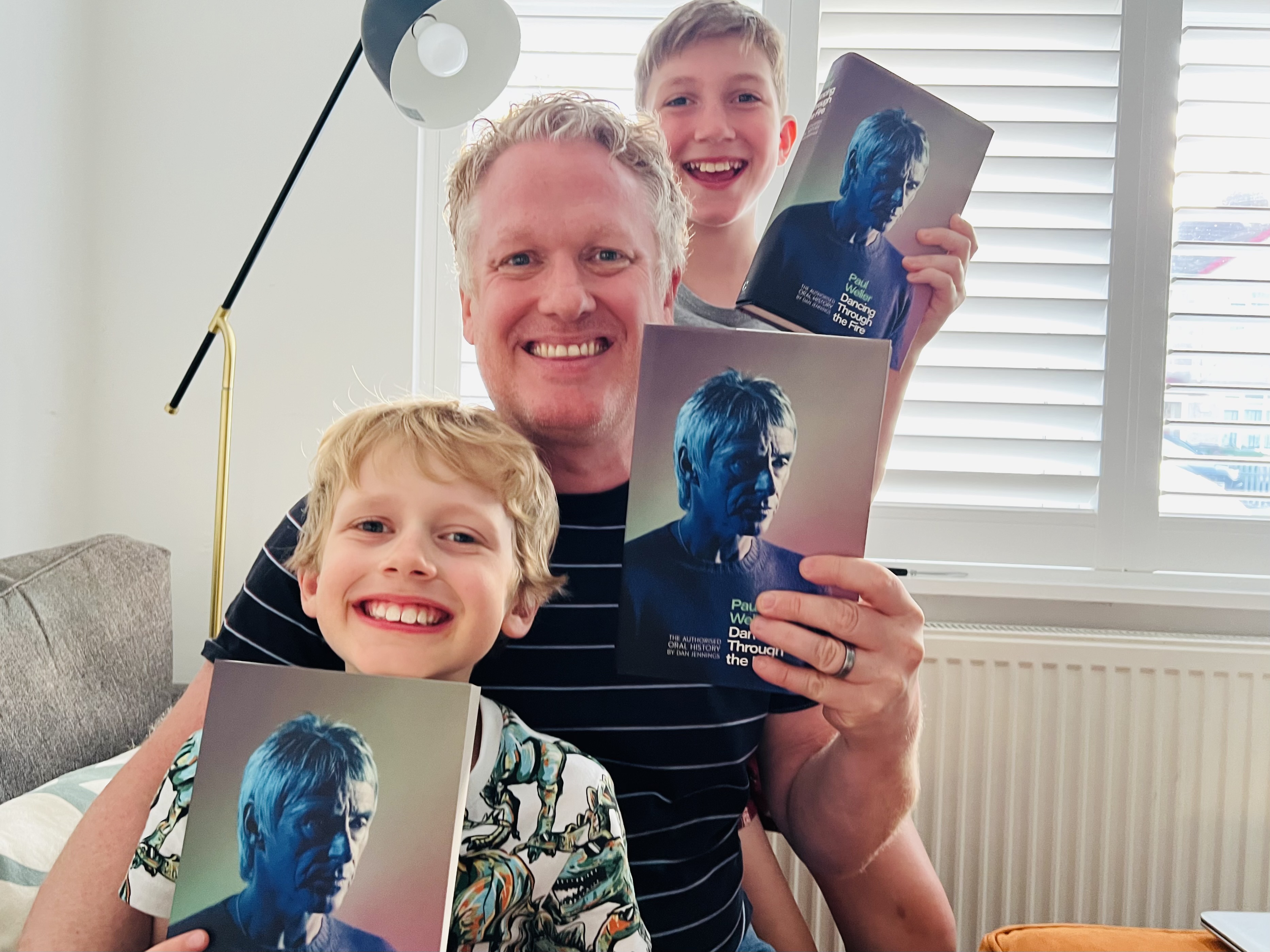
Looking back on your book launch, do your boys – along on the night – now realise how much of a thrill this has been for you? Or was that never in doubt?
‘Yeah, my wife as well, they’ve all been so proud of what I’ve done. When I did the Ann Weller piece, somebody made me a photo frame of a gold disc, and my wife got a ‘100 episodes and counting’ celebration placard made. Then, when I reached (edition) 180, the day that went out on air they got champagne, a cake, and all that. They’ve always been supportive… even though it must be hugely annoying that every time we get in the car, Weller’s playing, or when they walk in a room he’s playing on the Smart speaker… even though they’re not fans of the music. I don’t know why…’
Give it 10 years. They’ll eventually get it.
‘Yeah, but they’re hugely proud. And now the book is this physical thing they can see… This morning they both took a copy into school, we had cake and champagne for breakfast, and our youngest has decided he’s going to World Book Day in March as me! I suggested instead he goes as Weller, but he wants to go as me.’
That’s fantastic. And three book titles in, I should add that sense of wonder rarely loses its sheen. And in my case, my girls insist on ‘buns for tea’ on publication day, as with the mother in E. Nesbit’s The Railway Children when she sold stories.
‘Ha! And before John Wilson started the event, I said, ‘First things first – every time there’s a swear word on stage, my kids will get a pound.’ If Kenny Wheeler and John Weller, bless them, had been on stage, my kids would have paid off that mortgage! I knew it’d be fruity, but by the end it got to the point where my eldest, Henry, cheered every time there was a swear word… they’re both about £50 better off now and can afford a Switch 2, so they’re delighted.’
At this point, we compared notes on Weller-related writing projects and got on to the subject of both books serving as timely tributes to Rick Buckler and Ann Weller.
‘In the acknowledgements, I said there were three people who passed away during the making of the book – Rick, that was a real shock, but also Chalky, Suggs’ best mate (Andy Chalk), who wrote the words to ‘Nothing’ (as featured on 66). Then of course, Ann Weller passed away the midweek before we hit send to the publisher. I’d already written about Ann and how grateful I was, but tweaked that a little. Yeah, you realise the fragility, people getting older, and some of these voices you capture that then aren’t around. So actually I’ve captured Ann in this book, and she’s not here, bless her, to tell those stories again. That’s quite a wake-up.’
You mention your lads hearing Paul’s music wherever they go. What’s the most recent Weller-related record on the deck at home or in the car?
‘I’ve been listening to the covers album (Find El Dorado), but also the Will of the People boxset. For the launch, I did a playlist – it’s funny how long you end up taking on that, as if anybody’s going to be paying attention to the background music in the bar! – and there are so many brilliant tracks on that. There are so many brilliant songs on that. I don’t know why I didn’t listen to it a huge amount at the time – maybe just because there was so much Weller stuff out around then.

‘Things like ‘Serafina’ and ‘Devotion’, a bonus track on Sonic Kicks that was on a TV show about football, and things from the Jawbone soundtrack, ‘Into the Sea’, a bonus track on Fat Pop, which is beautiful, and a demo called ‘Let Me In’, which Ollie Murs covered. I don’t know why Paul didn’t release it – it’s a brilliant song. And ‘Praise If You Wanna’, about a minute and half long, and the ‘Mother Ethiopia’ stuff. It’s really diverse, all over the place, but a really good boxset.’
And when you’re off to your next event, what’s in the car?
‘There are a couple of albums I always go back to – the Wild Wood album is phenomenal. I do listen to other stuff, I promise! But when I go back to that, it brings back so many memories. Doing work experience at BBC Somerset, they had a record library full of promo CDs from the record companies. Bizarre, really – this was like BBC local radio broadcasting to pensioners! But I remember, clear as day, going in and on this pile of CDs – you could take what you wanted – they had ‘Sunflower’ two or three weeks before it came out. I remember driving from West Somerset to Taunton in a Vauxhall Astra estate my mum gave me, listening to that CD over and over. Then when that album came out, again getting a copy through the record library. Such a brilliant album, and it still sounds so fresh.’
Such a great run of LPs, those first three solo LPs incredibly important to me too, as was – in its own way – 22 Dreams, and on from there, several others making a huge impression.
‘Yeah, and I bounce around between them all. I listen to lots. On Sunset and Fat Pop as well – absolute bangers.’
And where’s home these days?
‘South-West London. I moved to London in 2009 when I got a job at Magic and Q Radio. That was exciting… then the week I started, they closed Q Radio down! I lived in Balham for a while, but couldn’t afford to buy there, so we moved out to Carshalton.’
I know it fairly well, being Guildford born and bred.
‘Ah, I was at Eagle Radio there for ages!’

Well, there you go, I was on work experience as a sixth former, mid-Eighties, in its days by the Friary shopping centre and the bus station, County Sound Radio, going on to help out that summer on an evening show for Dave Fitzgerald, more recently on BBC Radio Devon, once – I seem to recall – the voice of ITV West Country legend Gus Honeybun.
‘Ha! I remember Gus Honeybun! At Eagle Radio, Dave Johns was running County Sound, and Peter Gordon was there, another massive Weller fan featured on the podcast. I lived in Cranleigh and worked in Guilford. I did marketing, and used to be the Fuel Phantom. We’d go out, pay for people’s petrol on forecourts, which was hilarious. I had a kind of Zorro mask. There was also a mascot, so I had this bloody great bird costume, dressing up as an eagle, going to ice hockey.’
Guildford Flames?
‘Yeah! Ha!’
You’ve a quote from Mr Weller on the podcast website, saying, ‘I’m always looking forward to what I’m doing now and what’s ahead.’ So how about yourself?
‘Good question. I’ve been doing interviews with a bunch of BBC radio stations, and one person suggested there hadn’t been a decent documentary for donkey’s years, and obviously there’s a heap of content and voices and people there to mine… so that’s interesting.
‘And on BBC Radio Cornwall they said, ‘What about a Weller musical?’ I thought, ‘Oh, wow!’ I need to ask Weller HQ – they must have been asked, when you think about all these jukebox musicals lately.’
Well, bearing in mind there’s just been a Wedding Present musical…’
‘Oh really? And there were Tina Turner and Bob Marley ones, Bowie – the Lazarus thing… There are so many great songs, and then there’s the oral history. I don’t know. People could now steal that idea. I should at least message Claire!’

Sometimes you only need put these ideas out there…
‘That was the thing with the book. On ITV News, they said, ‘What’s next?’ and I said Paul Weller suggested, ‘Turn it into a book’. Then off the back of that, all these publishers were getting in touch. It was mad. But yeah, putting it out to the atmosphere… maybe not. I think my wife would be furious that I’m spending less time with the kids yet again!’
I reckon half of our acknowledgements in these books comprise apologies to better halves.
‘Well, someone at the launch went up to my wife and said, ‘Thank you very much for letting him do it.’! The thing is, I didn’t transcribe the podcast as I went along, so when it turned out we had this book deal, I had to start transcribing 200 episodes. Thankfully, loads of people came forward, started helping, bless ‘em, which was amazing. I don’t even know if it was a final book at that point, but knew I wanted to do that. What I did then was chop all the different little bits of stories up, like a big jigsaw puzzle, so I could put them in the right place… and I ended up with 1.5 million words!
‘Gary Crowley mentioned to me the Mark Lewison book, The Beatles: Tune In…’
Ah, yes, still on my shelf waiting for a few quiet weeks to tackle. Looks bloody good though.
‘Yes! Well, Mark has a three-biography deal with my publisher, and part one only takes you up to 1963 or something. Somebody said last night, ‘You need to do an extended version.’ Well, technically speaking, I’ve done a 1.5-million-word version already!’
I seem to recall that’s the way I did my Clash biography. And you’ve reminded me that for many years I’d feel aggrieved at radio journalists in my sports reporting days, as once they’d finished a commentary and summary and maybe tracked down a manager and player, they could bugger off home, while I’d end up writing a second report, sometimes a third, that evening or the next day. So at least now you’ve seen it from both sides.
‘The thing is, though, something my book doesn’t do but maybe the original 1.5-million-word version does is truly capture that cultural aspect of The Jam you were talking about, and the power of all that – how everybody came together in that movement. the youth around that period feeling those bands connected everybody. If you were a teenager back then, that was the most important thing. You listened to the same charts, watched the same telly… and that’s never going to happen again.’
Similarly, I’ve edited lots of personal history music books, and always prefer the early days’ content most. For instance, first-hand accounts of Bruce Springsteen at the Stone Pony, Asbury Park, New Jersey, are far more interesting than countless tales of modern audiences queuing to see him after stadium soundchecks with the right wristband and VIP backstage passes. Nice a bloke as The Boss seems, that doesn’t make for such gripping reading.
‘Yeah, I understand that. It’s not the same as where people discover and experience music.’
And with that, he was away for his next call, still powering through, the praise (if you wanna) continuing, tackling it all with plenty of fire and skill, as you’d hope. Take a bow, Dan.

Dan Jennings features alongside Nicky Weller on day two – Saturday, 15 November – of the three-day Louder Than Words music literature festival in Manchester, the UK’s largest, the pair taking to the stage not long after Malcolm Wyatt and Louder Than Words writer/broadcaster Iain Key debate the continuing draw of The Jam and The Clash in a Battle of the Bands special refereed by Spenwood Books head honcho Richard Houghton. And both of those events are on a day when the LTW guests also include (deep breath) John Robb talking Oasis, Debsey Wykes, Stuart Maconie on The Beatles, Clare Grogan, Steve Diggle, James Nice on Factory Records, TV Smith, Justin Currie, Henry Normal, David Barbarossa, Dennis Bovell, The Lovely Eggs, Matt Johnson, Dave Rowntree, and Daniel Rachel. Quite a line-up, eh. For ticket details and more information, head to https://louderthanwordsfest.com/whats-on/
Malcolm Wyatt’s Solid Bond In Your Heart: A People’s History of The Jam (Spenwood Books, 2025) is available from the author, select book and record shops, various online sources, public libraries, and from Burning Shed via this link.
For more about Dan Jennings the Paul Weller Fan Podcast and Paul Weller: Dancing Through the Fire – the Authorised Oral History, head here.
To order a copy of the latest publication from Nick Keen, Alf Button, Jason Disley and Harriet Keen, head to the Sartorial 65: Paul Weller Style – Five Decades of Cool website.
And to pre-order In the Shadow of the Sun: Paul Weller & the Nineties, by Stuart Deabill, Nicky Weller and Steve Rowland, follow this Soul Deep Productions link.


 writewyattuk