Celebrating Shellshock Rock, four decades down the line

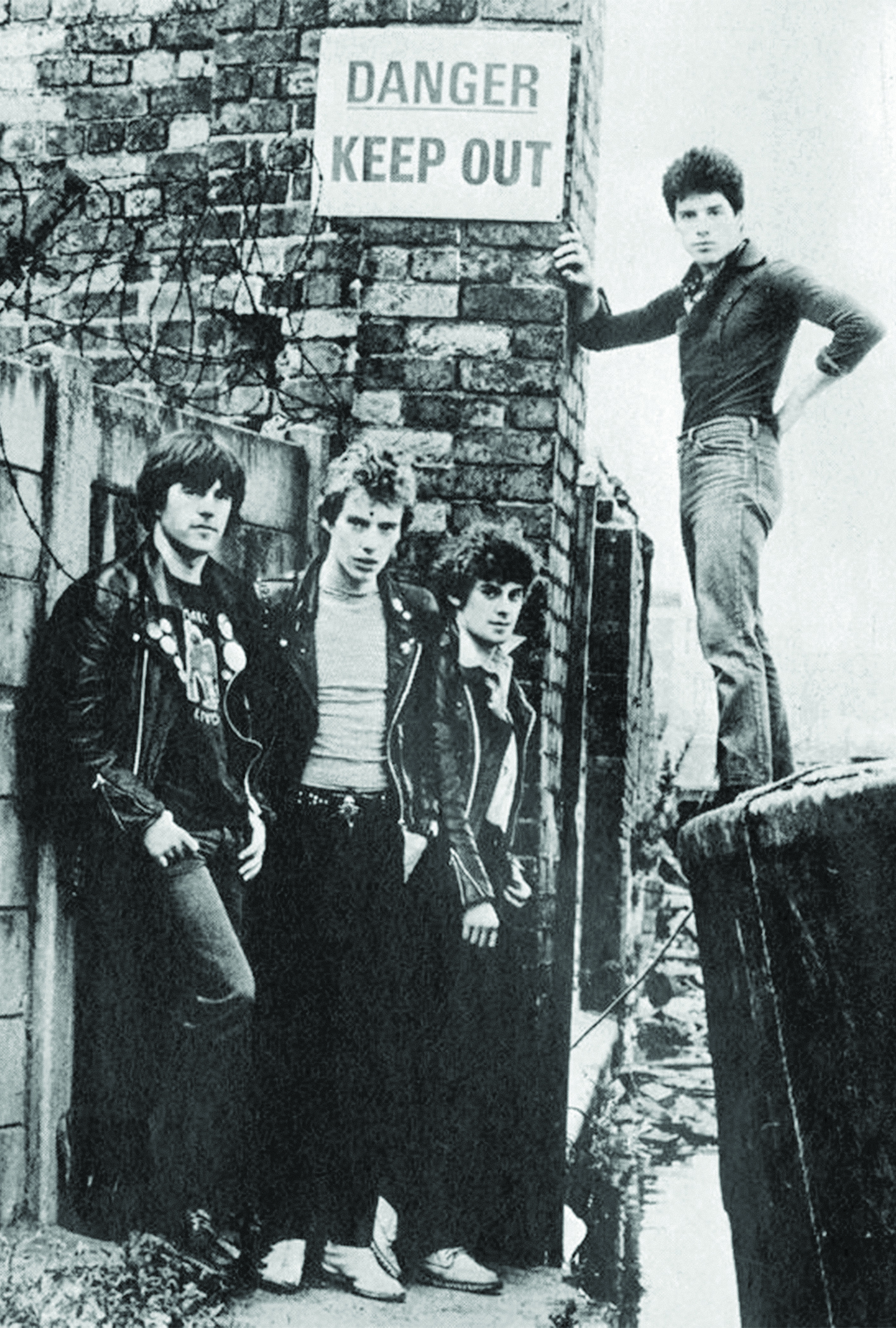
High Rise: Stiff Little Fingers, on their way to breaking through via the uncompromising Inflammable Material LP

Seeing as our TV sets were seemingly full of depressing images from the aftermath of bomb damage and troops patrolling streets at the time, it’s good to have a celluloid reminder of something more positive going on in late-1970s Northern Ireland.

Good Vibrations, the 2012 Lisa Barros D’Sa and Glenn Leyburn-directed film, told that alternative tale with a little license and plenty of swagger, while Tom Collins and Vinny Cunningham’s splendid 2001 documentary Teenage Kicks: The Story of The Undertones and Chris Wilson’s cracking Here Comes the Summer: The Undertones Story 11 years later told another side of the ground level story.

But perhaps the first notable film to emerge, in this case during those dark days of The Troubles, was John T. Davis’ 1979 documentary short, Shellshock Rock, an insightful study filmed in grim times that – despite its half-lit, scratchy, hand-held shots – comes over four decades later as a priceless document of that era, its focus an array of young punks – from the well-informed and right-on to the frankly naive – voicing frustration at being told what to do by their peers, instead choosing to get their teenage kicks watching live performances in tucked-away venues from bands deemed deemed disrespectful or irreverent in wider circles, and certainly with a wilful disregard of the established sectarian divide.

The plight of Northern Ireland throughout that period is well documented. As an outsider  I don’t feel I can go there, in large part. But this is more about the unifying impact punk rock and everything that came in its wake had on the country’s youth. Whilst violence, disenchantment and danger became everyday obstacles, punk provided a means of expression beyond the political landscape, with the spirit of those times at least partially captured through Davis’ lens in 1978.

Now, 41 years after its initial release, it’s being reissued by way of a celebration of that movement and a document of those times, alongside an impressive, somewhat exhaustive triple-CD collection including many rarities. There are 74 tracks all told, from approaching 50 bands, and it comes in hardback book format, the songs recorded during a period that arguably breathed new life into the country’s musical culture.

Looking at this collection with 2020 vision, so to speak, there are glaring holes in that it paints the picture of a very white male environment. Where were the Northern Irish equivalents of Poly Styrene, Pauline Black, Pauline Murray, and The Slits? We have to wait right to the end to hear a female lead vocal. But maybe that’s just how it was at the time, band-wise, with this more about exploring punk and the post-punk landscape over there back then, offering something of a celebration of the power of music and a youth movement that provided hope for the future when it was really needed.

Key bands featured on the Shellshock Rock: Alternative Blasts From Northern Ireland 1977/84 collection include Stiff Little Fingers, The Undertones, The Outcasts, and Rudi, all four also starring in the original film, plus more who offered real crossover potential, not least The Moondogs and Starjets. But I won’t just stop there, here taking a brief journey through those six dozen-plus numbers and profiling the groups behind them.

Any collection opening with The Undertones and ‘True Confessions’ is alright by me, part of that amazing Teenage Kicks debut EP on Good Vibrations, a label which understandably features heavily here. Did the O’Neill brothers’ buzzsaw guitars ever sound more urgent across the spectrum, and did Feargal’s wondrous warbling vocal ever seem as innocently raw and innocent?

Many acts featured were new to me, the first of whom Midnite Cruiser, the spirit of punk R&B coming through on their sole single ‘Rich Bitch’ and its B-side, with pub rock credentials even more evident with next contributors the Duggie Briggs Band, delivering a Shellshock Rockney standard (have I belatedly invented a new genre there?) on ‘Punk Rockin’ Granny’, while their other track here, ’42 Hours Late’, suggests they may have been Portadown’s answer to Bruce Springsteen (although I’m not sure what the question was). Meanwhile, North coast outfit XDreamysts‘ ‘Dance Away Love’ suggests a Phil Lynott influence, and they’re one of a few here who supported Thin Lizzy and one of several who recorded sessions for BBC Radio 1’s John Peel, a big supporter of the NI scene.

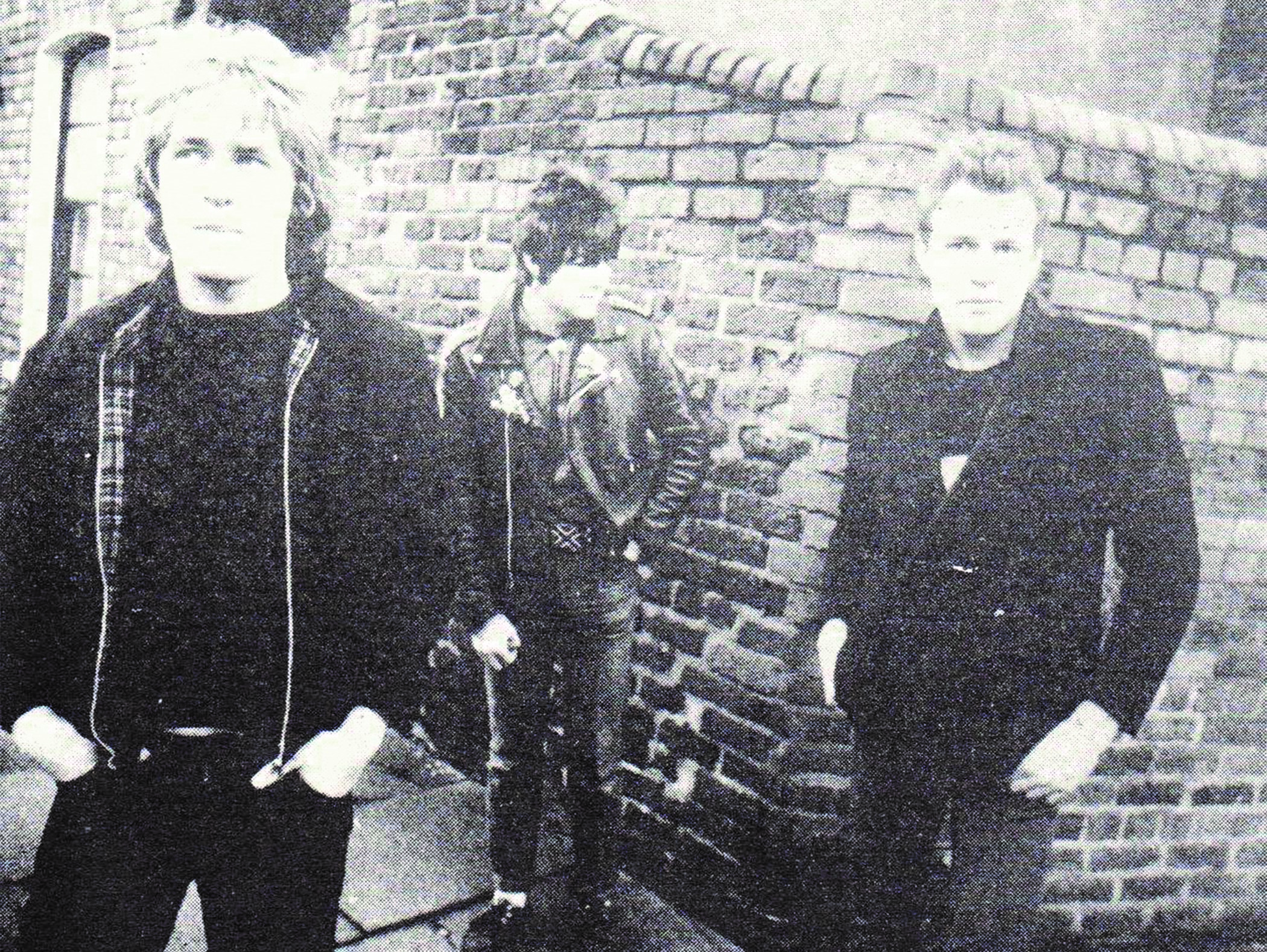
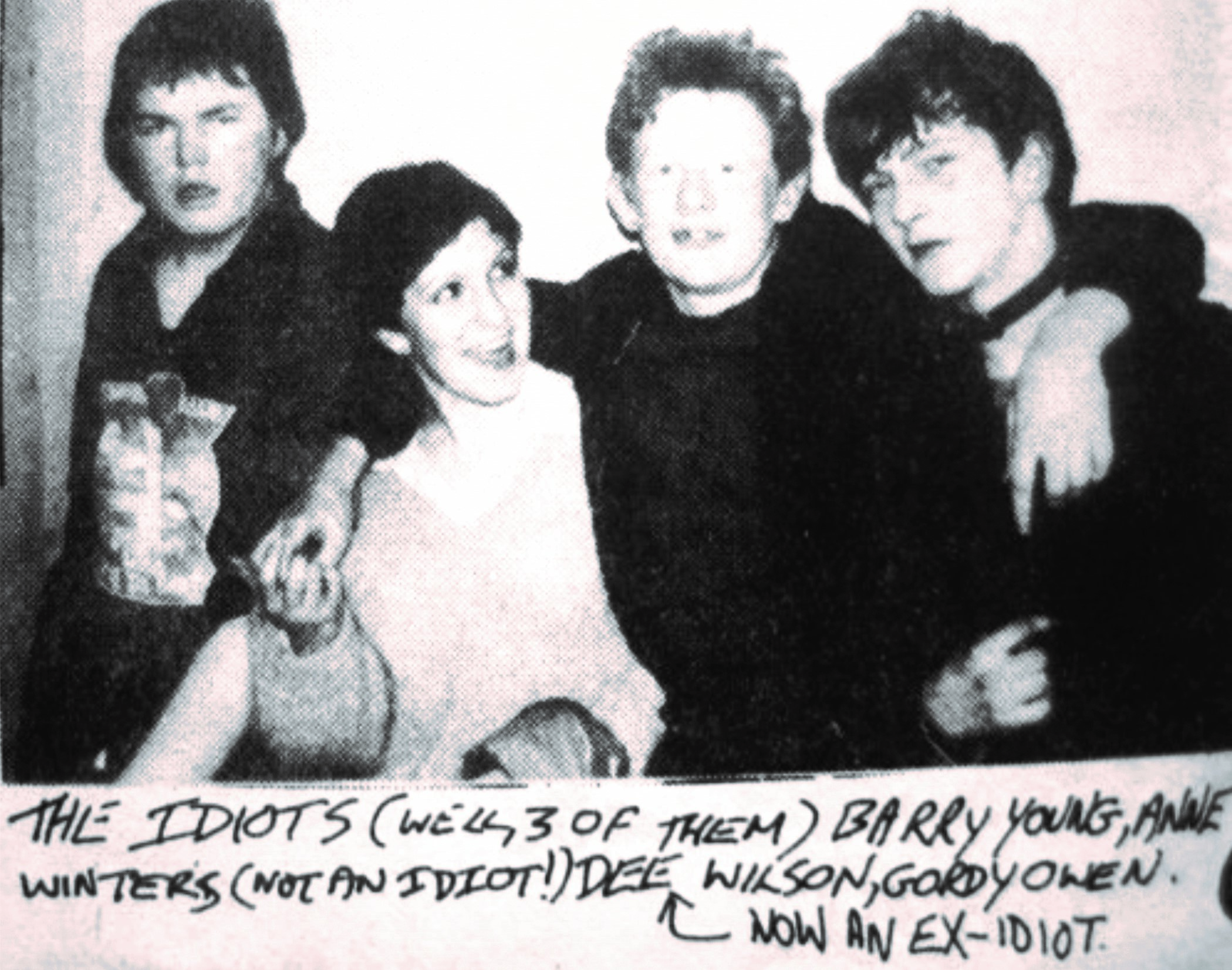
If one band put a smile on your face more than any other in John T. Davis’ film, it’s The Idiots, who provide a punky ‘Parents’ from autumn ‘78 here, of which guitarist Barry Young adds, in relation to the first song he ever wrote, ‘All I was trying to do was write about what was more relevant to me, as someone who had just turned 16, rather than the big ideas of anarchy or world rebellion. The Idiots got together out of a shared love of this exciting new punk music, having a laugh and enjoying the odd bottle of cider. Musical ability wasn’t too high on our priorities, but we were game enough, and we improved as we went along, becoming more confident. Looking back at it now, I have a lot of good memories of mad nights out and crazy, innocent fun. I’m just glad we recorded this as a testament that punk really was for everyone and changed the rules for good.’

I recall my mate Steve adding Starjets‘ ‘War Stories’ to an early compilation that came my brother’s way, and these London-based West Belfast ‘pretty boys of the new wave’ offer that track, still a corker all these years on, plus ‘Any Danger Love’, frontman Terry Sharpe going on to co-found The Adventures and secure more Top of the Pops coverage. As for Ali McMordie’s pre-SLF outfit The Detonators‘ ‘Cruisin”, there’s a reinvented Jonathan Richman feel, the band showing why they were chosen to support Buzzcocks when the seminal Manchester band played the Ulster Hall in September ’78. And Ballymoney trios No Sweat also impress with the new wave pop of ‘Start All Over Again’, sort of The Jags meet Thin Lizzy (not least due to its duelling guitars). But there’s more of a Stranglers feel to Pretty Boy Floyd and The Gems, a former showband reenergised by punk, initially as a sideline. There’s a story attached to that change of focus that you’ll have to buy the boxset to read. It’s not pretty though. Like many of the bands, they went on to try their luck across the Irish Sea, in their case including a backup band link with Auf Wiedersehen Pet actor and past Heavy Metal Kids frontman Gary Holton.

The Stranglers are also arguably channelled on Blue Steam‘s ‘Lizard King’, something of an oddity but interestingly so, from a band who just about cracked the UK top 100, with help from Peelie. And I like Jumpers‘ ‘Baby C’Mon’, another shot of R&B, complete with harmonica (perhaps I should say harp), a one-off project for producer George Doherty, backed by the afore-mentioned Gems. Cobra’s ‘Lookin’ for a Lady’ was another one-off single, with its B-side here, the band straight outta Belfast with something of a new wave Motorhead feel, providing the kind of impassioned oddity that makes this collection a joy.

Tinopeners make two contributions, a melodic teenage outfit with Ramones and X-Ray Spex-like qualities, inspired by fellow East Belfast outfit Rudi and so fresh here. And then there’s Clive Culbertson, whose name comes up a lot across these discs, and who despite success south of the border became better known for his production and session work with names like Van Morrison, the Chieftains and Cliff Richard. We also find Clive later with 1980’s The Sweat, who were No Sweat until a threat of legal action from Pete Townshend’s Eel Pie Records, whose band of the same name had been around a while.

‘Suzy Lie Down’ by Cramp carries raw energy, a one-off single from an outfit concentrated on Coleraine, Portrush and Portstewart’s live circuit. When Peelie played this, he pondered over the airwaves ‘what those guys would do if Suzy lay down’. Two members later turned up in North coast melodic four-piece Minor Classics, featured elsewhere on two Clive Culbertson-produced tracks with Boomtown Rats-like tendencies, unreleased before 2010’s Rip Off Records Sing Sing compilation. It’s a shame they released just one single, March ’82’s ‘Sign Language’, one of the last on Chiswick Records.

Lenny & the Lawbreakers give us a punked-up version of Kris Kristofferson’s ‘Me and Bobby McGee’, while The Androids, led by Joe ‘Zero’ Moody, supply two uncompromising numbers from the original Shellshock Rockers compilation. Bangor’s The Doubt sound a blast too, represented here via two tracks completing the first CD, the sleevenotes telling us, ‘Rehearsing in their singer’s living room and fuelled by nothing more than cider and ham sandwiches, The Doubt’s sound began to take shape and they began to play as many gigs as possible, using teenage enthusiasm and stupidity to overcome obstacles such as not having any transport and being underage for licensed premises. On one particularly memorable occasion a human train of ‘roadies’ carried all the equipment necessary for the gig a couple of miles to a beach. There, dozens of purloined extension leads were run across a main road from a friend’s house and the band risked life and limb to play a few songs’. Now that’s punk rock.

Who can forget the first time they heard Stiff Little Fingers? And that pure power and bite is relived here with the inclusion of October ’78’s vital debut 45, ‘Suspect Device’ and April ’79’s mighty ‘Gotta Getaway’. Jake Burns, the afore-mentioned Ali McMordie, Henry Cluney and Brian Faloon spring from the traps, the band who inspired by The Clash to write about their own experiences, with help from Gordon Ogilvie, truly nailed the zeitgeist of Belfast life back then, setting out their stall on ‘Alternative Ulster’, the single in between, and landmark debut LP Inflammable Material.

Protex, also featured in the film, are next to hit the spot, a melodic new wave feel evident on ‘Strange Things’ and ‘Strange Obsessions’, a take on life delivered in time for the ’80s from another band initially inspired by that iconic Clash visit. In fact, at first they used the name Protex Blue in honour of the Westway’s finest, but ‘evidently, they had absolutely no idea that the song was, in fact, about condoms’. Debuting in ‘78 at Knock Methodist Church Hall, Belfast, success to a point – short in the scheme of things but sweet all the same – followed via interest from Terri Hooley and Good Vibrations, Rough Trade, Kid Jensen and Polydor, while they studied for A-levels. Next came Adam & the Ants and Boomtown Rats supports, the band by then London-based, a subsequent North American tour part-caught on film by John T. Davis on another project.

Next up, Ruefrex carried something of the air of Howard Devoto for these ears, their ‘One By One’ single among Good Vibrations’ earliest, darker in feel, a touch of dystopia from a band living in a place where escape from reality surely appealed. In fact, slow-burner ‘The Perfect Crime’, also included, featured not only on the original Shellshock Rock film but also Good Vibrations.
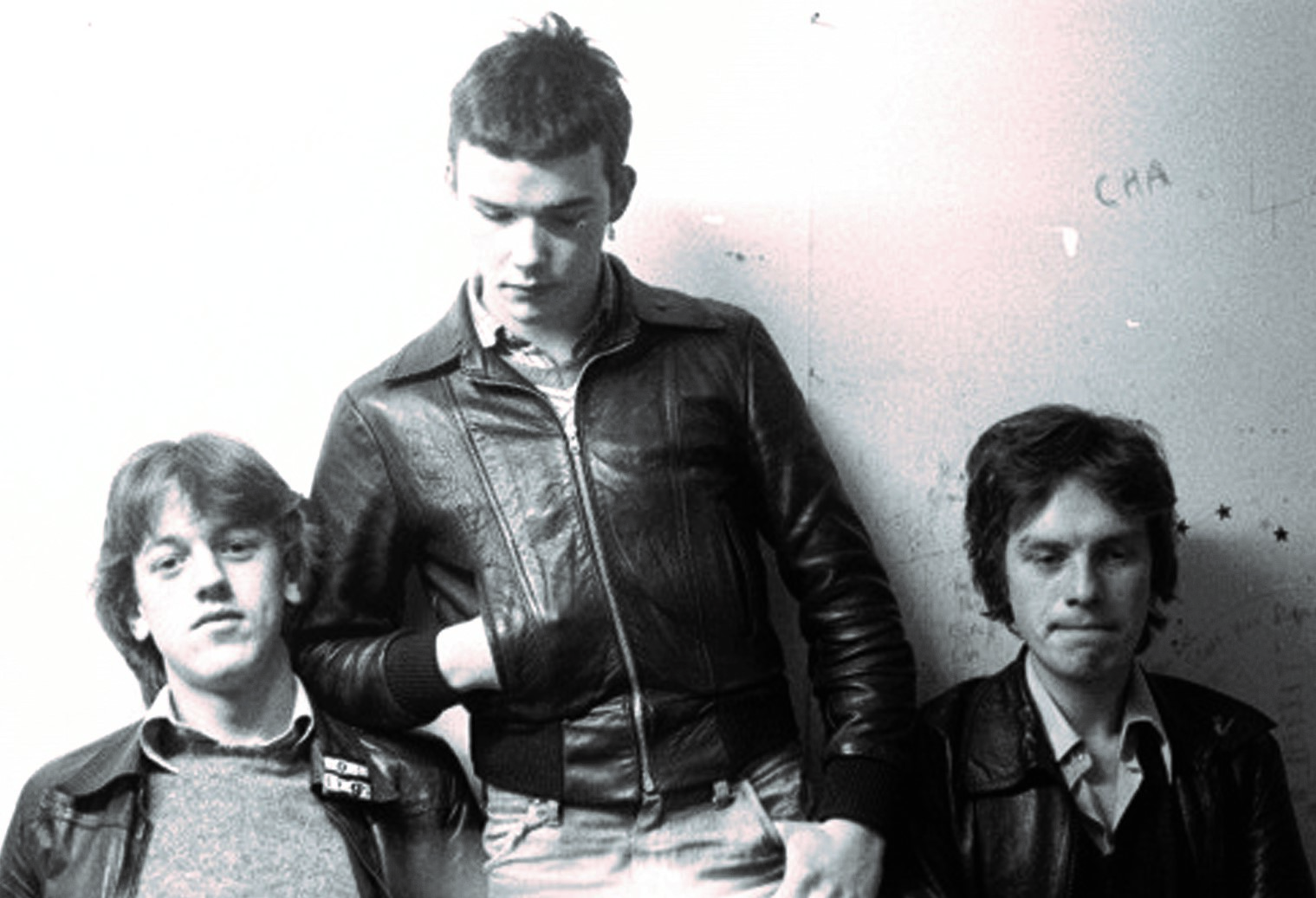
Lunar Force: The Moondogs, leading lights of Cherry Red collection, Shellshock Rock, and teatime TV stars to boot.

After that, Ballymoney’s The Faders sound fairly soothing with the Nick Lowe-like ‘In It For the Kicks’, and then we have The Zipps with ‘Don’t Tell the Detectives’, another who briefly swelled bills in Belfast and on the north coast. ‘Self Conscious Over you’ by The Outcasts will be more familiar, a classic angsty punk love song followed here by ‘81’s darker ‘Magnum Force’, tackling the Troubles head on, from a band also remembered for ‘Just Another Teenage Rebel’, a single I recall being covered in more recent years by The Undertones. And I have to admit that Victim’s sparky contributions from 1979 and 1980 were new to me, despite the band having relocated to Manchester. You certainly hear the progression between tracks, very of that time and Buzzcocksy.

Undertones fans won’t need an introduction to the work of fellow Derry outfit The Moondogs, who initially included John and Damian O’Neill’s brother Vinnie on bass. They positively sparkle on both sides of debut 45, ‘She’s Nineteen’, including ‘Tones-like guitar, those links leading to UK and Irish dates, Peel’s support and even interest from legendary boss Andrew Loog Oldham (see the sleevenotes for that tale). To give a flavour of this band’s story, I’ll just focus on 1981, when Granada approached them with a view to giving them their own teatime TV show. Further radio sessions and gigs followed, plus the ‘Talking in the Canteen’ and ‘Imposter’ (produced by Kinks legend Ray Davies) singles, before the band headed to New York to record their debut LP with Todd Rungren in late May. But, according to their biog, ‘That’s What Friends Are For proved to be an ironic title for the long player as the band split up halfway through recording. Warner Bros bought Sire Records and began to clean out the cupboards, and it seemed that The Moondogs would be dropped without the album ever being released. On their return to Derry, the band went en masse to the bank, collected their publishing and recording advances, paid the VAT and declared themselves bankrupt. With a few pieces of paper, it was over, and the following Monday The Moondogs went and signed on the dole. However, unbeknown to the band Todd Rundgren had finished off the album, and Sire released it in Germany later that year.’

There’s more of an ’80s feel to the two selections from Rod Vey, a Belfast lad in his early 20s dividing time between Queens Uni music studies and professional sax playing and session work for Rip Off Records, here messing around to great effect with electronics, another artist who went on to work with big names. And we definitely seem to be in post-punk, darker territory by the time we reach Stage B‘s ‘Light on the Hillside’, the band fitting in a filmed Toyah support tour slot before a 1981 break-up. Meanwhile, there’s a big sound to The Tearjerkers (their forntman once with Midnite Cruiser) with ‘Heart on the Line’, yet that’s a mere B-side for this Portadown outfit, who managed a Thin Lizzy support, a couple of Peel sessions, and a little TV and further radio before splitting. And the same goes for Aftermath, here with ‘Mixed Up Kid’, and also supported by John Peel and RTE’s Dave Fanning.

RTE favourites Male Caucasians looked to Dublin and Scoff Records to release ‘For the Night’, somewhere between Graham Parker, the Boomtown Rats and Split Enz maybe, the band’s Pat Cunningham explaining, ‘I gave up the boring day-job and concentrated on writing and gigging – we played around Belfast, Dublin, Cork and many places in between. It gave me an identity, a sense of belonging and a sense of possibility: we were going somewhere. The music provided an escape from the tribal politics and the drab reality that was Belfast then. ‘For the Night’ is the sound of that escape.’

Reflex Action provide both sides of 1980’s ‘Spies’ single, its school of The Clash skank’ a favourite of John Peel’s wife Sheila, and according to Paul Bradley, ‘a neat embodiment of the NI post-punk music community’s gift for dismissing sectarianism’. He adds, ‘Roughly half unionist and half nationalist, we, like many of our gigging peers, ignored sectarian divisions’.  Fair play to them. And disc two ends with fellow Belfast combo The Rattling Throntons‘ ‘The Whistle Song’, Rockpile-esque and from their sole EP in 1980. They played a cocktail of mod-punk covers alongside original material, their name taken from some cheap Chinese cassettes bought to record rehearsals, early bass player Andrew Thompson revealing that the ‘recording was funded by us putting on matching blue shirts and trousers and playing horrendous C&W covers under the name Bandit’, adding, ‘There was no commercial market in NI for our music, but plenty of demand for bad country music.’

So to disc three and Terri Hooley’s faves and NI punk pioneers Rudi, represented by a radio version of ‘Steps’ – among my favourites on this boxset – and 1981’s ‘When I Was Dead’, produced by Paul Weller. Some might suggest ’Big Time’ should be here, but like ‘Teenage Kicks’ and ‘Alternative Ulster’ we’ve all got that, right? Formed in 1975 by East Belfast schoolmates, they progressed from glam and rock’n’roll to a punk direction, inspiring Terri Hooley to set up his label and missing out on a deal with Polydor as they refused to sack drummer Graham ‘Grimmy’ Marshall, who the corporate considered a ‘madman’. As it was, while Grimmy stayed, Gordy Blair (bass) was turfed out soon after (later joining The Outcasts), and as a three-piece – Grimmy plus fellow founder members Ronnie Matthews (guitar, lead vocals) and Brian Young (guitar, vocals) – they signed to Tony Fletcher and the afore-mentioned Weller’s Jamming! label. In fact, as Brian Young put it, ‘Grimmy was the heart of the band, and was there from day one right through to the bitter end, alongside Ronnie and yours truly.” In that next spell, Weller took the band on tour. But fate conspired when The Jam split and the label folded, Rudi also deciding to call it a day.

Ex-Producers’ ‘The System Is Here’ sounds more like The Jam at their most blatantly political, the band meeting at school in West Belfast, starting in 1978 as Blitz – inspired by SLF and Rudi – before becoming The Producers, with personnel changes en route. The key further name change followed, the new line-up receiving radio airplay and featuring on a January ’80 Belfast edition of BBC TV’s Something Else, finally becoming a three-piece but never receiving the breaks they craved. They split in 1982 but re-emerged in 2004.

There’s real punk charge from The Defects – the vocals bringing to mind Ade Edmondson’s Vyvyan from The Young Ones – on Christmas ‘81’s ‘Dance (Until You Drop)’, which quickly sold out 2,000 copies, and presented here with its B-side. Formed in Belfast in summer ’78, they first performed Never Mind The Bollocks and The Clash covers, later borrowing money from parents to set up Casualty Records, before a deal with London’s WXYZ Records, alongside label and tour-mates Anti-Nowhere League and Chelsea. Key UK dates and a tour followed, plus the ‘Survival’ 45, the band living on a Chelsea Wharf houseboat moored next to Lemmy’s, regularly partying with Girlschool, Motorhead and various other rock‘n’rollers. An Ulster Hall date supporting the later version of The Clash was their finale, but they resurfaced in 2003, recording for Punkerama Records and still gigging far and wide.

The new wave/power pop of ‘Radio Songs’ and its cracking B-side follows from Strike, who played around Ireland, with various press and radio interviews, supporting the Boomtown Rats at the Ulster Hall in Belfast when the headliners were topping the UK charts, A&M Records expressing interest at that stage. And there’s a similar new wave vibe to The Singles, who hailed from the Portadown/Lurgan area, more aligned to the mod revival than the punk scene. They recorded with producer George Doherty, leading to one-off single ‘TV Deceives’ in 1981, included here with previously-unreleased demo ‘I’m Only Asking’. They split soon after, two members going on to synth-pop band Shadow Talk, who had a minor hit in 1983 (and who I saw support The Fall and Serious Drinking at Surrey Uni that year).

Another pleasant surprise for this scribe was the rather jerky, angular ‘Mr Mystery Man’ by Belfast’s Shock Treatment, whose members included Davy McLarnon, who leads Shock Treatment 21 to this day, and original vocalist Barry McIlheney, best known for his writing at Melody Maker, subsequent editorships at Smash Hits and film mag Empire, and much more. The track chosen is a tribute to his Dad, who died when he was just 19, and it’s a corker. The band formed around ‘78, inspired by bands like Eddie and the Hot Rods, Dr Feelgood and the Ramones, signing to Good Vibrations in early 1979. Their ‘Room to Move’ EP included ‘Belfast Telegraph’, with follow-up ‘Mystery Man’ on their DAB label in 1981.

There’s a Graham Parker/Elvis Costello/Joe Jackson vibe to ‘Put It Around’ by The Nerves from Newry, formed by the three McCaul brothers, previously The Mash. By March 1980 they were a four-piece playing their hometown and across the border in nearby Dundalk, and occasionally Belfast and Dublin. A demo tape left in Terri Hooley’s shop eventually led to a rare offer to record an LP. They received airplay from RTE and Downtown, the Notre Demo album recorded in Dundalk in late 1980, recorded and mixed in 46 hours for £400, a limited 1,500 pressing well received. A Battle of the Bands win at Ulster Hall led to finals at The Rainbow in London. There was also an early ‘81 Irish tour.

The Peasants shared a history with Protex, members of both playing in The Incredibly Boring Band. They issued one 7” EP, ‘Here She Comes’, pressed in limited quantities in 1981 before they split. And it’s a real pleaser, very ‘60s West Coast US in feel. And there’s a similar cross-Atlantic vibe with East Belfast combo Acme, formed in late 1978 as Acme Music, ‘sustained on Clash records, Protex gigs and Olde English cider’. They supported Rudi and The Outcasts, their pleasing contribution here early ‘81 demo track, ‘Jealousy’, with an Edwyn Collins feel.

Big Self formed in Belfast in the late ‘70s, the line-up swelled to a five-piece in 1982 by bass player Gordy Blair (ex-Rudi and The Outcasts) turned saxophonist. On a reggae-influenced canvas, they developed their sound and signed to Eire’s Reekus Records, first two singles, ‘Surprise Surprise’ (included here) and ‘Don’t Turn Around’ (its B-side featured here) both Sounds singles of the week. Relocated to Brixton in early 1983, they recorded LP, Stateless in Dublin the following winter, with 4 ¾ out of 5 stars in Melody Maker, losing the quarter-point due to an 18-month release delay (the distribution company went into liquidation). Several well received shows and festivals followed, plus John Peel and Kid Jensen BBC radio sessions, and BBC and RTE TV appearances. They bowed out in 1986 at Dublin’s Self-Aid festival.

Act Together: Belfast five-piece Katmandu. It took a move to Dublin to crack it. (Photo courtesy of Sean Hennessy)

Belfast five-piece Katmandu formed in 1978, yet frontman Marty Lundy – who died recently – had featured on the city’s club circuit since 1974. After 18 months writing in their home city, a Dublin move followed, regular gigs there establishing them, 1980 debut single ‘I Can Make the Future’ garnering major label interest and leading to TV appearances both sides of the border. The track chosen, ‘Get My Act Together’, the B-side of ill-fated 1982 second 45, ‘Coma’, carries a rather splendid Bowie meets Roxy Music feel. But it wasn’t to be, the band returning home and going no further.

The Boots & Braces label’s 1982 United Skins compilation shows us another side of the story with two belters from Control Zone, Tony McGartland explaining, ‘When bouncers at a local nightclub started using their fists to show their authority I found myself barred from the venue for wearing Dr Marten boots, not the sort of thing the new disco boom wanted to see. As bouncers laid into young skinheads and punks, Control Zone responded with a new anthem, ‘Bloody Bouncers’. “And ‘Johnny Johnny’ could have been the story of anyone who got into trouble, got on the wrong side of the law and managed to survive on the streets.’

The old punk thrill resurfaces via Electro-Motive Force, formed in the winter of 1980, previously named White Noise until a new line-up. With guidance from manager James Tweedie, they released a self-titled four track 7” on their Surge Records label in 1982 – two tracks featured here – with 500 copies pressed and soon proving hard to come by. Picture sleeves are particularly rare, a couple of hundred stolen from a band member’s car shortly after release, thus becoming a much sought-after NI punk artefact.

And finally, Dogmatic Element offer both sides of Summer ’82 post-punk single ‘Strange Passion’, and I’m pleased to finally hear a strong female voice through Alison Gordon, reminiscent of Leeds’ Girls at Our Best on the (preferable to me) B-side. They formed in 1980, rehearsing in the basement of a loyalist pub in Newtownards and a chapel hall on Sundays, debuting live at July ‘81’s ‘Project Bangor’ gig to a full house in their hometown. Building a reputation for energetic live shows, novelist Colin Bateman managed them for a time, setting up the Cattle Company label to release 7” singles in 1982 and 1984. They also released several cassette-only EPs, put down at Bangor Drama Club, recorded a couple of Downtown Radio sessions, and played on TV’s Channel One in 1984. Extensive gigging included support slots with Rudi, The Outcasts and Poison Girls, several line-up changes following before a 1985 split after a residency in Larne.

Back to the Shellshock Rock film included, and what strikes me is how young the acts look and how much passion for their art shines through. Through footage in the studio and live shows in sweaty clubs to vox pops on busy Belfast streets, there’s also a realisation of how far away that world is now, and how far off an eventual ceasefire they were too – another 20 years of suffering following before Ash, Bono, David Trimble and John Hume congregated on stage at the Waterfront Hall, the peace process finally in motion.

John T. Davis certainly captures the passion of Good Vibrations’ label founder, Terri Hooley a real star here, flicking (victory) Vs while pogoing in his record shop to Rudi’s ‘Big Time’, the first 45 he put out in a momentous year in which he took on the majors and won.

The boxset also features written contributions in its tie-in hardback book from music writer and WriteWyattUK interviewee Stuart Bailie, who featured on these pages after the release of 2018’s excellent Trouble Songs: Music and Conflict in Northern Ireland.

He suggests in his narrative that the original film is ‘regarded as a design classic’, and adds, ‘International fans have long considered the value of punk and alternative music out of Northern Ireland. It’s perceived as the real deal, the proof of concept, a place where music engaged and informed to an inspiring degree. Some of us believe that it pre-empted the dynamic of the peace process. The bands of Belfast and beyond created a scene entirely of their own making during those times, punk forging alliances that reached across sectarian boundaries and pushed back against a culture of traditions and establishment which seemed to offer very little to the country’s youth.’

As the boxset sleeve notes suggest, ‘Nowhere was punk as necessary and as life changing as it was in Northern Ireland’. And that’s something Shellshock Rock director John T. Davis also acknowledges in his notes.

He writes, ‘When I think back to 1978 and my days as a young filmmaker, I realise how fortunate I was to have been in the right place at the right time. I had the privilege then of documenting a brief and fleeting moment in the history of the Northern Ireland conflict.

‘It was a time when a small but brilliant chink of light shone in the heart of darkness, a shaft that split traditional values asunder. Out of the bombs, bullets, and bullshit came a movement more powerful than the hate and propaganda.

‘Terri Hooley said, ‘New York had the haircuts, London had the trousers, but Belfast had the reason’. Punk rock was bringing together kids from both sides of the sectarian divide, Catholic and Protestant teenagers uniting in the name of their music and what it stood for, far more important to them than social or political conformity.

‘I first became aware of this phenomenon when invited to a Stiff Little Fingers concert, hearing ‘Alternative Ulster’. I was compelled. Here was a film waiting to be made.

Shellshock Rock is not about punk, it is punk! This is the key to its longevity. Every trick in the book was employed during the production – friends worked for free, and Heath Robinson was never very far away.
Big Time: Rudi proved to be star turns of both Good Vibrations and Shellshock Rock (Photo courtesy of Colin Henry)

‘We had to be creative and ingenious in the execution of ideas, there was no real cash to oil the machine. What money was available came from community arts and myself.

‘For a small backhander to friends in the processing department at local TV stations, my raw film footage was developed along with that of the 6 o’clock news. Punks and paramilitaries in the bath together!

‘In the editing we couldn’t afford a work print, so the reversal master was cut – something fraught with problems and seldom done. The rolling credits were filmed by setting the artwork boards on top of my childhood model railway cars and pulling them along the track with string while the rostrum camera filmed from above.’

He also stresses that the film could not have been made without Terri Hooley assuring the punks that he had his seal of approval.

‘Terri ran Good Vibrations Records and I had known him when he was part of the Dublin Road Folk Club – long before Punk ever came to Northern Ireland, when Belfast was R&B city, in the days of Sammy Houston’s Jazz Club, Van Morrison and Them.’

It seems that his film really took off when it was pulled from 1979’s Cork Film Festival on its premiere night, John adding that, ‘After that everyone wanted to see the banned movie!’.

It went on to win a silver award at that year’s New York Film and Television Festival, with screenings in Europe, Asia, Australia, South America and North America. But it was the NYC exposure that its director recalls with most affection.
‘The Americans could not believe the message the film was bringing. All they knew of Northern Ireland was the violence and murder. We were the good news!

‘A lot of press was generated, and the film received national distribution, while the underground music clubs all wanted screenings. The line-up was impressive – Tier 3, Hurrahs, The Mud Club, The Peppermint Lounge, Club 57, and CBGBs.’

New friendships were forged along the way, not least with scene luminaries such as beat poet Allen Ginsberg and legendary documentary filmmaker D.A. Pennebaker.

‘You can understand how much this little film has meant to me over the years. I’m amazed by, and proud of, what Shellshock Rock has become. It’s been a huge part of my life. I’ve watched it grow like a child, and still hold the innocence we all had back then.

‘It’s a window into those times. From the desperate streets of Belfast in 1978 to the lofty echelons of New York’s Museum of Modern Art in 2018, Shellshock Rock has achieved cult status.’

The Shellshock Rock collection, including in-depth sleevenotes and previously unseen images, is the latest in a Cherry Red Records regional compilation series that also includes Manchester – North of England, Revolutionary Spirit – The Sound of Liverpool, Big Gold Dreams – A Story of Scottish Independent Music, and Dreams to Fill the Vacuum – The Sound of Sheffield.
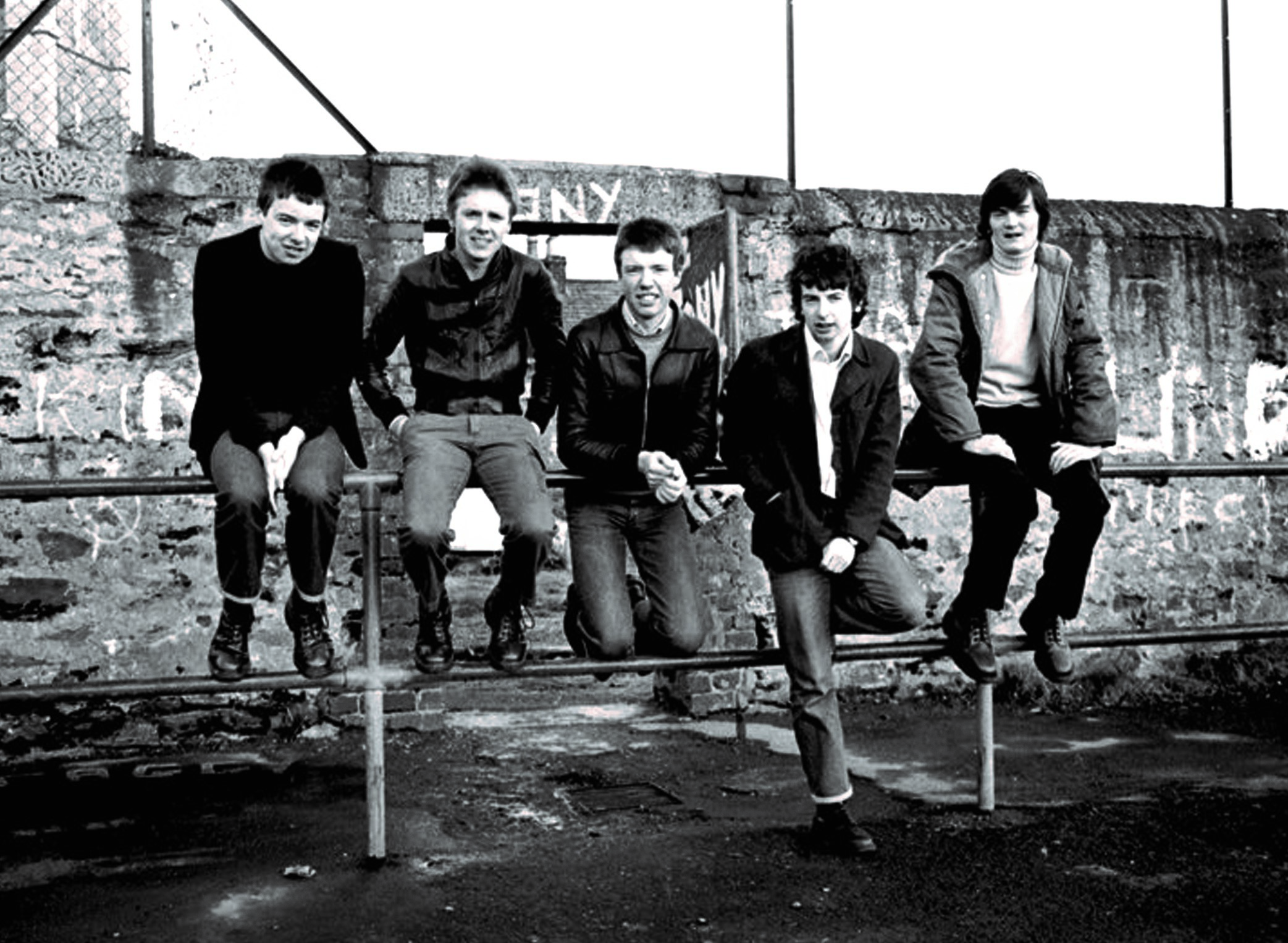
Derry Air: The Undertones. From left – Damian O’Neill, Billy Doherty, Mickey Bradley, John O’Neill, Feargal Sharkey.

Shellshock Rock: Alternative Blasts From Northern Ireland 1977-1984 is available in 3CD/DVD hardback book boxset format from Friday, July 31st, priced £24.99, including a bonus exclusive promo postcard while stocks last. For more details head here.

Posted in Books Films, TV & Radio, Music | Tagged , , , , , , , , , , , , , , , , , , , , , | Leave a comment

How we got there – talking Together with The Vapors’ Dave Fenton

Four decades to the week of the release of their debut LP, The Vapors delivered a new album, and it’s one that proved beyond doubt the staying power of a band that were always about so much more than one big hit.

Regular visitors to this website will know I’ve been extolling the virtues of a group from my old neck of the woods in Guildford, Surrey, since they got back together, any initial concerns about their decision to reform cast aside on witnessing their performance at Liverpool Arts Club in late 2016.

It was always going to be a balancing act, having loved the first album, 1980’s New Clear Days since I first heard it as a young teen, and learning to love in the interim 1981 follow-up, Magnets.

And while those early shows on reforming four years ago were all about playing the old songs, frontman Dave Fenton stressed from the start that he was eager to move on, not content to just play the numbers we already knew and loved, keen to take the band into a new era of creativity.

The shows that followed reflected that, with more and more new songs aired and tested live, and now we have Together, a long playing statement of true intent, a celebration of the band and a mutual enduring love with a loyal fanbase – young and not so young alike – and an album that suggested they’ve simply carried on where they left off before a 34-year hiatus.

As expressed in more detail in past interviews with band members on this site, Dave (lead vocals, guitar), Ed Bazalgette (lead guitar, vocals), Steve Smith (bass, vocals) and Howard Smith (drums) packed in a lot during the years in between, the latter deciding when they reformed his priorities had to be elsewhere at that stage, not least with a young family in tow.

In his place, up stepped Michael Bowes, a Brighton-based BIMM drumming tutor with an impressive CV, previous stints between the sticks including those with Nelly Furtado, Joss Stone, Tears For Fears, Heather Small, Michelle Gayle, Desmond Dekker and Laura Mvula. And Jamaica-born Michael fitted in right away, his infectious smile seemingly ever-present and somewhat infectious for anyone catching the band live since.

While Dave’s retired from his legal role (in later years working as an in-house solicitor for the Musicians’ Union), Ed’s work in TV and film (most recently directing Versailles and The Last Kingdom, and next up, The Witcher) continues to keep him busy, but there’s a more than competent replacement in Dave’s son Dan Fenton, regularly deputising on lead guitar, both players featuring on the new record.

Real Time: Dan and Dave Fenton locked down at home, near the South coast, waiting for the weekend when they can finally get back out again (Photo: Branka Fenton)

The initial decision to get back together (I’ll keep using that word, in celebration of the latest arrival) came after Dave and Ed guested with Steve’s punk and new wave cover band The Shakespearos at a PolyFest charity event at the Half Moon, Putney, south west London, playing their biggest hit, ‘Turning Japanese’, a UK No.3 that proved a hit around the world, even topping the charts in Australia.

That Half Moon appearance inspired four Waiting for the Weekend dates later the same year – in Dublin, back in London at Camden’s Dingwalls, then in Liverpool (where I caught them) and Wolverhampton. And from there there’s been precious little let-up, numerous gigs and festivals following around the UK, alongside a series of sell-outs in New York City which led to 22 Lost ‘80s Live package tour dates across the US, 38 years after their previous (third) saunter across the States, in what proved to be the final act before the initial split.

Law student Dave formed an early version of The Vapors in 1978, a year later recruiting Ed and Howard, with Steve on board shortly after, one of their early gigs at Scratchers, Farncombe (four miles outside Guildford) caught by past WriteWyattUK interviewee Bruce Foxton, who asked them to open for The Jam on 1979’s Setting Sons tour. He also took on management duties alongside Paul Weller’s father John Weller, and late last year The Vapors reunited with their old manager, supporting Bruce’s From The Jam on a Setting Sons 40th anniversary tour.

More of those dates happened this year, until coronavirus restrictions curtailed live outings. But now fans have that new LP to savour, made in Liverpool with BRITS/Grammy award-winning producer Steve Levine (The Clash, Culture Club), who said of the experience, “It was such an enjoyable project to be involved with. I’m enormously proud of this album. The band really upped their game musically and sonically during the sessions and were a pleasure to work with.”

COVID-19 curbs willing, Fenton and co. are set to celebrate not only the new record but also the 40th anniversary of New Clear Days with a headline UK tour later this year, playing the debut LP in full as well as songs from the new album. But Dave admitted when I called last week a sense of frustration at not being able to get out and about with his bandmates right now.

“We can’t rehearse, because we can’t travel. Writing’s fine, but …. I’ve got 30 songs towards the new album already. I’m just wondering what to do with them. We’ll probably have to do a double album.”

That reminds me of a recent conversation for this website with Erland Cooper where we got on to Paul Weller, the pair having worked together on projects in recent times. He told me Paul was already enthused about his new record … even before his latest is released. That’s the mark of the man, I guess, in his 60s yet as prolific as ever. And that seems to be the case with Dave too.

“Well, what else can you do if you can’t rehearse and you can’t play live?”

Nuclear Nights: Dave Fenton in action with The Vapors, before the COVID-19 lockdown kicked in (Photo: Si Root)

That said, I guess yourself and Dan, self-isolating together, will be all the more tight as a unit, seeing as you get to practise together while the rest of the band are elsewhere.

“Yeah, well, we’re going to end up doing loads of acoustic stuff, just me and him, unless we can sort out some way of getting everyone to record.”

A Zoom band meeting isn’t so easy, I suppose.

“No. The time delay on that is a problem. We’ve had podcasts though, and a Zoom party the night the album got released. We were altogether, drinking together … virtually. But there is some other software we’re going to try out, so we’ll see what happens, experimenting to find a way to play without a time delay.”

Dave’s been confined to base in recent weeks with wife Branka, sons Dan and Jack and two dogs, ‘a walkable mile and a half away’ from the South coast. And while missing their daughter, locked down elsewhere, he’s clearly loving the public and critical acclaim for Together.

“Well, who wouldn’t be? I haven’t seen anything negative.”

Those of us who have caught you live these last few years have been believers from the start, but even then, I think it’s fair to say the finished product has exceeded expectations. It’s as if you carried on where you left off with Magnets in 1981. Another winning set of songs.

“It’s nice when people say things like that. I’m just amazed no one so far has said, ‘It’s not as good as it used to be’. That’s what I was dreading most, that we’d let people down.”

Lining Up: Michael Bowes gets right behind, from left, Steve Smith, Dave and Dan Fenton. Photo: Si Root.

Despite last year’s US package tour on the retro circuit, I don’t think there was ever a doubt that you were always about the next record. You’ve never been a band to come up with more of the same, as proved by Magnets, arguably a step too far at the time for a wider audience.

“That was the initial basis on which we got back together in 2016, over a drink in a pub in London. I said I wanted to get back to where we were before, and that would include writing new songs if these gigs were a success and we still had an audience. And everyone agreed.

“It’s taken a bit of time. I didn’t expect it to take four years. But to be quite frank, I don’t mind the pace it’s going at. I’ve got nothing else to worry about. I’m retired and this is it, so I’ll get it right.”

That’s as good a place as any to include my own brief-ish critique of the new record before I get back to my latest chat with Dave. Apologies if you’ve only got a short break, as this feature is clearly turning into another trademark epic, it would seem. That fella Tolstoy’s got nothing on me.

T Time: The new Vapors T-shirt could be yours, all yours, via https://everpress.com/the-vapors

T Time: The new Vapors T-shirt could be yours, all yours, via https://everpress.com/the-vapors

“We’ve been through troubled times, we’ve been through stormy waters.”

Somehow, Together gets its message across without the angst and ire of a late ‘70s approach to kicking against the pricks. That’s not to say there’s no cutting edge. Far from it. There’s are more subtle ways to deliver perhaps, and while I crave a little more fire at times, I think they’ve struck a great balance. They certainly get their points across, sonically and lyrically. We’re talking melodic new wave pop with added bite.

Look away if you like, but for me the pop sensibilities of a very 21st century success like The Feeling come through on tracks like opener ‘Together’, incorporating a respectful nod to the past but pushing on all the same. The US term power pop always confused me, but I reckon it probably fits the bill here. And whatever label you use, the title track and several more scream ‘radio airplay’. Think commercial with attitude, carrying enough sonic hooks to lure non-partisan floating voters.

‘I don’t think I could have made it on my own; I don’t even think I’d find my way back home’.

Track two, lead single ‘Crazy’, also falls into that category, grabbing you from the moment you hear that introductory late-‘70s Steve Jones-like guitar riff. If Steve Smith’s side-project The Shakespearos start playing this and it’s new to you, you could be excused for thinking it was a little-known post-punk single from ’78. I’ll be honest and say, like ‘Turning Japanese’ and ‘Jimmie Jones’, I’d more likely point new fans to something more subtle and less commercial. But it’s a classic new wave hit.

‘All I really want is floating down the river; All I really want’s a reason to forgive her.’

It’s the deeper numbers that truly resonate a few more listens down the line, and ‘Sundown River’ carries a melodic laidback 12-string feel. A beautifully-crafted song, one more punk-rock elements among the fanbase might shy away from. Dare I say the harmonies put me in mind of Aussie environmental rock warriors Midnight Oil in reflective mode? In fact, I see the titular river more a dried-up creek picked up in an aerial shot by a passing helicopter. And there’s definitely a touch of the cinematic about this fine number.

‘Freeze frame, freeze frame, freeze frame; And look at everything you’ve got.’

The subject matter of ‘Real Time’ puts me in mind of ‘Daylight Titans’ on the second LP, and its ‘We can freeze time’ line. And while a band that have been away as long as this shouldn’t just be able to drift back into the groove, The Vapors pull it off, seemingly seamlessly. And if there’s an over-riding message across these vinyl grooves, perhaps it’s something about making the best of the limited time we have on this earth and using the power we have – personally and politically – for good. And a big yes to all that.

‘I could have stayed for longer, probably should have; But the last thing I saw happening was this.’

‘Girl From the Factory’ is the first of the New Clear Days: Revisited songs here, it’s title taken from ‘Letter From Hiro’, and while the sheer number of years between Vapors records suggests such reflection might have been over-thought, over-wrought and over-played, they manage to keep within the parameters. Nothing’s in your face, and similarly nothing comes with a smug or conspiratorial wink to the camera. It’s great storytelling, masterfully done.

‘I can’t remember how we ended up like this; Just that it’s beautiful, I feel so blessed.’

There’s cause for further reflection on ‘I Don’t Remember’, and this time I could easily hear Suggs and Madness tackle this. In their case too it would be tucked away on another quality album and only a select few of us would pay much attention. But given the chance it‘s a song that gets inside your head and refuses to budge, the message put across without the need for a mallet.

Double Act: Steve Smith, left, and Dave Fenton at Cardiff University SU Great Hall (Photo: Warren Meadows)

‘Now it’s a different story, someone’s singing our song; Land of hope and glory for the rich and the strong’.

The Vapors were always a political band for these ears, and those messages made an impression on a teenage lad waking up to what was going on around him, on both sides of the Atlantic. ‘In Babylon’ continues that great tradition, although for me it sounds like it would fit better on Magnets than the more direct debut album. Incidentally, the day after my fourth listen to the new record, this was the one still playing in my head, that chord progression imprinted on the brain. In a good way. A sure sign of staying power.

‘But if you wait till the war is all over, and then you wait till they all drop their guns; And then you wait till they pick up the pieces, no-one won.’  

I guess ‘Letter From Hiro’ was the song I returned to most during the ‘80s and ‘90s, thinking I’d never ever get a chance to see The Vapors. So near, yet so far, a band on my doorstop gone before I had chance to catch them live. So there was something of a thrill in finding out there was a follow-up here, one I first heard live at Manchester’s Ruby Lounge in 2018 (reviewed here)and it certainly doesn’t disappoint. ‘Letter to Hiro (No.11)’ moves the story on, in its structure and its narrative, and it’s certainly worthy of its company. It brings us up to date and again there’s a maturity that might not have sounded right if the LP had surfaced in the early ‘80s but sounds just right here. Think of Peter Gabriel (I know, I know, but please bear with me) at his most evocative. Think ‘Biko’ and the chill you got first hearing that.

‘White Rabbit is blue, Mad Hatter is too; I’ve told you before, you’re Alison Wonderland.’

Another number that has more in common with Magnets is ‘Wonderland’, which would have slipped into that set perfectly. There’s an ethereal feel in tune with the title, Dave Fenton with looking-glass in pocket in a creative nod to past Guildford resident Lewis Carroll, letting his imagination run wild.

‘I only came to pick up my things; I was hoping that you wouldn’t be in’.

I get the idea with ‘Those Tears’ that if all these songs were ready to record in, say, 1983, this could well have been the lead single. Who knows what might have happened then. It could have bombed without trace, the band done for, or it could have been a mega-success, at least in America, the biggest hit since Turning Japanese, a new era of The Vapors ushered in and a life by the pool with dubious substances and temptations assured. Ah well. I’d have probably walked away then, and would have certainly disliked the tie-in MTV promo video.

‘And we loved Suzanne, and we loved Marianne, and we hung out at the Chelsea Hotel; But then Jane came by with a bird on a wire; Hey, that’s no way to say goodbye, goodbye; King L!’

The car’s running now and we’re ready to depart, the plane not far off from taxi-ing across the runway as ‘King L’ kicks in, the crowd going wild, the band wigging out somewhat. Is this the track the band end on right now rather than ‘Here Comes the Judge’? It would make sense. There’s certainly not so many places to go from here. Kin’ ‘ell!

‘Cos those nuclear nights, followed by the new clear mornings, make the sun so bright in your eyes.’

Yet for all the penultimate song’s firepower, we have a perfect album finale in ‘Nuclear Nights’, the understated yet raw guitar at the death leaving us hungry for more. Again, there’s that perfect fusion between Heritage Vapors and 21st Century Boys in the Zone. And there will be more great records to come, I’m sure, that bridge safely crossed, new horizons in the sights. And here’s to that. Crack on.

Into 1980: The Vapors, on the New Clear Days sleeve

Nuclear Haze: The Vapors, 1980 vintage, on the debut album sleeve, somehow four long decades ago

Talking of which, now I’ve got that down, let’s get back to it. And in the same way that a successful football team builds around key players, I get the feeling the building blocks on the new LP are songs like ‘Together’, ‘Crazy’, ‘Sundown River’, ‘Girl From the Factory’, ‘Letter to Hiro (No.11) and ‘Nuclear Nights’.

“I honestly can’t remember which were written first. Some are quite old and we’ve been playing them since 2017/18, including ‘No.11’ and ‘Sundown River’, coming up from riffs that Ed played. But some of them were finished just before we got in the studio, and I was still tweaking lyrics when I was in there.”

I should point out that when Dave mentions ‘No.11’, he says ‘No-one won’, as those listening to the LP will realise. Vintage Fenton wordplay, up there with talk of ‘Alison Wonderland’ elsewhere, something there right from the start. And what was his gut feeling on first playback of the new record, and how that might have compared to first hearing the completed New Clear Days?

“I was pretty chuffed. We worked quite hard and quite fast with Steve Levine. He’s very good, but he cracked the whip, with about six days doing backing tracks and six more doing vocals and overdubs, six days mixing. There’s very little time to sit there and experiment. I was very pleased with how it came out, but at the time, it was like, ‘Is it finished yet?’”

Was that because he had such a busy diary, or just that’s he worked out over the years the best way to approach it all?

“I think it was a bit of both really. We were lucky to get a slot with him in the first place and lucky that he was keen to do it.”

And how did he compare to Vic Coppersmith-Heaven for the first LP and Dave Tickle for the second?

“Well, we got in touch with a number of these people to see if they were free or interested, and Steve was the first to come back and say yes. And we’re still waiting to hear back from some of them! Some were hard to track down, and I believe Dave Tickle is in Hawaii somewhere.”

Returning Heroes: Back in 2016. From left – Michael Bowes, David Fenton, Ed Bazalgette, Steve Smith

Somehow over the course of these last four years, you’ve become a five-piece with a twist, with Dan and Ed sharing lead guitar duties here and live.

“Yeah, we didn’t want to chop Ed out of the album. I think he spent three days with us, and he’s on three tracks, songs he knew already – ‘No.11’, ‘Sundown River’ and ‘King L’.

On the subject of the latter, I was wondering what Lemmy would have done with that. I’d have loved to hear a Motorhead cover.

“It would have been interesting to have found out!”

I love Mandy Cox’s cover design more and more, and Derek D’Souza’s live shots and Si Root’s bus stop five-piece line-up.

“That was in Porthcawl, South Wales. We did a gig there, and that was the last place all five of us were together. Dan came along to help roadie and Ed played.”

Would you have been out on the road now as a band, if not for coronavirus restrictions?

“No. we were halfway through the From the Jam 40th anniversary Setting Sons tour. That was set to go on until the end of April. Next up would have been a Lost ‘80s six-week tour in America from the end of July to mid-September.

“We were then set to tour in October/November /December to play stuff from the new album and mark the 40th anniversary of New Clear Days, so that’s still pencilled in for those dates, although Lost ‘80s Live is not going to happen, postponed to next year effectively.”

Steely Dan: Dan Fenton live, Cardiff University SU Great Hall, supporting From The Jam (Photo: Warren Meadows)

I guess if restrictions on live music and reduced numbers in confined spaces continue, there’s a chance it might even be five years on from the Half Moon reunion if those shows are delayed again.

“It could be. That was May, yeah.”

Either way, when that tour finally happens, there will inevitably be setlist casualties. There are only so many songs you can play each night.

“Well, it’s already been stated that we’d be doing the entirety of New Clear Days, so we’ll be doing less of Together.”

For someone like you who’s already thinking ahead to the next album …

“Yeah, it’s frustrating. I can’t keep all these songs in my head all the time. I have to rehearse them, depending on which set we’re doing.”

We had Talking Heads with More Songs About Buildings and Food in 1978 and The Undertones with ‘More Songs About Chocolate and Girls’ in 1980, and now we’ve got The Vapors 40 years later with, in your words, ‘more pop songs about war, famine, suicide, mental health, dementia and having fun’.

“Yeah, the short title was going to be ‘More Songs About Wanking and War’ … but we didn’t think that would get played!

Director’s Cut: Ed Bazalgette, live with The Vapors (Photo: Derek D’Souza at www.blinkandyoumissit.com)

“Some are about depressing subjects, people coming back and saying, ‘That made me cry’. Which, I think, y’know … is that successful? If it affects people emotionally, that’s amazing.”

Absolutely. And I was going to ask you about the dementia line, something I know all too well through struggles with both of my parents in their latter days. Was there a personal link with you?

“Well, yeah, my Mum was towards the end, but it was me I was talking about, really. I can’t remember lyrics. The older I get the less I remember … and it’s embarrassing sometimes. Because the audience know them all. Sometimes it goes through fine, but other times I just go blank.”

And you’re clearly a bloke who’s had to remember a lot of information over the years, not least through all those years in the legal profession.

“Yeah, but I’ve always found it hard. Names to faces as well. That’s difficult as well, and I’m really finding it now with new songs. The old ones I learned that long ago now that they’re still stuck in there somewhere. It’s just a matter of teasing them out.

“Then again, as it says in the song (‘I Don’t Remember’), ‘But then it comes to me.’ Sometimes you just sit on it and the answer will come. It’s no good me doing pub quizzes though, because it’s going to take a day or so!”

On a brighter note, the title track, ‘Together’ seems to be a celebration of relationships and doing alright at life. Am I right?

“I don’t want to spell it out, but they’re usually about more than one subject. It might sound like a boyfriend/girlfriend, and sometimes it’s me and the fans, sometimes it’s me and the band. The first line of the last song, ‘Nuclear Nights’, is ‘Don’t cry when it ends’, and that was about the end of the band. I didn’t know how long it would go on. I’m 67 now, already, and how long can we keep this up? It’s bound to end sometime, even if that’s not soon. But everything should be read on that level. And together in itself is three words – ‘to get her’.

Batman Returns: Steve Smith with The Vapors (Photo: Derek D’Souza at www.blinkandyoumissit.com)

I love that, and despite what you just said, in a sense you did spell it out with the front cover graphic.

“Well yeah, and it’s a stunning design. I love it. So simple, yet …”

Then of course there’s the alternative on the inside (and if you don’t know what that is, dear reader, it’s time you bought the finished product).

“Yeah, you don’t find that until you take the CD out.”

While you’re still pushing on and finding new ground, there are clearly links from the first album to this one. As heard in the titles of ‘Girl From the Factory’ and ‘Letter to Hiro (No.11)’, both linked to ‘Letter From Hiro’, and ‘Nuclear Nights’, referencing the first LP title. But it’s all rather subtle, like some of the key signatures and repeated motifs.

“Yeah, if I’d written an album immediately after Magnets, it wouldn’t have been the same. But now, with the hindsight of realising so many people did like us … that wasn’t at all obvious in 1981. There were a few people still turning out to gigs, so we felt bad about that, but there was no internet or MTV, the BBC’s Top of the Pops was off for the follow-up to ‘Turning Japanese’, and that crucified it. I think ‘News at Ten’ would have gone further if not for that.

“Instead though, I could stand back and have some perspective on what happened 40 years ago. So what’s on this album now comes with the benefit of hindsight.”

On that front, listening back to those first two LPs, they’re not dated in any way for me, and the subjects you wrote about first time around hold true to this day, whether it’s politics, relationships, or whatever. Even when you were the frustrated son in ‘News at Ten’, hitting out but maybe just worried you might turn into your old man. That song sounds as fresh and genuine today, and any generation will understand that sentiment, not least after several weeks of lockdown with family.

“Yeah, although I am now the father, with my son there next to me on stage. That’s weird. And he enjoys singing it back at me. We did an acoustic version when we played Portmeirion, where he did lead vocal on that.”

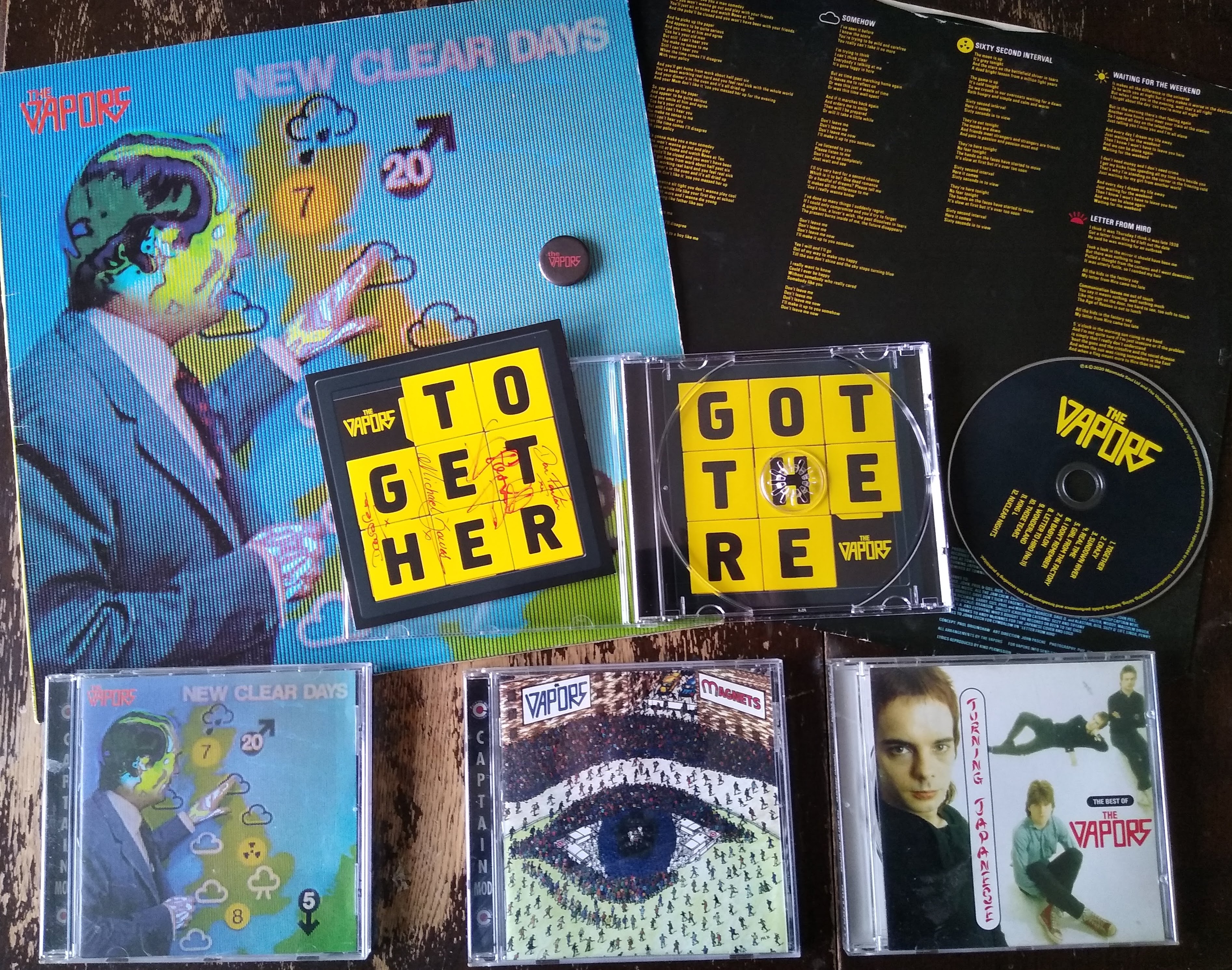
Sonic Boon: A few prized items from the WriteWyattUK HQ’s Vapors collection (Photo: Malcolm Wyatt)

That’s another venue I’d love to catch the band at when it next happens and this virus is behind us, past performances at Hercules Hall in Clough Williams-Ellis’ splendid Italianate estuary-side village in North Wales proving a hit with the fans in recent years. A gorgeous setting, and in keeping with the band’s history as the filming location for cult 1960s TV series The Prisoner, part of the inspiration for The Vapors’ debut single, Prisoners.

But I guess we’ll just have to wait before the band are out and about again, making do with playing Together at volume around the house instead. As for Dave, I asked before I went what was next for him that day – was he off to the coast to the accompaniment of a rousing rendition of ‘Sussex by the Sea’ perhaps?

“Erm … I’m vacuuming the garden! We’ve got fake grass, and it’s covered in petals and leaves, so I’ll be hoovering that off.”

Rock’n’roll lifestyles ain’t what they used to be, pop kids. And crazy don’t seem crazy anymore.

Pay Attention Stop: Michael Bowes, Ed Bazalgette, Dave Fenton, Steve Smith, Dan Fenton (Photo: Si Root)

For this website’s feature/interview with Dave Fenton from October 2019, head here,  and for another marking the band’s return from September 2016, head here. There are also Vapors-related feature/interviews with Ed Bazalgette (November 2016) and Steve Smith (May 2018).
For tour dates and details of how to order new Vapors LP, Together, go to www.thevapors.co.uk. You can also follow the band via Facebook, Instagram and Twitter.

Posted in Books Films, TV & Radio, Music | Tagged , , , , , , , , , , , , , , , , , , , , , | 1 Comment

West Coast aspirations, dreams and realisation – the Karima Francis interview

Fylde Roots: Karima Francis, exploring Las Vegas and Los Angeles via Blackpool, Manchester and London

There’s a new single out from Karima Francis, 11 years beyond feted debut LP, The Author. And it signals a welcome return for this acclaimed Blackpool singer-songwriter, currently based in London after a spell in Los Angeles.

‘Orange Rose’ is more West Coast America than West Lancashire and more Pacific Ocean than Irish Sea, a fair indication of where Blackpool-born Karima is at right now, as was the case with last November’s ‘Shelf Life’, both tracks suggesting added maturity but no less soul.

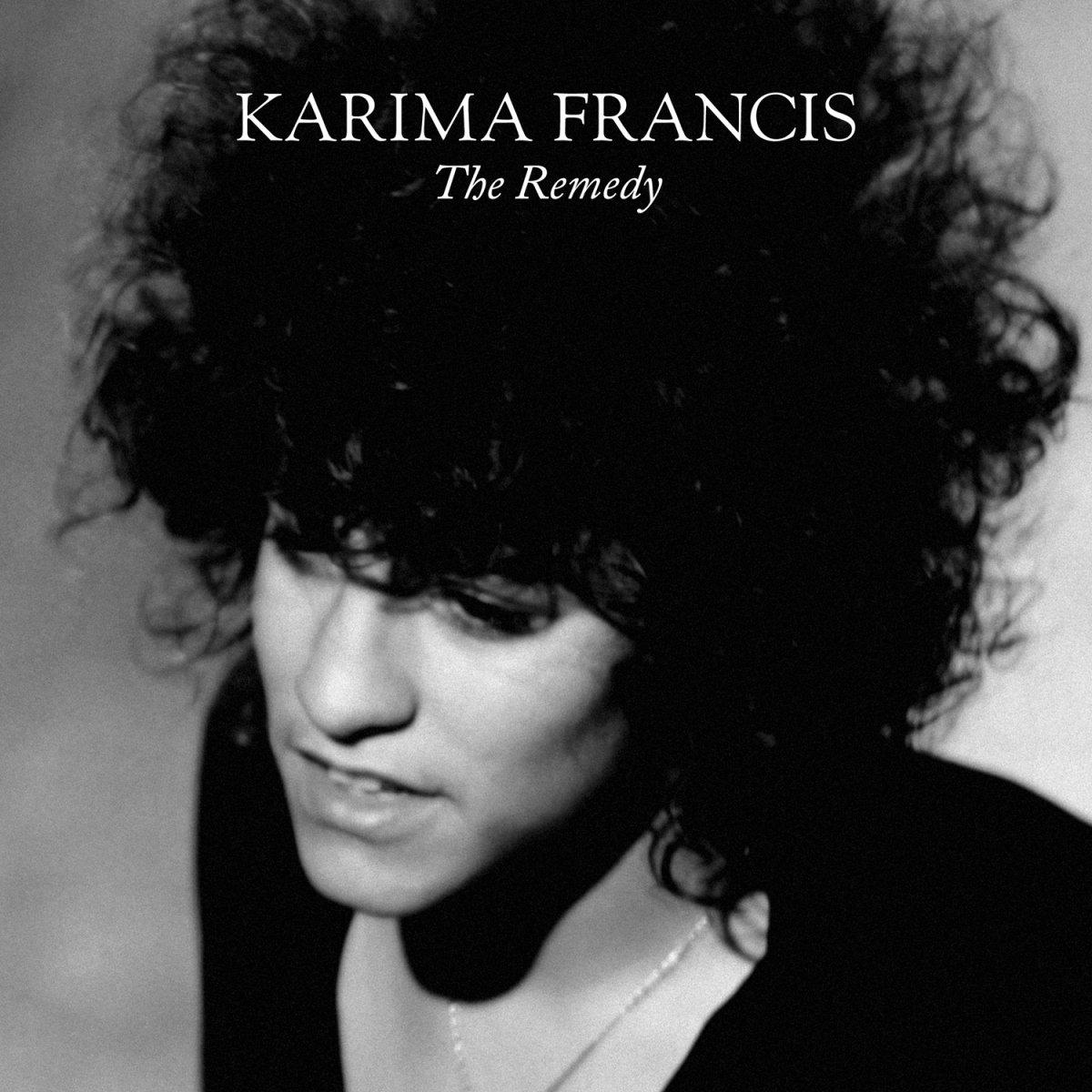
Taking her first steps into the music industry two decades ago, aged 13, self-taught Karima’s true break came in 2009 with her first album, consequent releases The Remedy (2012) and Black (2015) further showcasing her talent and creative development, Manchester and London moves later leading to the next step in California, selling some of her beloved guitars to buy a ticket to the States and kick-start a fresh direction.

Karima was 21 by the time she truly arrived, named by The Observer as the No.1 act to watch in 2009. And after winning performances at In the City in Manchester and SXSW, Austin, Texas, she was signed by influential indie label Kitchenware Records, linked to Columbia, and within two years was with Vertigo Records, linked to Mercury.

The Author certainly made a stir, notable appearances following on Later With … Jools Holland and supporting Paul Simon on the main stage at Hard Rock Calling in London’s Hyde Park, where she revealed to her backstage interviewer a ‘Made in Blackpool’ neck tattoo, while admitting it was a lie as she was ‘conceived in Benidorm’.

There were also shows on bills with Amy Winehouse, Patti Smith and The Stereophonics, and Karima  played the Royal Albert Hall in a Teenage Cancer Trust fundraiser. Her second LP was produced by Flood (U2, PJ Harvey, Nick Cave, Depeche Mode, Foals, Smashing Pumpkins), and her third by Dan Austin (Massive Attack, Biffy Clyro, Doves, Maximo Park).

Now, five years on, things have moved on again, her new 45 described as a love song ‘but like almost all love stories, it’s not without complications’, the artist offering wistful rumination on how mental health can send shockwaves through even the most intimate and entwined of relationships.

“In a world where we sometimes feel we can’t speak out, we tend to take the worst out on people closest to us,” she says. And as I put it to her, that’s surely all the more an issue in lots of lives of late, following the COVID-19 lockdown.

“It’s definitely very relevant, and it’s going to be hard at the moment for those in domestically violent relationships. I have noticed though there’s a lot of help out there, for instance hotels open in London, and a lot of phone lines. But it is very hard, a tough time. I don’t know anyone who’s finding this easy.”

That said, I imagine you more or less self-isolate much of the time anyway, with just a guitar for company.

“Yeah, that’s true. And I’m more of an isolating-type person actually. I used to be more of a social butterfly, but now I’m a little more within myself.”

Talking of air-bound existences, until that option was taken away you tended to flit between London and Los Angeles, it seemed.

“Yeah, last year and the beginning of this year I was in LA for around six months. It’s like a haven for me.”

I wonder if that’s helped you look at yourself from afar, in a sense – travel broadening the mind and all that bringing new perspective. You’re described on the new single, for example, as striking ‘a masterful balance of meditative and melancholy songwriting’. That’s you in a nutshell, isn’t it?

“Yeah, and I’ve been busy lately focusing my life on doing the things I’ve not done, travelling a bit, studying, and think that drive to go over to LA led to music starting to come out of nowhere, taking my perspective to another point of view, especially when writing ‘Shelf Life’.  I wouldn’t have been able to write that song over here … even though there is a massive homeless problem here.”

Karima found the other side of the coin to the City of Angels’ accepted image as a place of celebrities and million dollar mansions, feeling compelled to shine further light on the reality, devastated by what she saw and the contrast between rich and poor, as explored in an accompanying promo video shot with director Joseph Calhoun.

“It was different seeing it there, and it affected me so much. I was struggling to cope with it. It’s not what I expected to see. That was such a shock. But it’s such an inspiring place, with the energy, the creativity, the music.”

‘Orange Rose’ is one of a number of songs Karima penned in Venice Beach, California, finding herself ‘instinctively drawn to the sun and sounds radiating from the West Coast and its simmering alternative scene’, discovering a kindred spirit in LA producer Tim Carr, who also produced ‘Shelf Life’.

“I was fantasising about making more organic, saturated-sounding records for a long time and alongside this, I wanted to record out in America as I was finding most of my musical influences were artists from America. Last year I made the move to go out to California to find the sound for the new record and immerse myself in the West Coast indie/alternative scene. And out there, the relationship with Tim bloomed and the music was made.”

The fact that you’ve written songs in Venice Beach seems to make for very different records than before, adding something of a West Coast feel.  And I’m talking California rather than the Fylde.

“Ha! Yeah, definitely, this record definitely has that West Coast feel to it, almost like sun-kissed – very organic, almost vintage, I guess, not least in the production.”

You’ve mentioned a love of the indie-folk singer-songwriter revival happening out there. But how much of an influence was working with Tim Carr?

“A lot of it is down to him, but I knew how I wanted it to sound as well. He’s produced it, but it’s very much, ‘We’ll figure it out together’. I definitely knew what I was going for, but meeting Tim was a blessing.”

How did you go about letting your producer know what you wanted this time? Were there certain influences you directed him towards?

“Yeah, I’m a big fan of people like Sharon Van Etten, Katie Von Schleicher, and I loved the Phoebe Bridgers record when that came out. But when I was referencing stuff, Tim’s an artist in his own right and has that kind of Californian sound, so I didn’t really need to reference. I knew he was going to bring to it the kind of sound I was looking for anyway. It just happened really naturally.”

I seem to recall you were one of the bigger names to feature early on at Lancaster Library for Stewart Parsons’ Get It Loud in Libraries initiative.

“Oh, yeah, I remember playing there. That was a long time ago, but I remember it really well. And they’ve got a lot of cool people coming through from that. I like that idea. I’d definitely play there again sometime. It was cool. I loved it.”

Karima has spent the last two months locked down at her home in South West London, where I asked how her COVID-19 lockdown was going.

“I’ve been at home now for nine weeks, and just venturing out for runs and occasionally walks, but mainly I’ve been indoors. I live with someone else, so I do have company, which is nice. I feel sorry for people that have got a lot of friends but are isolating on their own, and who are going a bit stir crazy. I’m really lucky to have someone to talk to.”

While I moved from Surrey to Lancashire, Karima relocated to the capital from Blackpool via Manchester, of late becoming a regular visitor to my hometown, Guildford, studying for a degree at the Academy of Contemporary Music.

“There’s a lot going on there, it’s a very interesting set-up, with some very passionate people there. I really enjoy it. I’ve always been interested in music production and just wanted to take some time out to get to know all that.”

We got on to the town’s link with The Stranglers, with Hugh Cornwell a regular visitor to the ACM of late through band practises with course lecturers Pat Hughes and Windsor McGilvray, back on the patch where his breakthrough band made their name, a stone’s throw from the off-license Jet Black ran and where an outfit first known as The Guildford Stranglers first rehearsed. That also gave me an excuse to tell her about The Stranglers practiced in my village scout hut, a couple of miles out of town.

“That’s so cool, and Guildford’s a beautiful place. Very hilly too.”

Not as if I could afford to live round there these days, I add, having moved away in 1994, despite retaining my accent.

“No, that always stays, doesn’t it, no matter where you go. In my case, people say, ‘I can’t work your accent out, and I’m like, ‘I’m from Blackpool, me. Ha!”

That said, Karima was driven to get away from the ‘tatty seaside town’ Blackpool lad John Robb’s band The Membranes wrote about when she was less than a year old.

“I remember supporting John Robb and was just talking about this the other day. I used to play drums in a punk band years ago, and we supported The Membranes a few times. It’s crazy but growing up I came across John in lots of different circumstances throughout my music career, and at the time I didn’t really realise – I was only about 14 when I first played with him. I didn’t realise how much of a bit of a legend he is! Such a musical icon. He’s a taste-maker.”

He’s certainly an energy. I think we could all do with a bit of that in our lives.

“Yeah! And he’s buff as well. He must work out a lot!”

But what about your own Fylde roots? Are they an important part of what you’re about?

“Erm … of course. I think, socially, where I grew up and the life I had as a child has had a lot of influence on me, and as an artist as well. That passion and that drive to get out of Blackpool was the main thing. I think I was very lucky to have found music, because that was my get out card. Not as if I’m saying anything bad about it, but it wasn’t for me. I crave more culture and stuff.”

Yet there were times, not least in the 1950s, when Blackpool was at the heart of the entertainment world, rock’n’rollers like Gene Vincent and Eddie Cochran a part of that whole scene.

“I know! I believe it was!”

Is there a new album coming, and are ‘Orange Rose’ and ‘Shelf Life’ fairly indicative of that as a whole?

“Yeah, there’s going to be an album. I’m working on it, remotely, as I was meant to be going back out to LA to finish it. It’s probably going to be coming out early 2021 now. I’ll probably just be releasing singles up to then. That’s seems to be a nice way to do it, and I’m enjoying making videos.”

In the promo video for ‘Orange Rose’, filmed in Las Vegas before Christmas last year, Karima explores the notion of ‘ self-destructive behavior – a constant running away from our fears which potentially ends in us running away from the people who can make us whole again’- the artist portrayed lost deep in thought and caught between a rock and a hard place in Nevada.

Did you get to explore that Nevada fairly well while you were filming?

“I was only there a day and night this time, but I’ve been a couple of times, visiting the Grand Canyon the year before, and finding Las Vegas really bizarre. When I got to the hotel at around midday there were people gambling, and crazy amounts of smoke, and the same people were there when I got up in the morning, having got up at 4am to make it to the Grand Canyon. They were still there at the table, and I found that really sad.”

Casino life, eh. A home from home for a girl from Blackpool.

“I guess so, but I get scared even putting more than $10 on. The people there though … the amounts they’re putting on.”

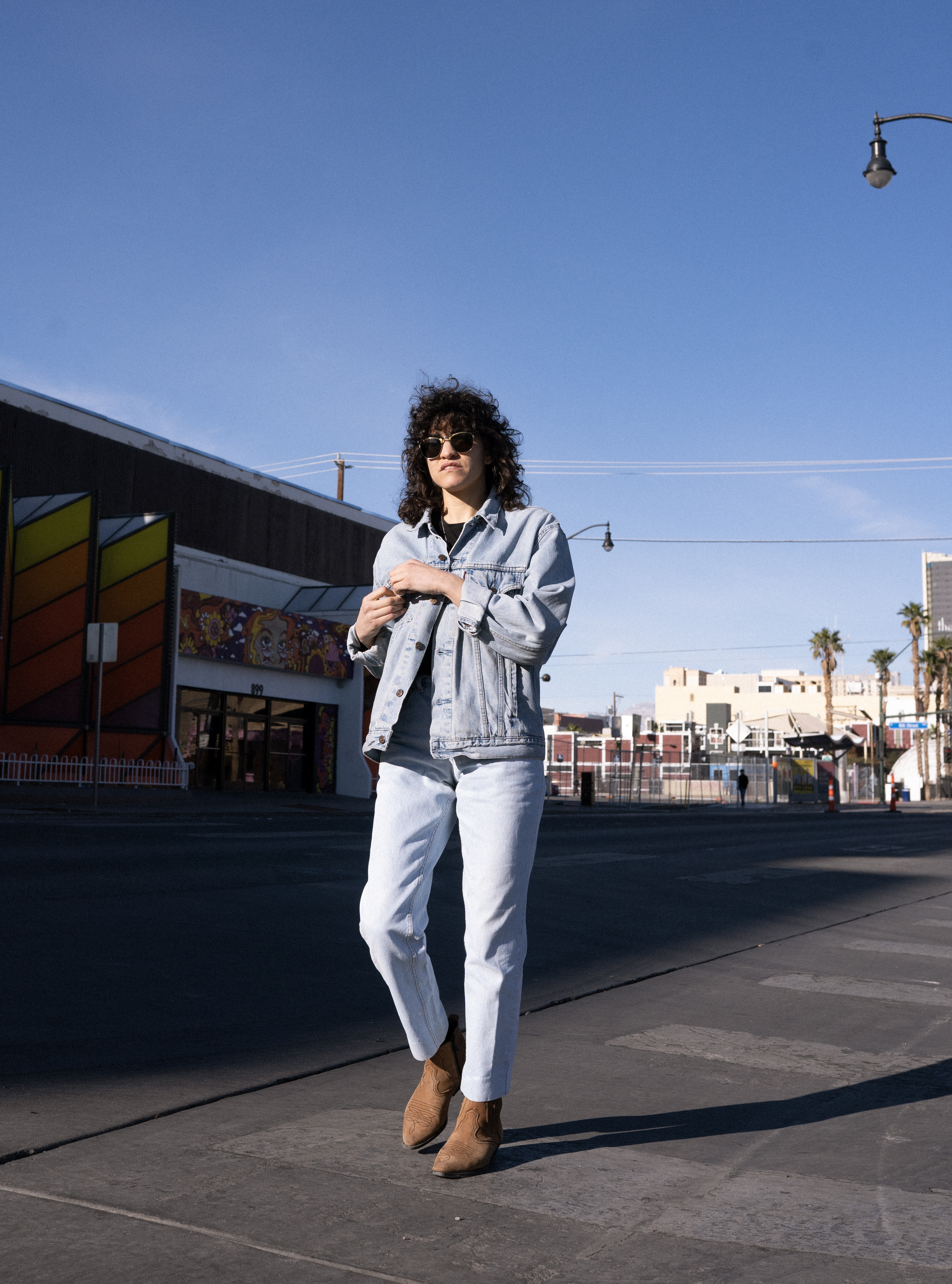
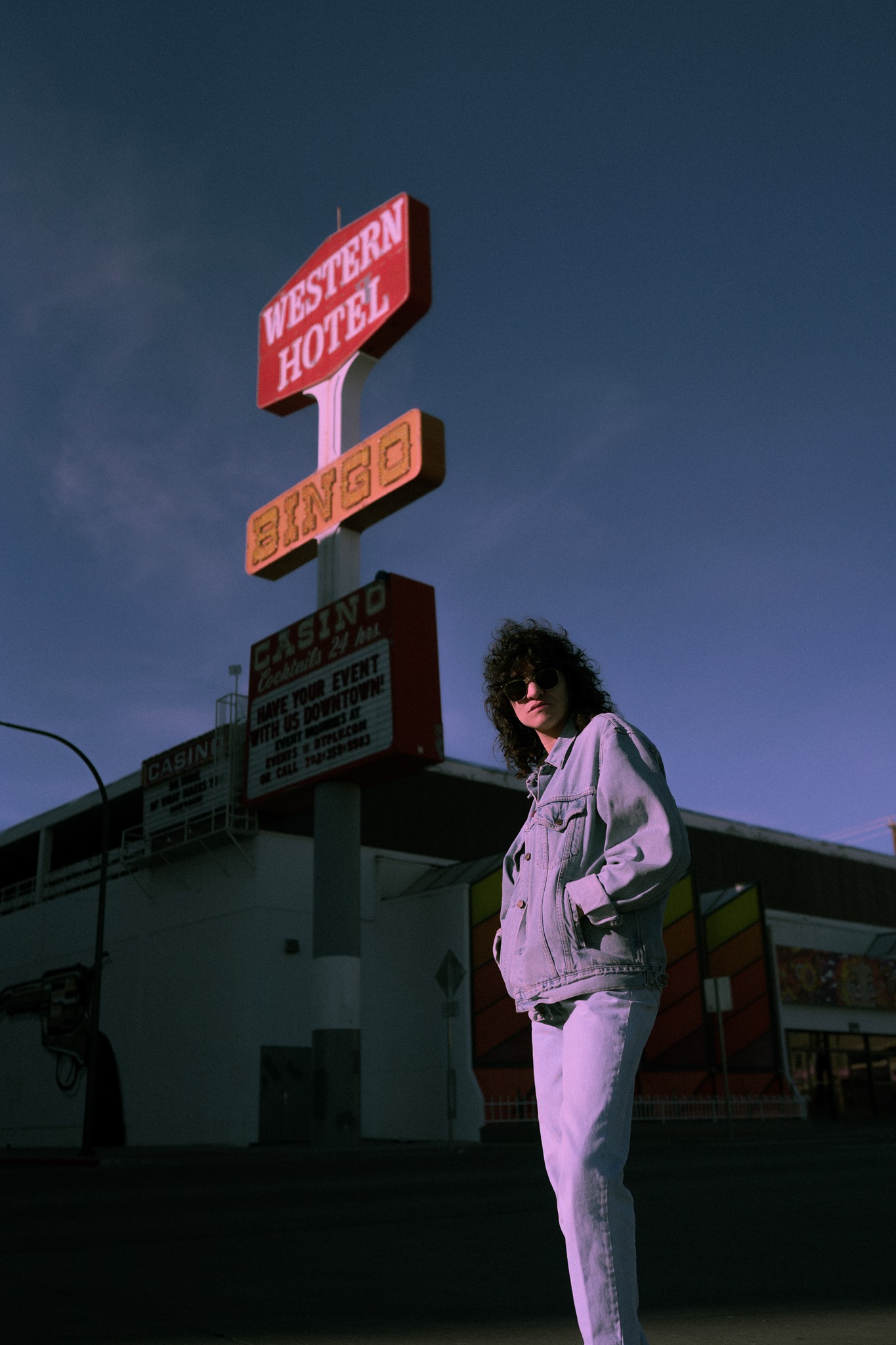
Street Life: Karima Francis, moving into a new creative period of her career through her move to America

Street Life: Karima Francis, moving into a new creative period of her career through her move to America

Do you get back to Blackpool to see family and friends from time to time?

“I do. Last time was just after Christmas, visiting my Mum and some friends, surprising a friend at a birthday party. Having a party the previous night, I had a few drinks and just booked a ticket, and it was really nice.”

Career-wise, you seemed to fly out of the traps on the back of lots of critical acclaim. Did that put pressure on, or was it all good?

“That was all amazing. I was so lucky and grateful to experience all that at such a young age. I take a lot from that. It was an amazing time for me.”

And that acclaim was from both sides of the Atlantic, it seems, following exposure at SXSW and so on. Do you feel equally at home over there in that respect?

“Yeah, the response in America is really positive, and it’s somewhere I always wanted to go with my music. Unfortunately, it didn’t happen with the first couple of albums, so it took a lot to buck up the courage to say, ‘Do you know what, I’m just gonna do this’.

“It was always my dream to tour the States, and I’m a massive fan of KEXP and the radio presenters there, listening to that station every day. This is no offence to British music – I love that too – but it’s just something that gets me in my soul. A lot of bands coming out of America, like War on Drugs, have completely blown my mind and inspired me so much. And I just want to go and play Philadelphia and all these tiny states. That’s the dream.”

Do you feel The Remedy and Black got enough traction, regarding radio airplay and so on? Tracks like ‘Wherever I Go’ deserved to be hits.

“I know! It was a strange one. The label didn’t think the numbers were as high as they were expecting, so the album was kind of dropped.”

Between Shots: Karima Francis on location for the promo video of new single ‘Orange Rose’, enjoying the sunshine

I guess you were a victim of changing times and the way labels were heading, caught up in the machinery.

“Totally! The industry I went into back then was so different to the industry now. I just wish … if I was doing it now, I’d have chosen to be solely independent and take a totally different direction. But I was young and believed in everything and was just so excited, going along for the ride.

“You’re always going to look back and wish you’d done something different. That’s my journey and it’s taken me until now to understand really what I want. You have to go on that self-exploration to reap the benefits, I guess.”

Do you feel you’ve learned a lot along the way from some of the artists you’ve been lucky enough to feature alongside or support? You’ve played with some big names over the years.

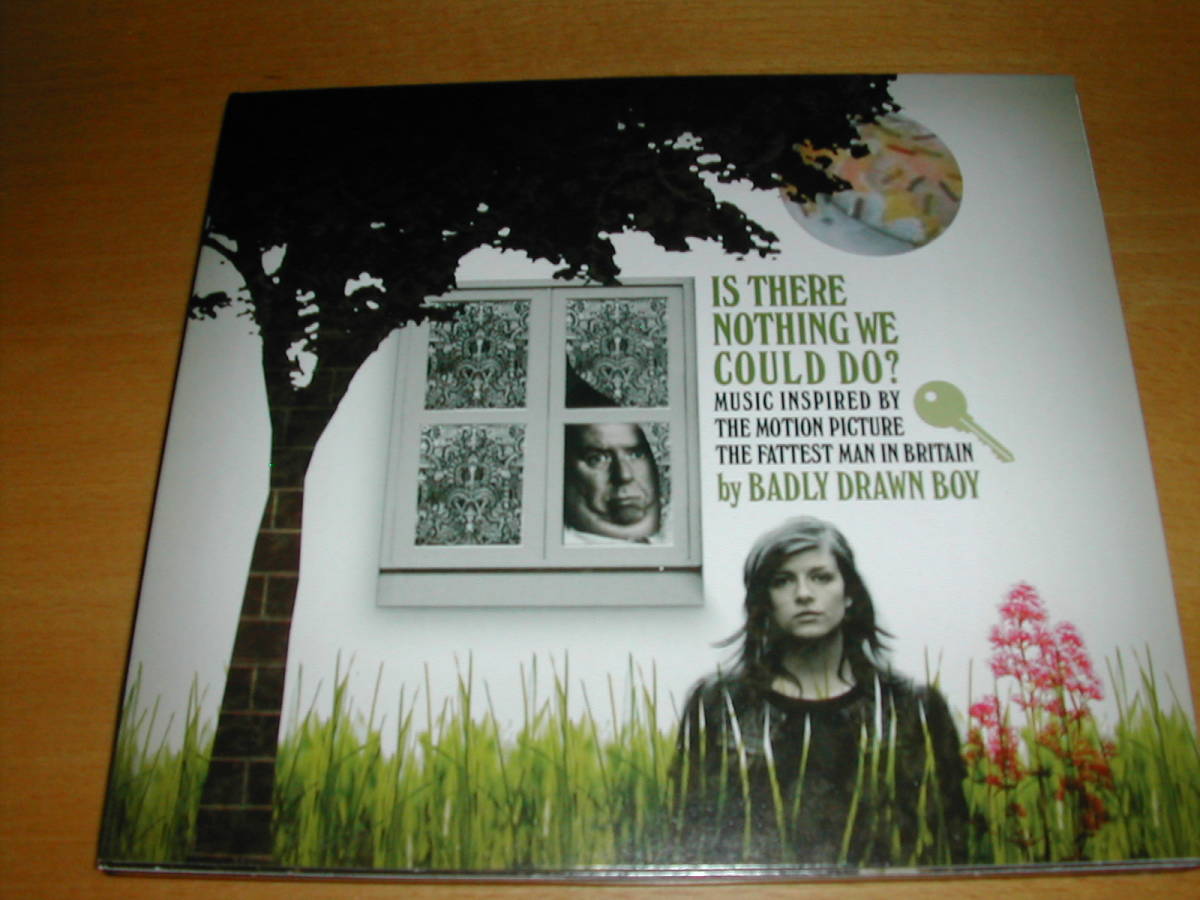
“Yeah, definitely, and I think the most influential people were Flood, the record producer, and Ken Nelson (Gomez, Badly Drawn Boy, Coldplay, Feeder, Paolo Nutini). I learned a lot from them in the studio.”

And when the lockdown’s over and you can go back to doing all the things you’ve truly craved these past few weeks, what will you do first?

“The first thing I’m going to do is – probably like the rest of us – go and see my family. But I’d really like to go to a park and meet with all my friends, have a few drinks, just socialise. That would be the best thing!”

Still Life: Karima Francis, ready to carry on exactly where she left off when the coronavirus is finally done and dusted

For more information about Karima Francis, head to her website. You can also keep in touch via Facebook, Instagram and Twitter.


Posted in Books Films, TV & Radio, Music | Tagged , , , , , , , , , , , , , , , , , , | Leave a comment

Return to Orkney – back in touch with Erland Cooper

We’ll have to wait a while before we see acclaimed Scottish singer-songwriter, composer and multi-instrumentalist Erland Cooper and his ensemble live again, but can at least transport ourselves to his spiritual neck of the woods in our imaginations through latest long-playing record, Hether Blether.

Featuring poetry by John Burnside, written after a trip to Orkney with the man himself (as documented on BBC Radio 4’s Wild Music), spoken word from the award-winning Kathryn Joseph, and ambient tape and modular synth work from Hiroshi Ebina, the final part of Erland’s Orkney trilogy follows on where the wondrous Solan Goose (2018) and Sule Skerry (2019) left off.

And this time, we move on from songs inspired by the archipelago’s birdlife and surrounding waters, our guide looking to the land and its people, the LP title name-checking a hidden island in folklore, said to rise green and fertile from time to time from the foam. Inspired in essence by Orcadian poet George Mackay Brown, filmmaker Margaret Tait and composer Peter Maxwell Davies, it’s described as a celebration of memories held in timeless landscape, community, myth and mythology, weaving in elements of its predecessors, bringing them together in a full circle around the cycles of the changing seasons.

Throughout the triptych, Erland explores a restorative path in the rhythm and poetry of the everyday, deep within a land and community at the edge of the world, and on Hether Blether, as before, song titles are taken from local dialect and acknowledge the places and stories of the island.

We’re soon in its spell, opening track ‘Noup Head’ introducing us to the title track’s hidden island via a young girl that goes missing one day, her family finding her in a storm – on an island emerging from the fog – grown up, with children of her own. The girl reappears, ‘as memories do’, as the album ebbs and flows, first in the swell of the Arco string quartet on ‘Rousay’, named after the island where she was born; then on the atmospheric ‘Longhope’, where we discover ‘The echo of a child, suspended in a web of kelp and feathers, a long-lost sister waiting for the tide to guide her home’.

I was hooked after barely a couple of listens, captivated as soon as we reached the mournful yet uplifting fourth track ‘Skreevar’, a moment of pure beauty totally in keeping with the finest moments of the first two records. And Erland’s voice comes through more (‘a point of strength and vulnerability’) on this final part of the trilogy, first on mesmeric third track, ‘Peedie Breeks’ (which translates as ‘children’).

Where Solan Goose didn’t feature his vocals at all, and Sule Skerry only featured his vocals briefly, this time his vocals are given room to breathe, inviting us down new paths of discovery and exploration. We also hear him – after the colourful, stirring ‘Linga Holm’ takes us further on from ‘Longhope’ – on the slow-building ‘Hildaland’, where we discover inhabitants that were said to retreat to a secret undersea kingdom every winter, ‘just as our guide retreated from the real world through the soft waves of his music’.

And there he is again on the beautiful title track, ‘Hether Blether’, reflecting on times past, whether he’s back to his subject matter or reminiscing about loved ones, familiar landscapes, cherished memories or all of those, confiding how ‘You gave me all the best days of my life; Even though I didn’t know it then; But I know now’.

Then, beyond the similarly-evocative ‘Hamnavoe’, we end with Erland delivering a lyric borrowed from celebrated film composer Clint Mansell, ‘Where I Am Is Here’ exploring time and memory, its repeated phrase ‘Love now more than ever’ sounding like an urgent demand for our times, described as ‘a natural end-point for a project that began with one man needing to retreat from the chaos of everyday life, to return to where he came from, taking all of us with him, to the very roots of ourselves’.

Closing line, ‘Time will show you how’ certainly resonates, reminding us how past and present always connect in our lives, bringing our experiences full circle. Yet Erland stresses this is far from the end of the story, saying of Orkney, ‘I’m only just coming to terms with where it’s taken me – from a place of necessary escape, to a very different world’. And when I called him, I enquired first where he was answering his phone, wondering if he’d managed to spend the lockdown back in his beloved islands.

“Oh, I wish I was in Orkney. I managed to get my folks back before the ferries stopped, as they live in England sometimes. I was supposed to be there now, travelling to the island of Sule Skerry … which sounds very whimsical … travelling there this week with Amy Liptrot. Instead I’ve been burrowed – like a puffin – in my studio.”

That’s in East London, yeah?

“It is, and I suppose the life of a musician, producer, writer … whatever … involves a lot of solitude, so I’m kind of used to it. The creative side hasn’t been hindered.”

You’re back in Orkney in your imagination, no doubt, and so are we after being introduced to your records about the Magnetic North of the British Isles, capturing something of the magical spirit of those surroundings you grew up among.

“That’s a lovely thing to say, and I guess it is transportation – that’s all I’m ever trying to do.”

I used that very word when posting a clip of ‘Peedie Breeks’ this very morning. We tend to associate transportation with convicts being carted off and dumped Down Under, the dark days of Van Diemen’s Land and all that. But in this case it’s nothing but positive.

“I was talking to Rob (co-artistic director Robert Ames) at the London Contemporary Orchestra, and the thing we both had in common when we first spoke – and working with the LCO is a big privilege for me, although obviously the mid-June show we were going to be doing at the Barbican is not happening yet – and what really resonated was that idea of being transported to a place for an hour or two, whether it’s in a concert hall or on a record. We both share that idea.”

At this stage, Erland’s kettle boiled, so he breaks briefly off to do the most important prep work needed for our interview, while I ask if he has everything he needs at his home studio (including biscuits, of course) to see him through this COVID-19 lockdown, not least in terms of recording and instruments.

“Yeah – I’ve got all my Moogs! It’s a real haven here, I call it my sea haven, and it’s exactly that. I spend hours, days, months in here.”

Before I know it, Erland’s turned the mic. on me, so to speak, asking how my lockdown’s going, how my eldest daughter – who he met at his Band on the Wall show in Manchester’s Northern Quarter last November – was doing, and what I miss most right now, confessing that he always tends to end up interviewing his interviewers.

In response to his enquiry I tell him the value of family and close friends and places I love has truly sunk in, with an increased desire to see those people and locations again as soon as it’s safe to do so.

That’s something that appeals to Erland too, but for now it seems he’s happy with his lot most of the time.

“I call it the magic of the everyday, and that can even be enjoying the process of making your coffee … even though that sounds insane. I’m delighted that every day I get messages from folks asking if I’ve noticed the bird song. I get sent a lot of that, and love that, and just noticing those smaller details is one thing I think everybody’s enjoying.”

I can’t fully work out if that’s just down to us listening that little bit harder, or the fact that we’re not about so much is making those birds sing louder and be more open around us.

“Noise pollution is a big factor in terms of the fact you can hear further in the distance, but also they’re wondering why we’re inside and enjoying it all.”

It’s all a bit odd, isn’t it, and I can’t believe it’s only five months since I saw you in your ‘mad sea captain’ guise, guiding us across choppy seas to Orkney with your ensemble at the Band on the Wall on a truly memorable night.

“Ha! Er, wait … what? Mad sea captain?”

That’s the expression I used in my review, with you there at the helm, the electronic equipment shaking and band members busy at their work, as if we were being picked up on the quayside at Scrabster, taken aboard and off on a journey to your beloved archipelago.

“I love it. I’ll take that. I like mad sea captain. That feels good, because the rest of the crew don’t know whether to trust the captain or not.”

There were elements of that. They clearly knew what they were about, but you seemed somewhat fussy around them, making sure they were doing what you wanted from them, as if you were altering your route every few nautical miles, cables or fathoms, twiddling knobs on stage as if to let them know, ‘This is how we do it’. You weren’t patronising their abilities, just eager to express your own inner vision.

“Ha! Good, because it’s not a lack of confidence. If anything, it’s taking you out of that feeling of knowing what you’re doing. Does that make sense? It’s not about going through the mechanics and the routine. I wanted everyone to get a sense that, ‘He might just change this!’ What that means is that you all enjoy it as if it’s your last performance of your life. And whether that’s good or bad or the reaction is good or bad, there’s a feeling of uncertainty but also absolute trust in each other.

“That’s the thing when you’ve got an ensemble of folk, and to me that’s such a joy. I trust them all implicitly, and know that if I throw something on the stage – not physically, but metaphorically – they’ll react to it, even just as simple as me walking off stage, going to the back and watching, with them thinking, ‘My God, what’s he doing?’”

One moment that fell into that category was when you had the houselights turned down and sound-deck consoles briefly turned off to re-enact a spell-binding Orcadian sunrise, mid-song.

“Kind of simple pyrotechnics. You see, I’d rather pay for musicians than all the glitz and glam. I always make sure everyone’s adaptive, and we had to come up with some creative way … it’s more like theatre, isn’t it?”

Do you think there’s a good chance of this new album tour going ahead this autumn? I’m hoping to see you on the first night (Thursday, September 24th) at Halle St Peter’s, Manchester, but I’m guessing the dates you’ve announced are all just pencilled in for now, depending where we go next with this virus.

“I think the reality is that nobody knows the shape if it – whether people will sit six metres apart, all these things. But I felt this determination to make sure we released the record as planned, the messages I get from folk inspiring me to carry on. Playing live is a rare bird for me anyway. That side of things will either happen or not. And if it doesn’t, we’ll find a way to do something else or do it another time. It’s more important that people are healthy and safe.”

In the meantime, we have the final part of your Orkney triptych to savour. I’m only a few listens in, but I was very quickly hooked, already instinctively knowing I’ll love it as much as the first two parts. And your vocal is more prominent this time, something you’ve built up album by album.

“I’m glad you’ve noticed. Narrative is really important to me in everything I do creatively, whether it’s guiding me or shaping what I’m doing. And each of those voices tells a story of what’s happening. You don’t need to know that story, but to me I almost don’t hear me singing.

“For example, with ‘Peedie Breeks’ I wrote that with King Creosote in my head. I went to ask him about it, but it was too late. So I left my vocal on, played it to a few folk, and got people saying, ‘You should leave it like that’. Even though I know I recorded it with a couple of drams of whisky in me, it was late, and it’s not really singing. I tried to sing it, and it was crap, so I just left the original vocal on.

“Each of the voices I kind of feel are people within this mythical island, part of the stories. The first record was about air, the second sea, and this one land, but it’s about more – it’s about community and it’s about people. So what better way than to have the voice tell that story?”

Strangely enough, getting back to your original idea for ‘Peedie Breeks,’ the last live show I caught before the lockdown, at Manchester’s Bridgewater Hall, involved King Creosote and his band scoring the wondrous From Scotland with Love film, taking my youngest daughter, experiencing more or less socially-distanced circumstances, seeing as barely a third of those that bought tickets turned up, restrictions about to kick in.

“Ah, you’re kidding! And it’s interesting you remember that fondly as ‘the last show’. It’s a surreal thing to say. Actually, I asked KT Tunstall, as I figured she knew Kenny (Anderson, aka King Creosote), but the email went to junk. I only found out recently that he’d replied … and it was too late by then.”

Well, much as I like the original concept, the track as it is proves pretty much perfect, and you’ll have to bear with me on this, but the first thing I wrote on an early listen was ‘Echo and the Bunnymen’ …

“Oh, that’s a nice thought!”

But there was also something else I couldn’t place, realising after much brain-mashing it was arguably reminiscent of Peter, Paul and Mary’s ‘Leaving on a Jet Plane’. Not convinced though, I played it to my better half, expecting her to say U2 or just agree, but she mentioned Cliff Richard’s ‘In the Country’. And I get that too.

“Ah, Jeez! Wow! That’s something I didn’t expect, but I love it all the same. It’s probably something the wonky sounds of Benge’s analogue synth and my slightly drunken voice trying to do King Creosote has!

“I don’t think I’ll ever forget that. And as you know, I wrote Solan Goose (the first album of the trilogy) as a tool, and these subsequent records are tools in themselves, finishing this record in around November then sitting on it. But now it’s out there in your world, it lives its own life.”

Well, I’m loving it, and was gone by the time we reached ‘Skreevar’ and ‘Longhope’, both clearly proof that we’re continuing on that same epic journey into the imagination we set out on for the first two records, part of the same set but pushing on into different areas.

“I’m glad you feel that way, and hope it feels like full circle to you. I tried to borrow all the elements. A keen ear will not only hear similar key signatures but repeated motifs from the first album.”

Agreed, and there’s also a point on ‘Hildaland’ where I was taken back …

“D’you know, sorry to interrupt, but its great hearing you say the titles. I get a real kick out of that. These are almost lost words. Hildaland – just listen to that word!”

Absolutely. It takes me back, musically, to childhood holidays on long sandy expanses of St Ives Bay, or maybe South Devon or the Isle of Wight. The way you add what you primarily saw as more of a guide vocal, that’s me back then, writing lots of fantastic songs at the water’s edge. The difference is that mine were very quickly lost in time, probably by the time I got back up the beach, whereas you’ve recorded yours, turned those initial melodies and ideas into songs of wonder, a master musician with the means, vision and determination to get them down on tape and truly realised.

“Jack of all trades, master of none! I just try and work hard, and among my peers and colleagues I feel like an under-dog … constantly. I just try and do as much as I can in the short time I have.”

Typical understatement, but I let it go, instead asking Erland about the title track, ‘Hether Blether’. I know the official explanation but get the feeling it’s also your tribute to past and present loves, or a sense of belonging to the place you love. Or all of those.

“Erm … yeah, it’s complex, but it’s also not difficult at all, telling the story of the myth itself. It’s both of those things as well though. I was curious as to how that would be read. For all intents and purposes, it sounds like I’m singing about a person, but really I’m singing about Orkney, about a home, about a memory and a place and how a place can be almost human-like. Does that make sense?”

Definitely. That’s what I get from it.

“Equally it could be about various people in my life. But it’s an interesting myth, a story about how to deal with grief. What a lovely thought – a grieving family over decades are still grieving, and so over those painful years create a story that a person’s probably happy somewhere. Madeleine McCann’s quite a good comparison. We like to think hopefully to deal with grief sometimes. If you don’t get closure, you make up a story. And I like to think that’s where that myth has come from, maybe on a small island.”

In the song’s delivery, I think there’s something of the spirit of Bryan Ferry too. I’d be interested to hear him cover that.

“Ha! People keep asking me to do remixes of their music. I did that Nightflight EP as an experiment, and a lot of my inbox now reflects that. It’s interesting, although I haven’t replied to half of them.”

Talking of collaborations and suchlike, having featured on the last one, are you on the soon to be released new Paul Weller LP?

“I’m not, but I feature in spirit. I got to listen to a bunch of tracks and funnily enough was messaging him as you were calling. He’s so great – he’s already thinking about the record after the one he’s putting out now!”

I heard the single, ‘Village’ for the first time today, and was saying on Facebook, there’s not much we can be sure of right now, but a new Weller LP comes into that category. I reckon I’d say the same about your records too.

“Ah, that’s kind, and I’d tell you to look out for the string arrangements on Weller’s new record, done by Hannah.”

That’s Hannah Peel, who has worked with Erland on several projects, notably joining forces with Simon Tong for two albums and tie-in-shows as The Magnetic North, that project title itself a nod to Erland’s Orkney roots.

“She collaborated again with him, quite extensively, so keep a keen ear out for them. Yes, the very talented Miss Peel!”

At this point the cadence of his voice is followed by a quick burst of electric piano, and I ask if that’s his equivalent of the old ‘b’dum-t’sh’ response from drummers to corny jokes.

“Yeah, when I walk around and a good line comes out, that just happens! This wee guy on piano just comes in with this melancholic minor chord!”

I thought that might be the case. Meanwhile, when I should have been working on questions this morning and several other things I should be doing, instead I mapped out a route to Orkney, and internet tools suggests I’m eight hours off by road to Scrabster. And I guess I’d be happy to wait a bit at the harbourside for a connecting ferry from there.

“Really? Well, maybe you should explore that, post-lockdown, that bit of the UK, going off that way. Go for it!”

That’s another thing I’ve missed – travel and seeking out new places to explore. And I think in that instance, if travelling by road between my patch and Orkney, it’d be rude not to drop by to visit Edwyn Collins in Helmsdale en route.

“Ah, he’s a keen birder is Edwyn. I’m a big fan of his work, going back to Orange Juice. I know his music intimately, but I’ve not met.”

Well, I think you should. That’d be something down the line for us all to savour, the two of you working together.

“That’s a nice thought.”

I was running out of time by this point but asked him next about working with poet John Burnside on this record.

“Ah! John was an absolute joy, and I was gobsmacked not just to have him write words for me – it felt like a true collaboration. We travelled around Orkney together in gale-force, horrific, nasty wind and rain that comes from the ground. We retired for the evening with a tea and got under the fingernails of our stories to each other, then went our separate ways. Then these words came into my inbox in floods!

“He’s a very prolific writer anyway, and we were there to do a Radio 4 programme, but I felt it important not to say we’d be collaborating on the new record as well. It made for a more natural way of collaborating – all the dots joined.

“Normally, Will Burns would do the poetry on the records, and I asked, but he was doing the record I helped put together with him and Hannah (Peel), Chalk Hill Blues. He was off touring for the first time – a poet on tour, he had no idea what was to come! – so instead I got John, which was an incredible honour.

“When you listen to music, new things present themselves in the layers within the piece, and his words are doing the same – I hear them in a different way. I was also fortunate enough to get Kathryn (Joseph) to read them. And hearing them read is another thing – such a joy.”

How about that wonderful voice on the record – is that Kalliopi Mitropoulou, who was with you for the live shows late last year, or Lottie Greenhow, who featured on the previous records?

“It was really important that the voice of Solan Goose threads all the way through, and that was Lottie’s. She wasn’t going to do it, because she was pregnant – she’s heavily pregnant now, which is great news – but I’d built a digital version of her, creating an instrument of her, told her about it, and she said that was cool but felt, ‘No, I’ll come – just tell me where and when!’ So she did, we did it in a day, had a cup of tea, and that was it. And it felt like full circle to me.

“Kalliopi is also a wonderful singer. They’re very different performers – both incredibly talented – but it felt right to have Lottie finish the record.”

First Footing: The Magnetic North’s debut album, from 2012

I recall you saying this Orkney trilogy was something you never planned to fly with publicly. Are you glad you did? I hope it’s not spoiled it for you, having to share your personal project with the wider world.

“Quite the opposite. It’s opened up a world of joy and opportunity and hope, and connections with people like yourself and other folk that connect with something I never thought possible. Actually, I’d go as far as say it’s changed my musical career in a way I simply didn’t expect.

“I’m able to work and collaborate with incredibly-talented folk and nothing excites me more than scribbling these notes down, giving them to someone in a studio, them making your work sound so much better.

“Collaborating isn’t just being sat in a room together. To me, it’s that last 20 per cent, so everything I do I leave 20 per cent open for a bit of magic to walk in the door. That comes through learning from people I admire and working with people I admire, and it’s changed my career, opening up a whole world of exploration. I was just recording clarinet remotely yesterday for this new piece, and what a joy – I’d never written for a clarinet!”

As we mentioned Hannah Peel, how about your fellow Magnetic North (and also Erland and the Carnival) collaborator, Simon Tong – are you still in regular touch?

“I texted him yesterday. Sadly he recently lost a close friend, Tony Allen …”

I was about to mention Tony, who as well as his many other acclaimed projects, such as his work with Fela Kuti and Afrobeat, worked alongside Simon, Damon Albarn and Paul Simonon with The Good, The Bad and The Queen. A sad loss.

“Yeah, and it’s been on my mind post-lockdown to get back together and catch up with Simon. We’ve all been so busy. I’m really looking forward to that. I miss him greatly.”

And now we’ve reached part three of your Orkney project, we also need part three of the Magnetic North trilogy, surely.

“It feels like a trilogy needs to be completed.”

Tidal Journey: Erland Cooper, the ‘mad sea captain’ takes overall charge on last year’s Sule Skerry UK tour

Agreed, although it shouldn’t necessarily stop there. I recall, after all, that Douglas Adams presented So Long, and Thanks for all the Fish as ‘the fourth book of the Hitchhiker’s Guide to the Galaxy trilogy’.

“I like that!”

And finally, what’s the first thing you’ll do once the shutters are up, when this crisis is officially over and it’s deemed safe for you to go back to everything you’ve wanted to do during the lockdown? I’m guessing you’ll be heading North.

“You’ve got it. A ferry to the Orkneys, heading north, and going to visit the North Sea.”

To revisit this website’s previous interview with Erland Cooper, from November 2019, head here. And for the WriteWyattUK verdict on Erland and his ensemble at Band on the Wall in Manchester in late 2019, head here.
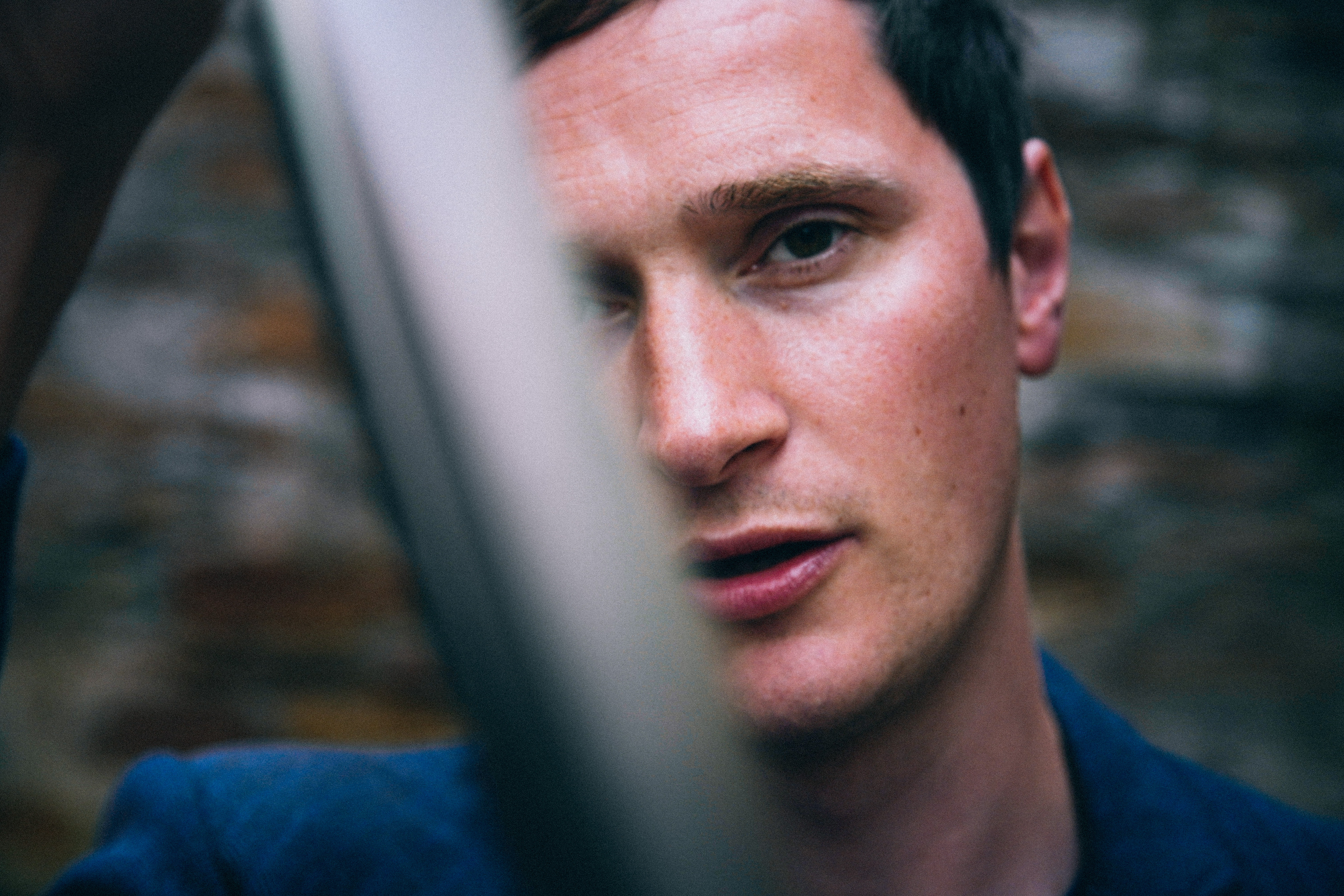
You can also find this website’s review of The Magnetic North at Liverpool Central Library from October 2016 here, feature-interviews with Hannah Peel from November 2016 here and September 2017 here, and one with Simon Tong from April 2016 here.

For details of how to pre-order Erland Cooper’s Hether Blether, released on Friday, May 29th, and his scheduled tour dates, pencilled in for autumn, head to his website  and keep in touch via Facebook, Instagram and Twitter.

Posted in Books Films, TV & Radio, Music | Tagged , , , , , , , , , , , , , , , , , , , , , , | 4 Comments

Exploring Badly Drawn Boy’s Pocket Guide To A Midlife Crisis – back in touch with Damon Gough

Boy Wonder: Damon Gough mentally prepares for his latest conversation with the fella behind the WriteWyattUK site.

It was almost six years since I’d last spoken to Damon Gough, and a lot had happened since in his life. On that occasion I cocked up, putting the lead in the wrong jack (which sounds like some obscure late-‘80s house track), recording half an hour of me asking questions and getting inaudible replies. Thankfully, my interviewee – better known as Badly Drawn Boy – was good enough to go through it all again 12 days later. But I didn’t go into that this time. First, because I thought he was unlikely to remember, and second, because I barely got a word in for the first quarter-hour.

There’s only been one Badly Drawn Boy LP since 2010’s It’s What I’m Thinking, Pt.1 – Photographing Snowflakes, and that the soundtrack to 2012 film, Being Flynn, which I understand never got a UK release. But that tells little of the real Damon Gough story, involving brushes with alcoholism, depression, rehab and therapy, finally knocking the drinking on the head in 2016.

What he now admits was a ‘long-time personal crutch, and an artistic one’, became something habitual in a busy career pattern of recording and touring for two decades, doing most of his best work at night, suitably relaxed after a few drinks … until that method stopped working. And that’s without mentioning an inevitable relationship breakdown.

In the end he quit the booze thanks to the help of a residential facility in Kent, counselling, and the love of the new woman in his life. Meeting him at a low ebb, in time they married and, in May 2017, had a son. Meanwhile, the world was going to hell in a handcart, Damon like many of us consumed by all those social and political changes, messing up his head even more. That’s where the therapy came in, and he reckons, ‘I’ve had to grow up a lot’. And now he wants to help others, reconnect, sing, perform and engage again, his subsequent ‘Pocket Guide To A Midlife Crisis’ a key part of that, Banana Skin Shoes rightly presented as one of the most honest pop records you’ll hear this year.

As he puts it on the opening song, ‘It’s time to break free from this plaster cast and leave your past behind … It’s time to supersize your soul.’ This is Damon ‘fessing up to his fall from grace but refusing to be dragged down, that title track upbeat, defiant, inspiring, and fun, neatly setting the tone. And he reckons this is ‘the poppiest record I’ve made’ but still wants ‘to say a few things and try to subtly be a conscience for people that might think like me, whether you call it your fanbase, people who are like-minded, Remoaners or whatever…’

Not as if it all came together so quickly. Away from his personal ‘journey’ there were trips to and from studios and producers. Four years ago, he recorded six songs in eight days with producer Youth (Paul McCartney, Crowded House, The Verve) in London. Then there was year-long paternity leave. Reconvening closer to home, he worked with Seadna McPhail at Airtight Studios and Keir Stewart, ex-Durutti Column, a neighbour with a home studio (Inch Studios). Then, at Eve Studios, Stockport, along with producer Gethin Pearson (Kele Okereke, Crystal Fighters) he whittled 20 songs down to 14 that properly told a tale, helped out by Public Service Broadcasting’s Johnny Abraham (brass), Skindred’s Daniel Pugsley (bass) and Davey Newington (aka Boy Azooga), the songs and recordings swimming into focus.

As his press release puts it, ‘Over 14 songs Banana Skin Shoes is the sound of a songwriter skipping between musical idioms, and between emotional extremes, but doing so with a cool, calm confidence’. He’s clearly happy with the result, and rightly so, as suggested by the fact that this interview had been going at least 17 minutes before I managed to get in my second question. Having scribbled down two pages’ worth before calling, I ended up mentally ticking off more than I needed ask this Bedfordshire-born, Bolton-bred, Manchester-based 50-year-old, who broke through to critical acclaim in 2000 on the back of Mercury Prize-winning debut LP, The Hour of Bewilderbeast. The furthest I got was, ‘How’s the lockdown been for you so far?’.

“Erm, well I dunno. It’s a bit weird, innit? It equalises us all and some say some are more equal than others, and I get that. It depends where you are and where you live, what your outlook on life is, how your mental state is. Where we were before predetermines how we’re equipped to deal with it, I suppose.

“I’m lucky. I live in a nice place. I’ve got my wife and little boy with us. We’re in a relatively nice version of lockdown. For somebody living in a high-rise flat with three or four kids, it might be a different story. We’ve got a nice big house and gardens, and that helps. I live in a nice area, Chorlton. I haven’t gone out much. Then again, I don’t go out much anyway.

“I gave up the boozing nearly five years ago, so I’m used to isolation of a certain type.  When it’s imposed on you it’s different, I suppose, and while I can cope with this, you feel other people’s pain. As this unfolds, the things that are important ….

“I’ve got two other kids, 19 and 18. My daughter was at uni, first year at Leeds, and has had her time cut short. My son was about to do his A-levels. My newest arrival, Reuben, is nearly three, and he’s not seen his nursery pals. That’s just me, one story. People’s livelihoods have been affected as well. At the moment we’re all wondering how we’ll end up living with this virus and coping with it.

“It’s easy to point the finger at the Government. I feel sorry for them to a point. I feel they were underprepared and made some fundamental mistakes, but to keep on going on about that is futile. It should be about getting it right now. I watch all these political programmes and I’m suck of hearing people complaining about it. Let’s work together, do something now.

“A lot of the stuff on my new album reflects this – the world at large, how’s it’s operated these last few years and how that frustrated me.  Now we’ve got this virus it’s perspective on other things, and you couldn’t have written that better, after three years bickering about Brexit and the time wasted doing that, with other issues overlooked because of it.

“I finished this album last November and it was made from that period of the referendum in 2016. I started recording in 2017, took a little break when my boy was due and once he came, after just a few weeks in the studio. There were a few false starts, but I resumed in 2018 around the corner with a friend, Keir Stewart, who’s got a studio in his house.

“Then last year I got Gethin Pearson to help finish it. So that three-year period seems like a moment in time, and this album for me in time will define a period in my life. I couldn’t have made this record any other time. I tried my best to reflect personal struggles I’ve come through.

“It’s a personal triumph to make this album, having gone through lots of knockbacks and the break-up of a major relationship with the mother of my two elder children, breaking up after 14 years. That was largely down to my drinking really, and not coping with all this. I was so busy for 12 years, from the first album in 2000, touring the world and what-not. I became a habitual boozer because of it and the break-up fuelled that further.

Gough Revival: Damon Gough, aka Badly Drawn Boy, back with a great new LP, his first non-soundtrack in 10 years.

“There’s a song on the album, ‘I Just Wanna Wish You Happiness’, about maintaining dignity throughout that, and managing to do that was a triumph, coming through that then meeting Lianne, my wife now, having met only a few months after the break-up.

“I was hardly looking for another relationship. I honestly wasn’t. But she helped me get through those first few years. I carried on partying, having a good time, the kids living with their Mum around the corner. We kept it all dignified, and me giving up the booze helped enormously. I’m more present in everyone’s lives now, and after I’d given up the booze I thought it was time I made another album.

“Time’s taken care of itself these last seven years, and it doesn’t feel to me like I’ve been away as long as I have, because of all these events. It was more or less my 40s – a lost decade in terms of being a recording artist. If I could turn back time and change that, I would, but because of all these things I’ve come up with a positive set of songs. I’ve had some tough times, but I’ve come back stronger. And I still believe there’s hope for me and there’s hope for everyone.”

It comes over as very reflective, and perhaps your most personal album yet.

“Yeah, they’re all kind of personal, but I feel I’ve learned lots of big life lessons, and if you’re going to bounce back from something like that … I feel I’m a better new version of me through the resilience I’ve had to show to come back. I wanted to articulate that in an album to help other people. Everyone’s got struggles of one kind or another. As life goes on, you’re lucky if you don’t encounter hardship. You learn so much more than if life was a breeze. If you come through that, you appreciate life more.

“This coronavirus is a great example. Hopefully we’re all in a better place, and the one thing everyone can do is appreciate life more. We’ve had a lucky escape if we get through this okay. And I’ve been through that on a personal level, on the brink with drink. I had to give up, and Leanne helped with her support and strength.”

And why call this Banana Skin Shoes?

“I wanted it to be a comedy title and a comedy take on a serious matter – taking ownership of your own mistakes. I’ve done everything I can to not come across as feeling sorry for myself. I’ve had health issues as well – I’ve had Crohn’s disease, diabetes, a hip replacement two years ago because of complications with Crohn’s and the medication I was on, steroids. But even when I was diagnosed with Crohn’s, I wasn’t bothered. My younger sister’s had it all her life, and as a teenager she nearly died through operations.

“When I was diagnosed I was almost jubilant, in solidarity with my sister, who’s lived with it for 30 years. She’s ok, and it’s made her a very spiritual person. I felt the least I could do was not let this bother me. It set her back at the time, missing a year of schooling, her grades suffering, so it didn’t phase me.

“Similarly, with diabetes – the discipline I gained from giving up boozing was just the beginning. Once I’d cracked that and regained some self-pride – feeling worthy again of people’s love, especially my kids – I was back to a better me, and that gave me strength and discipline. I thought about losing weight, lost nearly three stone, and that reversed my diabetes. I’ve also been doing some therapy over the last 12 months – more like life coaching, and that’s been amazing, sort of helping me manage my mind a bit.

“Depression and that is common with artists and with boozing, and again it’s something I’d love to help others with. Think more from your core self than from your brain, which gets cluttered with all the information the world throws at you. No wonder there’s so many people struggling at the minute. And on this album the messages are all kind of loosely based around reconnecting with who you are, ‘supersizing your soul’ as I say on the title track.

“You’re only useful to others when you’re in a position of strength yourself, and ‘I Need Someone to Trust’ is a spiritual song about that. ‘I lost control, a part of my soul, bring it back, make it whole’. Coming back from the brink of disaster, finding strength then being able to help others – ‘Where the river bends, you bounce, fall in, and if this should happen, keep a grip of my hand’. I’m offering some kind of guidance. Some is metaphorical, some is true. You immortalise these things when you put them in a song, making something bigger than it actually is.

“The gesture in real life only needs to be small, and doing lots of small things can contribute good things to the world. That’s what I’m trying to do with this record – adding something good to the mix rather than something meaningless.”

I was going to pick up on one of those songs mentioned. ‘I Just Wanna Wish You Happiness’ seems to be the antithesis of Elvis Costello’s ‘I Hope you’re Happy Now’. I feel you might have written a similarly angry song if you’d voiced those emotions straight away. Instead, we have more measured, reflective thinking further down the road.

“That’s a good point actually, and a really good analogy, but the sentiment of the song was there really soon. I wrote the skeleton of that song just a few months after the break-up, although I didn’t finish it until more recently. I knew that was the sentiment I wanted to carry through. Even though I didn’t orchestrate the break-up – Clare was ditching me, as it were – I still knew in my heart of hearts it was largely my fault. I felt a duty to pay respect, and the opportunity was there to do that.

“I couldn’t think of another song where somebody had said that in so many words. There have been some classic break-up songs. You’ve just mentioned one, and Dylan’s Blood on the Tracks was like a whole album’s worth. There’s another song on this album, and while I didn’t want to write more than one as I didn’t want this to be a break-up album, the other song touching on that is ‘Funny Time of Year’. The reason I kept that was because it tells the story from the point of view of the person doing the dumping, and the person having to make that choice. My ex-partner had to make that difficult choice, and that’s my take on trying to understand her and how that‘s not easy either.

“It’s hard being at the receiving end of being ditched, but just as hard in certain circumstances being the one making that hard decision. It was the day after my daughter’s birthday in December when I was asked to leave, and there’s never a good time of year. When you lose someone at a certain time of year, it’s always going to be a bad time. A ‘Funny Time of Year’ is basically any time of year it happens really.”

For me, songs like that, ‘I’m Not Sure What it Is’ and ‘You and Me Against the World are more noticeably Badly Drawn Boy of old. Deceptively simple, effective songwriting. And I could hear Glenn Tilbrook delivering ‘I’m Not Sure What it Is’ – something Damon sees as ’a milestone song for me, like ‘Once Around The Block’’ – with Squeeze. What’s more, I could also see him sending it to … erm, Michael Buble, his subsequent cover potentially setting Chorlton’s finest up for another year or two, financially.

“Ha! Well, daft as that sounds, I really like the idea. You’re bang on. It’s definitely a nod to what people know from me, stylistically, and in my head, I was trying to do Georgie Fame meets Frank Zappa. ‘I’m tired of climbing ladders’’. A jazzy big band number. ‘I know what I want when I see what it is’. That’s where Michael Buble works as a suggestion, weirdly.”

Maybe you could get your people to talk to his people.

“Well, it’s a great idea. I’m flattered by that, while years ago I may have put the phone down on you! Being older and wiser you realise the value. I’m not as competitive as I used to be. I appreciate other people’s abilities are different to mine. There’s room for everybody. So I’ll take that as a compliment, and I always find it fascinating what other people see in the potential of a song. Cover versions are an amazing thing in themselves. Remixes aren’t as much a thing as they used to be, but a good remix would enhance your own vision of what a song is capable of.

“The most obvious cover version that springs to mind for me when I’m trying to explain it to people who maybe don’t get music in a certain way and how a song can manifest itself in so many different ways is Joe Cocker’s version of ‘With a Little Help From My Friends’. His is probably the definitive version, even though the original is brilliant. It makes the original better. And more likeable. That’s what a good cover does. Like Hendrix doing ‘All Along the Watchtower’. That makes the original feel more powerful, show in the strength of the song.”

You could turn that concept on its head too. Imagine if Joe Cocker’s version was the original, subsequently covered by The Beatles.

“That’s a strange thought. That would seem even more improbable. You’d think, ‘How did they get that version out of his?’. Wow!”

Talking of songs taken into unexpected areas, the title track, ‘Banana Skin Shoes’ kind of reminds me of Kirsty MacColl and Johnny Marr on ‘Walking Down Madison’, as does ‘Tony Wilson Said’. There’s a fusion of styles there, and it might not be what people expect from you.

“Again, that’s a nice point. I love the reference, and Johnny Marr was working with Billy Bragg around them, working on his version of ‘Walk Away Renee’, the version I learned to play guitar from. ‘Walking Down Madison’ is a song I’d forgotten about. As an artist I’ve a lot of things that inspire – lots of soul music, dance music, hip-hop even. And with ‘Banana Skin Shoes’ and ‘Tony Wilson Said’, particularly the latter, it needed to be a joyous song.

“It’s one of those songs I’d have never thought I’d write. It just came to me while I was sat at the piano, humming a melody when those words came into my head. I kind of laughed, went outside, had a coffee and a fag – I don’t smoke anymore, I’m just vaping now – but reflected on it, and it took a bit of courage to pursue that song in the studio, with a few attempts, jamming it out. It eventually became a dancey, upbeat, kind of song reflecting that Manchester scene.”

Woodland Vibe: Badly Drawn Boy at 2013’s Festival No.6. But no outside or inside shows this summer as it stands.

Talking elsewhere about his Tony Wilson tribute, Damon revealed, ‘When we emerged in the ’90s – people like me, Andy Votel, Doves, Elbow – there was a thriving scene in Manchester largely because people like Tony had kept things going through pretty hard times.’ And there’s arguably an underlying Happy Mondays feel to the result, I suggested.

“I had The Beastie Boys in my head for some reason as well. None of that came to the fore but there was the essence of some spirit of what hip-hop’s about, as well as The Clash meets Motown. That line, ‘You symbolise and crystalise freedom’, is more like a Mick Jones melody. Big Audio Dynamite rather than pure Clash. But there’s something of that spirit in there. And it’s a Joe Strummer thing to do – championing a guy that meant something to you, like Tony Wilson.”

Now you mention it, I hear something of later Joe, on a track like ‘Bhindi Bhagee’ on splendid 2001 Mescaleros LP Global a Go-Go.

“Yeah, the fascinating thing about The Clash was that crossover of styles for what was in essence an angry punk band to begin with, with soul music creeping in, and reggae, and a fusion of influences, that Clash of styles. And Joe’s sensibility of spirituality and stuff …

“I was fortunate enough to get to know Joe well. I’ve been so fortunate in my career to meet people, and Joe was probably one of those at the top of the list. We hung out a few times, I met him at the Q magazine awards in 2000. I’d already won the Mercury Prize, was getting a handful of other accolades, and was up for best solo artist, while Joe … his acceptance speech humbled me. It was my first record and I’d won all that, then Joe walked on stage to accept his and said it was his first-ever prize, and was so honoured. I thought, ‘Wow!’

“Then we were stood waiting to get our photographs taken, and Joe tapped me on the shoulder, said, ‘Thank God someone in our country is making great music again. I thought he was talking to someone else, but he gave a hug. That was a shock, something I didn’t expect. I felt honoured but also there was this thing that Joe had done so much yet he was just getting his first award, while I was getting awards on my first outing. It made me realise how fortunate I’d been, and we stayed in touch.

“We ended up doing a few festivals where he’d be watching me from the side of the stage. When he died, I was involved in a few gigs with Mick jones and Billy Bragg, at Glastonbury and at Strummerville, and planted trees in Joe’s name, so that connection was always there.”

A creative purple patch followed, The Hour of Bewilderbeast followed by 2002’s film soundtrack to Nick Hornby adaptation About A Boy and next studio LP Have You Fed The Fish? that year. In fact, a mutual friend, much-loved broadcaster Pete Mitchell earlier this year told Damon’s story through a radio documentary celebrating the 20th anniversary of his 2000 breakthrough album. And subsequently, Damon was among those artists paying tribute to Pete in a Chris Evans-presented Virgin Radio tribute show in April, a few weeks after he died.

“Yeah, Pete came to my stag do and wedding, and I think because of this lockdown and everything I haven’t really had time to process Pete dying. I was in London at the time, just before it all took hold. I’d gone down to do Chris Evans’ breakfast show, which felt a bit odd when social distancing was starting to happen. Then I came out of that interview and Andy Votel told me Pete had died the day before. He wanted to call me rather than I find out through social media. I was floored by that news, having just been with Chris, a friend of Pete’s. Then we did that documentary.

“Pete went ahead and did that Bewilderbeast programme without me. He messaged me, but I thought there was no urgency as the album came out in June (2000) – I thought it’d be later in the year. But he cracked on, doing it with some of the archive stuff he had anyway. He said, ‘No worries, it’s great anyway, I’ve got it all together.’ That was the last I heard from him. I’ve still got his text. I’m going to print it out, frame it as a keepsake.

“It crops up in my head at certain moments in the day, and I haven’t had a chance to see anyone – I’d have gone to the funeral if I’d been allowed to – so haven’t had that real send-off feeling in my head.”

Staying with tributes, we talked about ‘Tony Wilson Said’, and on that song there’s a sense of adventure, as if you’re driving around Tony’s old patch with the music playing. In that respect, it’s kind of ‘Once Around the Block’ revisited. Perhaps you need to make that the next single from this LP, reshooting that breakthrough single’s promo video, this time taking in a few Manchester cultural landmarks en route.

“A video? I wonder if I’d get away with shooting my own video during lockdown. This morning I was talking to my management about putting together a video for ‘I Need Someone to Trust’ – that’s the next single.

“’I’m Not Sure What It Is’ is going to be another, but some of these songs will just go out and make it on to playlist platforms rather than being physical releases. I’m not sure how it works, but we’re hoping ‘I Need Someone to Trust’ gets on Radio 2’s playlist, as happened with ’Is This a Dream?’.

In old money, I’d say the latter would surely have been a hit single. It’s catchy, you can sing along, it deserves success, and it’s good to hear it received plenty of radio traction.

“Yeah, that was out at the end of January and got played through February on a few stations. That got us off to a good start. It’s a lottery though with anything like that. I’ll just be happy to get the album out. Then it can just sit there, do its thing, people discovering it in their own time, over a few months permeating its way into people’s consciousness. You never know.”

I’m only two listens in but can already tell this LP’s a real grower, with staying power. And there are plenty of great hooks.

“It was tough to compile. Because I had so much time away, I had quite a collection of strong songs, so they were almost fighting for space. ‘I’m Not Sure What It Is’ is one of my favourites. If you listen to it on its own, you really get it. Where it lands on the album you don’t get chance to digest it before you go on to the next song. With other albums, especially the first, I really took time making sure it listened down well, making segues, making songs breathe, little palate cleanser before you hit the next one. With this album I didn’t endeavour to do that.

“It was more like I was compiling a playlist – like a best of for my last seven years’ songwriting. I had a bit of irreverence for that, arriving at the running order relatively quick. There’s a kind of chronology in terms of what the songs mean, but I didn’t overthink it. In the modern era, people will put one song on, then listen to another at another time of day. I’ll let them do what they want with it. It could work in so many ways. People will have their favourites.

“Ultimately, I’m just happy to get a record together this time. It’s felt as close to making a debut as you can do again. So I tried to be instinctive, not worry too much – just to get some more music out there was a result.”

When we spoke in 2014, you were set for Lancashire’s Beat-Herder Festival and North Wales’ Festival No.6, having played there the previous year too. Did you have lots of dates in the diary this summer?

“Fortunately not many that have had to be postponed or cancelled. We had a cluster of dates towards the end of May, small venues to begin with, like Manchester’s Stoller Hall, which I’ve never played before. There were five or six dates planned, with maybe more to follow, but now we don’t really know what’s going to happen. I’ve been doing online streaming gigs recently to compensate for a lack of ability to play live. But who knows when we’ll be back to a situation where we can play.”

Before the lockdown you did manage to sell-out The Roundhouse in Chalk Farm, London, though.

“That’s right, at the end of January.  That was amazing. I knew about the venue, but I’d never seen a band there or played there before. I was shocked. It was one of my most memorable gigs, particularly in London.”

An interesting history too, from railway days through to its rebirth as a venue, its hippie collective past, the fact that the afore-mentioned Mick Jones would be there as a kid attending shows, and so on.

“I’ve seen footage of a few bands playing there and it never comes across on TV. You only really know how special it is by being there. It was like playing a mini Royal Albert Hall or The Barbican – a combination of that modern feel and an arty venue. It was a big deal me playing there, and I didn’t know it would be my last gig for a while. I got there for my soundcheck and just knew it was going to be special … as long as I kept my head together and did a good set.”

Thinking Time: Damon Gough wonders where he might be able to source a new pair of banana skin shoes.

Also since we last spoke, you’ve had your busking cameo on long-running ITV drama Cold Feet, in 2017. How did that come about?

“I got an email from my management saying they wanted me involved. I knew John Thomson and Jimmy Nesbitt. When they were filming the original few series, they were often in Chorlton, and I got to meet up. They were pretty wild in those days, out all night, drinking …”

When you were telling me your story, I was thinking about John Thomson, and a few personal parallels.

“Yeah, and John knocked the boozing on the head a while ago. I knew John and Jimmy pretty well, and when I got that call, it was a nice thing to be invited down on set, see them again and be part of that.”

You’re in great company. I recall Jimmy’s rant in an earlier series about The Undertones, pointing out to his newborn son the wonders of John O’Neill’s songwriting.

“I think Jimmy might have had something to do with this as well. He came to a lot of my gigs back in the day. And John – me and him have crossed paths a lot doing various weird shows, like the Manchester v Cancer show, with Frank Sidebottom sweeping the stage before I came on.

“And with Cold Feet, they let me choose which song I thought would work best. I felt ‘The Time of Times’ (from 2006’s Born in the UK) was appropriate, and they went with that. Yeah, it was a really nice thing to do.”

Talking of time, it had marched on by now, with so many of my original questions subsequently jettisoned. Maybe I’ll talk about some of that in an LP review soon. But on such a personal record, I felt I should at least ask more about closing number, ‘I’ll Do My Best’. Is that perhaps the closest to where he’s at right now? There’s a nod to one of his songwriting heroes, Bruce Springsteen, who popped up in conversation last time. But that link’s fairly subtle, despite something of a feel of The Boss around the time of ‘Streets of Philadelphia’.

Looking Right: Badly Drawn Boy seeking out inpsiration from afar … and within, and finding it in more recent times.

“Well, it’s nice that you picked up on that. Being at the end of the album, it’s kind of where I’m at in life now, so it was the right place to sign off for now. The album as a whole is reflective but forward thinking. It’s about what do I do now, what do we do now, and what life holds for lots of us. ‘Apple Tree Boulevard’ is near the end because it’s an ode to this country, my love poem to England, and the fact that apples are synonymous with us, the boulevard element a piss-take of us not really knowing what our identity is, with this island eroding away. That was fairly political, after three years of nonsense we’ve been through. But signing off with ‘I’ll Do My Best’ was me saying that even though that’s all gone, I’ve got this, I’ve got my relationship and I want to step up to the mark.

“Since we’ve been married, I’ve been too busy to perhaps be the man I need to be. That line, ‘it’s hard to start a fire when it rains’ is the link to Springsteen and how you ‘can’t start a fire without a spark’, but I feel I’ve made it different enough to call it my own.

“The interesting thing is that when he finished Born in the USA, Bruce’s manager and label were saying they didn’t have a lead song there. He came up with that line because he couldn’t write a song. He had no ideas, no inspiration. That became the song itself, writing backwards from the chorus, ‘Dancing in the Dark’.

“For my take on it, ‘how do you start a fire when it rains?’ is about not being my best because I’ve let things get to me, but now I’m through that, I’m in a better place to deal with these things and fulfil those vows we made. ‘I’ll Do My Best’ was the last song I wrote and recorded for this album. I’d half-written it, but knew I needed to put something in it that made it more rounded, bringing it back round to proper real life.”

Reverting to Type: Damon gets ready to respond to the critical acclaim sure to follow for new LP, Banana Skin Shoes

Banana Skin Shoes is out via AWAL on May 22,and can be pre-ordered via this link. You can also keep in touch with Badly Drawn Boy via Facebook, Instagram and Twitter.

And for a link to the 2014 feature/interview on this website with Damon Gough, head here.
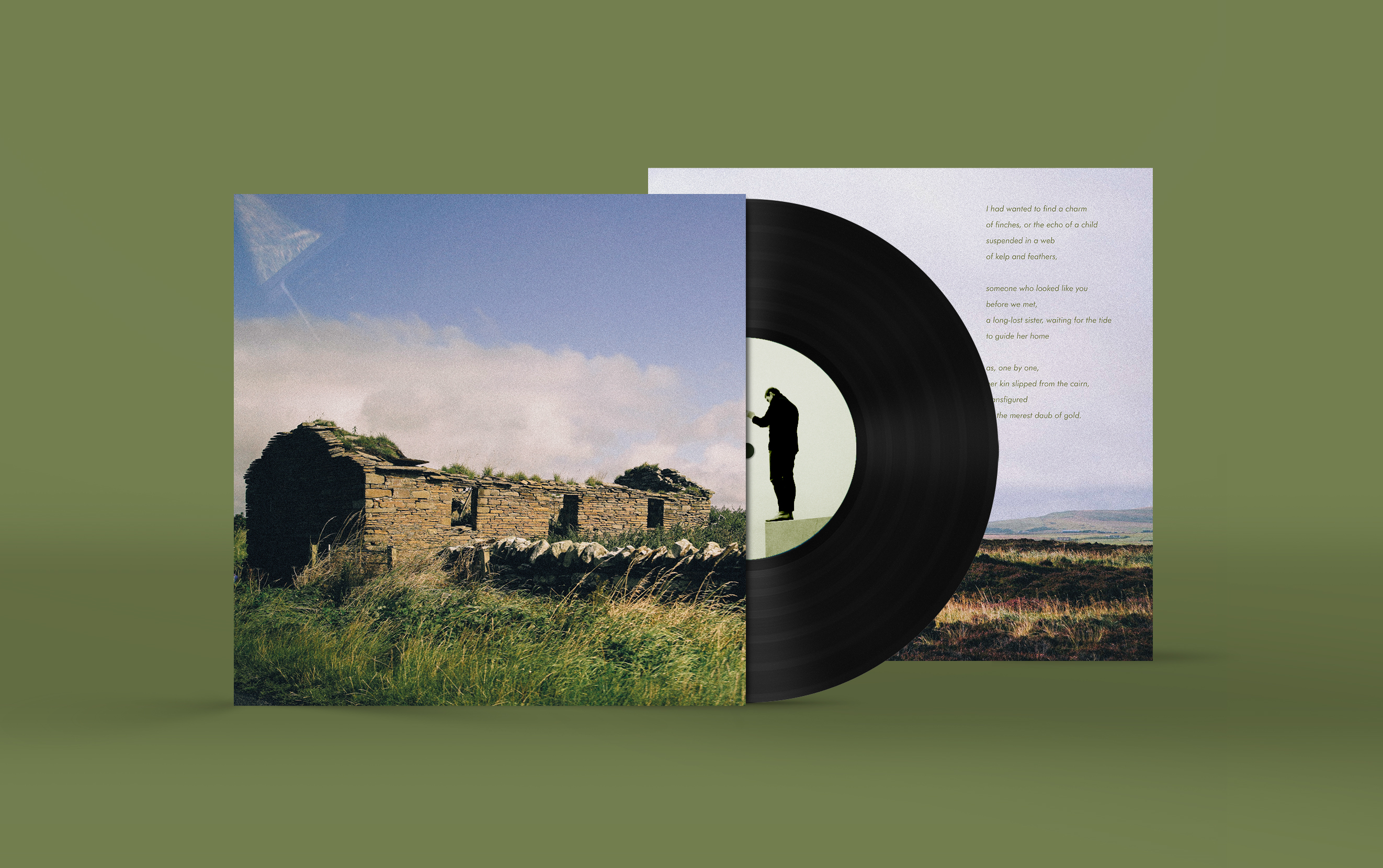
Posted in Books Films, TV & Radio, Music | Tagged , , , , , , , , , , , , , , , , | 2 Comments

Remembering Brian Pilkington, and Burnley’s 1959/60 title win

Leyland Legend: A visual tribute to Brian Pilkington at his funeral in Leyland's parish church in February (Photo copyright: Keith McIntosh)

Leyland Legend: A visual tribute to Brian Pilkington at February’s parish church funeral service (Photo: Keith McIntosh)

This weekend 60 years ago, Burnley were crowned league champions after a last-day victory at Manchester City, just the excuse needed to finally post about former Clarets star and England international Brian Pilkington, a near-neighbour and old friend who died in February.

It’s now 10 weeks since I joined a packed congregation at St Andrew’s Church, Leyland for Brian’s funeral, the same day St Patrick’s Church in Coleraine was rammed for Manchester United and Northern Ireland goalkeeping legend Harry Gregg, a year older than Pilky. That wet afternoon seems a lifetime ago in light of all that’s followed, but I felt it only right that I should brave the elements to pay my respects, around 300 mourners (downstairs and upstairs full) including Brian’s Burnley team-mates Jimmy Robson and Trevor Meredith, fellow Clarets and England international John Connelly’s widow, and Brian’s Barrow team-mate Mick Wearmouth, who I knew from my newspaper days reporting on Chorley FC, where Pilky was on the board and Mick was groundsman.

It was at Chorley, where his association began at the back end of his playing career in 1967/68 (when I was doing some dribbling of my own, as a newborn), that I got to know Brian. In fact, those are the memories I cherish most regarding Pilky, not least evenings when he’d cadge a lift back from away games rather than use the team coach, telling me tales from his footballing past en route.

I also visited the house he shared with his beloved Maureen, just across the wall from Worden Park, Leyland, and recently rediscovered the resultant feature I wrote about him. Suffice to say, he proudly had his club and representative medals and England cap by his side that day, the latter awarded after featuring for a home international side that triumphed 2-0 over Northern Ireland (Johnny Haynes and Don Revie scoring) at Windsor Park, Belfast, in October 1954, outside left Brian one of seven England debutants playing in front of 60,000, Walter Winterbottom’s side captained by Billy Wright and also including Nat Lofthouse and Stanley Matthews.

Brian’s story is real Roy of the Rovers in places, and I love the fact that on the day he married (at the same Leyland church where we said our farewells) on March 15th, 1958, the wedding was arranged early so he could travel 25 miles to Turf Moor straight after to be part of a Clarets side that beat Manchester United 3-0. Jimmy McIlroy (in that Irish side against England four years earlier), Alan Shackleton and Albert Cheesebrough got the second-half goals, but it was Brian interviewed by future This is Your Life presenter Eamonn Andrews for his TV show that evening, his wedding night.

Newspaper Days: My 2003 Chorley Guardian feature/interview with Brian Pilkington

I’ve only seen a few clips of him playing, but Brian was a gifted player for sure, and arguably it was only that he was competing against Preston North End’s England legend Tom Finney for a place that Brian missed out on more caps. He did add a couple of England B caps though, scoring once, his teammates including Brian Clough. He was also on standby for the 1954 and 1958 World Cup finals.

Perhaps part of the reason his story resonates is that he was just a year younger than my Dad, part of that generation having to undergo National Service. While Surrey lad Bob Wyatt got his basic RAF training at Padgate, Warrington, then moved on to Weeton, near Blackpool (later switching to St Mawgan, Cornwall, where we had family links), Brian wasn’t so far off, based at Kirkham and putting in representative duties along the way. By his own admission, in an era that national servicemen became embroiled in the Korean War and the Suez crisis, he had it relatively easy, the merits of his fitness and sporting prowess recognised in high places.

There were more links, and he told me he grew up a few doors from the Victorian terrace house I shared with my better half in Leyland at the time, albeit half a century or so before. What’s more, his daughter-in-law Helen showed us around the house we now live in, by which time she’d taken over the day-to-day running of Brian Pilkington Estate Agents in the town he so loved.

He wasn’t the first in his family to shine at football, telling me his Dad, William, played for PNE in the late 1920s, that team also featuring Scottish international Alex James. Brian was an apprentice at Leyland Motors and played for the works team in the Lancashire Combination when he signed for Burnley in 1951, for a £10 fee. He carried on as a coach-painter at first, becoming a first-team regular in the 1953/54 season before his call-up. He went on to make around 350 appearances for Harry Potts’ team, scoring 77 goals, missing just one of 60 matches in the year the Clarets won that 1959/60 league title, scoring 11 goals. Not a bad return for a fella earning £20 a week at the time.

That season they won the title – their first in 39 years – by a point over Wolverhampton Wanderers, it was a Pilky strike at Birmingham City that took the championship to the final game, 66,000 at Maine Road on that last day as he put the hosts ahead, his fourth-minute cross turned into the net by City legend Bert Trautmann. The Burnley Express match report recalled, “It came from the eighth throw-in (that in itself being an indication of the liveliness of the ball as against the subdued skill of the players). Elder and Robson pushed it on and Pilkington cut in along near the bye-line, hit a low centre across the face of the goal, the ball appearing to touch Trautmann, who had moved too near the post, and it finished inside the net by the far upright.”

Match Report: The Burnley Express take on the game that settled the 1959/60 league title

Match Report: The Burnley Express take on the game that settled the 1959/60 league title

Denis Law levelled for City, but then came a winner from John Connelly’s stand-in, Trevor Meredith, the Burnley Express revealing, “Strangely enough, each trainer made only a brief appearance. The players were too busy to note their bruises. No doubt they could count them afterwards, though the Burnley boys were too happy to bother. Most serious casualty was Pilkington, the Burnley outside left, who had been a constant worry to the City right flank. He is an expert at the acrobatic fall and he executed it with full dramatics on two occasions – to the baffled fury of the home crowd when the referee have free kicks in acknowledgement of justice, pain and suffering. However, it was the final occasion, a few minutes before the end, when he was brought down and the injury was actual and serious and left him limping with a damaged ankle.”

The following season Burnley reached the European Cup quarter-finals, and many moons ago Brian leant me a video tape of that last-eight showdown from the BBC coverage, a dreadful Turf Moor pitch helping the hosts on a freezing cold mid-January 1961 night in East Lancashire against SV Hamburg. Typically, he played down his part, telling me it was ‘blink and you’ll miss it’. But there’s no denying he was a star that night, scoring twice, the second a cracker by any standards, while Jimmy Robson – whose daughter Dany went on to train as a journalist with me in Preston in the mid-1990s – added a third in a 3-1 victory. The Clarets went out after the second leg though, losing 4-1 in Germany in front of 70,000.

Brian also played in September 1957 for Burnley against Brazilian champions Flamengo at the official opening of the Nou Camp in Barcelona. But by 1961, the year my Dad swapped steam loco firing duties to be a postman down in Guildford, Brian’s Clarets days were over, sold supposedly without his knowledge for £30,000 to Bolton Wanderers by chairman Bob Lord. He also told me he belatedly learned he was tapped up by Manchester United but turned down by his club in 1958, again without his knowledge, to come into their depleted side in place of David Pegg, one of the ill-fated Busby Babes so cruelly lost in the Munich air disaster.

Brian later moved on to Gigg Lane, Bury, then Holker Street, Barrow, where he helped win the Division Four title, his teammates including the afore-mentioned Mick Wearmouth, another lovely, extremely approachable fella I got to know during my Chorley Guardian and Lancashire Evening Post days. In fact, I recall Brian coming up to me and Mick one Saturday afternoon while we were chatting at half time over a cuppa and a custard cream in the boardroom beneath the main stand, reaching up to our shoulders (he was five foot four and a half) and announcing, ‘Centre-halves’. I’ll take that, any day, being talent-spotted by Pilky.

Also paying their respects to the National League club’s life president at the funeral were Magpies boss Jamie Vermiglio and chairman Ken Wright, respectively player and manager in the days I covered Chorley. And Brian’s love for the game never diminished, carrying on training in his Clarets days with Leyland Motors and retaining links with regional football throughout his career. I’ve heard several first-hand accounts of Leyland lads star-struck by him coming along to help coach them at boyhood park sides, joined by Clarets teammate Trevor Meredith, a Shropshire lad who taught in Preston after his playing days and settled in Leyland.

Playing Days: Brian Pilkington, as featured in Charles Buchan’s Football Monthly magazine in September 1960

Soon enough, Brian had another role, success selling houses for local businessman (and future Chorley FC owner and Grand National-wining racehorse owner) Trevor Hemmings leading to his post-professional football career change.

I saw him less often in later years, but now and again we’d chat, either while he sneaked in a cuppa at his old Leyland office, passing on words of wisdom to his daughter-in-law, or walking around a nearby supermarket. In time, it became clear he’d succumbed to dementia, and I felt for his wife and family as well as Brian. He died in a care home in Adlington in early February after a long battle with Alzheimer’s and Parkinson’s.

His legacy lives on though. Just this morning, my pal Keith Bradshaw mentioned how he’d travel over from Morecambe by bus to see that feted Clarets side in his youth, telling me, ‘I loved that team and saw most home games in the Championship-winning season. I even owned a claret and blue rattle, which is now with Sporting Memories’. And Brian’s close friend Keith McIntosh, a key player in Lancashire’s Sporting Memories Foundation group, a charity setting out to ‘tackle dementia, depression and loneliness through the power of sport’, paid a personal tribute at the funeral to a fella he clearly knew well. There’s also a stand at the Lancashire FA headquarters named after him these days, and through family, friends and the fellowship of football it’s fair to say Brian will never be forgotten.

With thanks to Dany Robson for casting her eyes over the finished feature, Keith McIntosh for his photographs, and Keith Bradshaw for his own Clarets’ memories.

For more details about the Sporting Memories Foundation, follow this link

Clarets’ Legacy: A visual tribute to Brian Pilkington at February’s parish church funeral service (Photo: Keith McIntosh)

Posted in Books Films, TV & Radio, Football | Tagged , , , , , , , , , , , , , , , , , , , , , , , | Leave a comment

Lockdown life, Dublin style, and Under Moving Skies – the Eileen Gogan interview

If you’re looking for something a little different to listen to right now, perfect for these challenging times we’re living through, I’d heartily recommend Eileen Gogan’s second LP, Under Moving Skies.

This talented Dublin-based singer-songwriter, backed by her band The Instructions and special guests Damian O’Neill (The Undertones, That Petrol Emotion, The Everlasting Yeah) and fellow Irish luminaries Cathal Coughlan (Microdisney, Fatima Mansions), Sean O’Hagan (Microdisney, The High Llamas) and Stephen Ryan (Stars of Heaven, The Drays), carries on where she left off on 2015’s rightly-acclaimed The Spirit of Oberlin, but this time handling production and mixing duties herself.

Some distance from last-year’s acclaimed Fontaines D.C. debut album, Dogrel, it may be, yet the title puts me in mind of a line from that LP’s finale, ‘And I kissed her ‘neath the waking of a Dublin city sky’, and Eileen’s on a similar creative roll, having come up with a set of songs – eight of them self-penned – that take her beyond previous boundaries, mixing pop nuggets with plenty of wistful moments, a fair few soulful, country and folk inflections presented en route.

With a voice inviting comparisons with Sandy Denny, Natalie Merchant and Kirsty MacColl, she draws on a range of influences that also include REM plus Richard & Linda Thompson, to great effect. And it’s fair to say she’s learned a lot in a 30-year career stretching from an apprenticeship of sorts with John Peel’s Irish indie favourites The Would Be’s, also working with The Revenants, The Drays, and guesting with Microdisney at their 2018-19 reunions at Dublin’s National Concert Hall, London’s Barbican Centre, and Cork’s Cypress Avenue.

Under Moving Skies, out on June 5th via Dimple Discs, also features respected session man Terry Edwards, more recently recalled for Gallon Drunk and Near Jazz Experience. She should be out there promoting the LP right now, but the coronavirus lockdown has left her back home with partner Evan, their cat and dog, 20 minutes or so outside Dublin’s city centre, where I found her earlier this week, sat in her living room.

“We’re actually getting an oven replaced, because of the lockdown – we’ve been cooking so much, it broke down. So I’m sitting here while a very nice electrician who agreed to come out installs a new one.”

I guess – as with us poorly-paid, home-based, freelance writers – it’s not so different right now for the likes of you. Worrying times maybe, with plenty of sadness and surreal moments, but nothing out of the ordinary in other respects.

“Like yourself, Malcom, I’m actually enjoying this – working away in the small, dark room I make music in. And I walk the dog, so that gets me out.”

Studio Tan: Brian O’Neill, Cathal Coughlan and Damian O’Neill take time out at Press Play in Bermondsey with Eileen

That’s Louis, a greyhound rescued as a pup, ‘with whippet or something in him’, named after the legendary Louis Armstrong. And that led to the first of our many off-the-main-subject conversational ambles, talking about how our beloved pets become such an important part of our lives in no time at all.

“It’s weird – when people haven’t got dogs, they wonder why we’re so upset on losing them, but they put such great structure in your day. He drives me bananas sometimes, but he’s great fun as well. I was veggie for years, slipped out of it for a bit, but since getting the dog I went veggie again – these brown eyes looking up at me, thinking, ‘Oh, my God, I can’t do this!’ They’re great company. And I’ve read a couple of great books by John Bradshaw, including In Defence of Dogs (2011), about how we didn’t domesticate them, they chose to be domesticated by us – they prefer being with us than their own kind. A fascinating read.”

It’s clear that this part-time librarian has a passion for books as well as music, also tipping me off about a biography of the aforementioned jazz legend, 1997’s Louis Armstrong: An Extravagant Life, by Laurence Bergreen. I also see she’s performed in a few libraries in her time, including fairly recent appearances with fellow singer-songwriter Ed McGinley – part of her band and featuring on the new LP – and author Sinéad Gleeson.

While she’s Dublin through and through, there’s a loose association with Cavan, around an hour and a half away to the north west, home of The Would Be’s, with whom she first had her first real break.

“That’s how it all started for me. I was singing a bit with a couple of indie bands, then a friend who was in a very good band John Peel loved, Hey Paulette, told me The Would Be’s singer (Julie McDonnel) had left and I should audition. I did, I got it, and that was great.”

Was that was your apprenticeship really?

“Totally! They were great to work with, and I’m still in touch a lot. They had that magic, with these three brothers together involved.”

I listened back to The Would Be’s on the lead-up to this interview, reminded as to what a fine band they were, Eileen’s addition seeing them more akin to Sandie Shaw guesting with The Smiths, with maybe a hint of Harriet Wheeler from the Sundays, but added brass taking them elsewhere.

We briefly broke off there, Eileen explaining another technical problem with the immersion heater to her hired help, but were soon back on track, her potted history continuing, starting with a switch to the band The Revenants, with a link there to another band I love, fellow John Peel favourites The Stars of Heaven, who I was lucky enough to catch live three times in 1986/87, loving their debut LP, Sacred Heart Hotel. In that pre-internet era, I lost touch with Stephen Ryan’s goings on, missing out on his next step with The Revenants and beyond. But Eileen filled me in.

“When The Stars of Heaven were going, I was too young to be going to gigs, so when I met Stephen through a friend in a pub in town, and he asked me to sing with The Revenants, I didn’t know who he was, although I’d heard of The Stars of Heaven. It was only after working with him a couple of years that I felt, ‘Jesus, this fella’s really good!

“He’s funny about singing himself, getting me to sing quite a lot. He has a new band, The Drays, who had an album out four years ago, and that’s great too. He’s kind of reticent about singing himself, but I think he’s got a lovely voice. He’s still working away, and his songwriting … he still comes out with some crackers. I’m very jealous!”

I can vouch for that, Eileen introducing me to splendid 2016 LP, Look Away Down Collins Avenue. And I put it to her that she’s clearly in talented company on her new record, not just through Stephen, but also another 1980s Irish band I loved, Microdisney.

“Malcolm, I’m telling you, I still can’t believe that happened. I loved that album, The Clock Came Down the Stairs, when it came out (1985). I was 16 or 17 and listened to that over and over again, the same time I discovered Countdown to Ecstasy by Steely Dan (1977), playing the two of them all the time. When Cathal Coughlan got in touch on Facebook … well, when you live in Ireland, there’s a lot of Cathals and a lot of Coughlans, so I didn’t really think of it. But I friended him, then he messaged me, saying Microdisney were getting back together, and I was just gobsmacked.

“They were a huge influence on me and I was still pinching myself, not least because I never got to see them live, with them being based in London. And when it happened, I was kind of annoyed that I was having to wait, side-stage, called up intermittently, thinking, ‘Feck! I’m not even getting to see them, and I’m playing with them!’ But that was great, and you know Damian O’Neill is playing on this album?”

I sure do. In fact, that’s why I first took notice, knowing he was involved. We’ll get on to his involvement soon, but first she fills me in on another gap.

“I never wrote my own stuff before, it was only a few years ago that I did, bringing out an album about three years ago.”

If that’s the wonderful The Spirit of Oberlin, time clearly flies – it’s actually five years ago.

“Is it? Jeez! And you’re right. I’m getting to that stage of my life now where 10 years ago is actually 20! Time is warping away. But I released it myself and was very lucky that a couple of people here in Ireland gave it great reviews. I was very nervous about writing my own stuff, as in my opinion I sang with the best out of Ireland, so was always a bit shy about doing that.”

Despite saying that, it’s only these past few weeks where I’ve finally caught up … falling in love with that LP. For me, it was ‘Murmuration (Cliche Song #1)’ that first stopped me in my tracks. And from there ‘Dream Time’, and I was soon hooked. There’s not a dud track. Far from it. And while I’m only a few listens into the new record, it’s clearly another belter. What’s more, with that first album relatively short, I was left hungry for more.

“Yes, it was seven songs, and that’s all I had ready. I’d never made a record before, so didn’t really know what I was doing. But it was a really good experience and the people who were working with me were great … and really patient with me!”

Reviewers have picked up on a few perceived influences, most of which I agree with. For one, I can hear Natalie Merchant (10,000 Maniacs) in there.

“Ah, yeah. I listened to a lot of her when I was younger. What I really liked about her was that she didn’t sing in a really American accent. She seemed to sing in her own voice. And that was before I heard Sandy Denny and all that. I think I was around 16. Then in my early 20s I started going back, listening to Sandy but also Dolores Keane, the Irish folk singer. As for Natalie, I think we naturally sing in the same register or something.”

Sandy Denny was another I was going to mention. That comes through for sure. But I’ve seen comparisons to Kirsty MacColl, and much as I love her, I don’t see that so much. At least no more than Dolores O’Riordan , although maybe that’s just the accent (I realise The Cranberries hailed from County Limerick, but I’m generalising a little). I also hear Maria McKee in places.

Album Input: Sean O’Hagan, of Microdisney and The High Llamas cult fame, at Press Play Studios helping Eileen out

“Oh right. I actually met her, at a friend’s hen night, we were doing karaoke together. She was great craic. I agree with you about Kirsty McColl. I don’t think I sound that much like her, but I think as well it’s someone who sings in her own voice.”

That’s true, and that love of words comes through in your work too.

“Oh yeah. I’m very particular about lyrics … you wouldn’t think it by some of the crap I write, but … ha! Some of the songs I love to dance to are a bit more, ‘Hey hey, woo woo!’, I’ve nothing against that, such as some Beach Boys songs with ridiculous lyrics,  But for myself I like to listen to something more interesting … although it might not mean much to anybody else.”

She likes to play herself down, but I like that down to earth quality – Eileen not carried away with her own importance in the scheme of things … despite her obvious talent.

On to this record, and opener ‘More Time’ seems perfect for these odd days we’re living through. That line, ‘I always thought we’d have more time’ truly resonates, thinking of those we’ve either lost or fear we’ve not made the most of seeing when we had the chance.

“Yeah, I never really thought about that. It’s actually about … my Mum died of cancer a few years ago, so that was kind of me getting over that. But I love hearing other people’s takes on what I write.”

The same applies – at least for me – to the lead single, ‘Don’t Let Me Sleep’, a little more country yet soulful too, the first song most of us heard from this record, and another arguably suggesting a need to live for the now, make the most of what we’ve got.

“That’s true, although for me that was when I went through a stage when I found out some disturbing news. Every time I went to sleep, I was getting nightmares. Wrongly, you just want to go out and get drunk, and not think.”

Dee Light: Damian O’Neill gets down to it in the studio for Eileen’s second long playing venture, Under Moving Skies

Did you get a shiver when you first heard Damian O’Neill’s contributed guitar line on that song?

“Did I ever! He did that in his house, and it’s just fantastic. That’s another mad thing that happened. I have Brian O’Neill (no relation) to thank for that. He took an interest in me, said he’d be interested in doing something with this album. He told me a friend had released a record and I told him I’d buy a copy off him. I like supporting people.

“I listened to my signed copy of Damian’s solo LP (2018’s wondrous Refit, Revise, Reprise) and told Brian I really loved his guitar playing. He hadn’t mentioned he was in The Undertones. I don’t look up bands, anything like that. But my other half’s like an encyclopedia on all that. I just thought he must be a session musician, and said to Brian, ‘Listen, his guitar playing is great, there’s one bit where I need a guitar solo. Could you ask your man Damian if he’d be interested. I’ll pay him.

“He asked, then Evan looks him up, tells me he’s a founding member of The Undertones. I had no idea. We were sitting there listening while playing scrabble. I just loved the lo-fi quality of that record. That’s what prompted me. Nothing to do with the riff from ‘Teenage Kicks’ or something, because I just didn’t feckin’ know!”

Damian seems a good match, and in the same way ‘Friday Tune’ would have fitted well on his solo LP, it fits nicely on Eileen’s record. It has a cinematic feel, part Midnight Cowboy, as if we’re on a Greyhound bus between big stateside cities.

“Yeah, ‘Friday Tune’ is just gorgeous. Actually, he wanted me to put lyrics to it, and I didn’t have the time, but now I’ve come up with something, post-album, working on another release, which I’m really happy about.

“He’s got a great ear for melody. And I was glad to have an instrumental on this album. It’s good for the ear, especially when it’s all vocal-based. I can’t even listen to myself that long, so don’t want to inflict that on anyone else!”

“I was the same with Microdisney. I knew about them, Fatima Mansions and The High Llamas, but Evan, being a Beach Boys walking encyclopedia, tells me, ‘He was going to produce Brian Wilson’. I put my hands on my ears, saying, ‘Shut up! Shut up! I’m so nervous already at meeting them – I don’t want to know!’. But when I went over to record with them all, everyone was so nice.”

Terry’s Turn: Session legend Terry Edwards talking tactics through with Eileen Gogan in the studio in Bermondsey

In fact, Eileen was put up by Damian and partner Viv during her London stay, friendship blossoming.

“Damian was just brilliant, and also plays the solo on ‘Echo’, and … Jesus, it’s brilliant! Cathal was in the studio those few days too, and when he heard him play, you could just see that recognition of how well he could play. When you’re used to hearing Damian with barre chords in The Undertones, y’know …”

You mention the evocative ‘Echo’, and it might have taken me a while without reading the sleevenotes to place Cathal’s backing vocals. I expected deeper tones. Your harmonies work well together.

“Well, Cathal sang on Sean O’Hagan’s most recent album, and no one copped it was him, as he sings so gentle and higher, and it really suits him.”

What’s more, rumour has it that Cathal’s working on new material right now. Not as if I got that from Eileen. Honest. I look forward to that though.

On the highly atmospheric ‘Sweet Alice’, there’s flute courtesy of Terry Edwards, adding something of a woodland spirit reminding me of Traffic maybe. Is there no end to that man Terry’s talent?

“Yeah, exactly, and he brought in a trumpet that day. And obviously through his work with Gallon Drunk and PJ Harvey, and …”

I’m old enough to know him from another John Peel favourite, The Higsons. But I don’t think there’s enough room on the internet to mention every band he’s been involved with.

On what seems a very personal, often rather deep record, ‘Malibu Stacey’ stands out as more of a road song, riding along with the top down, albeit in something of a ‘70s style.

“Erm, yeah, I guess. Although I’ll be honest with you, saying I love ‘I Want to See the Bright Lights Tonight’ by Richard and Linda Thompson, and wanted to write something about that. The lyrics are great, and there’s a street in Dublin full of pubs and clubs when you’re walking up it, and it’s full of amazing looking young ones with legs right up to their neck. When I was growing up, no one looked like that in Dublin! Everyone’s really drunk, and usually the girls are doled up to the nines and the fellas have made no effort at all – just a check shirt.”

That reminds me of my last weekend in Dublin, making a day of it then threading our way back to the suburbs to our B&B, the younger generation passing on the way into town. That’s when I realised I might be getting old.

“Exactly! I’m usually cycling home – ‘I’ve had my two gin and tonics, I must go now’ – and the whole bloody street is wavering towards you. It was really just about that.”

And the song title? You’re probably ahead of me, but Malibu Stacey’s the name of Lisa’s Barbie doll in The Simpsons. ‘Very niche,’ as Eileen put it. As for track eight, ‘Yes, Music Does Have the Right to Children’ carries the air of early REM. I could hear Michael Stipe harmonise on that. Are REM another influence?

“Oh yeah, I love the album, Murmur. I was around 13 or 14 when that came out, that time of life when you listen to something over and over again … although I still do that! I love the sound of that record, and their melodies. Then, when I got older, I got very much into bluegrass and old American folk music, and realised that’s why I liked REM. They make songs sound like old songs. Like you’ve heard them before, such as ’The One I Love’ – that sounds like an old folk song.

“To be honest, with a lot of this album, it’s really surprising it got done at all. I paid to go into a studio in Dublin, with a couple of people to play on it, the engineer was late and had his assistant stand in, but all the stuff I got back, I couldn’t use. I’m not a great guitarist, but Niall O’Sullivan, who also plays on this album, spent two weeks in his house throwing loads of ideas at it and recording them. And I basically went back and put all the pieces together.It was like making a collage.”

Penultimate track ‘San Fran 1997’ is a thing of beauty. There’s a lot to take stock of. It’s atmospheric, slow-building, but ultimately epic sounding, multi-layered but not over-showy.

“Ah great. Mission accomplished!”

As for the finale, an a cappella take on Lancashire-born Irish poet Nuala Ni Dhomhnaill’s haunting ‘Celebration’, it’s contemporary but there’s an old time feel, as if Michael Stipe is guesting with The Unthanks on ‘She Moves Through the Fair’. Is Nuala’s work something you were already aware of?

“Well, yeah, I really like her poetry. The words really jumped out at me from the page – they were so lyrical and so well paced. I needed another song, and I made up that melody.”

It certainly works. Maybe it’s your intonation and treatment giving it that timeless feel.

“It does sound a bit like that. Although when I started off. It was basically ‘Scarborough Fair’ at first. But that’s why it’s called folk … because everyone borrows it. I also listen to a lot of Martin Carthy, and a lot of his melodies and inflections probably have a lot to do with how that ended up.”

Talking of folk, we’ve mentioned Sandy Denny and Richard & Linda Thompson, so I’m guessing you’ve listened to a lot of Fairport Convention.

“Oh God, yeah. Love them. And Stanley Erraught from The Stars of Heaven, years and years ago, made me a mixtape which had a Fairport Convention song I loved, ‘Reynardine’ (from classic 1969 LP, Liege and Lief). I loved that, started listening to them, and knew Richard Thompson’s solo stuff before. And I think Sandy’s version of ‘Matty Groves’ is just phenomenal.”

I think those influences came out more on The Spirit of Oberlin. This time it’s more you, perhaps.

“Definitely. On the last album, someone mixed it, someone else engineered it, and I had no idea when I went in to make the album. When he handed the guy playing guitar a 12-string Rickenbacker, I had no idea how much that was going to veer the album in a certain way. It was brilliant, and I loved it, but I said this time I was going to mix and produce it myself.

“It took me a year to learn. I work part-time in a library so I took time off work and – like one of those hare-brained ideas – decided I was going to mix and record my own album. I did nearly all of it at home, so thank God for YouTube tutorials!

“It was actually Cathal (Coughlan) who got me through the very last part of the mix. He’s the one person I know who’s been around that long that I trust and whose hearing is still intact!”

That final stage involved three days at Press Play Studios, Bermondsey, South-East London, owned by Stereolab’s Andy Ramsay, working with engineer Ed Smith plus Damian O’Neill, Sean O’Hagan and Cathal Coughlan.

And shouldn’t you be out on the road promoting this record right now?

“Oh God, yeah. The road? What was the road? I can’t remember.”

Have you new dates pencilled in for when the lockdown’s finally over?

“Well, I was supposed to be over in April for rehearsals with Damian and that, preparing for a few gigs in London, so I’m hoping I can get that to happen, so people don’t just have to listen to my three chords! Ha! That would be brilliant, but to be honest, I think this social distancing will have to go on for another nine months or so.”

And what’s the first thing you’re going to do when this finally ends?

“That’s what I’ve been asking people. I’ll tell you mine if you tell me yours! I want to go for a swim. I really like that, and we’ve a great gym amenity here, with a pool and steam room. I really miss that, even though I exercise here, do lots of yoga … and walk the dog.”

Moving Stories: Eileen Gogan, locked down in Dublin for now but set to tour when the chance finally arrives

Moving Stories: Eileen Gogan, locked down in Dublin for now, but all set to tour once the opportunity finally arrives

Under Moving Skies is out on June 5th via Dimple Discs. To pre-order, try this RoughTrade link. You can also keep in touch with Eileen via Facebook, Instagram and Twitter.


Posted in Books Films, TV & Radio, Music | Tagged , , , , , , , , , , , , , , , , , , , , , , , | 3 Comments

Feeding The Ferret …. and the grassroots music and arts scene

While Danny Morris’ day-job is with a Bristol-based music promoter, he’s never lost touch with his Lancashire roots, in recent times giving over his spare hours to the independent music and arts venue in Preston where he gained his first experience in events promotion.

The 29-year-old returned late last year to The Ferret, just across the road from the University of Central Lancashire’s sadly-mothballed 53 Degrees venue, to help fairly recent arrival Sue Culshaw’s new chapter for the pub, instigating a number of higher-profile bookings and helping draw up plans to get the venue back in the game. But matters moved on in another direction recently of course, with Danny now helping front her crowdfunding campaign to save this grassroots live music spot amid the COVID-19 crisis.

In one respect, this is very much a local story, but it’s pretty much a national one at that – The Ferret just one of many UK venues with an uncertain future right now amid the lockdown. But the team behind it are determined to see their way through and their campaign is already proving a success.

This week they passed the £6,000 mark in their ambitious £7,000 fundraising initiative, with a couple of weeks to run. And Danny – who initially became The Ferret’s events manager in 2014, now working as an international concert promoter for TEG MJR – is pleased with that but keen to crack on.

“We’ve also got two benefit shows we’ve sold out, so there’s an extra three and a bit grand added to that total. There’s still £3,000 to find, but there are more ideas and more shows in the pipeline which should sell out in quick succession, T-shirt sales, and that sort of thing.”

As well as fundraising events, involving back-to-back sell-out shows by Preston turned national phenomenon and 2014 WriteWyattUK interviewees Evil Blizzard, Danny is promoting other high-profile events, such as the latest sell-outs at the venue for returning Manchester-based Doncaster three-piece The Blinders, and a Britpop acoustic night featuring Nigel Clark, frontman of Dodgy, Mark Morriss, from The Bluetones, and Chris Helme, from The Seahorses, that trio also selling out last time they visited. And just as I was going to press, he told me that the latest to confirm future bookings were former WriteWyattUK interviewees A Certain Ratio, plus Louis Berry and Tide Lines.

Eye Contact: Girls in Synthesis’ Jim and John thrill The Ferret, so to speak (Copyright: Gary M Hough Photography)

For those Evil Blizzard shows, the 200 capacity (100 seated) is reduced to 150 over two nights to ‘help give it that intimate feel and keep that demand up’. And as Danny pointed out, ‘That’s three grand straight into the fund’. Of course, with changing situations week to week, those dates can only be pencilled in at present, but the special guests remain committed to the cause and Danny remains hopeful that smaller venues like The Ferret will be allowed to open before bigger venues around the country when restrictions are finally eased.

“Those shows will go ahead, at the moment scheduled for November, and there are more I’m trying to get over the line. And the back end of this year – if we’re allowed to open again by then – is looking very healthy.”

Danny also mentioned how local artists and illustrators had pitched in with the campaign, providing designed art prints of the venue, being sold to help the fund, while bands are releasing live sets, with ‘100% of their profits towards the crowdfund’.

And what was it about this venue that inspired Danny – formerly part of local bands Vox Population and also The Youth Anxiety, who after his first spell at The Ferret went on to book acts for the Live venue operating across the city at Preston Guild Hall – to return?

“Growing up in Preston, when I was in bands there were more venues, such as 53 Degrees – downstairs and upstairs – and three venues at the Guild Hall. But now everything’s shut down, and there’s really just The Ferret, The Continental and a couple more that sometimes put gigs on.

“The Ferret’s the heartbeat of the city as far as I’m concerned. It’s more than a venue. It’s where bands cut their teeth and where you find bands. A lot of my favourites I listen to now were discovered there. While I don’t work in Preston anymore, I still try to put shows on there.

Hay Festival: The Ferret during its annual transformation for Glastonferret. Alas, it’s not to be this year, unfortunately.

“It’s important to me that the city still has that output and the potential to put those bands on the map. And it’s important for the fans. You can tell by how people have come together for this, donating money and their time and hard-designed artwork. Its personal to people. It’s important.”

Like city neighbours The Continental (as featured on this website via an interview with Rob Talbot in mid-January), it’s certainly a venue with a reputation for nurturing talent, keen to support local young musicians starting out, while attracting emerging touring artists, showcasing new acts on the alternative music scene as well as in world of performance art, spoken word, plus experimental sound and art. Many of its diverse events are free to attend too, The Ferret keen to offer an alternative approach among other pub venues hosting bands.

Their main aim is to offer young talent a place to develop on a stage with professional PA, lighting and a talented sound engineer, to responsive audiences, whether that be about hip-hop, indie, blues, jazz … you name it. And The Ferret has hosted up to 200 shows a year, past name acts including Ed Sheeran (you’ve heard of him, right?), Blossoms, Royal Blood, Wheatus, Rae Morris, Catfish and the Bottlemen, Idles, Working Men’s Club, Girls in Synthesis, The Orielles, She Drew the Gun, as well as the afore-mentioned Evil Blizzard and fellow past WriteWyattUK interviewees Jeffrey Lewis and The Lovely Eggs.

In fact, word has it that when Ed Sheeran played in 2011, his audience included One Direction frontman Harry Styles, who then referenced the venue as ‘The Stinky Ferret’ live at The Brits. But that’s probably another story.

It’s also a venue for the annual Preston Arts Festival, and works with the University across the road and nearby arts groups to host events during the annual UCLan-improvised Jazz and Music Festival, and more recently working with arts promoter – and former workmate of this scribe – Garry Cook to host monthly performance and spoken-word events.

What’s more, UCLan music students showcase their bands at The Ferret each term, the venue also working closely with the uni’s graphics arts department, offering wall space to students and hosting social events for its graphics and music department, while supporting arts graduates with photography and music tech students using the space. So as you can imagine, the shutdown of the uni too has had a big effect on the place, irrespective of everything else.

Live Action: Just another night at independent music and arts venue The Ferret on Fylde Road, pre-coronavirus. In this case the band are Working Men’s Club, including Preston bassist Liam Ogburn (Photo: Mic Connor Photography)

Then there are regular events such as quiz nights, open mic. and open deck nights, its Last Band Standing competitions and its annual three-day music and performance festival, Glastonferret (see what they do there?), during which the venue is cloaked in real turf and straw bales. Meanwhile, The Ferret offers space to recycled clothes markets and a regular charity evening raising money for Cuban musicians and a Cuban medical charity, one of many charity events throughout the year.

But the past few months have provided major headaches, the venue struggling before the coronavirus restrictions. Sue, on board at The Ferret since April 2019, told me that enthusiasm for live shows had ‘fallen off somewhat since Danny moved on, petering down really to just local gigs, the venue on the verge of going bankrupt’. That was something she was keen to address, reinvestment and refinancing initiatives following, Danny soon returning in his new booking role, Sue and her team – including manager Ian Cauwood – determined to continue ‘helping promote emerging talent’, often drawing in acts also playing in Liverpool and Manchester, enticing them in from those bigger cities.

“Between us we’ve been trying to get it back where it should be. We were making a lot of progress, but then came the Adelphi regeneration work (involving extensive road closures around The Ferret) – which will be great when it’s finished but has caused a hell of a lot of problems in the meantime. Then we had the wettest February on record, after a traditionally quiet January, bands not tending to tour in that first month. We were looking forward to all the plans we had for the year, through Dan and ourselves, including art and spoken word, poetry and comedy, building a wider brief really.”

Those acts have included revered performance poet Mike Garry, who has regularly toured with John Cooper Clarke and who I first caught live at 53 Degrees in 2013 (with my review here), and recent WriteWyattUK interviewee Lee Mark Jones, his show – after a Ferret performance at last year’s Preston Fringe Festival – among the first cancelled as coronavirus restrictions kicked in.

“UCLan uses us a lot, for tech shows and graphic art students, and all that’s gone too, as well as all the graduation parties and end of term shows we usually cater for. That’s been quite a substantial loss really.”

As Sue put it on her fundraising page, “The Ferret adds so much to the city’s arts and culture scene, its loss would be a tragedy to the community that love it. We really need to be able to support our sound techs, retain our staff and promoters and keep The Ferret operational, even if only at the media level when the inevitable happens and we close our doors, so we can ensure we rebound from this with a functioning venue and a dynamic programme.”

She adds, “The intention is to put most of the fund towards providing paid employment to musicians and artists to give The Ferret a much-needed lift, through painting, murals and a general upgrade while it’s closed. If more money is raised, it would aid upgrading of the outdated sound equipment.

“The worst thing for us having worked so hard over the last 12 months would be for the Ferret to decline and be unable to reopen. We welcome the Government’s help, but it is not enough as the future and timescales are so uncertain. We need The Ferret to stick around and will do everything we can to try and ensure this, but we can’t do it alone and need help. We promise to match any money raised in order to provide an even better resource for Preston.”

It seems that the campaign has hit a nerve too, and it’s become apparent how much The Ferret is valued as a community venture.

“Absolutely. It’s never going to make money. It’s not about that. We’re about keeping financially solvent and being able to put great stuff on … because we love it. It’s a passion.”

Were you doing something similar before all this?

“Not really. I’ve retired, but we’ve always been interested in the arts, and my husband Gary is a professional, freelance jazz musician, working in music since he was about 12. His Dad ran dance bands, so he’d be out at weekends, took it from there really. He‘s also known for Free Parking, which he started in 1984.

“And it’s a musical family, with my brother-in-law’s Paul Birchall playing keyboard in M People and with Heather Small over the years. I’ve always been involved in music, and helped my son, who had The Continental. And this grew embryonically really. I got involved because no one else was doing it and have a lot of ideas. It’s just grown and now it’s like an addiction. And Preston can’t lose this place. It’s too important. Too many people go there.

“I don’t want to be rude. Lots of other places put on gigs, but The Ferret’s different, with a reputation for finding emerging talent and supporting lots of arts and creative people. The Conti has to provide a much broader spectrum, including cover bands, but The Ferret is what The Ferret is.”

Being from outside town, I initially saw The Ferret more as a venue to grab a pint before heading to 53 Degrees across the road. And that’s something else you’ve lost, traffic-wise.

“Absolutely. That’s a good point. That was a nail in the coffin a couple of years ago when that stopped being a regular venue.”

I’m guessing you’ve been touched by the response to this campaign. You’ve got a fair way to go, but it’s been a real eye-opener as to the strength of feeling for this venue.

“To be honest, it’s almost become more about the response than the money. It’s been utterly amazing to hear the messages people have been putting out there. I’ve cried a few times. This place matters. That’s really been the theme.”

Ed Banger: 2011’s Ferret visit from a certain Ed Sheeran, when the audience included One Direction’s Harry Styles

For more details about The Ferret’s crowdfunding campaign and how to get involved, head here. You can also keep in touch on social media via Facebook, Instagram and Twitter


Posted in Books Films, TV & Radio, Comedy & Theatre, Music | Tagged , , , , , , , , , , , , , , , , | Leave a comment

Chance would be a fine thing – the Baxter Dury interview

Dury Service: Baxter Dury, self-isolated with his son Kosmo in London right now, but with his new album tour lined up.

“I went for a walk this morning and found this incredible deli that was open, serving food outside, and couldn’t resist buying some ridiculously-overpriced pizza pie. So my son and I could eat this delicious kind of apocalypse meal. We’ve been living on my cooking for three weeks.

“It was so incredible. I got my timing wrong, but I couldn’t eat the pie and talk to you at the same time.”

That’s Baxter Dury apologising – after a fashion – for telling me to try him again in half an hour when I initially called him bang on two o’clock, as per our arrangement, just as he was tucking into his dinner. It wasn’t a problem though. I got another chance to listen to a new LP called The Night Chancers, one I’d barely stopped playing in a week. Sound familiar?

“I’ve heard about that, yeah. By an interesting character.”

The Night Chancers is West London-based Baxter’s sixth album in 18 years, and it’s a cracking record, building nicely on the last released under his own name, 2017’s acclaimed Prince of Tears. Is he pleased with the early reaction?

“Yeah, I am. It’s been a strange time, but the feedback seems mostly positive. I’ve had a lot of time to actually read my reviews, thinking, ‘Fuck it, I will!’ this time. And luckily they’ve mostly been good.”

The new LP was released on March 20th through Heavenly Recordings, co-produced by Baxter and long-time collaborator Craig Silvey (Arcade Fire, John Grant, Arctic Monkeys), recorded at not so far away Hoxa studios in West Hampstead last May.

I’m guessing he’d have been deep into rehearsals by then for what was shaping up to be his biggest UK tour so far, now postponed until – in theory – autumn.

“Yeah, all that sort of stuff. But that’s just the way it is. I’m quite philosophical about it. I just volunteered actually – I signed up. When they asked me my skillset, I realised I had absolutely zero! I could talk about having a famous father, tell them I’m really good at interview techniques, or I could teach old people how to Instagram. Ha! Bleedin’ useless.”

Is that Chiswick way, where you’re based?

“Yeah, around the corner.”

That took us on to an interview I did a short while before with Paul Cook, the drummer of the Sex Pistols and the band that followed in their wake, The Professionals, letting on to Baxter how Paul was an apprentice electrician at the Mortlake Brewery site of Watney’s (home of the dreaded Red Barrel) before he gave it all up to try his luck with a certain infamous punk band. Which I guess if Paul was to sign up to volunteer right now would give him a slightly different skillset to Baxter. Anyway, how’s Baxter’s neighbourhood coping right now, with all that’s going on?

“Well, I live on the river, so you’ve got a point of convergence where everybody who wants to go for their daily walk comes here, so you’d never notice there was any difference – there’s so many people around.”

Less traffic though, I guess?

“Well, there’s less traffic ‘cos the bridge is closed. I guess there’s less air noise … and there’s not a lot of toffs rowing in the river. They’re quite loud, usually. But that’s about it. We’re quite lucky to live here really.”

Back to The Night Chancers, and it’s a very accomplished record, and somewhat multi-faceted, with opening track, ‘I’m Not Your Dog’ seemingly carrying on where he left off with the European disco vibe heard on tracks like ‘Tais Toi’ on the BED (Baxter alongside Étienne de Crécy and Delilah Holliday, who also features for London punks Skinny Girl Diet) collaboration. Was that where you were at when you came to this album?

“Sort of, but that collaboration was done not really thinking about much. There wasn’t too much effort put into that. But I guess so. I’m always more into soul music and dance. I’m more that way orientated than indie music. There’s always that thread going through.”

I see Delilah provides one of those voices on this record too, along with (a more prominent) Madeline Hart and Rose Elinor Dougall. When did that link come along? There’s a French theme in places here too. Do you spend a lot of time between London and Paris, pandemics aside?

“The B.E.D. thing is not that relevant. I spent a week doing it, and to be honest it wasn’t that enjoyable – everyone argued. So I kind of forget about that.”

I got the impression you wanted to push on from Prince of Tears though, building on its success rather than just trying to copy its winning formula. And you’ve certainly achieved that.

“Yeah, it’s a continuation, but you try and do something different.”

Comparing his celebrated last LP with this, we’re told Prince Of Tears was ‘a cinematic confessional trying to stay afloat on the seas of relationship failure,’ while The Night Chancers ‘finds the songwriter adopting a more directorial approach to his tracks, sketching out people and situations as he initially dives deep into the darkness before reaching an emotional dawn’.

The man himself adds of the conscious progression across the album, “It’s meant to be a bit Kubrick-y, a psychological journey through the maze bit in The Shining. So they’re not all confessional, it’s more of a feeling projected into a filmic narrative. On some of the tracks different characters appear.”

And if Baxter isn’t always coming from a personal point of view on every song – and there are still plenty of moments where he lays his life out lyrically – he is speaking from candid, first-hand experience. From thrilling affairs that dissolve into sweaty desperation (‘The Night Chancers’) to the absurd bloggers fruitlessly clinging to the fag ends of the fashion set (‘Sleep People’), via soiled real life (‘Slumlord’), social media-enable stalkers (‘I’m Not Your Dog’) and new day, sleep-deprived optimism (‘Daylight’), its finely-drawn vignettes are supposedly ‘all based on the corners of a world Dury has visited’.

“They are things I’ve experienced or seen. That explorative period after being in a long relationship – you find yourself in situations where your bravado about what’s happened and the reality are two different things.”

The title track and centrepiece defines that spirit, a brutal self-satire on an evening spent in a Paris hotel. He explains, “‘The Night Chancers‘ is about being caught out in your attempt at being free. It’s about someone leaving a hotel room at three in the morning. You’re in a posh room with big Roman taps and all that, but after they go suddenly all you can hear is the taps dripping and all you can see the debris of the night is all around you. Then suddenly a massive party erupts in the room next door. This happened to me and all I could hear was the night chancers, the hotel ravers.

“Nothing compounds your loneliness more than then you’ve got crumbs stuck to your face, the girl’s left and there’s a party next door. What do you do? You try to bring the person back and you lose all of your dignity by showing your vulnerability. It’s all a bit of a theatrical scream into the night. There are these moments and characters across the album – it’s quite a diss-y record, but most of the disses are inspired by insecurities. The characters are very flawed. It’s cocky but it’s really vulnerable.”

Night Chancer: Baxter Dury, set to tour as soon as he’s helped fight off the COVID-19 pandemic

The result is impressive, Baxter writing a soundtrack infused with classic disco, Italian pop, ’80s hip-hop beats and strings, each micro-narrative key to a wider mood across the album.

“Musically I’ve pushed on,” he suggests, its 10 tracks written over four months in the first half of 2019, then recorded over three weeks. “I had a formula for the previous records but now that’s done. Everything was leading up to the full sound I had on Prince Of Tears, so I don’t need to do another one of those. I’ve done something different, something new, with this one, and it’s been fun – although the orchestra was fucking expensive!”

Those differences include his vocal contributions, his charming yet brutal monologues underpinning the uniqueness, but with different inflections and voices – veering from his usual dispassionate cool, through rage, foppish injury and twisted documentarian.

“I recorded all the vocals alone. It’s what I call faux Chiswick Urban. It always goes back to Chiswick, because it’s a stable reference point for me. I wasn’t brought up there, but it represents the insulated safety of middle-class London yet has a sort of real undercurrent to it, it’s quite tough. So I did these faux accents on the record, inspired by a lot of real people who I’ll never namecheck.”

And with a different take on that earlier mention of skillsets, he tells us, “The only skill I’ve got is being honest. I’ve got a tiny bit of melody and a lot of honesty, and the latter is really my only facet. I’m not even sure it’s a skill, it’s more like being in a freak-show. I’m honest about my successes and failures, which sometimes can sound arrogant while other times I’m alarmingly, disarmingly honest.”

You describe the new LP as ‘a 10-song gaze into the black hours and characters and behaviours that swirl around within them’. It’s a dark and gritty LP, but you pull it off. It’s almost a 21st century take on Frank Sinatra’s In the Wee Small Hours in that sense.

“Yeah, that’s good. I like that, totally! But it’s just what it is. Information sourced locally from what I’m experiencing at the time. It’s not a concept album. It’s just micro-details about one’s life.”

He’s described the period after Prince Of Tears as ‘halfway between heartbreak and getting back on your feet, when you’re rebuilding – not necessarily successfully – your outlook on life’ and ‘trying to fit into the modern world, avoiding the barbed wire between youth and maturity’. And I don’t think it’s just the case that Jason Williamson guested on that last LP that makes me think track two on this one, ‘Slumlord’, carries an air of his work with Sleaford Mods, or at least that coupled with a Blockheads vibe.

“Oh, maybe, yeah. It’s good if people’s imaginations respond in such a way. It wasn’t intentional.”

I guess a lot of these influences are there anyway, whether you’re pulling on them or not.

“Completely, yeah. Absolutely.”

Who’s in the band on this record? And will it be the same live when you finally get out there?

“I can’t remember who we played with, but there’s a slight difference with some personnel shared between. Who knows with the live one, particularly as we don’t know when it will happen. Musicians are scrabbling to confirm any dates they can with any band they can, so it’s very hard, although we’ve put some theoretical dates in.“

I spotted those, aiming for the last week of September and into October. Although as you say, it’s theoretical for now. Besides, it seems that the world and his wife will be out on tour around then.

“There’ll be a big traffic jam of all the tour buses!”

You clearly work well with Craig Silvey.

“Yeah, we’re really good mates. The best of mates, and we have been for years and years.”

How did that partnership come about?

“I really can’t remember, but the very first album he worked on. And there was no real point not to work with him ever since. Consequently, he’s one of the biggest mixers in the world now, and we’ve just got good vibes.”

Guitarist and writing partner Shaun Paterson is a more recent addition though.

“Yeah, he joined the band about a year or two ago.  He’s been great though.”

Early Years: Baxter with his Dad, Ian Dury, on the front of the rightly-celebrated 1977 LP, New Boots and Panties

The previous weekend marked the 20th anniversary of Baxter’s father Ian Dury’s passing, far too young at 57. And I’m intrigued that the tour finale at The Forum in Kentish Town is now pencilled in for October 5th, 30 years – give or take 10 days- after I first caught Ian Dury and The Blockheads live, at the very same Kentish Town venue, then trading as the Town and Country Club. That was a benefit show – bass legend Norman Watt-Roy featuring for Wilko Johnson’s support band too – for Blockheads drummer Charley Charles, less than three weeks after he passed away.

“Oh, right. Weird, yeah. OK, that’ll be good. Charley was a good guy.”

I’m guessing you knew The Blockheads well, even around then.

“Yeah, especially Charley. He was one of my favourites, to be honest, very friendly if you were a young person. He was great.”

It’s all too easy to make comparisons between Baxter and his Dad, not least when they clearly share that love for words and wordplay and crafting them. There are many great examples on this record, not least ‘Carla’s Got a New Boyfriend’, part poetic, part-funny, yet somewhat chilling. Something his old man could definitely do. I tried my best not to talk too much about Ian though, realising all too well he’s his own man, as proved throughout his impressive career so far. How would he say his own work has progressed – album by album – since 2002 debut, Les Parrot’s Memorial Lift?

“I’m not sure. I just try and do something different. I’m not sure if you progress. Music’s inherently in people from the point you start wanting to do it. It doesn’t always get better or worse, it just changes. You can play the guitar a bit quicker, maybe, but that’s about it. You learn lots of unnecessary skills. But it’s all quite natural – lying there within people, and just has to be reared out.”

You mentioned your lad, Kosmo, who arrived on the scene around the time of your debut LP (and I am after all talking to an artist who appeared alongside his own father on the front cover of wondrous first album, New Boots and Panties). Has he followed your lead and got involved in music too?

“He has, yeah, and that’s how he’s surviving this apocalypse – writing songs. He’s good. He’s brilliant.”

Joining the family trade, yeah?

“Well, I’m trying to dis-encourage him from emulating it, doing his own thing instead, standing on his own feet.”

By rights, you should be just a fortnight from hitting the UK circuit again, touring the new record, starting with a first night in Leeds. But that’s not happening now, and I guess we’ve all got to just pull together to get through this now.

“You feel what you feel. You’ve got to work out another agenda really. Otherwise you’ll eat yourself up. There’s no point fighting it. It’s not like it’s just you and your street – it’s the whole world. You’ve got to sit back on this one, let it have its day. It’s pretty grotesquely massive, and I think if you’re in good health, credit yourself for that and be as positive as you can really.”

Not a bad philosophy for life itself.

You started out at the turn of the century with Rough Trade, but these days you’re on board with Heavenly Recordings. Did that mean a big change for you, dependent on who’s putting your records out?

“Well, I’ve been through a few labels, and it depends how good the people are. And Heavenly are really nice, so I can’t complain, y’know. They’re all owned by more darker, cynical people in the background, and you need a few of those in the business, but Heavenly themselves are an amazing label, and they’re my friends, so it seems appropriate.”

Time was running out on me now,  so I decided to go for a harder-hitting question – whose dog is that barking on the title track?

“Ah … the first one I could find on a Google search.”

Ah, he spoiled the image now. I wanted to hear that it was his, it belonged to someone at the studio, or was the son or grandson of the boxer dog on the front of his Dad’s final LP, the terrific Mr Love Pants.

“Nah, I just liked it and nicked it! I typed in ‘dog sounds’ and that was literally the first I found. I taped it randomly and whacked it on there!”

Ah well. And if there’s an over-riding message to this album, is it that ‘Baxter loves you’, as we hear from the girls on the play-out of album finale, ‘Say Nothing’? And is that your modern take on Clive Dunn’s iconic late 1970 UK No.1, ‘Grandad’?

“Well, it’s sort of an answer to the beginning of the record, where I’m a bit more dismissive. It’s a bit like The Shining. It’s sort of, ‘Baxter loves you … but I might stick an axe in your neck’.”

Fair enough. and with that I felt I better leave him to it. So he could get back to his riverside self-isolation with Kosmo.

Deli Ally: Baxter Dury knows how to track down a right good outdoor establishment when he gets the chance.

For more about Baxter Dury’s new LP, his back-catalogue and rescheduled tour dates, visit www.baxterdury.tv and check out his Facebook, Instagram and Twitter links. 

Meanwhile, to check out Really Glad You Came – this website’s re-appraisal of the Ian Dury record collection, from late October 2014, head here.
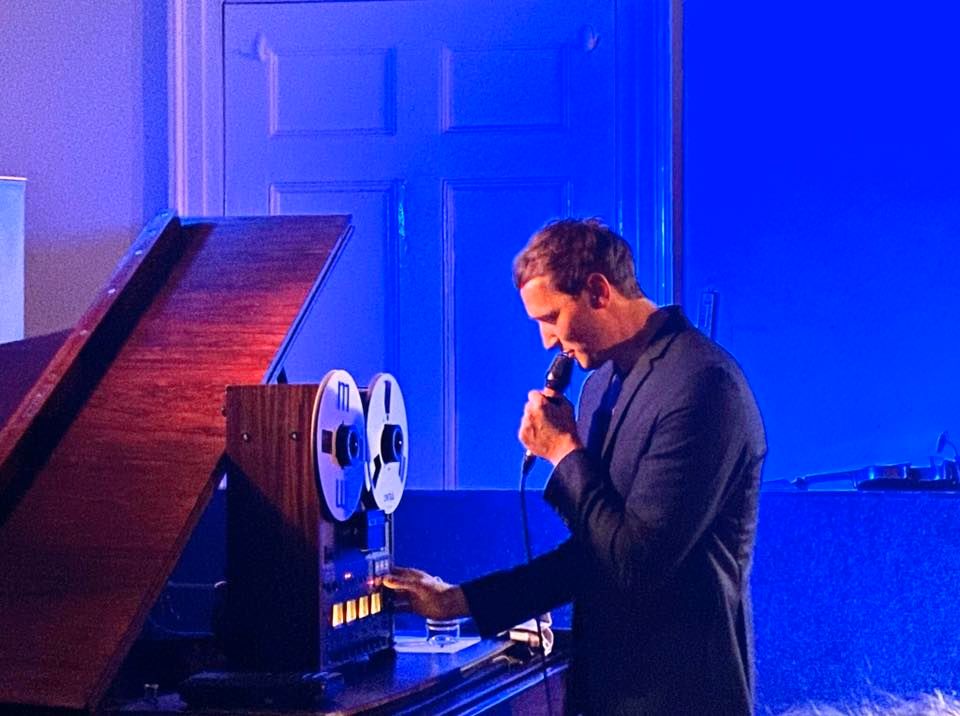
You can also check out February 2019’s interview with Blockheads and Wilko Johnson’s bass-playing legend Norman Watt-Roy, and a WriteWyattUK review of The Blockheads at Preston’s 53 Degrees in March 2013 here.

Then there’s Still Stiff After All These Years, a November 2014 interview with Richard Balls, author of Sex and Drugs and Rock and Roll – the Life of Ian Dury, and Be Stiff – The Stiff Records Story, via this link

Posted in Books Films, TV & Radio, Music | Tagged , , , , , , , , , , , , , , , , , | 1 Comment

Perilous Beauty – from Vampish past to touching presence and future intent – the Wendy James interview

Wendy House: Former Transvision Vamp frontwoman Wendy James, hoping to be out and about later this year

As another week of UK lockdown against the coronavirus pandemic gets underway, I’m certainly not the only one reflecting on just how much there was about our old everyday lives that we took for granted. And high on my own list was live music.

I’ve already struck lines through various scheduled nights out around Preston, Liverpool, Manchester and thereabouts, including chances to catch Wendy James and her band next month at Manchester’s Deaf Institute or Blackpool’s Waterloo Music Bar, part of a full-on 19-date schedule promoting new LP, Queen High Straight, due to start in Tunbridge Wells on May 5th but now pushed back until – or at least pencilled in for – September. And when we spoke, Wendy was already extremely concerned about how things were back here as the pandemic started to inch its way towards her home nation.

The London-born singer-songwriter first made her mark in the late ‘80s, fronting alt-rockers Transvision Vamp, whose second LP, Velveteen topped the UK charts, while also  managing top-five hits with debut album Pop Art and the ‘I Want Your Love’ and ‘Baby I Don’t Care’ singles.

She went on to collaborate with Elvis Costello, James Williamson (Iggy and the Stooges), Lenny Kaye (The Patti Smith Group) and James Sclavunos (Nick Cave and The Bad Seeds), the latter joining her on drums and percussion on the new record, along with James Sedwards (lead guitar), Harry Bohay (bass), Alex J. Ward and Terry Edwards (horns) plus Louis Vause (accordion). And judging by the advance tracks I’ve heard, it’s a corker, as the quality of the personnel involved would suggest.

When I got in touch, she was already self-isolating, in her case in the south of France, while eager to know what was happening back in her native UK, pre-tour rehearsals with her band up in the air and more draconian restrictions ever more likely. And within a week or so, the situation moved on considerably, Wendy making a decision so many more touring musicians were being forced into, her shows shelved for now.

A statement followed, telling us, Doing simple maths, it was easy for me to see that in one month’s time when I’d be due to begin rehearsals in London, it was just not going to happen, nor an all-clear of COVID-19 by May 5th, when my tour was scheduled to begin. Making a calculation as best as possible, I’ve postponed all the dates until September.”

She’s still very much looking forward to those engagements though, with the original ‘ticket links still valid and working’. And Wendy’s also excited by the prospect of her new solo LP landing early next month, carrying on where she left off with 2016’s The Price Of The Ticket, the follow-up to 2011 comeback LP, I Came Here To Blow Minds.

It’s not an easy album to categorise, the title track a fine example, its ‘jazzy type of chords’ lending a ‘gentle lilt’, Wendy – who also fronted indie rock band Racine in the early 2000s – documenting on record her appreication of Bacharach and David and early years listening to Sergio Mendes ‘Brazil ’66’.

“Overall, my taste and style have not changed with time. The music that excites me now, ultimately, is the same as when I was starting out songwriting and back through my days in Transvision Vamp.

“I continue to marvel at Lou Reed and The Velvet Underground, I continue to be blown away by The Stooges, I continue to be everlastingly enthralled by Bob Dylan, but the older one gets the more one discovers, and I am now informed more cohesively and fully by all the music, new and old, which settles into my consciousness.”

And from celebrations of Motown and ‘60s girl groups to ‘guitar guttural filth and sex’ on splendid first single ‘Perilous Beauty’, some ‘Django Reinhardt whimsy’ and a little speed punk, there’s plenty to savour.

But we started out by talking about her surrounds, Wendy ‘in the countryside, pretty much away from people’, in a country that had already seen a lot of cases confirmed. We were soon on to the home country though, at a time when America had announced it was stopping flights from Europe. Inevitably the conversation drifted on to Trump, Johnson, and co., my interviewee largely thinking along the same lines as me, although ultimately, as she put it, ‘It’s a subject we could explore for hours and hours … and reach no conclusion’.

“But tell me something though,” she added, ‘Out on the street, are people concerned? Are people wearing masks and stuff?”

Something of a pen-pic followed as to the view from the UK, albeit from someone admittedly in his own social media bubble, happier mixing in circles of like-minded souls, away from the nutters out there at the time, clearing supermarket shelves and swarming like ants on beaches and in parks. She soon carried on.

“I’ve a friend who lives in Rome, and he’s on lockdown, telling me this morning police are arresting people on the street if they don’t have a permit to be going somewhere. I’ve seen video footage from his window and sure enough, police patrols are on the street, speaking through loud hailers. Denmark’s on lockdown now too, and my friend who works for the embassy in Rome seems to think the UK is going to a lockdown. I live in America as well, and even though France has cases here, I feel so much safer with a European Government manning the station rather than that fucking Trump administration.”
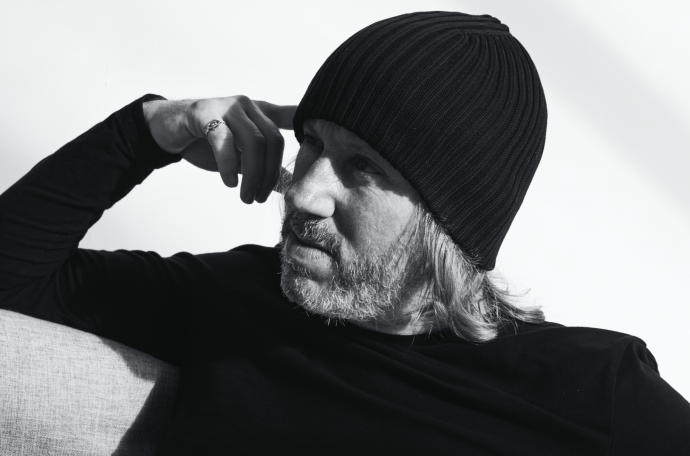
Yes, home is also New York City for Wendy, although she told me, “One can’t really classify that as America. It’s at least the very best of America.”

I should point out here – the ‘one’ was the giveaway – that I was slightly taken aback early in our conversation. Having recently seen Wendy in her late ’80s days via the wonders of BBC Four’s Top of the Pops revisits, I half-expected a somewhat breathy, sultry punk pop star at the other end of the line. She was always far more than that, I realise, but I found it intriguing to think that a contemporary of mine – I’m two school years younger, leading her to quip, ‘Ah, so you’re in your early 30s too?’ – who dated The Clash’s Mick Jones had such well-heeled tones. I reckon my Mum would have been impressed by that frankly posh brogue, and would have adapted her telephone voice accordingly, in true Irene Handl style.

Touring aside, does she still return to England from time to time?

“Really only for occasional get-togethers with friends or parties, or if I’m working. I no longer have anywhere to live in London. I have to crash on people’s sofas. I was in London quite a lot last year, making the album in the UK, and providence providing I’ll be travelling over in a month’s time to begin rehearsals for the tour. I’ve no idea how it’s going to pan out. I’m just monitoring the situation like everyone else. But I have no reason to think I’m not coming.

“The gigs are selling well, and Manchester is doing exceptionally well. I’m planning to shoot a video as well in Swansea, a whole gig but potentially concentrating on a couple of songs. We’ll be playing a cinema there, a massive screen behind us, so I put together an amazing shot-list of all the stuff that tickles my fancy, culturally and musically, in movies and everything, the cinema putting together this compilation of footage to play behind us. So I had to step up a gear to make sure I had video directors there to get the footage.”

When she does think of the UK these days, where’s home? Would that be Brighton?

“I was only there for two years of my life. Wikipedia is not all it’s cracked up to be … certainly not in my case. I was born in London, raised in London, then met Nick Sayer while doing some schooling down in the south of England. Transvision Vamp formed in Brighton, but I only ever lived there two years. My home, England-wise? I’m happier now in Soho, London, but grew up in Portobello Road, West London.”

There’s certainly some heritage there, not least with its links to The Clash.

“Yeah, exactly. All of that.”

Guitar Heroine: Wendy James lets loose on her inflatable six-string, in readiness for her rescheduled 2020 tour.

Discussing my own South-East roots, we got on to her scheduled date at The Boileroom in Guildford, me swapping tips on my hometown and Wendy keen to praise Lydia at the venue for her work in helping set up that visit.

“There are quite a few dates on this tour which have been on my bucket list of venues I’ve seen my friends play, like Leeds Brudenell, which crazily I’ve never played there. And I’m desperate to play Glasgow King Tut’s. Those places are iconic in my mind.”

So many music venues are on the edge right now. We’ve lost a lot in recent years, so it’s good to support those still functioning. It must be a very different circuit to the one you played in the late ‘80s.

“The thing about Transvision Vamp was that our first ever tour was a uni tour, and by the time we’d finished that we were playing the Marquee club on Wardour Street and were at No.5 in the chart.

“We never had that schooling – doing the pub circuit and building our way up. The NME, Melody Maker and Sounds were all covering us as the band to watch, and Transvision Vamp became mega really quickly. But I’ve gone back and paid my dues since, I can assure you.”

Do you think you’ve always had more to prove in the sense that the music media, like their counterparts on the tabloids, would find it hard to look past the sexy image and everything else? You played that part well, of course, as had Debbie Harry and so many others down the years.

“I wouldn’t call it playing a part. I guess some women play a part, but whether it’s Debbie Harry or me, that’s the way we looked and that’s the life we led. We were being completely authentic. It’s not like we put on a costume then afterwards went home and did some knitting. We were those people, and we are those people.”

I get that, but still there’s that tabloid mentality …

“You mean sexist mentality. I don’t give a fuck about the tabloid approach to cheapening values. It’s hard for me to remember, because I was always very insulated in as much as that I was in a gang of boys and we were successful quickly. And my friends remained exactly the same – from being on the dole through to becoming a successful band.

“My scene was also the same, the pub I drank in on Portobello Road, so while a whirlwind of tabloid frenzy did start to pick up, and I knew they were saying this stuff, it didn’t reach me emotionally. But I’m sure if one was to go back in a time machine, it was far more sexist then than it is now … and it’s incredibly sexist now.

“It’s also ageist, the music business. If you make it – unless you’re Bob Dylan, Mick Jagger or one of the properly established old rockers; or Debbie Harry or Grace Jones, who are both still out there – on the whole they like you to remain in your box; the one thing that you were.
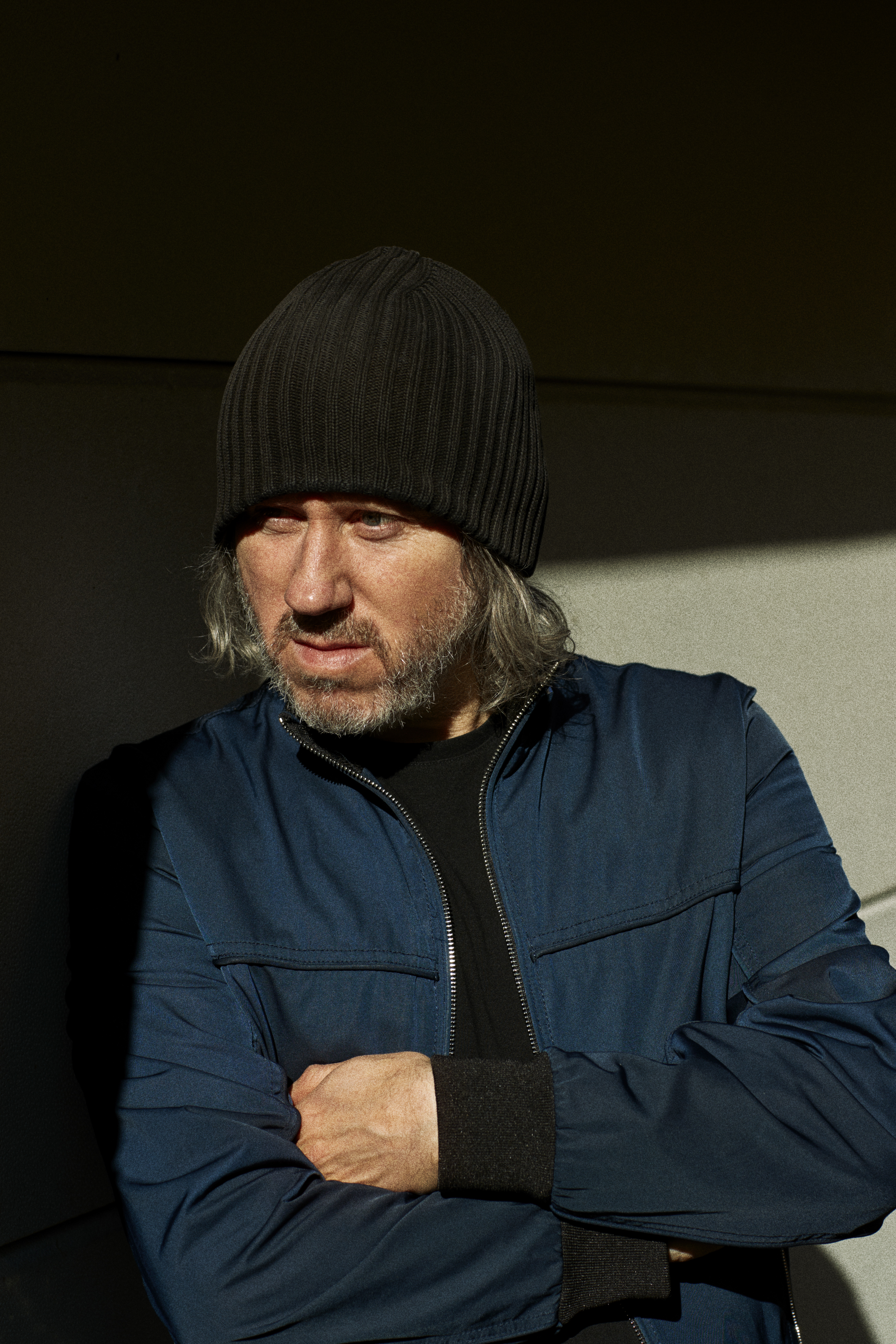
“And in the broadest sense of people’s knowledge of me – although of course fans know what I’ve done – the general public will still think of me as a late–‘80s/early-‘90s pop idol, right?  I mean, you don’t want to be thought of as what you were 30 years ago, do you? What’s that film where Brad Pitt gets younger? It would be a scientific challenge to ask someone to remain that person they were.”

Did you mean David Fincher’s 2008 film, The Curious Case of Benjamin Button?

“Yes, that’s right. They’re Benjamin Buttoning me! Ha ha! The truth is that I even think I look better, although I can see I was pretty in those days. And I’ve definitely enhanced my talent and creativity over the years. I’ve just become a more substantive human being. And I still think I look fucking hot, so what’s the problem?”
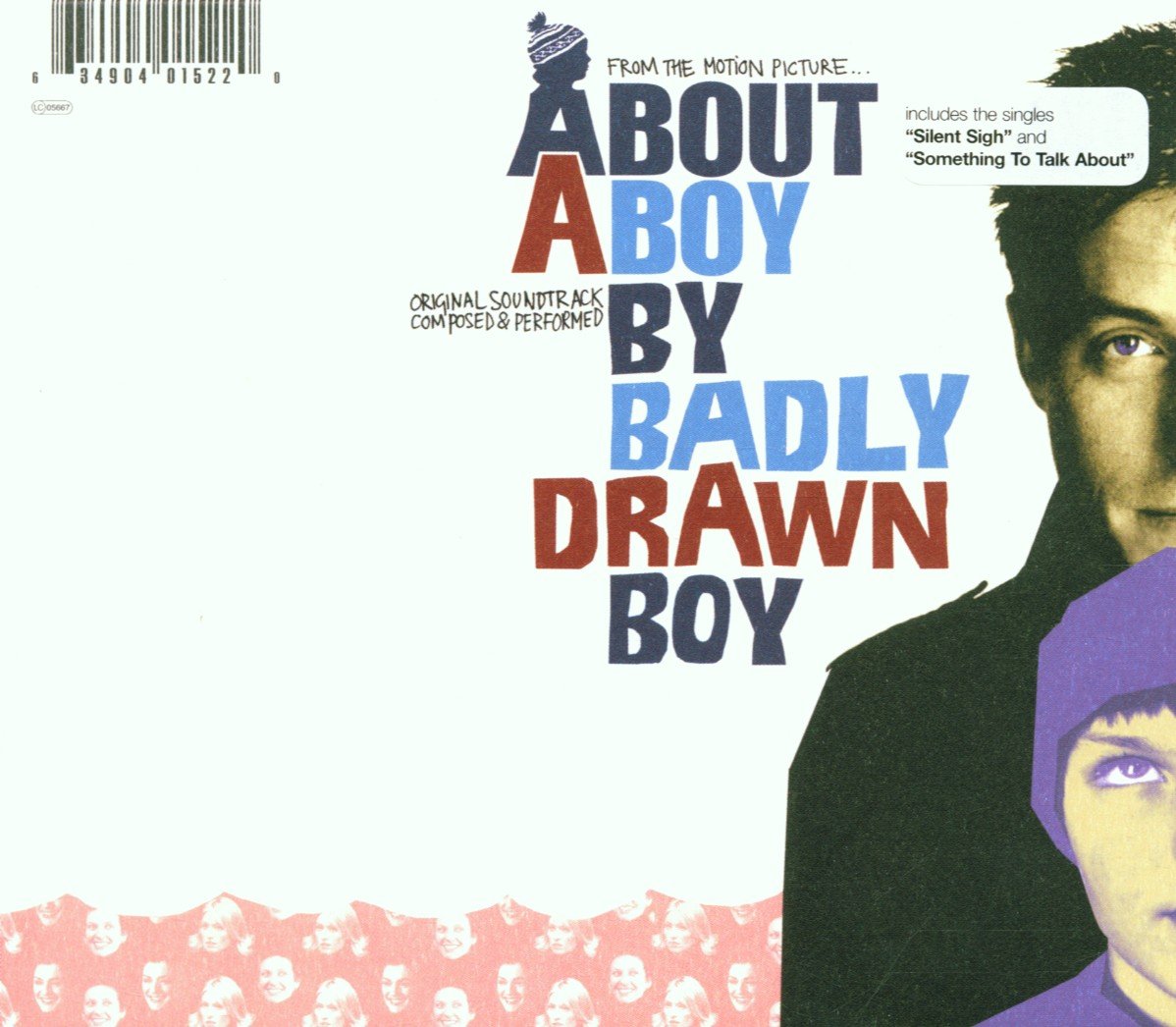
You’ve popped up a couple of times lately on BBC 4 re-runs of Top of the Pops for ‘I Want Your Love’ (1988) then ‘Baby I Don’t Care’ and ‘The Only One’ (1989). Have you relived those appearances lately?

“I have, because wonderfully I started getting messages last Friday night saying I was trending on Twitter in the UK. One of the ‘Baby I Don’t Care’ performances was on. I watched it and was, ‘Whoah!’ I can see why we were successful. It really was great.”

Is it like watching you in a different life?

“No, some of it I remember like it was yesterday. traipsing into the Top of the Pops studios. Some stuff I’ve forgotten completely, and you’d have to remind me, but some is so vivid it was like it was yesterday.”

Riding Tack: Wendy James puts in the hours at home, ready to promote her new LP, post-self-isolation period

Finishing what we were saying about your geographical roots, have you still got strong links to your Norwegian roots?

“Oh God! Where are you picking up this information?”

Well, I always read as wide as I can before interviews.

“Right … well, I was somewhat naïve to discuss being adopted when I was young. When you’re young you don’t realise you have to keep your private life private if you want it to remain so. Having said that, I don’t know who my parents are, but I do know I have a Norwegian birth mother.

“I’ve never wanted to find her or whoever the man is, but once the Brexit thing happened, as a person living and working in Europe quite a lot … the Norwegian passport is recognised in Europe although they’re not a full member state, so I went to their embassy in Paris to ask if I could finally become Norwegian, or have dual citizenship. And the sad truth is that apparently, up until the age of 21 I could have had dual citizenship at any time, but if you haven’t applied before, they strike you off – you’re no longer a Norwegian. I spoke to a couple of people in the embassy and there was no way of wangling that. So my Norwegian roots are gone, sadly. It was not to be.”

It’s been a manic couple of weeks with interviews and other bits and bobs to help keep a roof over my head, so I’ve not had chance to delve too deep into the new LP yet – that’s coming next. But I love the new single, both sides (I’ve since heard the horn-laden, soulful ‘Little Melvin’ too, and like that as well). I’m not sure how charts work these days, but these songs should be all over the place. ‘Perilous Beauty’ has true pop class and raunch in equal measure, taking me back to the likes of The Primitives back in the day, but also maybe Iggy Pop, while ‘Chicken Street’ has the charm of ‘60s girl bands with the added verve of The Cardigans. I love them both.

“Thank you!”

Are those both indicative of the delights of the album?

“Well, ‘Perilous Beauty’ is track two and ‘Chicken Street’ is track nine of the 20 tracks on the album, and the running order is literally the order in which I wrote them …”

Vampish Past: Wendy James, who followed three Transvision Vamp LPs with two for Racine now four under her name

So I gather. That in itself is an interesting approach, one I‘m surprised not many artists take.

“I don’t know why they don’t. It seems like the most organic tracking order you could possibly come up with. It’s the order in which they were birthed.

“With ‘Perilous Beauty’ I remember having a Eureka moment – I think it’s even on my Facebook video clips – where I was playing the demo three years ago, thinking, ‘Bloody hell – I’ve come up with a good one!’ And I was only two songs in.

“You’ll hear when you listen to the whole album, it’s a mixed bag. But you’re gonna freak, because I range from kind of Bacharach and David – with smooth, wonderful chord changes – through to hardcore speed punk. There are also a couple of really soulful ballads and there are so many Motown moments. As a white person I always want to try and get groove into my music, rather than just 4/4 white rock rhythm.

“This is what I mean about the evolution of a person as a musician. I was listening more and more to the basslines of James Jameson, the session bassist for Motown, and it was Glen Matlock who turned me on to him. Even though you’ll think of Glen as a punk, he’s a James Jameson nut.

“All the people I worked with on the last album – Lenny Kaye from the Patti Smith Group, James Williamson from The Stooges, my old boyfriend Mick Jones from The Clash, all of these men and James Sclavunos, my drummer from Nick Cave and the Bad Seeds – have got 15 years on me or whatever, but they’re fucking encyclopaedic about music.

“I’ve been educated through all this … starting with Nick Sayer with Transvision Vamp … always surrounded by male musicians who, if they weren’t musicians, they’d be working in a record shop. They’re fanatical nerds, and it’s glorious – they can tell you the RPM of something, an obscure B-side, or where and when a gig happened. One always wants to make money and all that stuff, but the joy of being in a band or being a musician is the collaborative camaraderie with fellow musicians.

“And if we’re lucky enough to live to ripe old ages, our musical knowledge will be even more. You spread into country, bluegrass, South American music, reggae … there’s so much, and everything cross-pollinates. That’s why Britain in particular is a rather special island for music – because historically it’s an island of ports where sailors came through – or even through the slave trade – with their culture and their music. If it was just left to white English music, you’d just have fucking marching bands! Ha ha! You need some of that culture coming through.”

Is your studio band also your live band?

“Bits and pieces. Some are attached to very successful bands, but I’ve a handful of musicians now that are my permanent musicians, with the exception of James Sclavunos. When Nick Cave says it’s time for a tour, I lose Jim and gain Jordan.

“When we opened for The Psychedelic Furs last October, much as I love Transvision Vamp and the other iterations I’ve been through, for the first time in my life I now have a perfect band. I love them, they look great, they play well, and are incredible musicians. They’re funny, they’re intelligent, hard-working, humble, they pull their weight, they perform like motherfuckers, and I love them. They make me laugh, they make me feel safe, they make me feel secure.”

Do you keep in touch with Elvis Costello and Cait O’Riordan, having collaborated with them on your first solo album (1993’s Now Ain’t the Time For Your Tears)?

“Elvis, I’ve spoken to a bit in my life, and I’ve had one Facebook message with Cait, but that came about because Transvision Vamp played with Elvis Costello and the Attractions, and it was facilitated by the drummer, Pete Thomas, who oversaw the project, even though Elvis and Cait wrote the songs.

“I can’t lay claim to becoming great friends with him, but he did cause me to become great friends with Van Morrison, in a roundabout way. I spent a lot of time in Ireland and Van became my Dublin buddy for a while and used to stay at my house in London.”

That’s pretty cool in itself … even if he’s a bit of a grouch at times by various accounts.

“I’ve seen him be an horrific grouch to poor fans who come up and interrupt him. Ha ha! But he’s a lovely, cantankerous man. And he’s lived in the fast lane … drink and drugs, all that stuff. I can also lay claim that James Williamson, Lenny Kaye and all these people are genuine friends.”

I detected something of an Iggy Pop influence on the new single, so it makes sense in that respect.

“Well, The Stooges, the Stones, the Sex Pistols, The Velvet Underground … you know, that’s my comfort zone.”

There’s been success, but there were lows too, not least being dropped from the big label in 1993. Did that hurt you?

“Not really, because I had enough money in the bank to survive and retrospectively it was the very best thing that could have happened. After the Elvis Costello album – whatever other people think of it – it gave me a very clear understanding from there on in. I wasn’t going to perform other people’s versions of me (from there). I was going to perform my own stuff.

“It was absolutely necessary that I went back to the bedroom and learned how to play guitar and how to write my own songs. And one could never have done that on a contract with a major label. They would have been hustling to put something similar to Transvision Vamp out and keep going. In order to evolve into what we now know as me, it was necessary. And on a human level, I hadn’t stopped working since I was 16, so just had to fucking step back.”

That tale of going back to the bedroom, learning how to play guitar and write songs got me thinking about Mick Jones again, long before The Clash, being kicked out of the band Little Queenie, a hammer blow that ultimately inspired him to rethink matters and start again, as memorably tackled in ‘Stay Free’. But I move on, asking Wendy how touring with The Psychedelic Furs was last autumn. Did she have a good time on the road?

“Yeah, I knew Richard a little from America, sometimes go to his art exhibitions, and the whole thing was a dream from top to bottom. I can’t thank the promoters, AEG, enough for putting us on that tour. Not only were the band playing great, but we had so many laughs and the audiences received us well. And to a man and a woman, the new songs – four or five on this album – went down like crazy, people coming up, genuinely saying, ‘I really like it when you play ‘blah’, but your new songs are amazing’.”

And you seem to be in a good place right now, as a performer and a recording artist.

“Yeah … I really am. Ha ha! I’ve got no complaints. It’s a lot of hard work, and it took three years to make this album, but when you hear the whole album, your socks will get knocked off.”

And seeing as you mentioned him first, are you still in touch with Mick Jones?

“Yeah, I’ll always be super top friends with him. He’s one of my confidants in life.”

I’d love to interview him someday, and would like to think he’s seen my book on The Clash by now … and liked it. Maybe one day.

“Ah well, good luck with that – he’s the worst communicator in the world! He’s never sent a text in his life. You have to phone him about 10 times in a row to get one answer. And he doesn’t do emails either.”

Perhaps I’d stand a better chance getting a season ticket for the next block to him at Queens Park Rangers.

“I would say so … actually, literally, yes!”

Anywhere. It was lovely to talk with you. Hope you’re not in quarantine for a long while from here.

“I’m self-isolating, darling! But I always have done.”

Wendy James’ rescheduled dates: September 3rd – Bristol Fleece; September 4th – Swansea Cinema & Co.; September 5th- Cardiff Clwb Ifor Bach; September 6th – Brighton Concorde 2; September 9th – Cambridge Junction; September 10th – Birmingham Institute 3; September 11th – Stoke Sugarmill; September 12th – Portsmouth Wedgewood Rooms; September 15th – Nottingham Bodega; September 16th – Manchester Deaf Institute; September 17th – Leeds Brudenell; September 18th – Blackpool Waterloo Music Bar; September 19th – Newcastle Cluny; September 21st – Guildford Boileroom; September 22nd – Tunbridge Wells Forum; September 23rd – London Islington O2; September 26th – Glasgow King Tut’s; September 27th – Edinburgh Bannerman’s; September 29th – Norwich Arts Centre.

Queen High Straight is available for pre-order as in 20-track deluxe gatefold double vinyl, gatefold deluxe CD, regular CD and digital download/streaming formats via this link, where you can also find details of all previous recordings and associated art, t-shirts, and ‘all things Wendy’.  You can slo keep in touch via her main website address, Facebook, Instagram and Twitter.

Posted in Books Films, TV & Radio, Music | Tagged , , , , , , , , , , , , , , , , , , | 2 Comments