In which author/writer Malcolm Wyatt jealously guards his own corner of web hyperspace, regular feature-interviews, reviews and rants involving big names from across the world of music, comedy, literature, film, TV, the arts, and sport.
Thrill Me: The Undertones in live action at Hangar 34, Liverpool. Photo: Steve Watson
It’s always so good to catch The Undertones live, with last Thursday night no exception… exceptional as they always are. What’s more, this marked my official North-West big show farewell before an impending move to Cornwall. And coming on the back of Carter, Cook, Jones and Matlock a fortnight earlier in Manchester (reviewed here), it seemed particularly poignant for this long-term fan to catch Derry’s finest again for my 501st live encounter since 1980.
It all unfolded at a new venue to me, involving a stroll up from the Albert Dock, along Jamaica Street towards the city’s Baltic Triangle, taking a more circuitous route than necessary up and down Greenland Street before spotting the spacious but somehow intimate Hangar 34. But while this was my 19th Undertones outing since 1981 and 15th live sighting of the Mk.II line-up since 2000, I’d somehow missed out until now on special guests and fellow punk survivors Ruts DC, the openers for this English leg of the tour and the following dates in Sunderland and Sheffield.
Formed in 1977 as The Ruts, they enjoyed a fair bit of post-punk limelight, revered debut LP The Crack spending its sole week in the UK top 20 this week 45 years ago, on the back of summer of ’79 top-10 classic 45, ‘Babylon’s Burning’. Sadly, a year later we lost frontman Malcolm Owen to heroin, the band having amassed two more hit singles by then, posthumous compilation Grin and Bear It following shortly after.
They soon returned, reconvening as Ruts DC, and while the post-Owen line-up disbanded after two more LPs, originals John ‘Segs’ Jennings (bass) and Dave Ruffy (drums) were back by 2011 and continue to impress, skilfully blending a potent mix of punk, dub, rock and reggae, ‘defying the norm for decades’ as they put it.
Overcoming Anxiety: Ruts DC live at Hangar 34, Liverpool. Photo: Steve Watson
The appetite was clearly there, an earlier show in 2007 seeing Henry Rollins in Malcolm’s place at a benefit for fellow founder member Paul Fox, following his diagnosis of lung cancer (he died later that year, aged 56), an event also involving Tom Robinson, The Damned, Misty in Roots, UK Subs, Max Splodge, and John Otway.
These days Leigh Heggarty provides guitar duties for a formidable three-piece that went down well with this Merseyside audience. Personally, I see them as something of a cousin to The Members, that mix of influences inspiring the original punk movement key to their sound, not least a love of reggae. And as with JC Carroll and co., their new material fits well, not least 2016’s ‘Kill the Pain’ and 2022’s ‘Faces in the Sky’, the opener of that year’s Counter Culture? (the title track also aired at Hangar 34, along with fellow winner ‘Born Innocent’) and this evening’s entertaining set.
Ruts tracks ‘Something That I Said’ (first time I’d heard that new wave blast for a while), ‘S.U.S.’ and ‘Jah War’ also impressed in a dozen-song offering, and their skank-happy ‘Mighty Soldier’ positively smouldered. I prefer not to listen to bands before gigs these days, making their set choices more of a revelation, not trying to second-guess what’s coming. And it worked a treat here, ‘Staring at the Rude Boy’ certainly taking me back, while ‘West One (Shine on Me)’ – the last single with Malcolm – suggested where they were headed, and glorious debut 45 ‘In A Rut’ sounded as vital now and prompted a crowd singalong. All in all, I got a lot of it (out of it, out of it, out of it…).
And while I expected ‘Babylon’s Burning’ to signal their departure, there was time for a storming ‘Psychic Attack’, the opener of Music Must Destroy fusing the spirit of Damned classic ‘New Rose’ encased in Sixties sci-fi guitar on a number I could see The Rezillos – the next special guests on this tour (starting in Lincoln’s Engine Shed on Thursday 17th – take to live. Storming set, fellas. Here’s to many more.
Backstage Shenanigans: The Undertones (sans Michael) and Ruts DC backstage
There’s not much I can write about the Undertones that I haven’t scribbled down before, but seeing them is always a joyous affair, and this adventure on Greenland Street was rather epic. It’s never enough in a live review to list a set then sit back… but I was tempted to. They started with ‘Jimmy Jimmy’ and ‘Girls That Don’t Talk’ and we barely drew breath from there.
Much as I love the first two long players, I’m pleased to see them give further gravitas to the latter-day fare too (from the first and second incarnations of the band), ‘The Love Parade’ there to savour in its purest form before modern ‘Tones classic ‘Thrill Me’ set us off again. ‘Nine Times out of Ten’ and ‘Tearproof’ then had us hurtling back to Hypnotised before exclamation mark punk classic ‘Male Model’ and one of the finest singles by any band, ‘You Got My Number (Why Don’t You Use It!) stopped us in our tracks, the latter released 45 years and one day ago, yet still flooring me.
Then there was Billy Doherty’s wondrous ‘Wrong Way’ and Positive Touch two-piece, ‘It’s Going to Happen’ and ’Crisis of Mine’. I’m always caught out by a couple of songs I don’t expect to pull at my heart-strings so much, and that was the first tonight. Sublime. Speaking of which, we then got the whole of the Teenage Kicks EP, the iconic title track followed by ‘True Confessions’, ‘Smarter Than You’ and ‘Emergency Cases’. At that point, I reckon I needed a lie-down, let alone Paul McLoone and his somehow no longer 21-year-old bandmates. But a rather bizarre intro to ‘Wednesday Week’ after confusion on Billy’s part (not as if Mickey Bradley mentioned it… much) led eventually to that and (as I understand it) fellow wonder ‘You’re Welcome’ being dropped. Ah, well, there’s always next time… not as if I take any of this for granted.
Accordingly, the handbrake was back off for John O’Neill‘s ‘Here Comes the Rain’, which somehow gets better with every airing, then – on a night when the temperature dropped and all the talk was of Northern Lights, ‘Here Comes the Summer’. We were revving up for a big finish by now, lost in the moment on ‘I Gotta Getta’ from the first LP and ‘Dig Yourself Deep’ from the most recent, ‘Family Entertainment’ (deeper in the set than I’d envisaged) and further eponymous elpee delight ‘(She’s a) Runaround’, then ‘When Saturday Comes’, the O’Neill brothers on top form with those searing guitar lines, Billy keeping up on drums and sometimes powering ahead, Mickey’s bass lines continuing to leave me sent, and the ever-theatrical Paul in his element among it all, his banter with Mickey always a bonus. Besides, as Damian O’Neill once put it so succinctly, ‘It’s never too late to enjoy dumb entertainment’.
Digging Deep: The Undertones live at Hangar 34, Liverpool. Photo: Steve Watson
‘Oh Please’ is another example of how Mickey can also still come up with classy songs, and from there we were firing towards a big finish, ‘Girls That Don’t Talk’, ‘Hypnotised’ and ‘I Know a Girl’ as great as ever, ‘Listening In’ another somehow nailing the experience for me, then ’Get Over You’ bringing us to our latest climax with the North of Ireland’s foremost Humming, Leaping and Minging fraternity.
Back they came, ‘Mars Bars’, ‘More Songs About Chocolate and Girls’, ‘Jump Boys’ and ‘’My Perfect Cousin’ a total joy. And okay, that ended up sounding like the list I suggested I wasn’t going to scribble down, but if you’ve read this far anyway, you’ll know you missed out if you weren’t there, and it might reflect what you saw if you were. Furthermore, it might inspire you – if you need that push – to book tickets for any of the remaining dates (see details on the poster below), with either The Rezillos or the Mighty Wah-nderful Pete Wylie in tow.
So, thank you, one and all, and adios for now, Liverpool. I’ll be back, I‘m pretty sure of it, but what a way to go out, three decades after moving to Lancashire. I’m still in a spot. Their spell isn’t broken.
For the latest from The Undertones, links for tickets and details of the band’s live LP, available exclusively at their remaining dates, head here. and for details of the next Ruts DC shows, try their Facebook link.
Pistol Packing: Frank Carter leads from the front at Manchester Academy. Photo: Prentice James
The spirit of ’76, ‘77 and all that written large on a stage in M13. I give you Manchester Academy, 24th September 2024, where punk met heritage rock ’n’ roll, with added panto and theatrical moments, all before an adoring crowd of mostly old ’uns but a few spellbound young faces too.
Two nights after a Glasgow Academy appearance, this was part four of a five-date sell-out tour on the back of a two-evening fundraiser in Shepherd’s Bush in mid-August, and a proper night to remember, and what a way to bring up my 500th gig (no doubt give or take a few I’ve failed to scribble down since 1980) – a three-quarter reunion of the Sex Pistols taking place just off Oxford Road, marking a rather special personal North West farewell outing for a punter who celebrated his 10th birthday the day before Never Mind the Bollocks first hit the shops.
I’ve been lucky enough to interview Paul Cook and John Lydon in recent years, and both were great company and came over so well. But I’d never managed to catch them live. On the afternoon of this epic show though, moving a stack of Mojo magazines as part of my dreaded downsize reorganisation, I lifted the top of a pile and startlingly had Lydon, Cook, Jones and Matlock staring back at me (some more menacingly than others) from 2008’s reunion. As if asking, ‘You coming, or what?’ It was meant to be.
Bass Instinct: Glen Matlock and Frank Carter at Manchester Academy. Photo: Prentice James
And while Johnny has his own thing going on right now, deputy Frank Carter does the job superbly. More to the point for me, thankfully I’ve a good mate still savvy enough (and quick and patient enough) to have somehow snared tickets during that sell-out morning rush a few weeks back. Credit due to Prentice James, who was taking in key punk bands at the Electric Circus in 1977 at the age of 14, but missed out on the Pistols… so here was his chance to triumphantly make up for that, albeit 47 years later.
In my case, my first live gig was in the Summer of 1980, aged 12, at a village hall in deepest rural Surrey. I already knew my way around the new wave jungle at that point, thanks to an older brother and his mates, and the band I saw that night – Blank Expression, schoolboys themselves but crucially two years older – exuded punk rock for me, pitched somewhere between the Pistols, Buzzcocks, The Damned, and The Stranglers. They sadly lost their lead singer, my old friend Chris Try, last year, at far too young an age, but back in the day he carried that trademark Lydon sneer to a tee, and Frank Carter too has that quality, adding the energy required here. Mind you, let’s face it, how wrong can you go backed by a band featuring legendary trio Cook, Jones and Matlock?
We headed for stage right front not long before showtime, so were in a prime spot to catch Glen, effortlessly cool as you like, in full flow, even if the initial soupy nowt but bass and drums sound belied the fact that Steve Jones was just the other side of that speaker stack, giving it his six-string all. But from LP and gig opener ‘Holidays in the Sun’ and ‘Seventeen’ onwards there were miles of smiles, frequent audience sing-a-longs, and it was nostalgia central without added schmalz… even if we were inevitably dragged into the dewy-eyed sentimentality of just being there to drink it all in.
Stood in the lobby of the Students’ Union building next door, earlier, looking out for Pren, that line ‘Now I’ve got as reason, and I’m still waiting’ sprang to mind. And any doubts I might have had about the prospect of this line-up were soon put to bed, our pre-show anticipation truly matched by the performance.
Jonesy stepped forward enough through the show to see plenty of him, and eventually the sound improved where we were stood. The Lonely Boy from Shepherd’s Bush and Battersea and his bandmates adored by 2,500 like-minded souls. Meanwhile, as if perched above a gap in the PA’s twin towers, I occasionally caught sight of a super-animated Cook, that craggy visage every bit as recognisable as the glorious trademark pounding beats he supplied. And then there was Frank, seemingly not at all over-awed at any responsibility on his far younger shoulders (okay, he’s 40, but his bandmates are now in their late 60s), adding a full-on live presence and enough youth to make this work. All of that would count for little without a voice, of course, but he pulls that off too, doing his own thing without having to resort to any Stars in Their Eyes take on Lydon. Just the way it had to be – there’s only one Johnny Rotten and only one John Lydon. What’s more, Hemel Hampstead Frank’s antics allow his more illustrious bandmates to just get on with their own thing, heads up and occasionally down no nonsense, mindless boogie (hats off there to Manchester’s late great CP Lee, of Alberto Y Lost Trios Paranoias fame)… and what a glorious racket they all still make.
I can’t recall when Frank first lunched himself into the crowd. Glen didn’t look too worried. Was it at the start of ‘Pretty Vacant’? That was certainly one of many glorious moments, as of course was fellow crowd pleaser ‘God Save the Queen’. Soon, Frank was surfing on a sea of upturned hands, and then he disappeared… but the strong vocals remained. He eventually returned though, and the second time around he helped form a rather chaotic circle out there in the melee (I knew he was there, but all I could really see was a punter with a Rebellion-like punk cockerel cut going round and round, like a demented shark closing in) on ‘Holidays in the Sun’ flip-side ‘Satellite’. Jonesy, peering into the crowd at the end of that number, enquired if ‘Frankie Baby’ was staying put for the next ‘un, ‘No Feelings’. He decided he was , and I’m not even sure if he was back in time for the start of ‘No Fun’. They were certainly having fun though, all four of them I reckon.
The full set? Well, it comprised all of Never Mind The Bollocks, a couple of B-sides and The Great Rock ‘n’ Roll Swindle’s stand-out ‘Silly Thing’ plus first encore ‘My Way’ (Frank owning the vocal like Sid never truly did, his outfield bandmates sat down until the climax). And from the aforementioned opener right through to rousing show-stopper and LP closer ‘EMI’, before a brief exit (I could see Jonesy between stage and dressing room, and he seemed a little stiff, shall we say, the workout clearly punishing, but certainly looked fresher and fitter than a decade or so ago), it was a blast, the set inevitably ending with ’Anarchy in the UK’, still so fresh 48 years give or take a few weeks since it was first nailed in the studio at Wessex Sound. What a great night. Cheers, lads. You’ve been missed. Those with tickets for the remaining show tomorrow night at Kentish Town Forum (Thursday 26 September) are in for a treat.
Four Most: Paul Cook, Glen Matlock, Frank Carter, Steve Jones take a bow. Photo: Prentice James
Tapping On: Slady in live action at Vinyl Tap, Preston. Photo: Alan Doyle
Can it really be a staggering 44 years this weekend since Slade’s Reading Festival rebirth? Apparently so, the Black Country’s finest spectacularly seeing off the critics in what proved to be the inspiration for an 11th-hour career resurrection, acceptance from a hard-nosed hard rock crowd paving a way for what turned out to be three final years of live shows for Nod, Jim, Dave and Don, that appearance the launchpad for a bolted-on couple of phases of the band, with more hits and more unforgettable live shows.
At the age of 15 I was lucky enough to see one of those shows, the band in full pomp at Hammersmith Odeon in December 1982, the classic line-up only touring once more in the UK from there. That marked my lucky seventh live outing since the summer of 1980, while Friday night was, (give or take a few I’ve failed to record) No.499, and it was somewhat poignant that it involved all-female four-piece Slady, a band that for my eyes and ears carry the true spirit of Slade all these years on, and of whom I heartily recommend a night or two in the company of.
It was great to see Noddy back on stage after his recent health problems last summer in Salford with Tom Seals and his big band. I’ve also had the pleasure of long chats in recent years with Dave, Don and Jim, and it’s lovely to see them all still working on various projects. But when it comes to full-on live spectacles that take you back to the beating heart of Slade, look no further than a cracking act with roots in South Wales, Southend-on-Sea, East Sussex and West Norfolk, on this occasion pointing towards the Magnetic North (a trip to a gig on the Fylde coast at St Annes Music Festival following) at a launch night for their latest single.
In my case that only involved a 15-mile round-trip from my Lancashire base, at a watering hole new to me in the heart of Preston’s university quarter, the Vinyl Tap on Adelphi Street not far off equidistant from three more venues that have played an important part in my gigging years around the city – The Ferret (‘saved’ last year from closure by a heart-warming Music Venue Trust-backed community campaign), The Adelphi, and currently dormant ex-uni hub 53 Degrees. And the Tap is another winner on this evidence, the kind of pub outlet sorely needed by emerging and established acts and punters alike.
Platform Roots: Slady get down and get with it at Vinyl Tap in Preston. Photo: Prentice James
True, in this case, the clientele was largely older, but there was enough youth in the headliners’ line-up to fool most of us that we were back in Slade’s early Seventies pomp, an impressive turnout welcomed on board a veritable time machine on a night when the girls’ infectious treatment of such classic songs brought miles of smiles, their love of performing, meticulous appreciation for the finer points of a grand back catalogue, and a storming live show plain for all to see, hear and taste.
Must I paint you a picture, as Billy Bragg asked? Well, here we have four consummate professionals who not only look the part but also nail the sound and (yep, that word again) spirit of the originals, bringing out the best of that wonderful Holder/Lea repertoire (the occasional Powell classic also featured) and live electricity of the band themselves in those halcyon days.
I’ll start with self-dubbed Gobby Holder, aka Danie, who really rules the roost (admit it, you said that in a Neville Holder style, right?) and was on fine form, that amazing voice (a Welsh thing, right?) leaving first-timers and regulars alike open-mouthed, the lady towering over us in killer platform boots, Nod’s trademark red shirt, braces, check trousers and mirrored top hat get-up (and get-with-it) wonderfully conveyed. At times, I worry for that vocal treatment (for instance, she seemed to have nowhere to go on ‘Born To Be Wild’, having opened on such a high note that the glass ceiling needed gaffer-taping back together within a minute), but she saw the night out in style.
Then there’s Jem Lea (Wendy), to her right and our left, ever dependable, laying down such stonking basslines that make you realise – not as if many of us needed reminding – how beautifully constructed Jim’s songs are. And as well as those cracking harmonies and backing vocals, she also steps up to the mic for the undervalued ‘When the Lights Are Out’, the Slade single that got away.
New Noize: The latest addition to the catalogue, courtesy of Sladydor Records
It’s something of a cliché to talk about engine rooms in bands, but Jem’s underpinning task is made far fluent through Slady’s stand-in Donna Powell (Kēra), the youngest of the quartet (I’d venture) in her element back there in Don-esque waistcoat, the smiles on band faces somewhat infectious, even catching out the more jaded live show veterans and miserable gits among us. And then there’s Davina Hill (Dawn), again playing a part to perfection – visually and sonically, bringing new life to H’s guitar parts and injecting plenty of her own innate stage presence into the mix. Much more than just a six-string denizen in eye-catching silver catsuit. Sparkling, to be sure.
As for that set-list, I never wrote a word all night, so bear with me, but with their musical prowess and stage allure where could they go wrong? ‘Take Me Bak ‘Ome’ set us on the right track, and from there, hearts regularly skipped random beats, with many highlights. ‘Coz I Luv You’, ‘Look Wot You Dun’, ‘Mama Weer All Crazee Now’, ‘Bangin’ Man’, ‘Skweeze Me, Pleeze Me’… the latter’s tweaked lyrics placing us firmly into a brave new century, Gobby letting it be known, ‘When a girl’s meaning ‘Yes’, she says, ‘Yes’ (not ‘No’)!’
On we went, the magic of Slade Alive brought to life on ‘Hear Me Calling’, ‘Know Who You Are’ and the afore-mentioned Steppenwolf cover. Hell, they even made ‘We’ll Bring the House Down’ and ‘Run Run Away’ sound cool. Some feat, that. I’ve a feeling, scribbling this now, there was ‘Move Over’ and ‘Just a Little Bit’ too, but maybe I dreamt that. The power of Guinness Zero, perhaps. And of course, B-sides were always important for Slade, so we got an outing for self-penned ‘Dig Me’, from their take on ‘Cum on Feel the Noize’, much of the calibre of those classic original flipsides. And somewhat as a tribute to Reading ’80 there were teases about ‘Merry Xmas Everybody’ being played on an August Bank Holiday weekend, before the band instead launched into its B-side, ‘Don’t Blame Me’.
Another personal highlight was ‘Gudbuy t’Jane’, their sign-off before a nailed-on encore featuring the new single and ‘Get Down and Get With It’. And while I might have got some of that out of order, that’s not important. Long may they continue to rock it, roll it, and reign over us. Nod bless our Slady.
Slady’s Gobby Holder and Jem Lea, aka Danie and Wendy, feature in this scribe’s Wild! Wild! Wild! A People’s History of Slade. You probably knew that, but wait… you’ve not yet got a copy? Well, now’s the time to remedy that, messaging me or ordering direct via the publisher’s link.
You can also order Slady’s new single here, following them online via Facebook, Instagram, and their own website, seeing where they’re at next (next up, I understand, is The Betsey Trotwood in London EC1 on Sunday 8th September, Gobby and Davina rocking out live acoustic Slade tunes in the company of fellow Slade author Daryl Easlea. And you can catch the promo video for the new single, shot at The Marquis in Covent Garden, here.
Distant Echoes: Echoes of The Bunnymen at the Conti. Photo: Lottie Wyatt
I was nervous enough ahead of this live show, let alone the band. Four fellas with deserved acclaim for their own adventures in music tackle a tribute set to a much-loved Liverpool outfit with such a revered back catalogue… and then word gets out just before stage time that the legendary guitarist behind that iconic group has showed up to see just what’s in store.
As I caught up with a couple of mates in the corridor on the approach to the Boatyard venue at the rear of The Conti, there was Scott Carey, bass player of some repute (latterly of West on Colfax and prior to that Paris Angels) balancing a couple of pints on his way past.
‘Ah, didn’t expect to see you here,’ I remarked, with a little of that poorly executed dry humour that is often my downfall.
‘And I didn’t expect Will Sergeant to be here,’ he responded, a little of that thousand yard stare associated with Viet vets in his eyes.
A few minutes later, queuing to go through, there’s past WriteWyattUK interviewee Will in front. What must he have been thinking… and what must the band have been wondering? Too late to pull out now. And yet, any fears on ours or their part were soon proved unfounded, this very public unveiling of Echoes of the Bunnymen – comprising WriteWyattUK favourites The Amber List with the aforementioned guest bass player – something of a triumph, and hopefully to be repeated again soon.
They didn’t go about this as any ‘run of the mill’ tribute act might. l was going to start this post with, ‘I don’t usually do covers bands, but…’ I’m sure I’ve already done that though. And in this case, we’re talking a four-piece of considerable merit and pedigree with a proper respect for the original group and the songs covered, their set spread across four vital LPs between 1980 and 1984 that paved the way and influenced so much more great post-punk indie magic beyond.
I guess as I knew he was there, I was listening – in my head – with Will’s ears and eyes, wondering just what he might make of it all. Yet if he or us were just expecting hits, we’d have been pleasantly mistaken. ‘Going Up’ and ‘Show of Strength’ saw us away, followed by my first real highlight, ‘Heads Will Roll’, all the proof needed that we were in for a storming gig, ‘Turquoise Days’ then leading to the wondrous ‘Silver’ before ‘Stars Are Stars’ and ‘Crocodiles’ brought us to the sublime ‘Ocean Rain’.
As is often the case at such social events, softer touches lead to incessant talking closer to the bar, but that was neatly shut down – with more polite humour than most of us could manage – by frontman Mick ‘Mac’ Shepherd, that latter fourth LP title track reminding me I’m long overdue in playing that wonderful album in full again, to dive back into its many depths.
Honourable mentions for the afore-mentioned Scott Carey and drummer Simon Dewhurst. Les Pattinson and Pete De Freitas’ shoes, and all that. As for Mick, his voice lends itself well to the experience, and not at one point did I feel this was beyond any of them. Turns out Tony Cornwell, on lead guitar, didn’t know Will was there until after. Probably a good thing on his part, confidence wise. He certainly cracked it though, and word has it the guest of honour loved it, fully endorsing the project and by all accounts happy to bask in the glory of those songs from a distance (not least a few they don’t tend to play these days). He was certainly swapping notes by the bar later.
There were plenty of A-list hits, ‘Killing Moon’ and ‘Seven Seas’ lovingly rolled out before ‘Villiers Terrace’ led to ‘The Puppet’ and ‘Do It Clean’, then ‘The Cutter’. ‘Rescue’ was in there somewhere too. Wonderful. ‘Is this the blues I’m singing?’ asked Mick. Certainly was, and in some style.
They’d hardly walked a few yards from the stage before they were back to close out, ‘Pictures on My Wall’ leading to a lap of honour on ‘Bring on the Dancing Horses’. Hopefully we’ll see them back again soon, and a fair few of us will be there again. ‘Wherever they may roam,’ you could say.
Special Guest: Will Sergeant after the show with Tony Cornwell. Photo: Scott Carey
For more about Echoes of the Bunnymen and forthcoming shows, head here.
I love reading around a subject while writing, and work on my book about The Jam has me not only returning to or finally delving into various other publications about the band, but also reliving the years around which they were together (1972 to 1982) and immersing myself in extra background concerning a Surrey patch barely half a dozen miles from my own Guildford roots.
And among the best biographies, appreciations, and invaluable first-hand accounts, I’ve devoured two books that until now sat on the shelf unread, finally thinking the moment was right.
My better half and I became foster carers in 2022, another key reason why I felt the time had come to tackle Paolo Hewitt’s memoir of his Woking children’s home days, The Looked After Kid and its follow-up, We All Shine On. And it’s fair to say both publications truly nail the subject – providing an extra layer of understanding to something I felt I already knew plenty about, a few key points on our own recent bumpy journey making more sense.
It’s not the right place to go into detail, but we’ve been on numerous county council-run courses regarding children in care and how to learn from all that and add your own positive life experiences to the mix, so as to best pass on some of that learning and understanding to less fortunate young people who miss out on basic building blocks along the rocky way.
We’ve spent valuable time getting to grips with the realities of all that, enriched by it all, and – for all the low points – gaining so much from the experience. Yet I felt I learned a little more from a skilled writer who’s been there and knows the subject so well, a Looked After Kid who somehow found his way out of the wild, wild wood, as an old friend might have put it.
In many ways, I reckon I’ve been the lucky one. Brought up in a solid working-class family with very little money to spare but always lots of love to go around, with plenty of friends and family I could count on. Paolo’s own background was much harder, personal circumstances and the bigger system letting him down time and again. However, he ultimately beat the odds, I feel, making his own positive impact, proving his own sense of worth and finding that love for himself.
For all our disparate beginnings, we have much in common, from shared geography to the cultural and sporting influences that inspired us going forward. Music and football clearly had a pull on us, and alongside Paolo’s enduring passion for all things Tottenham Hotspur and SSC Napoli, there’s a nostalgic appreciation of Woking FC too, his grounding there long before I became a late-Eighties Kingfield regular. As for the music, he first properly got to know The Jam just as they were making their first successful forays on the London scene and pretty soon followed suit, getting to know the chief songwriter along the way, a friendship developing. It seems it was rarely a cosy relationship. Complicated might be a better word. But there was plenty of love too, and he saw in the Weller family dynamic something missing from his own upbringing.
In a sense, Paolo – who turned 66 this week, just under seven weeks after a certain Paul Weller – got the writer’s life I felt I craved in my teens. I finally went down the regional journalism line in my late 20s after several years of office jobs and working for weekends, travel and holidays, until then making do with penning my own fanzines and scribbling away on the novels and scripts while going large on life experiences. Paolo’s own path took in the halcyon late Seventies, Eighties and Nineties days of the Melody Maker, the NME and further afield, writing on many subjects dear to my own heart. But there was always something else there driving him, and it would take him a long time to get to grips with his past and his beginnings.
Sitting Comfortably: Paolo Hewitt, whose first national music press features landed 45 years ago
And despite the picture I paint of my own relatively safe and certainly contented upbringing, I often wonder if Paolo’s early fate could have been mine. I revisit key parts of my mum’s life story, going back to Reading, Berkshire (notably losing her mum to TB when she was barely five, her dad soon marrying again, ultimately keeping the family together) and see a girl who could so easily have ended up in care and in an orphanage, maybe even shipped across the Commonwealth, possibly landing with non-deserving foster or adoptive parents. I also revisit key parts of my dad’s early years in Woking, and there are further elements there. From his days as a steam loco fireman through to 30-plus years as a postman and beyond, I think he was acutely aware that the break-up of his parents’ marriage might well have seen his destiny change for the worse. But here were a couple who stayed together long enough for him to find his own way. In fact, love overcame in both cases, my folks taking that on with their own family, the fate of us five Wyatt children (and the nine grandchildren and three great-grandchildren that followed) testament to that.
Other parts of Paolo’s Burbank books similarly resonate, such as the tale of his good friend Des, who has a close link to a long-time friend of mine (and fellow Woking FC fan). I’ve since learned that Des had some of his happier later years in the village I grew up in. Then there are Paolo’s words about the first children’s home he knew, in the next village to my own, where I was meeting schoolmates around the Jam breakthrough years, not so long after his days there. Small world, and all that.
Back on the Woking front, so much of what I equate the town with today (my family links go back to the 1890s, my dad and Wyatt grandparents born and brought up there, my nan still on Arnold Road a century later) is encapsulated in Paul Weller’s songwriting. For me, songs like ‘Saturday’s Kids’, ‘That’s Entertainment’, ‘Town Called Malice’, ‘Liza Radley’, ‘Tales From The Riverbank’ and ‘Wasteland’ (without even delving beyond 1982) couldn’t be about anywhere else. Yet they clearly resonate with so many more outside our bubble (and I get that, in the way so many songs resonate with me that were written in – off the top of my head – Birmingham, Coventry, Liverpool, London, Manchester, Norwich, Sheffield, Wolverhampton, Belfast, Derry, Cardiff, Edinburgh, Glasgow, New York, Toronto, Brisbane, Melbourne, Sydney, Te Awamutu…). Maybe it’s what Paolo called in our recent conversation (not without affection), ‘that small town mentality’. And while there’s very little about the rise of The Jam in The Looked After Kid and We All Shine On, those books are also integral in revealing more about a Place I Love – for all its negatives – and have got to know fairly well.
As for Paolo’s autobiographical forays into writing about the care system, they’ve served to make more sense of my own recent involvement on the edge of all that, giving added understanding as to what we’re occasionally dealing with, and that alone proves those publications invaluable for anyone wanting to grasp what it was like to grow up in care in the Sixties and Seventies. In fact, in any era.
It was only recently that we spoke for the first time, and for two blokes who’d never met there was a lot of reminiscing about old times and new, mostly drawn around similar influences, inspirations and mutual friends and acquaintances. Paolo is more geared towards scriptwriting these days, partly in recognition of realisation that so few authors make a living from their craft today. But we talked openly about all manner of things, not least on football, including recollections of Ken Oram and the Woking FC link (Paolo has his own blighted past with Woking FC, as readers of The Looked After Kid may recall) to Chelsea player turned trainer Harry Medhurst, Paolo’s championing of Spurs striker Martin Chivers in a brief audience with Peter Osgood as a kid, Alan Mullery and Jimmy Greaves’ fear of Millwall fans, and legendary cult hero Robin Friday (who he reckons he saw play at Woking in Hayes days… or hazy days, maybe), who had many of his best sporting moments at Elm Park, Reading, less than a five-minute walk from my mum’s childhood home.
Many of you will know Paolo co-wrote The Greatest Footballer You Never Saw: The Robin Friday Story with Oasis bass player Paul McGuigan (Mainstream Publishing, 1998), and later helped Martin Chivers with his autobiography, Big Chiv: My Goals In Life (Vision Sports, 2009). In fact, he mentions the latter in But We All Shine On, a side-story I feel neatly sums up that ‘living the dream’ mentality he has for his craft, recalling a first return to his children’s home in Woking, and the bedroom where he spent so much of his teen years.
He writes, ‘I looked at the wall on the right and remembered a picture I had hung on it of David Bowie. I recalled lying on the bed for hours looking at that pic of him as Ziggy Stardust, trying to work out what song he was playing at that exact moment in time, where he was, what he was thinking. I did the exact same thing with my poster of the Spurs centre forward, Martin Chivers.
‘In the picture, Martin was either receiving the ball or passing it. I spent hours wondering what game he was playing in and where the ball was going next, and was he about to score, and who was the opposition? I never did get the answer, but two years ago I met Chivers. My agent called me and said he wanted to write a biography and they were looking for a writer.
‘We met him at a hotel in London. I could hardly look at him. When my agent told him that he was a hero of mine, I actually blushed and looked away. I got to write the biography with him and throughout the whole time I spent with him in his car, I could never tell him about my past and what he meant to me.
‘Chivers once played for Southampton FC. In April 2009 we went there together to interview some of his old team-mates, get information. We caught the train from Waterloo. And it stopped at Woking. Burbank stood half a mile away. I could not believe it. For two minutes as Martin spoke, oblivious to my position I sat there thinking to myself, My God, if you had told me back in Burbank that at some point in my life I would be sat on a train in Woking with Martin Chivers, I would have thought you were mad.
‘As the train slowly slid out of the station I said a little prayer, one of thanks, one of gratitude, that life could be as wondrous as this. That book, his biography, started here in this bedroom.’
The day we spoke, Paolo’s young lad was at home, our conversation briefly curtailed as he made him a wrap for his lunch.
‘Jam or Brie?’ he asked.
‘Jam, please’ came a muffled voice in the background.
‘Well, there you go, Malcolm!’
There’s no getting away from it, is there.
‘There’s not, is there!’
Speaking of which, some subjects we steered clear of, other than conversational mentions of moments like him nipping upstairs to at Michael’s to see the band in the early days ‘with a disco underneath and a gambling club upstairs.’ Or Rick Buckler giving out Jam badges at the Nashville when they started making their big move on London. Or a brief mention of the ‘doddery old colonel’ who ran the Cotteridge Hotel in Woking, one of the band’s old drinking holes.
In response to mentions of the parts of town I knew best, he mentioned his own ’15-minute walk straight down the hill to Kingfield.’ But somewhere along the line there was a visit to the Civic Hall on my Guildford patch to see Dr Feelgood, Wilko Johnson’s guitar playing the inspiration needed for Paul to make that next step up (at a gig Paolo also attended).
In my 2002 edition of The Looked After Kid, a certain ‘PW’ – the musician who’s just released his latest solo album, 66, in a summer which will also mark that birthday milestone for Paolo – gets a dedication (referred to as ‘mio fratello’), but within a few years their friendship was behind them, something Paolo respectfully has no wish to air in public, despite this Cappuccino Kid being right up close and personal towards the end of the Jam years and into the Style Council era.
I stood little chance of getting Paolo to reveal much new there, on the record (so to speak), although not really for any other reason than he’s written so much in detail about the band already, starting in book form with authorised biography The Jam: A Beat Concerto (Omnibus Press / Riot Stories, 1983), before taking the story on in Paul Weller: The Changing Man (Bantam Press, 2007).
Both books I found indispensable. A Beat Concerto was the one I lapped up as a teen. In retrospect, it’s way too raw and came far too soon, the wounds still open. It certainly went down poorly with Bruce Foxton, judging by my correspondence with him in those years (part of which ended up in my first real interview for my Captains Log fanzine). Rick Buckler clearly felt the same way, and a decade later The Jam:Our Story (Castle Communications, 1993) saw a published response from the other two-thirds of The Jam that arguably re-opened those wounds, the Saxa to the fore.
As for The Changing Man, I do wonder if it’s healthy to write about someone you know so well. I’m sure Paolo has pondered on that. But for me, that biog and John Reed’s Paul Weller: My Ever Changing Moods (Omnibus Press, 1996) are so important in understanding the bigger picture. And there’s real insight on and love for the subject from Paolo, some of which was possibly overlooked by those seeking more salacious detail. As I said, complicated is the word, but I like to think Paolo and John’s books – written by insiders and outsiders, arguably – ultimately celebrate a unique talent and neatly examine where he came from and what makes him tick.
As for his Burbank books, I won’t go into too much detail (I am 22 and nine years, respectively, late with my reviews, after all), but in The Looked After Kid, Paolo re-examines his life from his 1958 arrival to his move to London and a writing career. It’s inspirational and heartening, and while it was probably lined up on bookshop shelves alongside more harrowing ‘Daddy, don’t’ books, it’s often funny, it’s entertaining, and it’s thought-provoking. As all good biographies should be, right? As Irvine Welsh put it, it’s ‘an uplifting story about refusing to give up on your dreams’.
It was certainly a brave book to write, no doubt emotionally exhausting for its author, but with time to dwell on it and plenty of praise following, a follow-up was somehow inevitable. And But We All Shine On did that wonderfully, Paolo providing not only great writing but also sensitivity, tracking down a few fellow children’s home friends then asking them about their lives, with often revealing, extremely open responses. Again, words like inspirational, powerful and moving don’t quite do it justice. In the wrong hands, it could have seriously misfired, but once more, there’s humour and colour, and there are fully formed characters you feel real affinity with. As poet and writer Lemn Sissay put it, ‘With his pen Paolo projects light on the darkest path as he seeks the family that never was and unravels a tragic, comical, magical and moving story.’
It turns out that plans are afoot (fairly advanced) to bring The Looked After Kid to the stage next. Meanwhile, Paolo is busy with his own writing and research, three scripts currently in circulation (‘two film scripts and a TV pilot… one about a tailor, one about Little Italy, one about a ten-year-old boy living with an alcoholic mother.’). Then there’s a project he first previewed on social media a while back, one which on his 66th birthday yesterday, he revealed a few more details about. As the man himself put it, he’s ‘going live’. I’ll let him explain…
‘Using seven of my books (on Oasis, Steve Marriott, Robin Friday, and others) plus stories from my music press past, I am going to put together a reading and take it out to the people. I’m currently talking to venues in Buckinghamshire, London, Glasgow and Birmingham, sorting out ticket prices and sales as we speak. Very much looking forward to it as well. Going to put a lot into this.’
Sounds like another winner to me. Regarding the music press days, we’re talking a ‘collection of stories about my work on the music press, 1979-90,’ Lot of big names there – Prince, Springsteen, Strummer, The Specials, to name a few.’ He initially looked to crowdfunding and was ‘very moved by the response I got’, but reckons he was ‘too lazy, should have pushed it more.’ This time he’s determined to get there though.
That timeline stretches from November ’79, to be precise, and that will ring a bell for Jam fans, his review on the (almost) secret ‘John’s Boys gig at the Marquee early that month carried in the following edition of Melody Maker and leading to a commission for a feature-interview with the band themselves soon after around their Manchester Apollo double dates. And that’s what’s been keeping him busy in the British Library lately, seeking out his music press features, reacquainting himself with his past works. It will certainly include some impressive copy, judging by my own memory of the many impressive interviews carrying his byline in the years that followed.
We did touch a little more on his Burbank days in conversation, how it was ‘probably 20 kids and three staff’ then, but now ‘three kids and 20 staff,’ a change he heartily commends. And then there were the nuggets of advice on understanding the ‘looked after child’, or in current parlance, ‘the child looked after’ (the child always comes first, you see). Above all else, when he recalls those days in Woking, he reckons it mostly involves happy memories and laughter now, and voyages of discovery, not least about being turned on to new avenues in music and recalling the enduring friendships that were carved out back then.
Which somehow reminds me of Only Fools and Horses, the regulars reminiscing after a drink-fuelled reunion night out, back at the Trotters’ flat, self-proclaimed midfield dynamo Del Boy recalling the school football team they had in The Class of ‘62.
‘We had Denzil in goal, we had Monkey Harris left-back… we had camaraderie…’
And Trigger cuts in, ‘Was that the Italian boy?’
Here’s to the next chapter, Paolo. Looking forward to our next catch-up.
Road Trip: Paolo Hewitt is destined for the literary trail, 27 books and many features down the line
For the latest from Paolo Hewitt, head to his website here.Meanwhile, if you have a story to share about seeing The Jam back in the day, or would like to pen an appreciation of the band and the impact they made on your life, and you’d like to be included in Solid Bond In Your Heart: A People’s History of The Jam (introduced on these pages in this feature), please drop me a line via thedayiwasthere@gmail.com
The Weekend Is Here: From The Jam at Preston’s Flag Market. Photo: Michael Porter Photography
‘Hello hooray, what a nice day…’
Forty years to the week from my first live solo sighting of Bruce Foxton – at Guildford Civic Hall on his Touch Sensitive LP tour – the Flag Market in Preston was transformed into Nostalgia Central for this punter, the ‘Manchester Rain’ forecast by Steve Diggle’s second-on-the-bill Buzzcocks staying away on this occasion, the impressive setting (Preston’s own Cenotaph to the left of the stage, the Sessions House to the right, the Harris Museum, Art Gallery and Library over our right shoulders) a fitting backdrop in the four hours I caught of an impressive heritage meets locally-honed talent line-up on a grand spring day.
Commitments elsewhere ruled out my latest encounter with WriteWyattUK faves The Amber List, first live sightings of Beach Mountain and Ginnel plus many more Lancashire-based guests, but I at least arrived in time to hear the crowd roar along to the unmistakeable heavy metal thunder supplied by Evil Blizzard (if a band who wear face masks can be described as unmistakeable) as I strode along Lancaster Road looking for a way in (30 years after I was at that end of town for my first Preston work engagement, a banking role that inspired me within a year to quit the day job and enrol at the local uni).
In an event curated by Preston’s Business Improvement District organiser Peter Alexander – from the city’s not far off Blitz nightclub – and due to take place in the same location last summer but then pushed back, at first inside the nearby Guild Hall then shifted back outside after a discovery of RAAC at that venue, the Blizz were concluding their be-masked thang as I snuck closer to the stage, the grotesquely-grand PIL-popping finale ‘Are You Evil?’ blasting out. And while the open-air aspect perhaps wasn’t working in their favour from distance, they left an indelible stamp on the proceedings, even if their trademark claustrophobic intensity was maybe lost on many of the uninitiated milling around by the food stalls and bars. There were enough fans to see them over the line though, terrace-like chilling chanting ringing out across the square and into the side-streets.
Blizz Kids: Evil Blizzard at the Preston Weekender. Photo: Michael Porter Photography
Getting closer was the key, I realised, and the same applied for next act Space – the nearer you got, the better they sounded, this punter consequently inspired to return to first two LPs Spiders and Tin Planet (accounting for two-thirds of a 15-song set here), two of my first purchases when I finally succumbed to the CD era (well, you can’t rush into these fly-by-night fads), part-soundtracking my early days in this beautiful neighbourhood, as frontman Tommy Scott would have it.
They were a three-piece on this occasion, increasingly impressive as the set unfolded, even though as with the other acts you had to be near the front to get the full effect, the latter half of the set more convincing for these ears, Tommy’s earlier virtual duet with Cerys Matthews (the Catatonia chanteuse’s lines for ‘The Ballad of Tom Jones’ played over the PA in what he called their ‘cabaret moment’) low-key in comparison to later crowd-pleasers like the top-notch ‘Female of the Species’, ‘Me & You vs the World’, a gorgeously out-of-hand ‘Violence is Art’ (by Tommy’s side-project The Drellas) and the aforementioned ‘Neighbourhood’.
The jury remains out for many regarding a post-Shelley Buzzcocks, but they gave it large, Steve Diggle – a few days short of his 69th birthday and close to the release of his Autonomy memoir – in his element, the champers backstage clearly ensuring it wouldn’t be a case of ‘no showy’ and ‘no band on’. Okay, so the crowd were often clearer on diction amid renditions of a flawless back-catalogue mixed in with a few recent additions, but I’m all for celebrating that wonderful legacy. ‘What Do I Get?’, ‘I Don’t Mind’, ‘Everybody’s Happy Nowadays’, ‘Promises’… oh, man, that was just the opening salvo. And while their Preston Weekender performance wasn’t up there with past live highlights, they gave it their all, inevitably finishing a 13-song set with ‘Ever Fallen In Love (With Someone You Shouldn’t’ve Fallen In Love With’) and ‘Steve’s ‘Harmony In My Head’, setting us up nicely for the headliners.
Beautiful Neighbours: Space at the Preston Weekender. Photo: Michael Porter Photography
Okay, there are lots of gesturing to the sky moments from the ‘Cocks original these days, live music equivalents of Frank Lampard Jr. goal celebrations, but he’s still out there, doing it, kept younger by his band, and playing with a smile on his face. Fair play. Besides, I’m not doing the same things I was when I was 10, so why should he be out to replicate what he was an integral part of in the late ’70s (when this was all just ‘nostalgia for an age yet to come’)? He’s never claimed he’s Howie or Pete. And you can always play those classic LPs at home.
With both the Buzzcocks and From The Jam, you have an original band member out front (both 68 on the night), more likely seen back in the day as the second songwriter. But I think it’s fair to say Bruce Foxton never looked to lead the latter, always happy to co-front alongside Russell Hastings, who’s certainly proved himself down the years to be a consummate pro, not only capable of playing Paul’s parts and innovate with that wondrous song catalogue, but also emerging as a formidable songwriter in his own right, as proved by three fine LPs – under the names Bruce Foxton then Foxton & Hastings – since 2012.
I make it 17 years since Bruce joined – in what originated as tribute act The Gift, with fellow Jam legend Rick Buckler also key to the mix in the early days – and while the live set rarely showcases Russ’ own writing talent – the band seemingly wary playing to audiences where the majority are just there to hear Jam songs – and despite this being a shortened set (organisation for the Weekender proving somewhat problematic, the final act seemingly heavily affected by a 11pm curfew) there was time to showcase 2022’s ‘Lula’, sounding great to these ears on a gorgeous evening at From The Jam’s first outdoor gig of the year other than a Dubai engagement.
Happy Nowadays: Buzzcocks 2024, at the Preston Weekender. Photo: Michael Porter Photography
Technical problems didn’t help, but Russell, Bruce, Mike Randon (drums), Andy Fairclough (keys) and Gary Simons (percussion, second bass) got around that, holding it together in a set that often sparkled. While wondrous opener ‘A Town Called Malice’ sounded more like a soundcheck, they hit form from ‘To Be Someone’ onwards, Bruce leading on Ray Davies’ ‘David Watts’ before that trademark bass intro signalled ‘Pretty Green’ on a night of solid gold choices. Every one a Maserati, as Graham Chapman put it.
Further in, Russell’s wistful mention of hopefully being home within six hours or so to see the sun rise over the South coast near Selsey Bill or Bracklesham Bay heralded another evocative number taking me back to my Surrey roots, ‘Saturday’s Kids’, the band then daring to dream with a restarted ‘Heatwave’ from that same Setting Sons masterpiece, summer definitely on the mind.
And while we got little further than the looped subterranean sound effect intro of ‘Tube Station’, there were many more highlights to come, not least Russ’ poignant solo rendition of ‘English Rose’ in its place, the set like The Jam’s own career ending while they were on that high – time up against them – with three glorious singalong romps, ‘The Eton Rifles’ followed by ‘That’s Entertainment’ and another evergreen anthem for our times, ‘Going Underground’, still making this boy shout and this boy scream all these years on.
That’s Entertainment: From The Jam at the Preston Weekender. Photo: Michael Porter Photography
The Jam’s incredible legacy remains solidly intact, Paul’s brazen, brave decision to end it when he did long since proved to be the right course. But these past 17 years have proved just how much life remains in those songs. Ever resonant, ever apt, and a pristine songbook in safe hands through Weller’s occasional re-imaginings and the live interpretations of From The Jam.
With a massive thank you to Michael Porter Photography for the use of his wonderful images. You’ll find a full set and much more via this link.
Ever get to see Bruce, Paul and Rick live with The Jam the first time around, anytime up to that final emotional farewell at Brighton Conference Centre in December 1982? Then there’s still time to contribute to a new book paying tribute to The Jam, pulled together by this writer, Malcolm Wyatt, alongside Richard Houghton at Spenwood Books, looking for fans who might like to relive those glory days in print, ideally calling on those ‘who were there’.
On the back of the success of recent Spenwood Books publication, Wild! Wild! Wild! A People’s History of Slade, this Lancashire-based Surrey lad is working on a follow-up featuring Woking’s finest trio, a celebration of all that was great about the band – from working men’s and night club days through to those memorable Beat Surrender finales.
About Town: Russell and Bruce out front at the Preston Weekender. Photo: Michael Porter Photography
A key cornerstone in this Boy About Town’s music journey, The Jam resonated with me from the moment I first heard them – I’m thinking ‘Modern World’ on the radio, late ’77, aged 10 – and it still pains me that I never managed to catch them live. By the time of that December ’82 split, I was only 15 and while I’d already managed a few concerts, the opportunity never arose.
My first live show, at a Surrey village youth club in mid-July 1980, involved the debut appearance of Blank Expression, who ended up supporting The Jam at Brixton’s Fair Deal 21 months later. That was barely a week before The Jam played the third of seven dates in total over the years at my nearest big venue, Guildford Civic Hall. But that was between ‘Going Underground’ and ‘Start’ topping the charts, Paul, Bruce and Rick at a commercial peak, and the clamour for tickets to see these local lads made good ruled out any hope of this 12-year-old getting in. The same went for the return that December, this Saturday kid just about a teenager by then.
There were back-to-back Civic Hall shows in July ’81, barely a fortnight after my first visit there for The Undertones, me missing out due to lack of funds – wages from a village grocer’s and Sunday paper-rounds not going so far – and having to make do with a heady diet of the incomparable All Mod Cons, Setting Sons and Sound Affects at home, among my brother’s record collection.
When this legendary three-piece from just up the A320 returned to Guildford in early March ’82 ahead of the Trans Global Unity Express tour, a private gig marking John and Ann Weller’s silver wedding anniversary, this 14-year-old secondary school lad clearly wasn’t in the know. And I was travelling back from a half-term break in Cornwall with my folks when the split was announced, with little chance of a ticket when the initial farewell tour was extended and set to finish back at Guildford, a subsequent frenzy for tickets leading to a far bigger finale down the A281 at Brighton.
Happy Together: From The Jam after their Preston Weekender set. Photo: Michael Porter Photography
My brother and many mates I grew to know in years to come were at the Civic for what was seen as the proper last show, but I had to make do with those final telly appearances, then a copy of Dig the New Breed on cassette. The Bitterest Pill was mine to take.
I’ve since seen Paul, Bruce and Rick many times, in various formats, and had the joy of properly meeting and interviewing the latter two. Four decades after it all ended, they all still have that stellar allure for this perennial teenager. But I never saw them first time around, so hopefully you’ll indulge in me having to live the live experience via your own recollections of those halcyon days.
Solid Bond in Your Heart: A People’s History of The Jam, set for publication in September (with a pre-order link here), celebrates an explosive three-piece that conquered hearts and minds All Around the World, working their way upwards and onwards from Surrey’s club and pub scene, properly launching their first assault on the capital in the year punk rock exploded, going on to enjoy a half-dozen incendiary years of chart success before the plug was pulled.
What can we add to what’s already out there? There’s been a wealth of great books about the band and their individual members, but we have a chance to add to that canon, many of the eyewitness accounts already lined up being told for the first time, further highlighting an amazing outfit with the help of those who were there at various key stages. I’ll include excerpts from my interviews with Bruce – having first interviewed him in the mid-‘80s in my fanzine days – and Rick, and Jam co-founder Steve Brookes, and words of wisdom from Russell Hastings among many primary players, peers, insiders and those others who truly made it special – the fans. The idea is to celebrate an evergreen legacy and a trio that inspire to this day, 40-plus years after the split. And I’d love to hear your stories about seeing the band and how much The Jam meant to you.
Here are a few prompts to help some of you get the grey matter going:
Where and when did you see The Jam live, and who did you go with?
What initially appealed about the band, how did you get to know about them, what was the first Jam record that truly resonated with you, and did you hear that on the radio, TV or a friend’s record player maybe?
If you saw them live, what was it like in that crowd? Did The Jam shape your own direction? Did they inspire you to get involved in music, politics, fashion, find new avenues in films, literature, etc.?
And when that decision came to call it a day, how did you feel about that?
For more details, send your words, contact email address and any good quality Jam-related copyright-free images you may have (memorabilia, you with band members, etc.) to me via thedayiwasthere@gmail.com
White Rat Boogie: Attila gets his pint at Foxtails in Chorley. Photo: Malcolm Wyatt
Mick Pike, frontman of Preston post-punk outfit Pike and Lancashire alt world music faves Deadwood Dog, has a new venture on the go alongside his day-job. He tells me, ‘We haven’t a clue what we’re doing,’ in a ‘Blockbuster’ style, but he’s fooling no one, his licensed coffee bar in Pall Mall, Chorley, a cracking venue to catch another old veteran of the punk wars, John Baine, the artist better known as Attila the Stockbroker, out there entertaining and spreading the word about the evils of fascism since an enlightening moment catching The Clash at the Rainbow in ’77.
It says ‘punk poet, dub ranter, singer-songwriter, early music punk pioneer, writer and social commentator’ on the tin, and these days Attila – now 66, just ahead of Paul Weller – organises gigging schedules around Brighton and Hove Albion fixtures. In fact, he’s probably done that for many moons, and on this occasion that involved a post-match trek from Anfield after a narrow defeat at Premier League title contenders Liverpool. And despite the result, it’s clear that on reflection he’d happily take that feeling of disappointment bearing in mind where his club were at when he first properly got involved behind the scenes with Dick Knight and co., helping resurrect the Albion from ’97, the club having narrowly avoided a drop into non-league but soon playing ‘home’ games 70 miles away at Gillingham (‘If Kent was the garden of England, that was the outside toilet,’ he put it last night, recalling the Priestfield days).
He certainly made swift progress from Merseyside after the final whistle, getting to the venue not long before me, a few miles away, rare Spring bank holiday sunshine having necessitated a back garden kickabout with the lad followed by a sharp exit while listening to the closing stages of Arsenal’s ground-out goalless draw at the City of Manchester Stadium that ensured Liverpool stayed top.
Arch Enemy of Fascism: Attila in action at Foxtails. Photo: John Winstanley
A pint of White Rat in hand, I squeezed in at the end of the bar just before his first set, the same bitter being drained a little more fluently by our Sussex coast visitor, mighty fine lubrication on a night when it seems his voice was on the edge of croakiness, Attila opening with songs about his beloved Joe Strummer and first pop love Marc Bolan. He’s never pretended to be a great singer, but he can work his way around a few chords as well as his sharp prose and poetry, as those who have caught his band Barnstormer will know. And he bedded in, he played to his strengths, easy and entertaining repartee and a little preaching to an admittedly already converted audience proving to be his danger USP (unique selling point, that is, for those who’ve not been on marketing courses), the White Rat a key stage prop (‘White Rat, I wanna Rat; White Rat, a rat of my own!’ he sang, his sten guns over Southwick transported 250 miles north west. Danger Stranger alert).
John’s stories and verse ranged from standing in for Donny Osmond one night to travels in Albania and North Korea, the latter connection ultimately leading to catchy singalong ‘DPRK’, the Village People’s ‘YMCA’ reworked. Props also included his phone for poems he couldn’t remember so well (I could never do his job – I’d remember bugger all without a book or a notepad, and I’d be sweating at the thought of gadgetry failing me if I was reliant on a moby) and two mascots from the National Poo Museum in Sandown on the Isle of Wight, where his poo-et in residence role not only gives him a chance to indulge in childish humour but also help spread the word re bowel cancer awareness and pollution at the hands of corpulent utilities companies seemingly working hand in hand with short-sighted, share-scheming, money-worshipping Governments.
For me the true standout sections across his first set were his personal takes on losing his mum to dementia and his relationship with his step-dad, respectively ‘It’s Made of Wire’ and ‘Never Too Late’, the latter something I hadn’t heard for a while but was no less poignant (this scribe having lost both his folks to that dreadful disease), while the second set included a triumphant dub poetry section, an autobiographical ’40 Years in Rhyme’ (although it’s 44 now, he added) for me suggesting lineage back to Ian Dury’s wonderful ‘You’ll See Glimpses’ before a crowd-pleasing ‘Tenorman’, loved by no less than late great Benjamin Zephaniah, his toasted take on advice for the ageing bloke detailing his own cancer battle and the need to check yourself out to potentially save your life, while praising the wonders of our ailing NHS.
Stockbroker Merch: John Baine’s mobile Trade Centre. Photo: John Winstanley
The politics was everywhere of course, from railing against Tory-voting relatives and Express/Mail/Sun-reading types to national obsession with the Royal Family, with ‘Prince Harry’s Knob’, ‘Maggots 1 Maggie 0’ and ‘Poison Pensioner’ worthy winners. These days he bats for the Labour Party, brought back into the fold by Jeremy Corbyn and determined to stick around, continuing a south coast pushback against the Tories, canvassing for his wife, Robina (who got plenty of mentions on the night), an ‘Anyone But Conservative’ philosophy at the ballot box not far from my own take on it all, determined to be rid of those in charge rather than focus on in-fighting among those on the left. And this being Attila, there was plenty of talk of socialism, the intricacies of anti-semitism name-calling and the sad erosion of national building blocks that the likes of Nye Bevan established, post-WW2, delivered by an artist proud to have been part of that golden generation that prospered under the Welfare State with regard to health, social care and education.
As he puts it on ‘40 Years in Rhyme’, ‘When I started off, spoken word was people talking to each other. Now it’s a genre!’ And I think we touched on it all, his words about Bob Crowe and the unions also going down well, and the finale a pensive piece on Palestine. I come out of gigs like this thinking the world will be alright after all, his words and the audience’s warmth for the subject suggesting perhaps the years of Brexit and twisted UK support for the Johnsons and Farages were just blips, the hedge fund drivers set to be banished, the Trusses, Kwartengs and Rothermeres to be resigned to history, as gleefully envisaged in ‘Left Wing Economic Establishment’, the song to go with the t-shirt. But then I think of the dinosaur who lives a few doors down, excited at the thought of Reform UK chancers coming through, suggesting we may still have some way to go. That said, all the time the likes of Attila are banging the drum and adding a little recorder (two at a time, I should add), there’s hope for a brighter future.
It took me just short of 35 years to catch him a second time, having first chanced upon Attila at Reading Festival in August ’89. But it was worth the wait… not as if my non-attendance down the years will have helped his bank balance. My mate Alex wrote this week, ‘I hope Attila doesn’t remember his review of our Guildford Labour Party Young Socialists’ magazine from the ’80s. It was, and I quote, ‘It’s shit’. If there had been a second edition, we could’ve put it on the front cover.’ We were sixth formers then. Wish I’d have been able to dig out my copy and get him to sign it, staples ‘n’ all. That may have been my first foray into publishing outside a school mag, quickly followed by Captains Log and Wubble Yoo fanzines, the latter charting my enduring love affair with Woking FC, one of our biggest paydays coming at the away end of the long gone Goldstone Ground ahead of an FA Cup tie in December 1992,the Cards securing a replay. That’s the only time I was on Match of the Day, slow-mo VHS plays catching me turning around to my better half with a wry, defeated smile among a sea of despondent fans following their goal. And thankfully Clive Walker later made up for his involvement in their eventual progress, signing for us, providing some of the best entertainment ever witnessed at Kingfield. Happy days. And while that has no real place in this review, if Attila’s allowed to rant and go off at tangents on stage, I am too. It is my website, after all.
Cheers, John. I raise a glass of White Rat in your direction.
Tails It Is: Mick Pike in earnest conversation with Attila the Stockbroker. Photo: John Winstanley
For my 2015 feature-interview with John Baine, aka Attila the Stockbroker, head here. And for the latest from Attila head to his Facebook, Instagram and Twitter pages and check out his Soundcloud and website links. And to see what’s coming up at Foxtails in Chorley, which offers cask ale, beers, wines, spirits, barista coffee, bar snacks and live music, and is sport-free – apart from when Attila’s visiting – and dog-friendly, check out their Facebook and Instagram links.
Sonic Odyssey: Keeley Moss, left, and Lukey Foxtrot, in action in Preston. Photo: Nick Clift
My second live sighting of Keeley, and another triumph, albeit in this case with a rather less frenetic audience than that encountered in Manchester on their first English mini-jaunt.
Thirty miles further North West in the heart of Lancashire, I missed hometown act Dead Things, but heard dead good things about them later, and was certainly impressed by Blackpool’s Sweet Knuckle, a three-piece of some pedigree, linked back to Factory acts Section 25 and Tunnelvision (a former support act to Joy Division and New Order, don’t ya know). Singing drummer they had, but Genesis they were not, angular grooves bringing to mind in places a little Wire for these ears, even if the bass player’s jacket with pushed up sleeves suggested late-’70s US power pop. The dance floor could have been busier, but two-thirds of the headliners – out front – were giving it some shapes at least.
After the on the edge drama of Keeley’s performance at Aatma in Manchester last time around (with my review here) – a venue they returned to the previous night – this was a comparatively laidback affair, audience-wise, but the band were no less impassioned from where I was standing, the audience invited to budge up a bit closer at one stage to bring on the intimacy. On a short tour that started with a support role to rightly loved reformed mid-‘80s blues-punk mavericks the Folk Devils at London’s 100 Club – this performance was followed by a night at Birmingham’s Sunflower Lounge then a return to the capital to play Camden’s renowned Dublin Castle. And six months on from my first Keeley live experience there’s been a line-up change, the band now a threesome (although word has it that Dublin-based keyboard player Marty ‘Mani’ Canavan still fills in from time to time), the eponymous Keeley Moss (guitar, vocals) now relocated from the Irish capital to these shores, closer to co-driver ‘Lukey Foxtrot’ Mitchell (bass) and Andrew Paresi (drums), the latter now in Tom Fenner’s place, his past credits including the first three Morrissey albums and work with producer Stephen Street.
The slightly slimmed-down set-up certainly worked well, the unit somehow more in your face, while a few electronic pedal effects kind of suggested a far grander ensemble than met the eye. In fact, I was getting keyboards in my head much of the night, in that way you do when you know a fair amount of the songs being served up, instinctively weaving them in. And what is it about that three-piece dynamic that proves the worth of a band? Think of The Jam, or Hugh Cornwell’s current trio. There’s proper gritty power there and no hiding places, in this case with plenty of luscious dreampop/rock in the mix. What you get is what you put in, and this trio certainly put something in.
Floating Above: Keeley Moss, live at Two Palms, Hackney back in January
Also, there must be something about this venue that helps acts turn it up a notch or two. When I think about the bands I’ve seen there in recent times, they often defy expectations. Take for instance intense performances by fellow dynamic trio Girls in Synthesis in 2018 and both Pip Blom and The Woodentops in 2022, all providing nights to remember, the latter on a bill including The Amber List, a locally-based trio that similarly pared down and somehow ended up all the mightier.
Set-wise, there were a few additions and changes to that I witnessed six months ago, but they started as last time with ‘Last Words’, from debut EP, Brave Warrior, albeit with technical gremlins – Andrew having to reconfigure his drum kit, giving Ms Moss the opportunity to tell us all about her muse and just where she’s coming from and travelling to, setting the scene, ever the broadcaster.
Techie issues addressed, they cracked on, further non-LP track ‘Where the Monster Lives’ from the Drawn to the Flame mini-LP seeing Lukey’s thumping bass and Andrew’s thudding beats proving a neat foundation for K’s Banshee-like guitar licks and often intense vocal phrasing, us punters soon lost in the moment.
Talking of muses, we were then introduced to recent set addition ‘Inga Hauser’, namechecking the German 18-year-old so cruelly robbed of her life on a solo European backpacking trip 36 years ago, all the songs dedicated and inspired by this tragic Munich teen that Keeley has set her life’s work on commemorating and keeping in the public eye (with a little background here for those not in the know, from my July 2021 feature-interview).
The indie (as in industrial in this case) dance of ‘Forever Froze’ and ‘Scratches on Your Face’ also helped set the scene perfectly, our guests in their own late ’80s bubble, fitting the overriding theme. And in that world, I reckon Lukey is the bass player I felt I was in my head back then, channelling Andy Rourke in places, the band chemistry clearly bringing out the best in the taskmaster to his right, with hints in her playing of earlier influences I’d not previously paid so much attention to, among them John McGeoch, Steve Severin and Keith Levine.
Ahead of the melodic ‘Railway Stations’ – yep, six songs in and still nothing from the debut Dimple Discs long player – she spoke of her first Preston visit, a brief stop-off at the station as part of a European rail trip retracing Inga’s steps, en route to Inverness at that point, in her case 30 years after that devastating incident. Of course, with such grim subject material you need plenty of light, and the music provides that at every turn, as do the ever engaging Keeley and forever cheery Lukey out front, their easy banter and clear passion for great music (our bass hero has his own electronica project too, under the name Lukey Foxtrot, as advertised on Keeley’s t-shirt) adding a little inspirational something.
Admittedly, there’s a feeling that Keeley overshares sometimes, arguably diluting the power of the song, but she’s determined to get the message across, and however you stand on that the four songs that followed did their own talking, a poignant, dreamy ‘To A London Sunrise’ followed by three more winning cuts from last year’s Floating Above Everything Else, the band in full blissed-out flow now, audience and band alike on a transcendental journey, ‘Seeing Everything’, ‘Forever’s Where You Are’ and ‘Arrive Alive’ ensuring we remained on those soaring heights.
The latter track was perhaps my favourite on the night, its Bizarro-era Wedding Present-like bass riff met with a Lush vocal delivery, so to speak. Above all else, to take that LP analogy further, the smiles on the band’s faces at those moments of sheer blissful musical chemistry spoke volumes, their set brought to a fitting end by another newbie, ‘Trans-Europe 18’, on a night when they further extended their sonic reach, this latest mini-tour keeping flames burning ahead of a second long player set to be ready before the year is out, Keeley’s profile set to grow again in 2025… on screen and on record. Watch this space, cats.
Sonic Odyssey: Keeley, left, Andrew Paresi on drums and Lukey Foxtrot, in Preston. Photo: Nick Clift
Keeley Moss and Andrew Paresi are taking part in the Manchester Festival’s Andy Rourke fundraiser concert in aid of The Christie Charity on May 17/18 at the Star & Garter, close to Piccadilly station, as part of tribute band Rourke in an event hosted by author Julie Hamill (with ticket information here).
Rollin’ On: John Robb, set to revisit his days among rock ‘n’ roll’s vanguard. Photo: John Middleham
Do You Believe in the Power of Rock ‘n’ Roll? John Robb does, and I’ve got to realise in recent years that you don’t have to do quite so much preparation for a chat with this ever-entertaining Manchester-based, Fylde coast-born alternative music aficionado.
Throw in a few choice observations about glam, punk, post-punk and indie, for example, and you’re away, as audiences across the UK will soon experience for themselves.
The author, bass player/vocalist, journalist, presenter, pundit and all-round man about town is set for a 22-date tour celebrating his life in music, running from late March to early May, where he’s sure to discuss everything from recently released bestseller The Art Of Darkness – The History of Goth to being the first person to interview Nirvana, coining of the term ‘Britpop’, and no end of adventures on the post-punk frontline.
His latest press release throws in ‘many-faceted creature’ too, as well as ‘music website boss, publisher, festival boss, eco-warrior, vegan behemoth and talking head singer from post-punk mainstays The Membranes’. And regular readers here will recall we’ve chewed the fat on many of those fronts before, but this time we’re concentrating on that talking tour.
Growing up in Fleetwood and Blackpool before punk rock ‘saved him’, John formed The Membranes, the highly influential, forward thinking post-punk band whose more recent albums have attracted no lack of critical acclaim. But he’s never one to put all his Lovely Eggs in one basket, so to speak, and that always ran alongside his writing, formative days on the Rox fanzine leading to a breakthrough ’80s stint with the established rock press, thrashing out copy for Sounds, his CV including becoming somewhat instrumental in kick-starting and documenting the Madchester scene.
These days, his Louder Than War website is apparently the fifth most-read UK music and culture site, and like its founder it remains at the forefront of diverse modern culture. Also a talking head on Channel 5 music documentaries and regular TV and radio face and voice, and having also dabbled with his other band project, Goldblade, John’s always happy (and richly qualified) to pitch in on music, culture and politics, having become one of our leading in-conversation hosts, with his own successful YouTube channel and a rightly adored book and music festival, Louder Than Words, annually run on his Manchester patch.
Then there are the best-selling books, also including Punk Rock – an Oral History and The Stone Roses and the Resurrection of British Pop, plus 2021’s publication on leading eco-energy boss Dale Vince, Manifesto, my interviewee now working on his autobiography and collected journalism works, part of the process of that neatly entwined with his Do You Believe in the Power of Rock ‘n’ Roll? tour.
But don’t go thinking he has his own plush office space among the swank of modern Manchester, Nuevo Cottonopolis’ own JR clearly one not to get too anchored down in his work, laughing when I ask him if the seemingly ever-falling rain has confined him to his desk.
“My office is usually just a little posh café in town where I sit and type away, but I’ve been away a few days so I’m just catching up.”
He was in Guernsey the previous week, his first trip to the Channel Islands, but now he’s back, back spinning plates (borrowed from the café, maybe) while looking forward to those live dates, following the success of his last jaunt around the British isles, promoting The Art Of Darkness – The History of Goth.
“Because that book tour went really, a promoter got in touch and said I should go out and do a spoken word thing. I’ll still talk about that book as part of it, but also other stuff I’ve done, for instance that first Nirvana interview, growing up in punk rock in Blackpool, post-punk, and the very DIY nature of it.
“You know, the first gig we played, we’d never been plugged into an amp before, didn’t know what chords were, or anything, it was so fumbling, and lots of people can go, ‘Yeah, I remember doing that as well.’ It’s not just about me. There will be stories that people should recognise, because we’ve all been through that kind of phase, the way punk could just turn people into creatives, who had never previously been creative.
“It was so inspiring, and it will be good to tell that kind of story. The story of bands like the Pistols are really important, but it’s been told a million times, and one of the great things about punk is that it was people in small towns getting it all wrong that actually created something really interesting.”
I was thinking about this recently, be that getting it wrong or just going off at major tangents. For instance, Haircut One Hundred, with Nick Heyward heavily into The Jam and guitarist Graham Jones well into The Clash, but then they went somewhere completely different, helped create an iconic pop outfit. That’s just one example telling a different story, with punk the spark for that DIY approach, inspired kids getting out there and doing their own thing.
“Yeah, the DIY thing was brilliant. Before that, the stage was something locked away from you. I was really into glam rock before punk, including all those bands like Sweet and Mud that you’re meant to pretend you didn’t like now, but were all really ace. And of course, Bowie and T-Rex, but to have any idea of making music seemed to be so remote. Bowie seemed like he was from outer space and everyone else was from London, and in Blackpool both scenes seemed so far away.”
And the consensus seems to be that the prog scene was also out of reach, unless you were some kind of virtuoso guitar or keyboard wizard.
“I think that prog thing’s been over-played. For a lot of us, 12 or 13 growing up watching Top of the Pops, you didn’t really know those people even existed. It wasn’t something you couldn’t attain so much as something you were totally unaware of. The music we really knew about was glam rock, then when I started buying music newspapers in about ’74, we’d read about all these other bands, interviews with bands like Man or Budgie, thinking, ‘How do these people even survive if they’re not on Top of the Pops?’ Not knowing you can spend your whole life being in bands and still not get to that level.”
Are you working on your autobiography alongside this latest tour?
“Yeah, somebody’s asked me to do it, so I’ve started collecting stories. And I’ve got loads of stories.”
I don’t doubt it. Are you thinking the live dates are going to prick your memory on a few more tales?
“Oh yeah, I think so, and we’ll see which ones people will be interested in, and the way to make it all work, so maybe I’ll partially be trying that out as I go along. But there are loads and loads of good stories, being part of that Manchester scene and all those years writing for the music papers, later life adventures like being at the Berlin Wall when that came down, when the pickaxes came out, smashing it down… there’s tons of stuff to put in there.
“But people could go to one of these events and not have any idea who I was – which is totally cool – and still understand the stories, because they grew up in those times and have stories themselves, or if they’re younger it could be like watching an archaeological dig into a pop cultural past! Ha ha!”
It’s a fair point, that archaeological Time Team led by a lad from the Fylde coast who was there for a key part of our cultural history, overseeing Britpop. Madchester, the grunge scene and more, not least what was going on at the edge of Eastern Europe. You never had pretensions of being there in the first place, I’m thinking. How did that happen?
“Yeah, you can’t really say that yourself, can you. You just do your thing. And I guess, in a way coming from a place like Blackpool, you could never be cool. You weren’t hanging around with Vivienne Westwood. You’re too far away. It doesn’t really matter what you get into, you just follow your instinct, and often I’ve got into things on that basis… like Nirvana, before the first single.”
That debut release being a 1988 cover of Dutch rockers Shocking Blue’s 1969 track ‘Love Buzz’, on Seattle indie label Sub Pop, made record of the week by Sounds, who’d already carried that first interview with John.
“The few people that heard them were saying, ‘These are very good,’ and I’m going, ‘These are amazing!’ But I didn’t have any idea they were going to sell millions of records. They were just really great. It was more an instinctive thing.”
Cover Up: John Robb, ready to hit the road again and answer a few questions. Photo: John Middleham
How do you look back on those Sounds days, and how long a spell was that?
“About five years, and the great thing about Sounds was… if you were writing about a new band in the NME, you’d have to check their midweek chart position first, whereas in Sounds, you’d just write about them. They’d say, ‘We’re not always into what you write about, musically, but we’ll just let you write about it.’ For us freelancers, that’s what made it a really brilliant paper. And what’s the point of having a freelancer on your paper if you don’t trust what they write about?”
Remind me how you got involved? I was – a few years later – this lad from the Surrey suburbs hoping to be spotted writing about indie bands for my Captains Log fanzine, London and South-East based. But in retrospect I wasn’t pushy enough to break into that world. I’m guessing there were mentors for you though that truly believed and pushed you, ultimately giving you that springboard.
“I had the fanzine, but also wrote for ZigZag. The weird thing is that I had a bit of a fallout with James Brown, who I’d known since he was 14, this kid writing a fanzine. But to sort of make up, he got me into Sounds. But it’s not like being a proper journalist, being a music journalist. It’s not like you go for a job interview. You kind of stumble into it. And in the end, if you’re a massive music-head and can write a bit, you’ll be a music journalist. It was never a career option… that’s why it’s funny now – although a lot harder as there’s a lot less money – that people say it’s not a career option. It never was a career option! Ha ha! It was always a very chaotic existence.”
Did you go straight from living in Blackpool to London, before settling in Manchester?
“I never lived in London. I went to Manchester… and stayed. But I’ve always moved around, couch surfing and so on.”
Do you think that, pre-punk days, the music papers would have entertained the idea of a writer living away from the capital?
“Well, I write about music from all over the world. I don’t have geographical boundaries. Being based in Manchester, it’s an obvious thing to say now that it’s a huge music scene. But even then, it was a cool music scene, and I felt close to that because I already knew people there, and there was always lots to write about.”
‘Branes Trust: John Robb with fellow Membranes Rob Haynes, Pete Byrchmore and Nick Brown
The Art Of Darkness – The History of Goth has done really well. And not only have you written a mammoth book there, but you also put in the legwork to sell it, with lots of public events and so on.
“You have to, really. Initially, it was self-released, because I fell out with about three publishers, as their idea of what the book should be about was different from mine. So I bought the book back off one of them, put it out itself. I had no idea how it was going to do. I thought, ‘If this flops, I’m going to lose quite a bit of money. But… then it went crazy, selling hand over foot, and I couldn’t keep up with it while I was on tour. Manchester University has a printing arm, though, and they took it over for me, because you don’t want to be on a train trying to get to the ferry for the Isle of Wight and trying to order 20 books for events. It’s so difficult. So they kind of took over, and it’s been a lot easier since, and just carried on selling. It’s way over 20,000 now. That’s a relief. Ha ha!
“And I like touring, so that’s a plus. I know how to do it, being in a band for years. I can arrange my own tours. I don’t have to wait for a book company to get me three Waterstones events. I can go out there, get in touch with record shops, venues, anyone who’s got a space, up and down the country. If they can cover certain costs, we can do it, and loads of people are up for it.”
It’s great sharing those stories at public events too, isn’t it, as I’ve found out with my Clash and Slade events. And you really have very little idea of what tales will come your way in those situations.
“Oh, I love that, and when I tour – all kinds of tours – I sit in with the merch. it’s nice when people buy stuff, because that keeps you going. But, you know what, it doesn’t really matter if they do – I just like to talk to people about music and stuff. My ideal gig – as well as sold out! – will be one where you get to chat to everybody who’s there, and hang out.”
At that point John mentions, by way of example, the second date of the tour, on March 23rd at Chorley Theatre, close to my patch.
“I haven’t been to Chorley since 1983, when I played a gig there. A pub, by the town square. I’ve got photographs of the gig that someone sent me, and I remember it very clearly. Luckily for a writer, I’ve got a photographic memory.”
Chorley has never really been seen as on the circuit, despite the odd memorable show, such as The Fall at Tatton Community Centre, just across town, where the audience included members of James, something Jim Glennie told me all about in a past interview.
“Well, the gig circuit was really ad hoc then. The venue campaign going on now is brilliant, and it’s really important. But I remember how ‘untogether’ gigs were in the ’80s, the person putting on the gig often younger than we were… probably not even allowed in the venue! Then they’d run out of money, collecting all the money, putting it in a plastic bag. It was super-DIY, wasn’t it. Ha ha!”
That grass roots image reminds me of you telling me about The Membranes playing upstairs at the Enterprise in Chalk Farm, London, on the evening of Live Aid in the Summer of ‘85, five weeks after my own visit to Dan Treacy’s Room at the Top happening there, catching That Petrol Emotion.
“Yeah, the only gig in town on the night of Live Aid, about 200 people crammed into a room that should have held about 130! There was a bar downstairs, and a massive crack appeared in the roof, so the landlady came and told us off! Somebody sent me pictures of it.”
I seem to recall from my own visit that the stage was no more than a step up from the crowd, the audience on the front row – the one in front of me – more or less linking arms to protect the band from stage invasions.
“Yeah, it must have been about three inches high. I’ll have to look back at the photos! And I never actually saw Live Aid, because I was playing that night. It’s like opposite ends of pop culture, musically – there were the bands that played Live Aid, and they were the diagrammatic opposite of our world, really.
“I’m not knocking it. I know Bob Geldof, he’s a good guy, and what he was doing was good. But as a piece of captivating entertainment, that’s different, isn’t it. Ha ha!”
And I’m guessing no one offered to transport The Membranes on Concorde to the next gig.
“Ha ha! No!”
You mentioned Chorley Theatre, a lovely venue that I know well, and there are lots on this tour that must jump out at you, such as the Music Room at Liverpool Philharmonic.
“That’s a really nice space, and it’s a slightly different circuit than what I’d normally do, so a lot of these are new venues to me. There’s towns on this tour I’ve never been to, although I’ve been to nearly every town in Britain. I’m looking forward to going to places like Pocklington and Selby, which I’ve passed but never been in.
“And when I go to any town on tour, we always look around, so there will be things about that town threaded into the talk. Like when we play in Norwich with the band, we go to this lookout tower, by the mediaeval walls, the Cow Tower. Every gig, I ask, ‘Anybody ever been to the Cow Tower?’ and people get really confused!”
That’s a late 14th century artillery blockhouse, pop kids. And talk of Norwich got me on to one of my favourite subjects, discussing various bands based there in the first half of the ’80s, chiefly The Farmer’s Boys, The Higsons, and Serious Drinking, and how there was supposedly no such scene until John Peel’s on-air patronage for those outfits created one.
“Yeah, a made-up scene, but the bands were good enough to make it worth that label. They all had cool, really catchy songs, and if those bands were going now, they’d be going really well. It’s funny now, looking back at that post-punk period – all the bands were kind of pioneers, treated as outsiders. Now you hear bands doing really well in the indie mainstream, like Yard Act from Leeds – they’d have been the sort of band that supported us in 1984 – quite quirky, really good, about 100 people liking them; but on today’s scene, they’ve had a No.2 album!”
Will you properly prepare for these live shows? Is there a framework you try to stick to? I can’t imagine you being too rigid on that. You’re more off the cuff, surely. I can’t imagine you getting lost in the headlights, but there must be moments when the mind goes blank.
“It never goes blank. I’ve been told to have some kind of structure though! I’ll probably have a setlist and just move around that. But I can’t learn it. I know Henry Rollins quite well, and seen him do his thing loads of times, and thought he was quite off the cuff, but he learns the whole thing, one end to the other. That to me is really impressive – how do you learn two hours of stuff? Stewart Lee is the same. He’s brilliant, and I asked him the same and he said he kind of learns most of it, although he goes off on those tangents. I’m impressed with that. I’d rather stand there two hours, off the cuff. Nearly everyone goes, ‘Oh my God, how can you do that?’ But I find it much easier to do that than learn it! And I like to change it every night.
“In Chorley, it’ll definitely have a Blackpool, Preston, Chorley and Lancashire line to it, but in Southampton I’d have a different version, alongside the main stories. It’ll be about the place I’m in, such as the music scene that came out of those towns and how those things connected with me. “And there will be two halves some nights, the first half my talk and the second half me in conversation with somebody then a Q&A with the audience, which is great – people could be asking me completely random stuff!”
At this point I suggest he gets local lad John Foxx along for an ‘in conversation’ at Chorley, letting on about Phil Cool getting in touch with me after I interviewed John, giving his side of a story that connected them in their school days.
“There are some weird crossovers, aren’t there! Like with Blackpool’s music scene. Jethro Tull went to my school, way before me, and when I interviewed Lemmy once, who also lived in Blackpool at one stage, I asked, ‘Did you ever meet Ian Anderson?’ And he said, ‘I didn’t know him that well, but yeah, I sold him my guitar… I wished I’d kept it!’ So when I interviewed Ian, I asked, ‘Did you buy a guitar off Lemmy?’ And he said yeah, remembering what he paid for it and everything. They both knew Roy Harper as well. He used to shout poetry at seagulls, and everyone was a bit scared of him! You wouldn’t think of those three being on the same time zone, but sometimes, in a very small town…
“And yet David Ball from Soft Cell and Chris Lowe from the Pet Shop Boys went to the same Blackpool school, and were one year apart, but never met each other.”
And what’s next for you, writing-wise, beyond the autobiography?
“I’m collating it now, putting little stories down, but I’m also writing a children’s book… kind of not for children! I wrote it in the pandemic, and about a month ago went back to it, thinking ‘This is actually pretty good!’ It’s about England… mythical England, it’s about nature, it’s pretty trippy, but kind of works as a book. It’s got Pan in there, running around Lancashire. It’s not going to be a bestseller, but someone who read it said it’s really evocative about nature. And because I still own my little book company, I thought I might put out a limited edition.
“I’m also still working on this green education project with Dale Vince, helping create green jobs. We’ve got the courses together now, so that’s closer to a launch point. There are so many projects going on, including a zero carbon project in Blackpool.
“I’ve said for some time that one thing Blackpool really needs is a university. Now they’re actually going to open a branch of Lancaster University in Blackpool, which is great. But I still think Blackpool needs it own university. Coming from around there you notice how snobby people really are about that. The university in Preston {UCLan} has done wonders for that area, it’s got a whole other vibe in the city centre, which you wouldn’t normally have.
“I went to Stafford Poly, which became Staffordshire University, in Stoke now. I went back a couple of years ago, and they gave me a doctorate. I only ever went to one lecture and got thrown out, but now I’ve finally got my degree, after 41 years!
“The weird thing is that Dale Vince went there at the same time. When I helped write his book for him, he told me he went to this ‘really boring polytechnic in the Midlands.’ Turns out it was the same one… and the same year! He obviously went to as few lectures as I did. We never met each other.
“Meanwhile, Blackpool wants me to be one of five representatives for a project in the House of Lords next month. That will be really cool. I’ve loads of ideas for all that. I don’t know how it’s supposed to work, how they choose where universities should be. But maybe we just need to cut the crap and make this all happen.
“I mean, why’s Blackpool not a city? I was in Brighton over the weekend, and it’s great, but it isn’t massively bigger than Blackpool. It’s going for city status too, but they won’t have it. Again, it’s snobbery. Living in Manchester now, I find every normal person loves Blackpool. And people like Ian Brown say, ‘You were so lucky growing up in Blackpool.’ They still go for day-trips.”
And while I’m on, I’ll mention how much I enjoyed my first visit to Louder Than Words last November. It was great to see Slade legend Don Powell, and there was a real buzz about the place. I just wished I had the time to fit in a few more events. Maybe next time.
“Ah, you should. And maybe we need Don back again too. We’d love that. Everyone loves him, and he loves going.”
For past feature-interviews with John Robb on this website, follow these links:
John Robb’s Do You Believe in the Power of Rock ‘n’ Roll UK tour 2024 dates: March – 22 Selby Town Hall; 23 Chorley Theatre; 27 Kendal Brewery Arts; 28 Sale Waterside; 29 Halifax Square Chapel. April – 10 Sheffield Leadmill; 11 Pocklington Arts Centre; 12 Buxton Pavilion Arts; 18 Worcester Huntingdon Hall; 19 Bristol Folk House; 20 Southampton The Attic; 21 Cambridge Junction; 22 Sudbury Quay Theatre; 23 Colchester Arts Centre; 24 Norwich Arts Centre; 26 Chester Storyhouse Garret; 27 Liverpool Philharmonic Music Room; 28 Leeds The Old Woollen. May – 1 Brighton Komedia; 3 London Woolwich Works; 4 London Soho 21; 9 Edinburgh Voodoo Rooms.For more information check out John Robb’s Twitter, Instagram, and Facebooklinks.
Rocks On: John Winstanley, left, at the opening with Simon Forte of Alias Kid, managed by Alan McGee
I can’t truly pinpoint when I first met John Winstanley, but in self-published 2014 memoir, Unsigned Unscene, he mentions a late summer 2002 news story I wrote in my Chorley Guardian newspaper days that created a spark, about a dozen or so lads from that Lancashire market town frustrated at being regularly asked to move on by local police for congregating during school holidays, suggesting they had nothing to do.
That tale proved a red rag to John’s inner bull, this grass roots music promoter and fanzine writer – at that point recently involved with a battle of the bands competition at Chorley Community Centre – writing an open letter to the paper, stressing how little things had changed from his own formative days in nearby Euxton, where he moved when he was six, eager to do something about it, this somewhat reluctant community campaigner involving Labour MP Lindsay Hoyle, now best known as the House of Commons speaker, this family man throwing his own precious spare time into new community initiatives, becoming something of a local music and culture champion in the process.
My own archive included CD recordings put my way back in the day of two bands he promoted, Chorley punks Let’s Not Lose Mars to the Commies and Burnley’s Pretendgirlfriend, while he brought legendary former Sex Pistol Glen Matlock to the North Bar, Blackburn. And I’m not sure he ever took his foot off the pedal in his promotional duties. If you’ve met John, you’ll know there’s no such thing as a five-minute chat on such matters, his passion for local music and arts these days more geared towards helping developing the area’s writing talent.
While I’ve always looked to spread the word about less feted and more obscure bands, I reckon John beats me hands down there. ‘You remember Rick from Fatal Carcass, right?’ Erm, the name rings a bell, John. ‘They became Swamp Logic.’ Ah, of course. Okay, not strictly the right names (although I quite like those names just plucked from the air), but often, I’ll have little idea about some of the bands he’s raving about, but admire his passion and belief, one that suggests he knows his subject well and these outfits not far from my doorstep will be worth a listen. And while my roots were South-East and it’s only really in the last dozen years or so that I’ve immersed myself in the North-West indie and alternative scene, John was there way back, a day-job in financial services back then seemingly somewhat removed from his commitment and understanding of that scene, something he calls ‘a beautiful distraction’.
Special Guest: Sarah Tutin in live action at the Lancashire Rocks launch
That was evident from the guests at his Lancashire Rocks: Chorley Music and Youth Culture in the Noughties exhibition launch event at Chorley Library on Saturday, the assembled guests getting a brief ‘in a nutshell’ stroll down the path – more a ginnel really, given the territory – of local talent, John still shining a spotlight on a largely unsigned underground ‘unscene’.
I learned a fair bit over a mere hour and a half of top entertainment (as Ted Chippington would put it), the assembled acts suggesting John’s eyes and ears remain on that promotional footing. I was also reminded of his own music story, as set out in the afore-mentioned memoir, our host out front, covering key moments from his youth and later days as band manager and concert promoter, music journalist (chiefly for the Pogo ‘til I Die fanzine) and Chorley FM community radio DJ, while eager to let us in on a few new names.
His 2014 memoir largely covered his time promoting various genres of local music in the first decade of the 21st century in and around Chorley, Blackburn and Preston, but we also discovered his own dalliance with dance and performance in the early years, this Okehampton, Devon-born lad who moved to Bridgwater, Somerset at two and a half, finding himself immersed in dance hall culture, with his dad – from Wigan – a motor mechanic by day and piano teacher and organist by night, and his mum – from Birkenhead – soon enrolling him into ballroom classes, something he mentioned in brief by way of introducing Chorley lad made good, Clive Donaldson, who I’ll get on to shortly.
John’s folks soon moved back to Lancashire, his dad enticed home by the chance of more work on that club and cabaret lounge circuit by night. And while in time his father left the family home, his mum continued to encourage John’s interest in music and dance, in time immersing him in the working men’s club scene when home from his Fylde coast boarding school, part of that story also told in his contribution to my own Wild! Wild! Wild! A People’s History of Slade (Spenwood Books, 2023), the appeal of the Black Country’s finest for John proving something of a gateway to a national scene. In fact, his next major passion in music came when he heard The Jam, the story of which he’s telling me more about for the book I’m now working on about that iconic outfit (see the foot of this feature).
Swing Commanders: Lancashire’s own All4One, ending the live proceedings at Lancashire Rocks in Chorley
There’s only so much I can tell in this feature, but John – whose last five years of high school and sixth form education were spent in Leyland, which became my base a few years later – remained enthralled by the arts world, and while attempts to gain national stardom as a disco dancer ultimately fell through, there would in time be a regular semi-pro drumming gig on the working men’s club circuit and a brief foray into amateur dramatics. Meanwhile, his love of Northern Soul sat alongside an appreciation of punk, and by the time he was working in Barrow-in-Furness in the mid-‘80s, a passion for the unsigned local music scene took hold, something rekindled after he’d settled down and had children, his ‘90s days with a young family in tow in time giving rise to a desire to get back involved in all that.
He tells that story in detail in Unsigned Unscene (in fact, his follow-up, Unwritten, Unread is expected to land later this year), but it seems that reaching the landmark age of 60 also made a big impression on him – not least having lost some dear friends along the way from that scene down the years – and a house move in more recent times led him to rediscover so many boxes of memorabilia and what-have-you from those promo years that he felt moved to – as part of a downsizing operation – contacting Lancashire Archives’ local studies archivist Hannah Turner, ultimately leading to this current exhibition, the information boards now on show upstairs at Chorley Library – written by John, working with Hannah – until June, while his newly-donated collection is now held within the county’s archives centre on Bow Lane, Preston, and available online.
As John – also a key player with the Chorley & District Writers’ Circle and as secretary for the Lancashire Authors Association – put it, “Through this exhibition I share my experiences, which could have happened to anyone in Lancashire who had an interest in live music. The pictures and many hundreds more, along with documents and recordings – audio and video – of the venues, musicians and the fans, are now held at Lancashire Archives and Local History.”
Saturday afternoon’s launch certainly proved to be an apt celebration of that handover to the Red Rose archives, John putting on a number of acts that helped show and tell the assembled guests just where he’s at now. And his love of Spain down the years was wonderfully reflected in an opening set from Mark Duckworth and Ted Duprez, aka Duckworth & Duprez, two talented guitarists bringing a flamenco-like energy and evocative backdrop to the proceedings, this scribe wondering if this was the sound of John’s adopted Chorley hill country setting these days. In fact, they’re from Clitheroe, but the same applies, I reckon.
Dnce moves: Clive ‘Wiggy’ Donaldson is put through his paces by two of his former dance students
Then came that hint of John’s dance hall days ahead of a short set by entertainer, performer and fellow promoter Clive Donaldson. Recognise the name? Well, a fair few of us certainly realised when he donned his trademark wig and became alter-ego Wiggy, this amiable Chorley lad a resident dancer on late-night weekend Granada TV show The Hitman and Her in the late-‘80s/early ‘90s, regularly hogging the camera shots in the Pete Waterman and Michaela Strachan-hosted show, filmed at night spots around the UK, that late-night theatre irregularly chanced upon by this punter, post-nights out back in Surrey and while visiting Lancashire, my own clubbing days already mostly behind me by then.
These days, Clive still has the moves – as proved in a breath-taking routine alongside two of his former proteges, now running their own dance schools – and is a music artist in his own right, giving us a brief hint of that with a soulful number, accompanying himself on keyboard.
From there, we also saw how John keeps his eye on the ball regarding local acts, Kayleigh Hall and Sarah Tutin providing separate two-song sets, both talented guitar-playing singer-songwriters with plenty to offer. Kayleigh’s from the Rossendale Valley, and recently saw her rather splendid ‘Where I Was’ single – featured on the day – played on BBC Music Introducing for Lancashire and Cumbria. As for Sarah, from Bacup, her rich, bluesy and soulful tones also impressed. But time was against us, and before we knew it, the last act were on, Wigan’s All4One bringing plenty of smiles and laughs with their Lankie twang take on The Andrews Sisters, these local lasses – four sisters, and my, couldn’t you tell – offering engaging wartime boogie-woogie, close harmony vocals and accomplished poetic touches in pastiches of ‘Chattanooga Choo-Choo’ and ‘Don’t Sit Under the Apple Tree’ (‘Don’t go walking into Chorley bars with anyone else but me,’ they sang). Guaranteed to make any retro-flavoured spring and summer gala swing, I’d venture.
And I think it’s fair to say the assembled got out of this event just what John intended, that passion and feeling he has for it all properly conveyed to one and all.
Flamenco Feel: Duckworth & Duprez kicking off proceedings at Saturday’s launch
John Winstanley’s Lancashire Rocks: Chorley Music and Youth Culture in the Noughties exhibition display can be found upstairs at Chorley Library until June 2024, in the Union Street library’s local history department, which is open on Tuesdays and Thursdays from 9.15am to 12.15pm and 2pm until 5pm, and Saturdays from 2pm until 4pm. For more information, head here.
For more about Kayleigh Hall, head to her Facebook and Instagram pages. For Sarah Tutin’s Facebook page, head here. And you can check out Duckworth & Duprez via this Facebook link.
Live Presence: Kayleigh Hall, mid-set at Lancashire Rocks in Chorley
John Winstanley first caught The Jam live at Reading Festival in 1978, and also got to see them at Blackburn’s King George’s Hall. Did you ever see them live and would like to tell Malcolm Wyatt your story for publication in a book coming out this year? If so, please drop him a line via thedayiwasthere@gmail.com


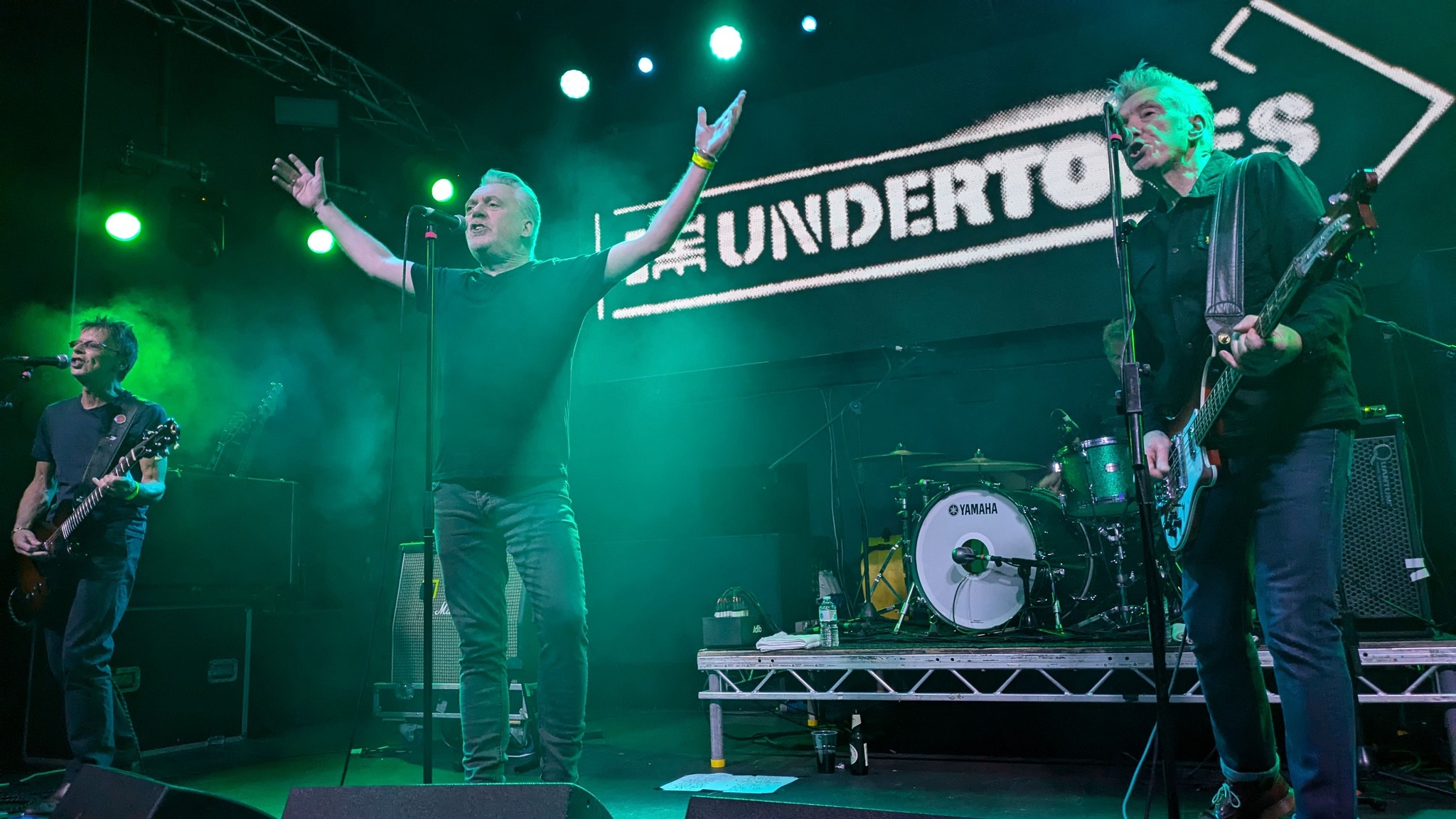


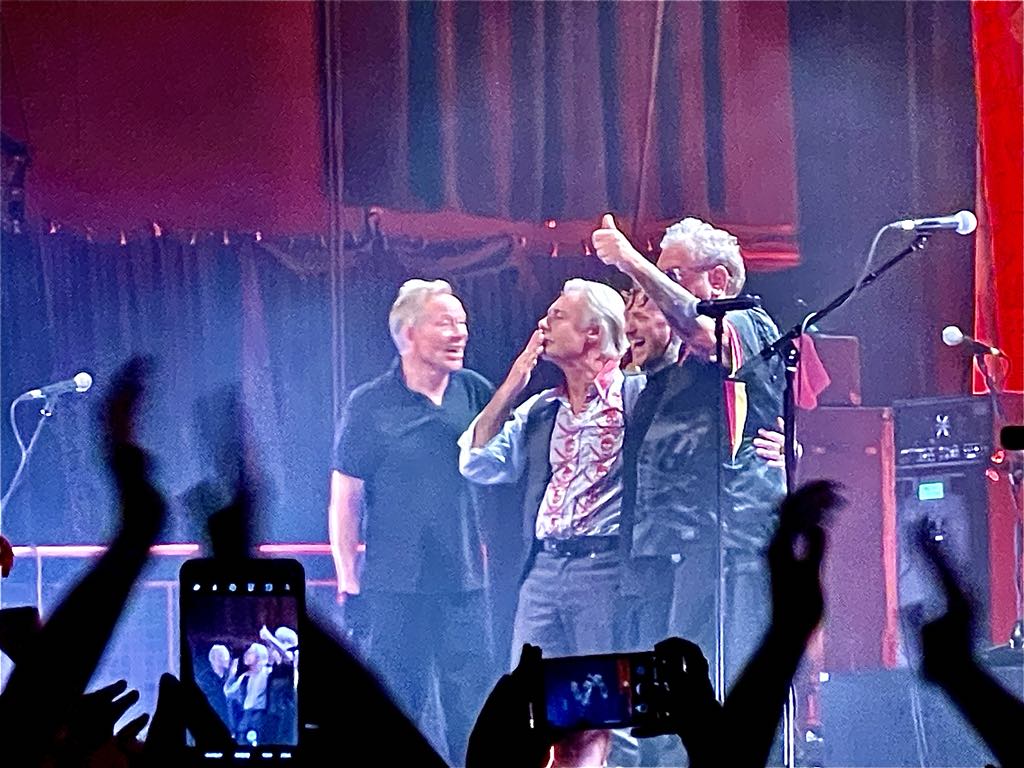


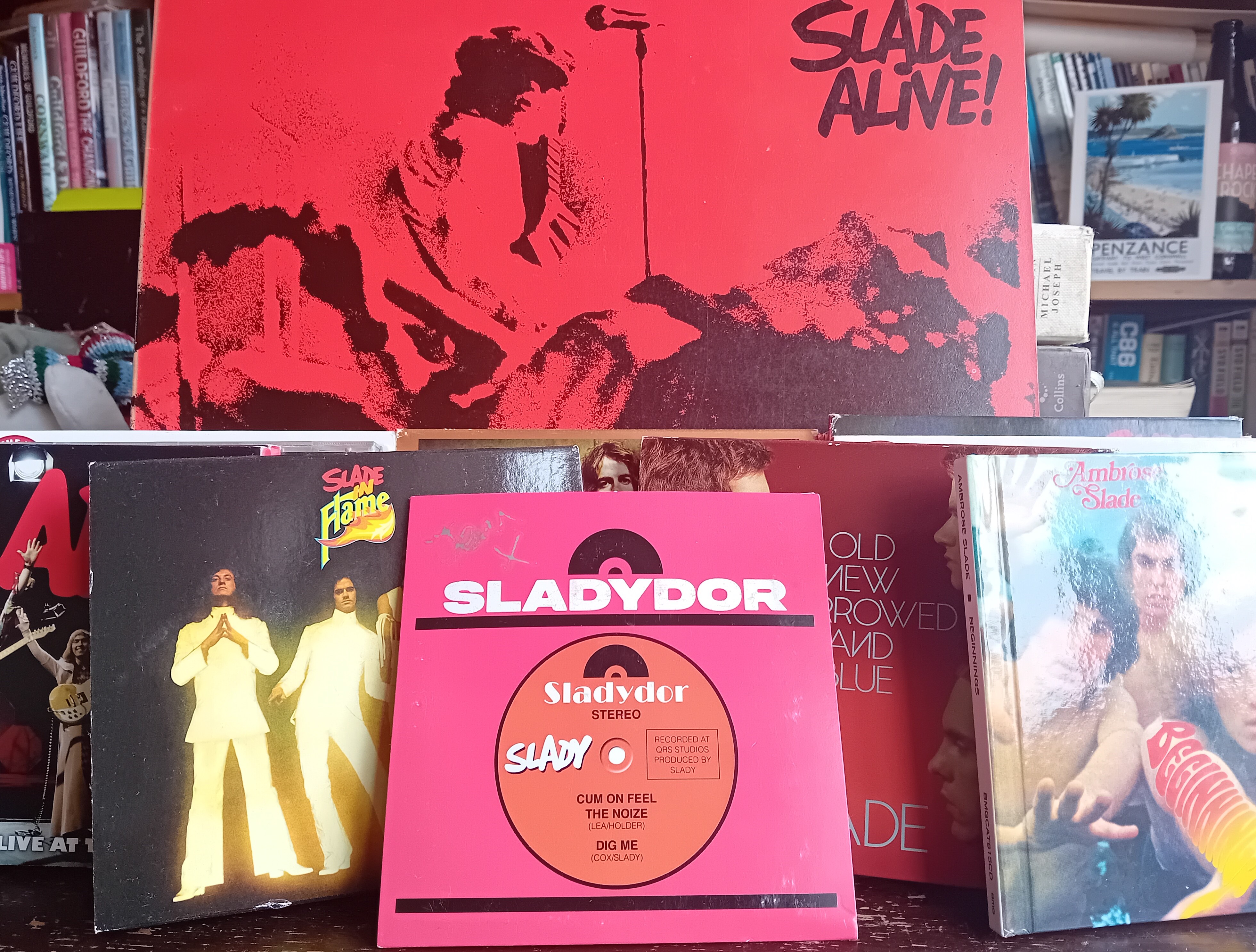


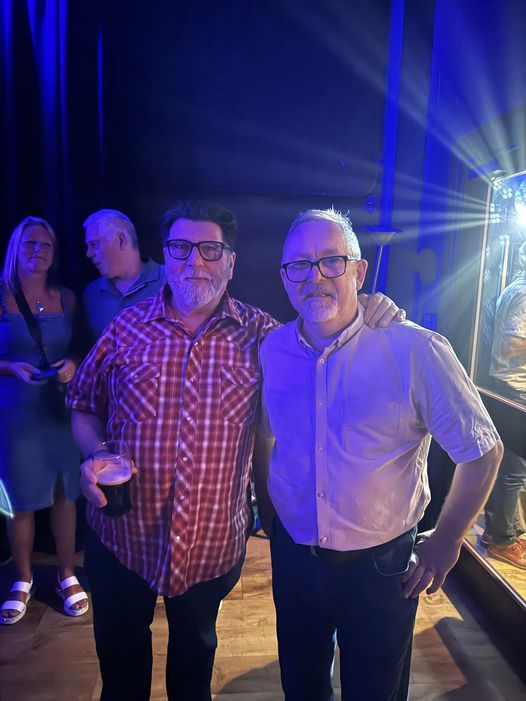


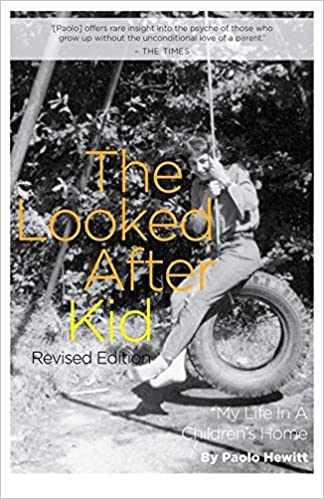
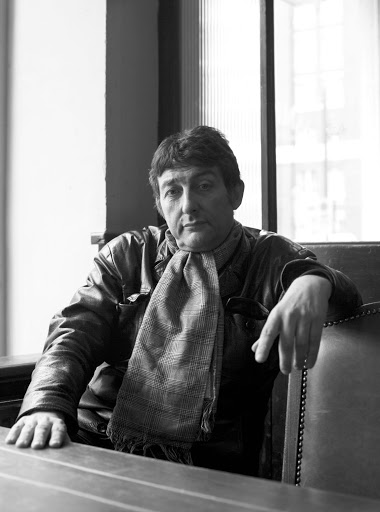


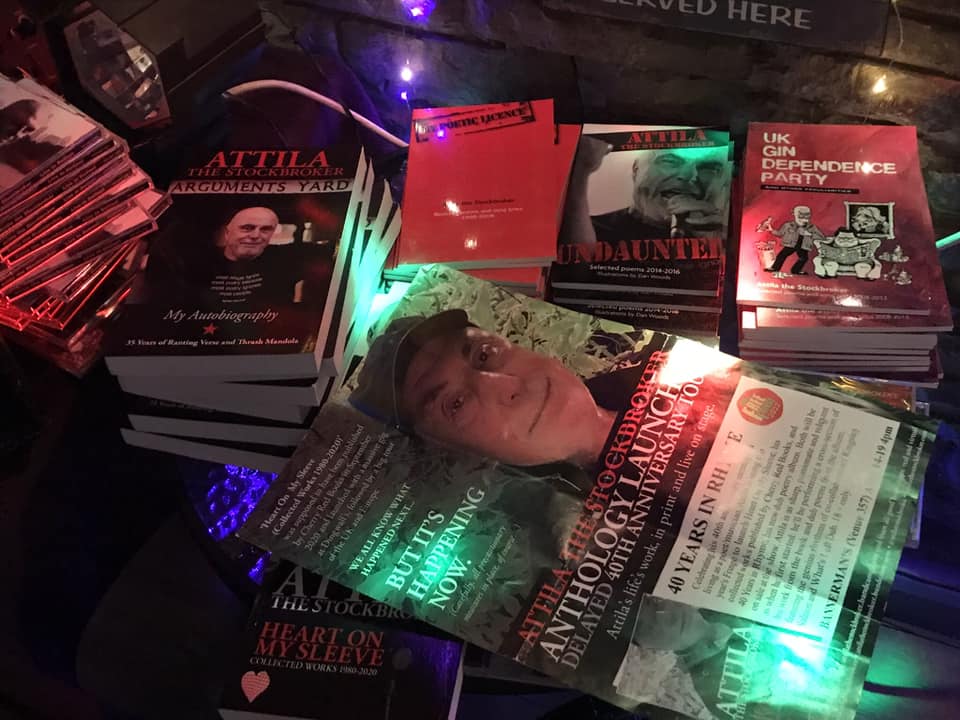
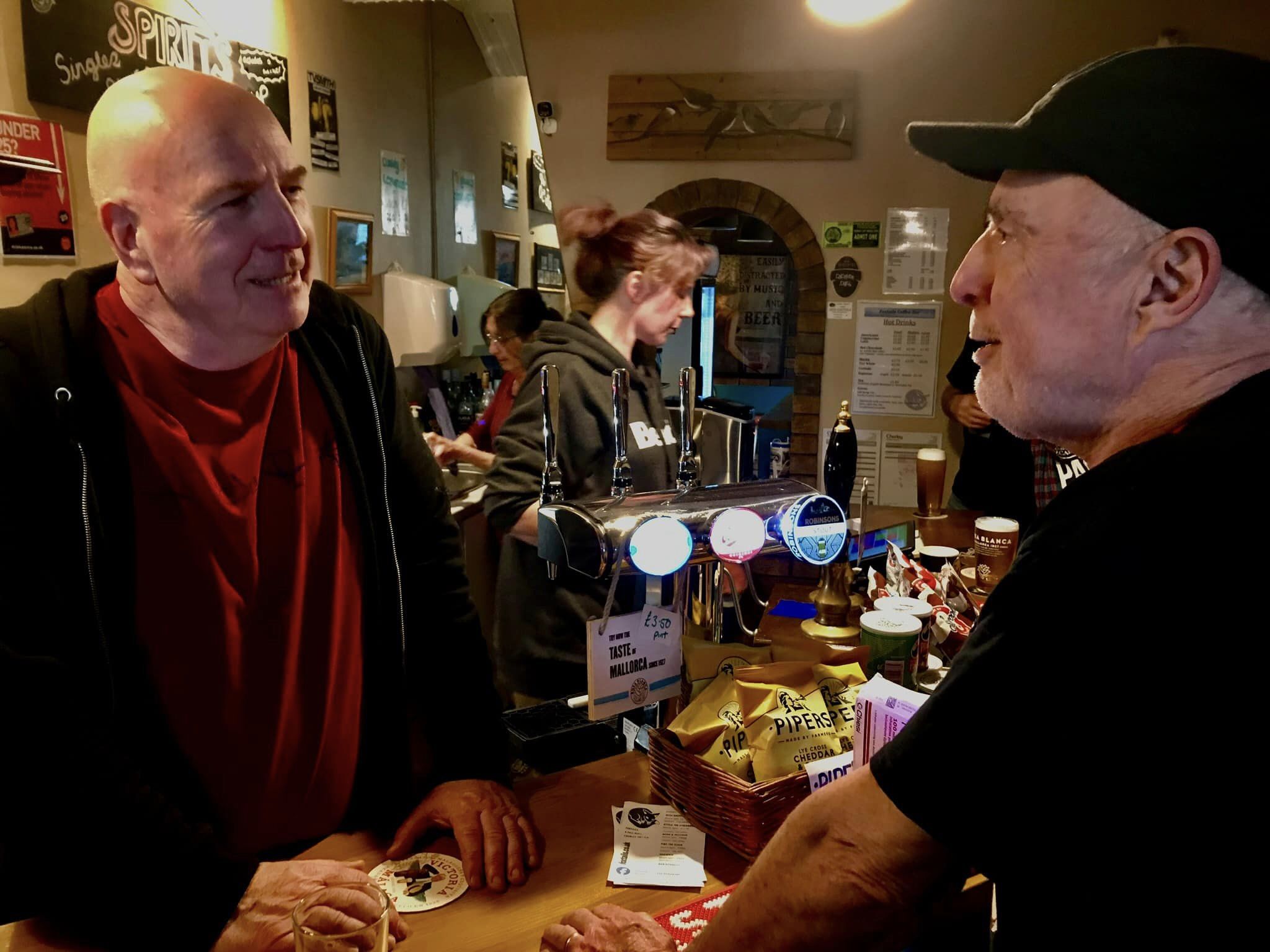

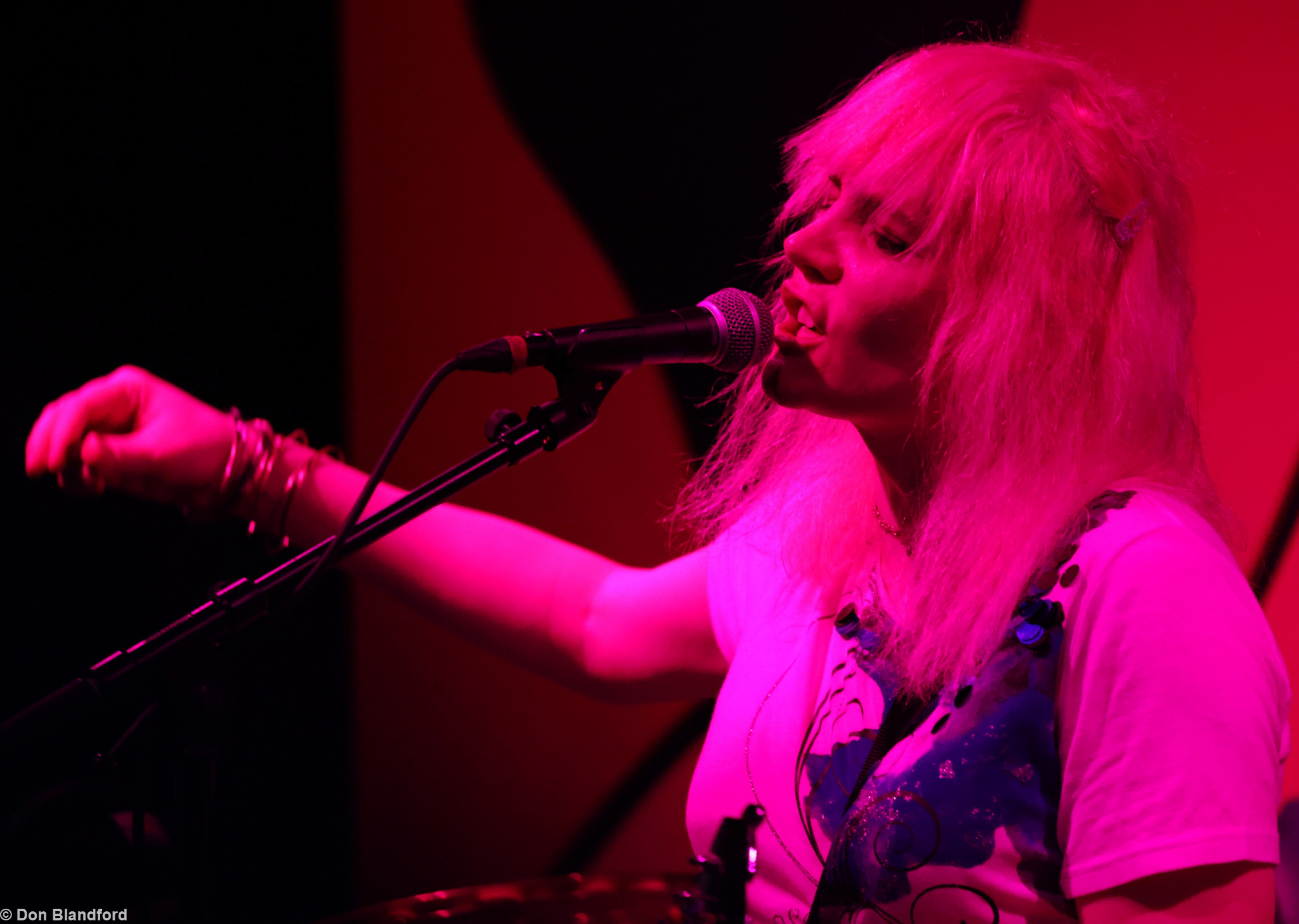
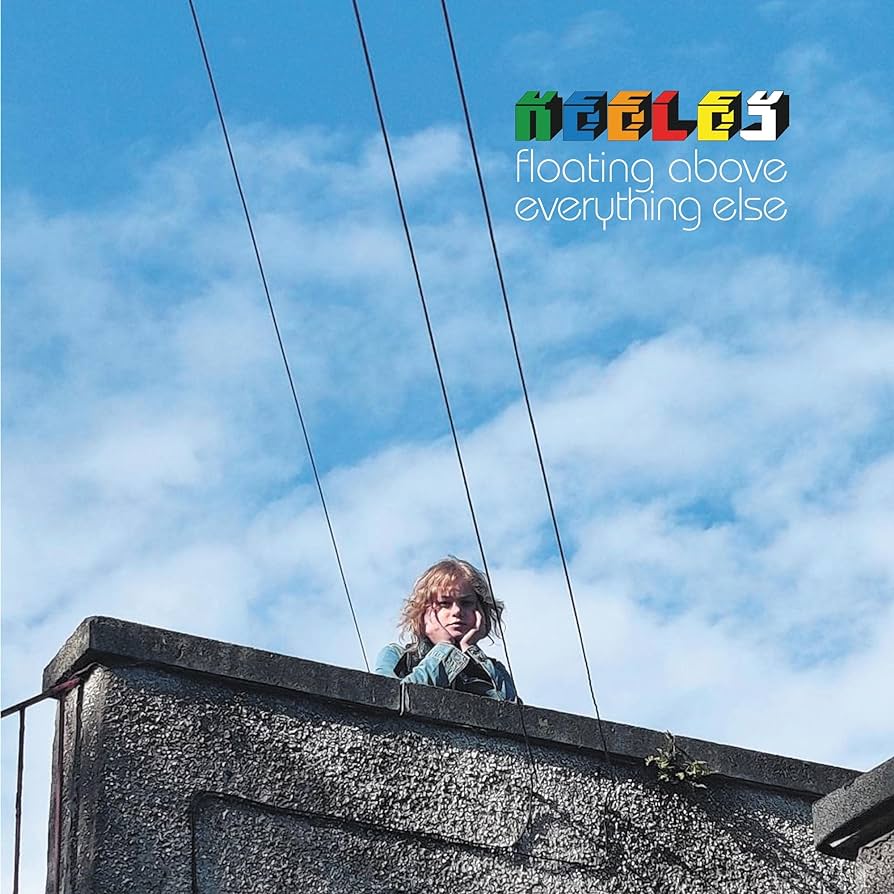


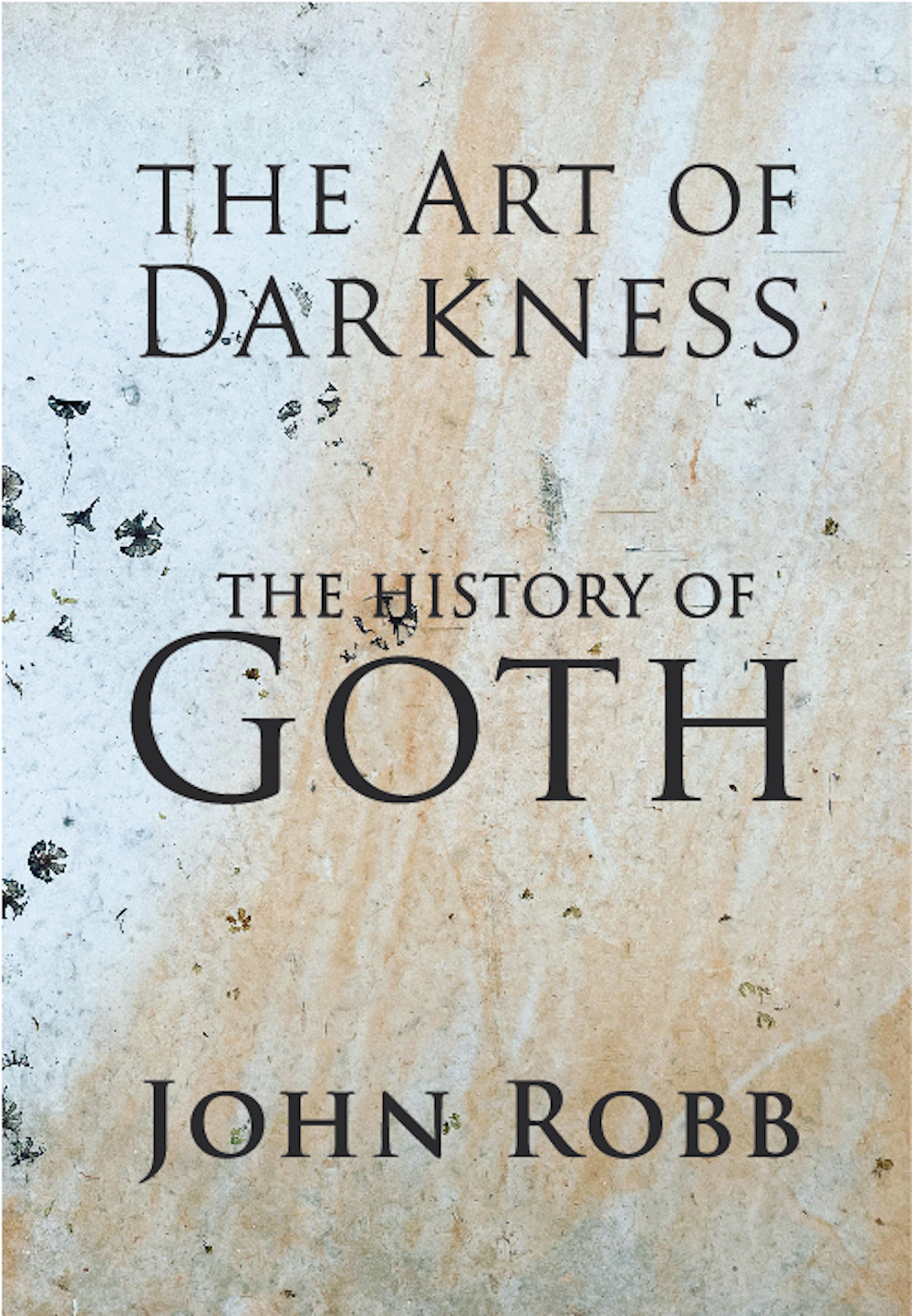




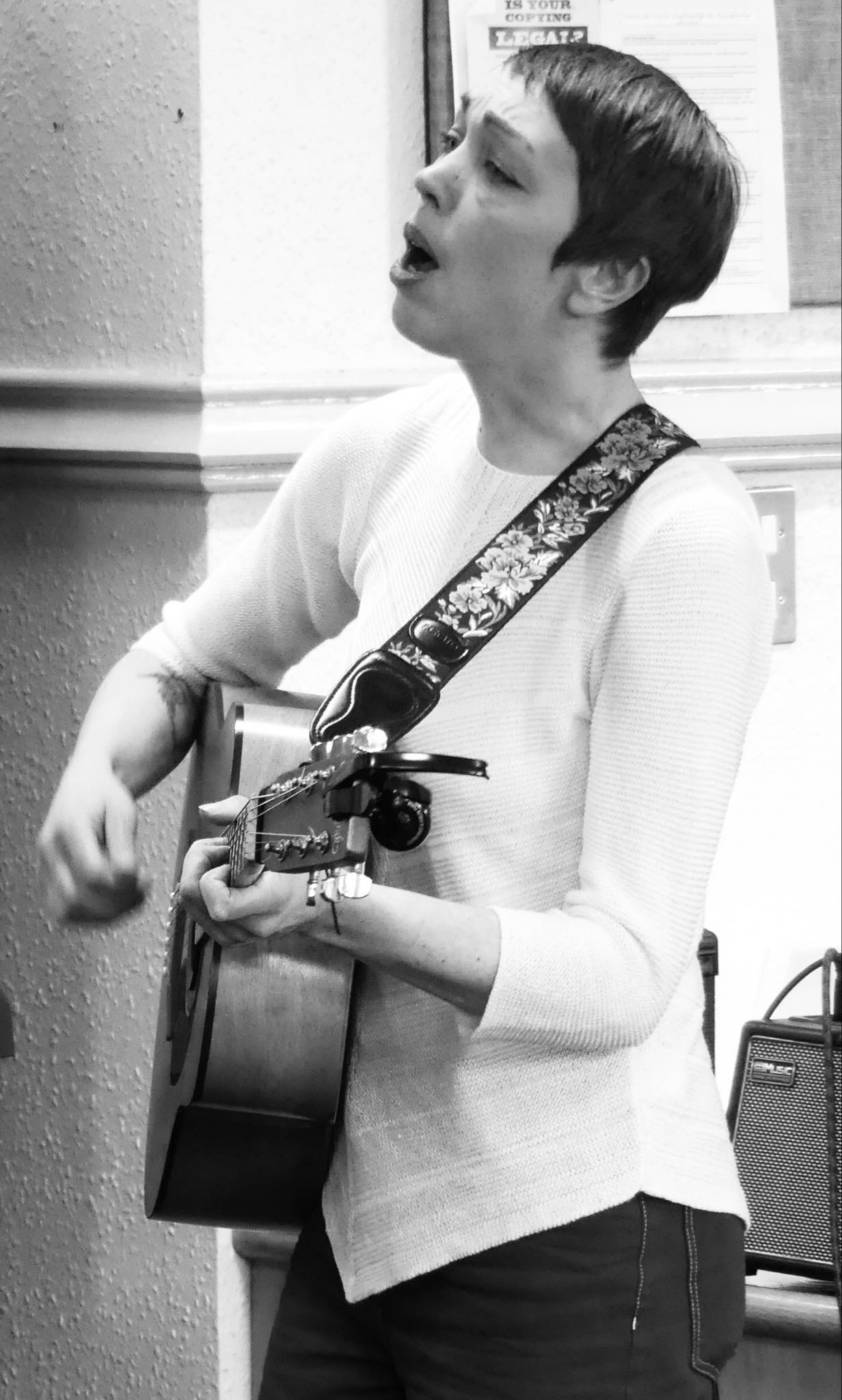

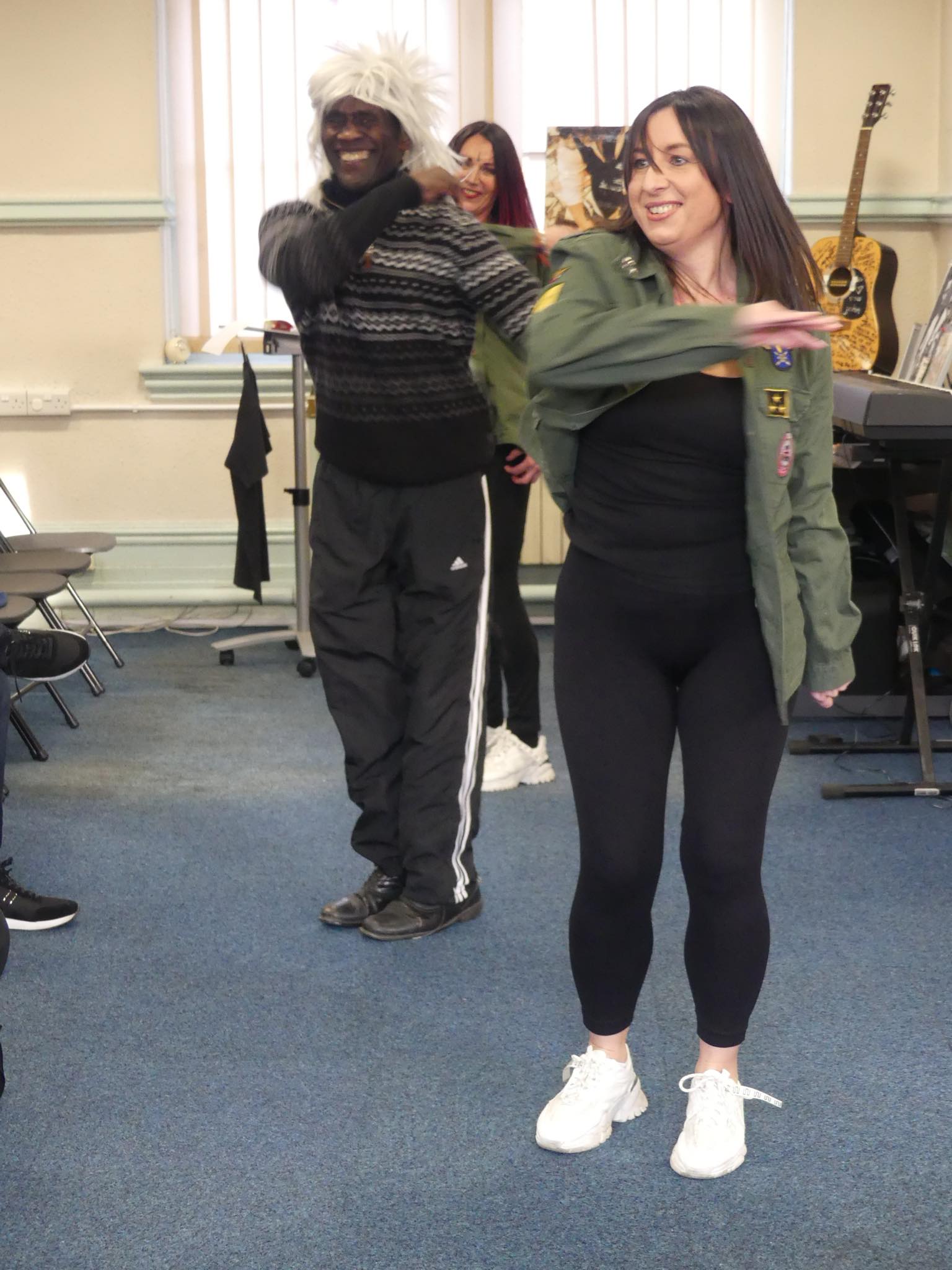


 writewyattuk