Remembering England’s Evelyn

Never forgotten: The imposing Thiepval Memorial contains 72,000 names of British and Commonwealth troops killed during the Battle of the Somme who have no known grave, including Evelyn Lintott

IT’S difficult to know where to start when it comes to a suitable Remembrance weekend tribute to all those who died in military service protecting our freedom. But I’ve chosen a distinguished England international footballer and schoolteacher who grew up just three miles from my old Surrey base and represented my beloved Woking FC.

Evelyn Henry Lintott turned out for the Cardinals between 1900-08, the most successful player to ever represent the Surrey non-league club – capped at amateur and professional level for England, and also shone at Plymouth Argyle, Queens Park Rangers, Bradford City and Leeds City.

This acclaimed all-round sportsman and schoolmaster was born in the village of Busbridge, Godalming, on November 2nd, 1883, and brought up in nearby Farncombe, yet never even saw his 33rd birthday. He was killed in action on July 1st, 1916 in Northern France while serving with the West Yorkshire Regiment’s 15th Battalion – the Leeds Pals.

Respected Throughout: Lieutenant EH Lintott

Lintott, educated at the Royal Grammar School, Guildford, lost his life at Serre on the opening day of the Battle of Albert, the first phase of a British and French offensive that became known as the Battle of the Somme – one of a staggering 19,000 fatalities that day, with another 57,000 men injured. Yet a few months before, while stationed in Egypt, he wrote home saying he was ashamed to put ‘On Active Service’ on the envelope as he ‘had so little to do’.

Woking was Lintott’s first major club, and he was still in his teens when he broke into the team, quickly making his mark as a centre-forward. In Cardinal Red – The History of Woking FC by Roger Sherlock and Robert Cumming (CNR Sports Promotions, 1995) we learn: “It was a bold – if fortunate – stroke when the committee, hard pressed for a centre-half, converted him to that position, as in that previous season he had scored some 60 goals of about 90. Centre-half in those days was the key position in the team, the place for the hardest worker, and it was because of his tremendous energy and untiring enthusiasm that he was given his chance there. It was probably his best position, though he was to gain his greatest fame as a left-half.”

Lintott made his debut in the 1899-1900 season, two months past his 16th birthday, in a 2-1 friendly victory over Brookwood, scoring the winner. His league and cup record in the East & West Surrey League, the West Surrey League and various cup competitions from there was impressive, scoring more than 50 goals in the next three seasons, claiming the captaincy, moving to centre-half and becoming an automatic choice for Surrey too, in whatever position it was felt he was needed.

He added 27 Woking goals  in 32 games during 1904-05 from centre-forward again, before his teacher training took him to St Luke’s College, Exeter, and in those next two seasons was only available during his holidays. Yet the Lintott link with Woking – where he also taught at Maybury School – continued, and over that era all four of his brothers featured for the Cards too, with the eldest, Stacey, captain in an FA Cup tie at Bolton Wanderers in 1908, later following Evelyn to Yorkshire and working as a Bradford Daily Telegraph reporter and editor of the Football Player Magazine.

Hoops Man: Evelyn Lintott in his QPR days

While based in Devon, he also signed for Southern League club Plymouth Argyle in 1906, making two appearances in the 1906/07 season before moving to London, where he taught at Oldfield Road School, Willesden, and joined QPR in 1907, making his debut against New Brompton, the first of 31 Southern League appearances there before moving to the League with Bradford City in 1908.

Lintott made his England debut in 1907, when the FA first staged amateur internationals, the gifted left-half part of the side that beat France 15-0 on its first overseas tour. He went on to play against Ireland, Holland, Belgium and Germany too.

Despite retaining his amateur status, he soon won his first full cap – becoming Rangers’  first player to win international honours in a 3-1 win at Solitude, Belfast, against Ireland in the Home Championship on February 15th, 1908, aged 24. According to future Leeds City team-mate and football writer Ivan Sharpe, he ‘received the England selectors’ verdict on account of his bubbling enthusiasm, enterprise and brilliance.’

Further appearances followed in that year’s Home Championship against Wales (a 7-1 win at the Racecourse Ground, Wrexham) and Scotland ( a 1-1 draw at Hampden Park, Glasgow, in front of a new world record attendance of 121,452) and the following year against Ireland (a 4-0 win on his patch at Bradford Park Avenue) and Scotland again (a 2-0 win at the Crystal Palace), before friendly wins in Hungary (4-2 and 8-2, at Millenaris Sporttelep, Budapest) in late May 1909.

Lintott was certainly respected among his peers, and when Manchester United’s Billy Meredith and several colleagues formed new players’ union the Association Football Players Union (AFPU), soon adopted by the majority of Football League players, non-pro Lintott joined in an act of solidarity and was swiftly became chairman, among the union’s  campaigns a drive to abolish a £4 ceiling on wages.

Cigarette Card: Evelyn Lintott in Bradford City colours

In 1909, with QPR in financial difficulty, Lintott signed pro forms to help out, and was sold to top-flight Bradford for over £1,000. He quickly settled in a terraced house close to Valley Parade, at the heart of the community that spawned and supported City, and the club found him employment at Sports and Pastimes, who made their shirts. Yet he expressed a wish to return to teaching and found a post at a school in Dudley Hill.

Lintott went on to help the Bantams avoid relegation in the 1908-09 season, while retaining his place in the England team and helping City finished seventh in 1909-10 and fifth in 1910-11. But after three more caps while at Bradford, a bad injury at Bolton saw him lose his confidence and form, and he missed an FA Cup Final win over Newcastle United.

After two goals in 53 games for City, he was persuaded by Herbert Chapman to join Leeds City in the Second Division in June 1912, his boss agreeing to pay a full year’s salary of £208 for the 10 months to the end of the season, more than the maximum wage. He went on to play 43 games for the Peacocks.

Of his debut, a 4-0 reverse at Fulham, a Leeds Mercury reporter wrote: “Lintott had always played magnificently. Strong in defence, he also found the opportunity to do nearly all the dangerous shooting that was accomplished on behalf of Leeds.”

England International: Evelyn Lintott in his national kit

Lintott became club captain, soon proving he had lost none of his old ability, with further reports of his ‘clean tackling, smart headwork and clever placing…and untiring energy’. The Mercury added: “Lintott looks like proving an ideal captain, and in him Leeds City have certainly found a treasure. He is the sort of leader who by his play and general conduct on the field encourages and inspires his colleagues.”

He was ever present as City finished sixth in the table, impressing regularly at centre-half and prompting talk of an international recall in March 1913 when England selectors watched him against Bury.

In the 1913-14 campaign, he moved to right-half, yet struggled there. An ankle injury led to a lay-off until November, limiting him to just six appearances that season. He would probably have played on, despite being out of favour, but the onset of war changed all that.

Lintott joined up shortly after the outbreak of war, on 14th September, 1914, and frustrated at delays in recruiting in Bradford, enlisted at Leeds, giving his occupation as schoolteacher. His battalion left Leeds station on 25th September en route to training in the Yorkshire Dales, more than 20,000 giving a rousing send-off.

Lintott was promoted to sergeant and by December to lieutenant, becoming the first professional footballer to hold a commission. The following June his battalion moved to Ripon, meeting up with the 1st and 2nd Bradford Pals and 18th Durham Light Infantry.

And on December 7th, the Leeds and Bradford Pals boarded the Empress of Britain at Liverpool, bound for Egypt to guard the Suez Canal, landing at Port Said on December 21st. After three months in Egypt, the Pals boarded the troopship Asconia on March 1st en route for France, landing at Marseilles, transported to the front in time for the Somme assault.

Lintott’s death was officially reported by Private David Spink, who wrote, ‘Lt. Lintott killed by machine gun at 3pm in the advance. He was struck in the chest.’ More detail followed in a letter to the Yorkshire Post describing: ‘Lt. Lintott’s end was particularly gallant. Tragically, he was killed leading his platoon of the 15th West Yorkshire Regiment, the Leeds Pals, over the top. He led his men with great dash and when hit the first time declined to take the count. Instead, he drew his revolver and called for further effort. Again he was hit but struggled on but a third shot finally bowled him over.”

All-round Athlete: EH Lintott, respected wherever he played and taught

Lintott’s personal effects were sent home to his mother in Surrey, listed as three books, two bank pass books, one cheque book, one advance book, two note books, photograph case and photographs, photographs and postcards, with £78 distributed among his family.

His body was never found, but E.H Lintott is commemorated on the Thiepval Memorial to the Missing, among the 72,000 names of British and Commonwealth troops killed during the Battle of the Somme who have no known grave.
* With thanks to Mark Doyle, http://www.bantamspast.co.uk,
Posted in Books Films, TV & Radio, Football, sport | Tagged , , , , , , , , , | 1 Comment

Permission to pay a tribute, sir!

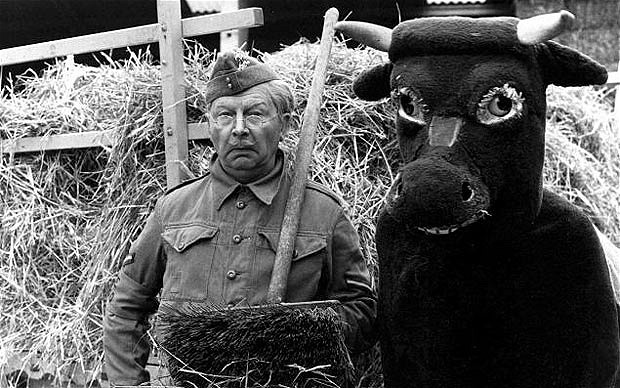
On Parade: Corporal Jack Jones (Clive Dunn) and a bovine friend (Pic courtesy of BBC)

I was on a London Media Workshops ‘Writing Television Comedy’ course in my late teens, led by the great Jimmy Perry – the actor-turned-writer who teamed up with David Croft and wrote It Ain’t Half Hot Mum, Hi-de-Hi! and You Rang, M’Lord.

Oh yeah, and Dad’s Army too. For while a few of those BBC sitcoms lost their edge over time (or in some cases never quite reached it), Dad’s Army shone out from the rest, in no small part due to Perry and Croft and the amazing chemistry of the actors they assembled.

Back in 1986, I listened in rapture as the man himself reminisced about so many comedy gold moments and memories, awestruck in his presence for a couple of days at Rodney House, Dolphin Square, SW1. The course also involved us writing our own sitcom, and while that predictably came to nothing, it was enough purely being in the presence of the man who helped bring Captain Mainwaring, Sergeant Wilson, Lance-Corporal Jones and Privates Frazer, Walker, Godfrey and Pike to our screens.

One topic I did discuss with Jimmy was a mutual love of Will Hay films, and he recalled the influence of Hay and sidekicks Graham Moffatt and Moore Marriott on his own big hit, stripping that successful formula back to its main component parts – the supposedly-superior bumbler and supposedly-inferior clever one, supported by bungling old men and wet-behind-the-ears young ones.

Golden Memories: Jimmy Perry’s autobiography, A Stupid Boy (2002)

I’ve seen various different versions of that premise since, but the main strength of this Perry/Croft collaboration was that you could perm any of those great characters and get the same result in the right hands – comedy gold.

Many of Perry’s small screen successes were based on his own life experiences, not least his time in the Watford Home Guard – very much the model for Private Pike – and in Burma with the Royal Artillery Concert Party, then on his demob as a Butlin’s Redcoat.

There was clearly a link there for Clive Dunn too, the former POW from a theatrical family having cut his cinematic teeth as a youth in Hay’s schoolmaster films Boys Will Be Boys and Good Morning, Boys, long before his big TV break in the late 1960s.

And it will always be that later role that Dunn, who died this week at the age of 92, will be remembered, having turned Perry’s vividly-drawn character of Corporal Jack Jones into someone so many of us grew to love over that next decade … and beyond.

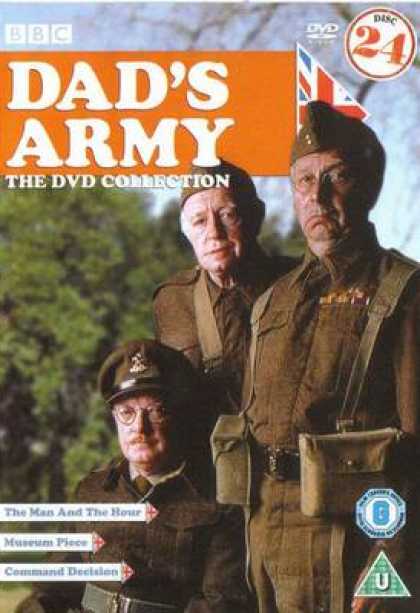
Required Viewing: Dad’s Army – the BBC box set is a writewyattuk favourite

Okay, so there have been times over the years when Dad’s Army became something of a byword for all the BBC’s lazy scheduling, just ‘another bloody repeat’, barely off our screens. But thankfully it was that rather than one of the many poor sitcoms that could have taken its place. For while the world has changed immeasurably since Walmington-on-Sea’s Home Guard stood down, it still sits comfortably, generation after generation still getting that quintessentially British humour. Timeless, in fact.

We have Perry and Croft to thank for that, but also all those great actors they cast, not least Arthur Lowe (Mainwaring), John Le Mesurier (Wilson), John Laurie (Frazer), James Beck (Walker), Arnold Ridley (Godfrey), Ian Lavender (Pike) and Bill Pertwee (Warden Hodges). And of course Dunn as Lance-Corporal Jack Jones, the local butcher and ageing former serviceman.

Jones the character was born in 1870 (yes, a 70-year-old played by a 50-year-old – another Moore Marriott parallel), an old campaigner who joined up as a drummer boy aged 14 and participated, as a boy soldier, in the Gordon Relief Expedition of 1884/85 and as a soldier in the campaign of  Kitchener in the Sudan in 1896-98, where he learned how those ‘Fuzzie-Wuzzies don’t like it up ’em’, his character closely based one of the elder statemen in Perry’s own LDV platoon.

Lining Up: Mainwaring, Godfrey and Jones square up to the Boche

Dunn the actor played his own part in the Second World War, although his active service was soon curtailed – an early capture leading to four years’ internment in Greece and Austria. Even when that hell was over, he had to serve two more years in the forces before his demob, when he finally learned his acting craft – following  two previous generations of his family into that business called show.

The breaks finally came, roles under the likes of Tony Hancock, Dora Bryan, Dick Emery and Michael Bentine leading to his big TV hit, having by then honed perfectly his trademark role of ‘doddering old man’.

Dunn, a committed socialist whose politics often led to tensions with old Tory Arthur Lowe on set, was 48 when he first transformed himself into Jack Jones, and within two years he was taking on a parallel role for his surprise 1970 No.1, Grandad, in turn leading to a similar role on children’s TV after the Dad’s Army years.

By the time I met Jimmy Perry, Dunn had disappeared from our screens and was in Portugal enjoying semi-retirement, working on his artwork and helping run a family restaurant.

Yet, all the time I have my treasured Dad’s Army box set, Clive Dunn and Jack Jones will remain with me – those nine series from 1968-77 (80 episodes in all) and spin-off radio shows (and less successful film) lasting well beyond their expected shelf life – and still as pertinent 35 years after that final episode when the platoon disbanded and Jones married his ‘lady friend’ Mrs Fox.

This past week, the current BBC was called into judgement again, this time over the furore that followed treasured broadcaster Danny Baker’s bizarre ousting from Radio London after an out-of-touch decision from the suits (or ‘weasels’, according to Baker) now running the joint. But I guess there’s nothing new there, not least when you hear of the lukewarm audience and management responses to the first episodes of this much-loved television institution.

Some will just remember Dunn’s catchphrases (‘They don’t like it up ’em!’ ‘Don’t panic!’ ‘Permission to speak, sir!’), but there was far more to Jones, his under-the counter culture and illicit sausage and bacon re-distribution, seemingly-innocent innuendo, and comically slow reactions with rifle and fixed-bayonet after all that illustrious active service.

Of course, the irony of that casting was that ‘old dodderer’ Clive Dunn out-lasted so many of his fellow Home Guard comrade actors. And 92’s a pretty good innings for a such a great character actor.

Posted in Books Films, TV & Radio | Tagged , , , , , , , , , | 1 Comment

Concentrating on the league again

Big Day: Outside Kellamergh Park, Warton, before AFC Fylde’s big FA Cup payday against Accrington Stanley (Pic: Greig Bertram/AGBPhoto)

ANOTHER year on, another FA Cup run over. Or at least that’s the case for a few more non-league clubs this week, including my near-neighbours AFC Fylde, after their exit to fellow Lancashire outfit Accrington Stanley on Saturday.

So while Stanley go on to host Oxford United in the second round at the beginning of December, Dave Challinor’s side had to raise themselves for a Lancashire FA Trophy second-round clash with Atherton Laburnum Rovers on Tuesday night.*

No disrepect to the mighty Atherton LR there, even if Glenn Moses’ side aren’t even the biggest side in Atherton at present, judging by this year’s North West Counties League table. That particular honour falls to neighbours and fellow NWCL second flight side Atherton Collieries.

It’s been a few years since I graced Crilly Park (for an early FA Cup qualifier against Bamber Bridge in the mid-90s, I vaguely recall – another rock’n’roll moment in my less-than-illustrious era as a sports reporter). But this week’s county cup fixture is unlikely to worry the BBC, ESPN and Sky Sports production teams.

Yet that at least gives the club time to dwell on all that’s gone on these past few weeks amid a highly-contagious bout of cup fever at their base in Warton, not far from Preston, better known for its low-flying jets from the nearest British Aerospace plant.

And the Coasters will have to be firing again by Saturday for sure, when they face an FA Trophy third qualifying round trip to the West Midlands to face Solihull Moors.

Again, no offence to the mighty Moors, who are a stage higher than their Lancashire visitors, even if they are currently languishing in the wrong half of the Conference North.

The name itself suggests a touch of spice to be honest – the sort our rulers would have waged war upon in the dark old days of the Crusades. But – sorry to burst your bubble – it’s really just a club borne out of a financially-astute amalgamation of the former Moor Green and Solihull Borough clubs.

Either way, Fylde’s trip to the south of Birmingham and the tasty-sounding Damson Park, Solihull, is a potentially mouth-watering tie for the Coasters, and could in the long run be every bit as important as last Saturday’s FA Cup epic. Yet somehow I don’t think it will attract the same level of interest.

Fylde went through a whole heap of excitement last week as the camera crews followed them around, including features on BBC One Breakfast and North West Tonight.

The cameras were down at the club’s training session at Preston College and there were interviews with Challinor (including the inevitable chat about his prowess with the long throw at Tranmere Rovers), Glen Steel and ex-Manchester United star in the making Michael Barnes, whom ITV filmed in his role as a tree surgeon, while Chally and club president Dai Davis also held court on BBC Radio Lancashire in a live studio preview.

As it was, there was no shock result though, and the national bandwagon instead moved on to Dorchester Town, their defeat of Plymouth Argyle the most eye-catching result to come out of the weekend’s FA Cup first round results.

But – irrespective of Saturday’s outcome in Solihull – I guess it’s the Evo-Stik League top flight where the club’s real focus should lay this season.

Wing Raid: AFC Fylde’s Michael Barnes takes on Accrington Stanley’s George Miller on Saturday (Pic: Greig Bertram/AGBPhoto)

The Coasters are currently nicely placed, in 10th place in the NPL Premier Division, with enough games in hand to make a real assault for a place in the Conference North next term.

However, it doesn’t hide the fact (warning: cliches ahead – don’t read on if easily offended by lazy football phraseology) that we’re down to bread and butter rather than jam again, and there can be few worse lines to hear in football than those tired old quotes about it being time to ‘concentrate on the league’.

Let’s face it, the days are getting shorter, the first frosts have already arrived, and the lure of all that terrestrial and satellite TV coverage is surely behind us for another year.

There were probably a lot of people on Saturday at Kellamergh Park who had to be reminded who was who and which way the hosts were kicking, a few perhaps on their first visit since that big trip to Wembley and victory over Lowestoft Town in the FA Vase final of 2008.

I’d like to think a few of those fans will visit again, and enjoyed their big day, but you just get the feeling that it will be down to the club faithful from herein as the Coasters look to keep their season on track as winter wends in Warton.

Let’s not be morose though. Surely there’s a fair few quid in the Coasters’ coffers after the FA Cup run, and the club’s rise through the ranks continues – those West Lancashire League clashes with the likes of Slyne-with-Hest and Tempest United long behind them. No offence to clubs at that level either – I spent some enjoyable times reporting on matches at Charnock Richard, Coppull United and Euxton Villa.

And that (further warning: more cliches and mixed metaphors to follow) unpredictable roller-coaster of highs and lows is surely what it’s all about. You’ve got to take the crunchy with the smooth, and the less remarkable games make the more climactic moments all the more sweet.

So well done, AFC Fylde. The cameras have gone for now, but the dream remains. And there’s always next season.

* You’ll be pleased to know there was no FA Cup hangover for Chally’s boys, who brushed aside Atherton LR 6-2 in their county cup tie the following Tuesday night.

This Malcolm Wyatt article, in an earlier form, first appeared on the http://www.sportnw.co.uk website on November 5, 2012.

Posted in Football, sport | Tagged , , , , , , , , , , | Leave a comment

The relentless search for our favourite 30 family reads

Family Favourites: Just eight of the 35 good reasons to visit your local library, according to the blogger

A few weeks ago, the Wyatt family (Northern branch) was asked to get involved in Lancashire Libraries’ Reading Families* project. And as a regular Leyland Library customer since my girls were tots, and a keen supporter of The Bookseller‘s Fight for Libraries campaign**, I guess I was fair game.

So, after a little guidance from LCC librarian Andy Johnston, we went about choosing the 30 books we’d recommend above any others to fellow library users. An easy task in theory, yet the reality was something different, and a couple of weeks later I was still crossing through some entries and replacing them with others, trying to reach our agreed total.

The fact that the list ended up as the Wyatt Family Top 35 gives you something of a clue as to the process. It certainly took some whittling down and a fair bit of  debate, but we (sort of) got there in the end. Next month it will no doubt be different again though. Come to think of it, next week it would be different.

Fun as these ‘best of’ lists can be, they prove very little of course, but if nothing else they serve as a reminder of where you were at a key moment of your life – and that goes for films, albums, or whatever else too. There have to be some ground rules though, and the main one here was that I didn’t allow myself to make all the choices myself and then pretend they were my girls’ selections too!

There were books that I chose, others suggested by my better half, and those put forward by our daughters, aged 12 and 10. Some of those more than one of us agreed upon, while for others we agreed on an author but never the same book, and then there were those we just didn’t agree upon.

We went with a wide range of style and genre, from early years picture books to full-blown adult and children’s novels, as well as cartoon collections, and quickly realised a one-book-per-author rule was necessary. Within the chosen pages there’s adventure, classic prose, comedy, crime, cult reads, cultural diversity, history, mystery and travel, books we’ve loved individually, and books we’ve loved as a family. And with this designed as a family choice we tried our best to share the love equally and come up with at least six choices each before adding the extras (working out how many votes those others polled between them to reach our final selection).

And the fact that the Lancashire library system tracked down all but one of the books we picked in some format or other – the exception being Noel Streatfeild’s White Boots – proves a great advert for public lending and why we should all support our local library branches. You might not agree with many of our choices, but why not get along to your own library and see about starting your own instead.

So here’s that final top 35, in author-alphabetical order, with a brief explanation as to why each was chosen:

Gill Arbuthnott – The Keeper’s Daughter  My eldest daughter bought a copy at a school book fair (like her dad judging a book by its cover), and was enthralled – mentioning this more than any other these past two years. “An exciting and equally scary adventure”.

Kate Atkinson – Case Histories My better half was always a fan of detective novels (from a teenage love of Agatha Christie onwards) and TV drama like the original Taggart. What sets Kate Atkinson’s Jackson Brodie books apart from (often strong) competition is the quality of writing – the humour and colour as well as her plots.

Nina Bawden – Carrie’s War Both generations of our family have loved this, the first after seeing the ’70s TV adaptation, and recent reads confirmed the book has aged well, standing up today as much as it did back then.

David Bedford & Leonie Worthington – Bums A big favourite in our household, along with sister-pic book Tums, and perfect for young ‘uns obsessed by talk of bottoms (i.e. most of them!). Funny, simple, but effective.

Caroline Binch – The Princess & The Castle Caroline’s drawings are simply luscious, very real, and accompany beautifully-told tales, in this case with a subtle message helping children deal with the loss of a loved family member and adapt to new faces on the scene.

Sita Brahmachari – Artichoke Hearts Another that our eldest took to her heart after receiving it through a high school initiative. A glimpse into growing up as a teenage girl is faced with life’s challenges.
Bill Bryson – Neither Here Nor There Bill has written so many funny yet informative, often educational but never preaching books. We chose this as it was the first of his that her outdoors & I read. The scene in the bakery where Bill tries to speak French – disastrously – is a ‘laugh out loud’ classic. Representing the very best travel writing.

Lauren Child – Don’t Look Now, Clarice Bean Lauren is a big influence on this family, and if we hadn’t decided to keep it to one-book-per-author, the Charlie and Lola series would have featured too. Appreciated by parents and teachers too, and my youngest chose this as it is one she felt would help children of her age deal with friendship issues.

Frank Cottrell Boyce – Framed My favourite children’s author at present, and while Millions and Cosmic are loved too (and we all appreciate his Chitty Chitty Bang Bang books), Framed is his finest moment so far, with well-defined characters, humour, and sumptuous, simply-executed prose. A delight for all the family.

John Meade Falkner – Moonfleet A favourite of mine as a boy, one I’ve re-read more times than any other, despite the fact that it was written 69 years before I was born. Good old-fashioned smuggling adventure and so much better than the ’50s film.

Sebastian Faulkes – Charlotte Grey Many may choose Birdsong, but Charlotte Grey  turned me on to Seb’s writing, and while it took her outdoors a bit of perseverance to get beyond the early stages, she too learned to love it.

Michael Foreman – Cat On The Hill Whether on his own or illustrating Michael Morpurgo’s text, Michael Foreman offers such evocative stories and pictures, not only of his animals and human characters, but also the settings – particularly in this case with our mutual love of St Ives, Cornwall.

Sally Gardner – Lucy Willow My youngest’s number one choice, a beautifully set-out yet uncomplicated story of a girl trying to fit in and trying to overcome major financial concerns for her down-trodden family.

Joanne Harris – Holy Fools From Chocolat onwards, my better half has enjoyed many of Joanne’s books, but this is the one – despite the fact that the premise did not inspire her initially – she enjoyed most.

Nick Hornby – High Fidelity While it was Fever Pitch that made his name, and About A Boy was more of a success, this was the one that won me over. The film is great too, but the book was set in this country and all the better for it! Just about edges out Tony Parsons this week, but it was close and I might change that again next week!

Shirley Hughes – The Big Alfie and Annie Rose Storybook So difficult to pick just one of the many great picture books Shirley has written and beautifully illustrated over the years. My eldest chose Moving Molly, but in the end we went for a collection of superb stories that this family has pored over these past 10 years.

Eva Ibbotson – Journey To The River Sea Another that really inspired my eldest to read alone, similarly endorsed by her Mum, who says, ‘a wonderful writer, so descriptive, writes great characters – good and bad alike – and really draws you in’.

Emma Kennedy – The Tent, The Bucket & Me Travel books have always inspired us, and this is a great example of one of those annoying books that keeps partners awake at night as their other halves giggle away while reading – in this case her outdoors no doubt contemplating her own formative days with tents, buckets and camper vans.

Judith Kerr – When Hitler Stole Pink Rabbit Judith may be better known for the Mog series and wondrous ’60s classic The Tiger Who Came To Tea, but this full-length  autobiographical take on a miraculous escape with her Jewish family from Nazi Germany is told – so cleverly – with childlike innocence.

Dick King Smith: Just Binnie Another author with several titles in our collection, but Just Binnie is the one my eldest has returned to again and again, giving a glimpse of Edwardian life for the daughter of a landed family dealing with financial and emotional strife.

Nelle Harper Lee – To Kill A Mockingbird One of the few books forced upon us at school that still rings true to this family’s Mum and Dad. An impassioned and brave book, its central message about the evils of racism and narrow-mindedness still holds true.

Kate Long – Swallowing Grandma My other half has enjoyed several of Kate’s books, but this is the one she values most – loving the humour, depth of characters and references to local places, not least the biscuit stall on Chorley Market!

Colin MacInnes – Absolute Beginners A big influence on me as a teenager, although I was unimpressed with the musical inspired by it – despite a great soundtrack. Just one of several great postcards of late ’50s London by this Aussie author.

Michelle Magorian – Back Home Goodnight Mister Tom was one of the last books I read with my eldest, but inspired her to read several more Michelle titles, and this was her favourite, the story of a WWII evacuee’s return from the US, family upheavals on the home and war front, and the many problems experienced in difficult times.

Spike Milligan – Adolf Hitler, My Part In His Downfall A huge influence on me as a lad, and I still love to pick it up at random and wade in. Just the first of many great books detailing Spike’s war days, progressively sadder. Yet here the humour is so sharp.

AA Milne – The House At Pooh Corner My absolute favourite as a child and adult, and loved by the rest of the family too. The Disney version was cute, but this was the business, and so beautifully written. Funny and warm.

Michael Morpurgo – The Amazing Story Of Adolphus Tips So many brilliant children’s novels and short stories to choose from, with Running Wild and several others close, but this the one that first inspired us to read more Morpurgo.  

E NesbitThe Railway Children Another timeless classic, as is the case with Edith’s 5 Children and It and Treasure Seekers books – well worth the effort of passing on to the next generation – 106 years after publication. Every bit as powerful as the film versions.

Robert Radcliffe – Under an English Heaven A vivid picture of air base life in Suffolk during the dark days of the Second World War, a fitting memorial to all those we lost in order to preserve our freedom. More than just a book about war, but about the relationships it wrecks and the emotions that tie us in times of great peril.

Anita Shreve – Sea Glass I might have picked Resistance, my better half wins this argument as she’s read far more Anita, with Sea Glass the first she read, and ‘so clearly evokes Depression-era America’.

Noel Streatfeild – White Boots My eldest first read this when obsessed with wanting to go ice-skating, loving it so much she took to Ballet Shoes and Party Shoes with equal vigour. The latter would also have made her list if we hadn’t been double-checking!

David Walliams – Mr Stink A favourite of my youngest these past few months. Why? “Because it makes me laugh, and it’s funny”. Can’t say fairer than that!

Bill Watterson – Calvin & Hobbes The many wonderful tales of a mischievous boy and his best friend, a tiger who appears to be no more than a stuffed animal to everyone but Calvin and us. The best cartoon series ever in our opinion. And so perfectly observed.

Mary Wesley – Jumping The Queue From the Camomile Lawn onwards, Mary offers a fly-on-the-wall expose of British society, and tackles issues other often only skirt about, and in this case that involves old age.

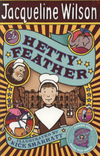
Jacqueline Wilson – Hetty Feather My daughters’ shelves carry a wealth of JW titles, and picking one proved hard. The Lottie Project came close, but after much debate it was decided they’d go with this tale of an orphan in Victorian London.

Incidentally, the nearly-but-not-quite-runners-up list includes 10 more choices, namely Dawn Apperley’s Flip And Flop, Enid Blyton’s The Island of Adventure, Roald Dahl’s Matilda, Roddy Doyle’s The Commitments, Anne Fine’s Flour Babies, Frances Hodgson Burnett’s The Secret Garden, Gary Larson’s Far Side series, Megan McDonald’s Judy Moody series, Daisy Meadows’ Caitlin the Snow Fairy ( many will sneer, but if it gets people reading in the first place, surely that’s the key!) and Lauren St John’s Dead Man’s Cove. With that in mind, I should really have tried to get it up to a top 50. But that would have just made it an even more painful selection process, believe me.

* Reading Families is a Lancashire Libraries project in association with the Reading Agency and the Publishers Association, with funding from Arts Council England as part of their Library Development Initiative, also working with Halton Library Service and publishers Faber, Harper Collins and Raintree.

The aim is to take your interest in reading and show you how to pass it on to others using some of the channels available to all in the digital age through social media. For more details and how to get involved, go to:  http://www3.lancashire.gov.uk/corporate/web/?siteid=6599&pageid=40030&e=e

** Fight For Libraries co-ordinates support to defend public libraries from closure programmes, working to both the letter and spirit of the 1964 Public Libraries Act, which stipulates that local authorities have a duty to maintain a comprehensive and efficient library service for all their residents.

The organisation supports library users in all their various campaigns to defend local libraries, including calls for a national public enquiry into the library service, determined that libraries should not be singled out for cuts disproportionate to budget cuts in each local authority and deserve protection; calling for councils to look at senior salaries and back office costs before cutting professional librarian posts or closing libraries; and calling for decisive Government leadership to support, preserve and improve library services.

For more details follow the campaign on Twitter via @Fight4libraries or via Facebook at https://www.facebook.com/pages/Fight-For-Libraries-campaign-from-The-Bookseller/134767896588119

Posted in Books Films, TV & Radio | Tagged , , , , , , , , , | 6 Comments

Sat Nav be buggered – the pitiful search for Rodney Parade

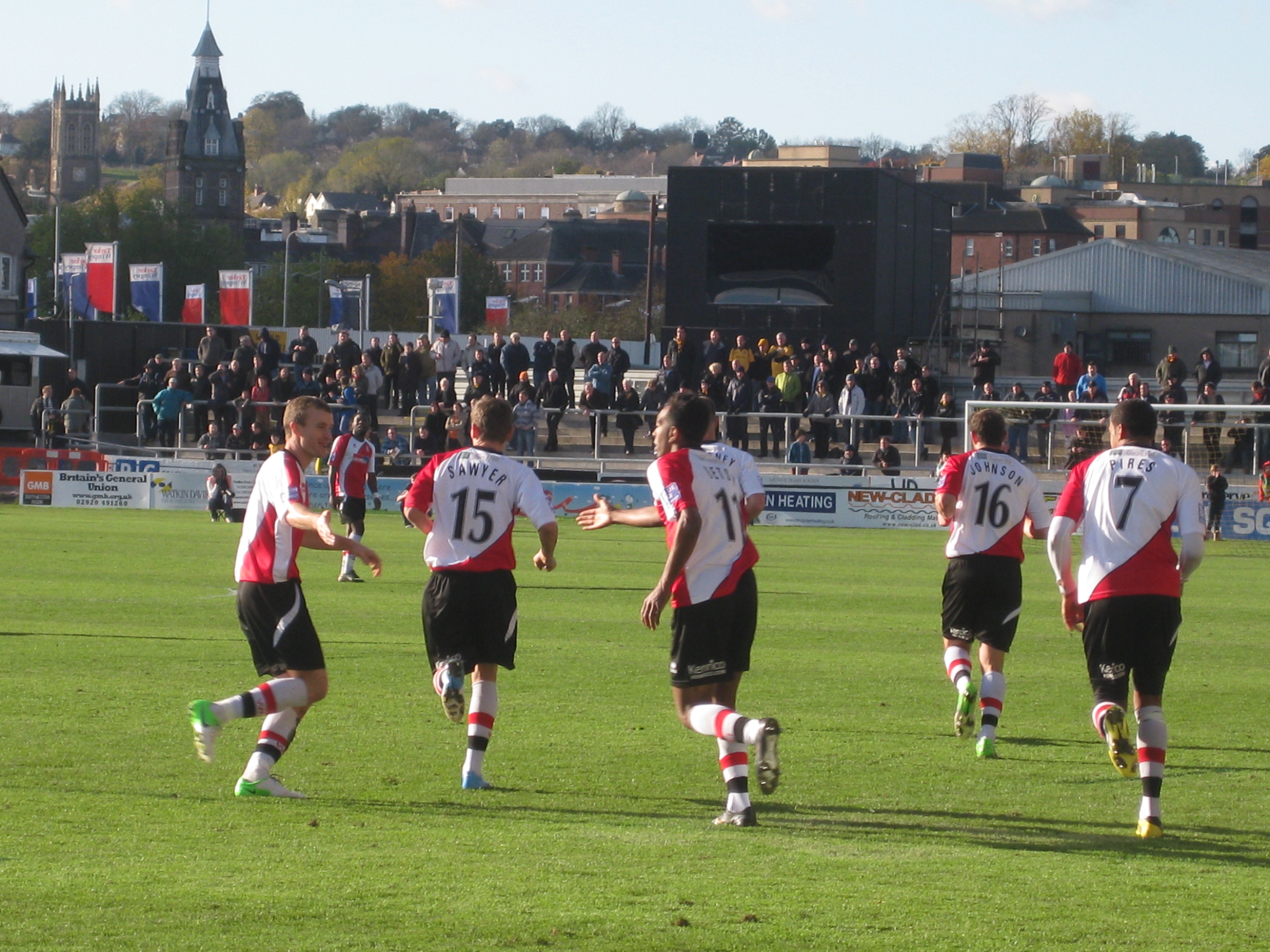
Nice One: Woking skipper Mark Ricketts congratulates Kevin Betsy after his second goal at Newport, snapped by the blogger from his corner flag vantage point. Note the ‘Mr Grumpy’ scorebox in the home end.

We were doing so well, with the motorway traffic between Lancashire and the South Wales border flowing as smoothly as could be expected on a busy Saturday morning at the beginning of half term and everything going to plan.

The Family Wyatt were headed for Newport County FC, about to mark my (don’t ask) birthday in style. OK, so a family room in a budget chain motel chain and a trip to see a Blue Square Bet Conference Premier clash might not be everyone’s idea of style, but there is a recession on, you know.

Fact is, I know how to show my girls a good time, and we were on our way to my old stomping ground in Surrey via the delights of Monmouthshire, or in new money Gwent, as my beloved Woking FC were in town and ready to rock the current Conference leaders.

An autumn afternoon at a fifth-flight football match, a night out in nearby Pontypool, a few treats in rural South Wales the next day, then a trip across the new Severn Bridge the next afternoon (the free way of course) before a trip to Granny’s. What more could they wish for a holiday weekend?

It was also a bit of a first for my daughters, completing their 2012 UK tour after trips in previous months to Scotland and Northern Ireland too. I’d already conceded that my youngest might not fancy a two-hour diversion at Rodney Parade, but my other half fell on her sword and decided to schmooze around downtown Newport that afternoon instead while my eldest and I cheered on the mighty Cardinals.

We had contemplated a night in Casnewydd, as the locals say, the third largest city in Wales having a few claims to being a bustling kind of place. Yet money’s too tight to mention Mick Hucknall these days, so we opted for Pontypool instead, not least as it was a cheaper option and we weren’t totally sure if Newport was the sort of city Elton John warned us about when it came to Saturday nights.

Actually, I have to admit I came pretty close to booking via the interweb a night in Newport, Rhode Island, with a rival motel chain. It seemed quite a good deal and I was close to clicking on to the next page while it was still available. But once we’d forked out for new passports for all of us, flights to Boston (no, I’m not talking Lincolnshire either) and transport from there, it was going to be a dear do. And as it was we hadn’t even factored in the might of Hurricane Sandy. What was I thinking of?

Airborne Antics: Woking’s two-goal Kevin Betsy celebrates in style at Newport (Photo: David Holmes)

With relatively few obstacles on the M6 and M5 we made good progress, despite the usual slow start, yet there was a biting wind (it was hardly hurricane conditions, but it was bloody cold for the last week of October) as we set off on a walk down to the river at Ross-on-Wye, taking in the superb local scenery for my birthday picnic. There wasn’t time to do the impressive Herefordshire town itself, but it didn’t matter – we had a date with Rodney Parade.

This was where it started to go wrong, leaving my bag in the back. You know the one, packed to the rafters and hiding a flimsy bit of paper detailing where we needed to head.  We recalled – with my other half driving by this stage – that there was no parking at the ground itself, but how hard could it be to find? Very hard, it turned out.

I already knew a fair bit about the town’s coal-exporting past – long before it received city status in 2002 – and its important part in the social history of our land, my A-level studies of Britain from 1815-1914 including knowledge of the area’s link with the pre-trade union Chartist movement and 1839 Newport Rising, the UK’s last large-scale armed insurrection.

What I couldn’t remember though – having run out of time to do some proper research that previous week – was where the ground was. I knew the old one was at Somertons Park, and just assumed the new one – shared with the Newport Gwent Dragons rugby union team – was nearby, if not on the same site, which happened to be near the docks – the way we came into town.

Mighty Span: Newport Transporter Bridge, nowhere near Rodney Parade (Photo: Wikipedia)

So when we saw a sign for Somerton and spotted the might of the Newport transporter bridge – dating from 1906 – I thought we were on the right lines. And when I saw a shabby-looking ground with a big advert on the side advertising Gwent Dragons I told my beloved to try the next turn-off.

We did, but there seemed to be little sign of access to that ground, despite driving a couple of times around a convoluted dockside route. It was only then that I was sure this wasn’t in fact the modern home of the Ironsides, or more recently the Exiles (that should have been a major clue – I can see that now), and we headed into the city.

My better half had also skipped the revision – she should never have trusted me – but did recall that the stadium was ‘just five minutes’ walk from the city centre’ according to the club website we’d (very) briefly studied. So we headed further in, with time against us by now and a late arrival likely. But – and I defy to be proven wrong here – there are bugger all signs for Newport County FC when you approach from Ross, and certainly no brown ones, and in the end it was down to three of us peering out of the window looking for floodlights while our driver negotiated an unfathomable city road network.

Eventually, on the second pass and with every traffic light going against us, we were as convinced as we could be that Rodders (as we now knew the ground) was just on the other side of a half-built development across a pedestrian bridge, so when the next light turned red, my eldest and I vaulted from the car, crossed the busy thoroughfare and sprang over a mightily impressive span over the River Usk, having not seen any football likelies for some time by then.

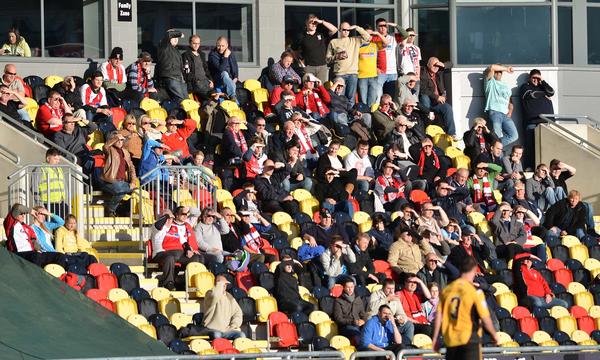
Glaring Sun: The WFC faithful salute their heroes in sun-baked Monmouthshire (Photo: David Holmes)

With the trusty Volvo long disappeared, thankfully our instincts were right, and I could  hear a tannoy announcing the teams just beyond. With the help of a foreign student with barely a few words of English, we then made a convoluted route around the building site to find the way in, eventually taking a seat at the bottom of a sun-drenched away stand (that biting wind nowhere to be felt) by the corner flag at the end Woking were attacking.

And attack we did, taking our seat in the fourth minute, just having settled in time to see poor County defending punished by Kevin Betsy’s sixth-minute opener. A bored steward then asked me when Newport had scored, and there were seeds of doubt for a while that we had missed a goal, but by the 15th minute Betsy had struck again and the leaders were rocking.

County came back, but only showed a little of that resilience you might expect from a table-topping team managed by ex-Spurs defender Justin Edinburgh, the man with the best nickname in football (‘Musselburgh’ – geddit?). And while a stunning Andy Sandell free-kick just before the break gave home hope, Woking sub Bradley Bubb made it 3-1 on 67 minutes and despite a few late scares and a late County consolation, we hung on.

Hounded Out: Newport mascot Spytty the Dog, squad number K9, on the run at Rodney Parade (Photo: David Holmes)

On the way out, talking to a fellow Cards fan who’d let the train take the strain and crossed via the Severn tunnel from his base in Bristol, we decided to head off with him in the hope of a more direct return to the bridge over the Usk. But after a few minutes walking in the wrong direction we realised we were talking different bridges and made our way back around the ground before finding our way to the other half of the family. All further evidence of my incompetency as for as they were concerned.

However, it was a triumph overall, and after a brief look around the closing-down town, with the police vans already congregating, we headed off up the A4042 to our destination, the next part of our adventure awaiting, and the recriminations over the mis-directions in full swing.

But would I swap all that for satellite navigation? Certainly not. Getting lost in a strange town, to paraphrase Woking’s famous son Paul Weller, is just part of growing up and being British. And this time I didn’t miss any goals. So there’s lush, as the locals might say.

Posted in Football, sport | Tagged , , , , , , , , , | 1 Comment

Tales of witchcraft – from 1612 to 2012

To mark the 400th anniversary of the Pendle witch trials – and in the week of All Hallows, ghouls, ghosts, witches, wizards and those things that go bump in the night – writewyattuk looks at two new children’s/young adult publications with witchcraft at their heart.

One offers a fresh interpretation of the famous 1612 Lancashire court case – aimed at younger readers – and the other a modern twist on the theme for the YA audience – this time set just across the Yorkshire border. 

Malkin Child – A Story of Pendle’s Witches by Livi Michael (Foxtail, 2012)

Landmark Trial: Livi Michael’s Malkin Child

Manchester author Livi Michael’s fictionalised version of the legend of Old Demdike and her extended brood brings to life for the modern young reader a powerful parable of good and evil and how those lines can so easily blur.

The story of East Lancashire’s Device family and their downfall via the infamous Lancaster Castle trial of 1612 is re-told in simple but effective form, pitched at children but proving absorbing for all ages.

Michael’s tale, commissioned by the Lancashire Literature Festival, is based on Thomas Potts’ notes as clerk of the court in the trial, brought under the zealous rule of King James I, the dark art-fearing monarch recently celebrated in religious circles as the man who helped bring us the modern bible.

Potts’ account, told in The Wonderfull Discoverie of Witches in the Countie of Lancaster, is given a 21st Century treatment here, yet the fact that this witch hunt remains so resonant 400 years on is key – offering a window on a world not so different from ours, its depiction of moral dilemmas and the yardsticks of right and wrong just as relevant in 2012.

Malkin Child is told from the viewpoint of youngest daughter Jennet Device, following her journey from impoverished childhood in tumbledown cottage Malkin Tower at the foot of imposing Pendle Hill, to the outcome of the Lancaster court case.

Michael vividly sets the scene, with our subject in a one-room windowless hovel with leaking roof, bare dirt floor, its walls black with smoke from the fire that brews up the broth and ‘keeps our Granny’s old bones warm’.

This is no warm and loving upbringing, Jennet’s mother strict and severe and the Device children forced to somehow bolster the family’s fortunes. We soon learn that the youngest child is not of the same stock as her siblings – having a different father, one she dreams may one day return.

Jennet’s is a world of mad grannies, gizzards, gruel and powerful demons only true witches can see, where the trees murmur and whisper, but we soon see her world crumble and her innocence capitalised upon by evangelical authorities.

The family’s fall follows a curse upon a passing pedlar, Jennet’s sister Alizon seeing red after being verbally abused while begging, in turn wishing ill upon the travelling trader. Yet it appears to be a unexpectedly potent curse, her victim falling ill on the spot, setting into motion a chain of events leading to the Devices’ demise, incarceration and far worse.

As word spreads, Alizon is called before the Justice of the Peace on suspicion of witchcraft, the first of the arrests that finally see Jennet taken into care, her God-fearing guardians making it their mission to denounce her kin as witches and save her soul.

Jennet is introduced to a life of riches, decked out in brand new frock and shoes, transformed into her new master’s good and clever little girl – seemingly a million miles away from Skinny Jen, the Malkin Child who can’t get anything right and can’t even do spells.

Our protagonist is taken into confidence and encouraged to give enough anecdotal evidence of her family’s practises and lifestyle to denounce them and see them hang, a devious offer to help ‘save’ her family ultimately sealing their fate as she learns the phrasing she believes will set them free – a small price for access to a world of fine clothes, proper meals, warm surroundings and the kindness of strangers.

The final straw for Jennet comes as she is so bitterly disowned by her mother in court – setting into motion a semi-conscious decision to tell all and sundry the ‘truth’ about her home lifestyle, in words carefully rehearsed with her master before the court sessions.

That sense of betrayal is then later repeated as Jennet is let down by those guardians she grows to trust.

Litfest Backing: Malkin Child author Livi Michael

In essence, Malkin Child is not only a tale in which a young girl’s innocence helps decide the fate of her family in dark times, but also a reminder of the power of words as testimony.

And it is to Michael’s credit that we ultimately feel Jennet’s sense of betrayal, with genuine sympathy for all she went through at the hands of her family and those so eager to bring her salvation.

Malkin Child – A Story of Pendle’s Witches by Livi Michael is published by Foxtail, an imprint of Litfest Publications, Lancaster, in a special hard cover at £8.99, and available from all good booksellers.

For further details about the trials on which the book is based, go to  http://www.lancashirewitches.com

Hollow Pike by James Dawson (Indigo/Orion, 2012)

Gruesome Moments: James Dawson’s Hollow Pike

When Lis London leaves her mum in Gwynedd to join her grown-up sister in the Yorkshire Dales, she hopes to escape a culture of high-school bullying.

But Lis’s fresh start is not all it seems, and there’s something familiar in the remote setting of Hollow Pike, an area where her family has long-held links, the teenager soon facing new friendship issues and embroiled in a murder investigation.

In North Wales, Lis suffered ever-more elaborate nightmares in which she found herself covered in blood struggling in a red stream, hair matted to her face amid freezing rain and howling wind, hearing distant frenzied screams. That jigsaw of jarring images continues as she moves to Hollow Pike. Furthermore, the moment she arrives at her sister’s rural base her surroundings seem strangely familiar.

West Yorkshire author James Dawson’s Hollow Pike is as much about growing up, individuality and self-confidence as it is a murder mystery, macabre adventure and allegorical spin on age-old tales of witch hunts.

The teacher-turned-author clearly knows his audience well, painting a vivid picture of his characters, giving valuable insight into high school life and all the pressures surrounding young adults struggling to find their path in life – not least the importance of fitting in rather than standing out among the crowd, and ultimately surviving school – something much of his target readership will recognise and empathise with.

Within Hollow Pike, Lis lurches from one bullying nightmare to another while trying desperately to find her place in her new setting, but is perhaps inevitably drawn towards her school’s own circle of outsiders, putting her into conflict with the gang of girls who first latch on to the ‘fresh meat’ in town.

She soon finds comfort in a good-looking teacher and her oddball head, and then with a geek-turned-sporting star and a clique of like-minded classmates associated with the dark arts – caught up in the dilemmas of friendship that girls and boys alike will recognise only too well.

There are elements of Arthur Miller’s The Crucible and its metaphor for modern-day witch hunts here, while the Pendle witch trials of 400 years ago are clearly another major inspiration. Yet while a few of the teenage issues involved may see parents ward younger readers away, Dawson treats his themes with care and wisdom.

Care & Wisdom: James Dawson

In short, anyone who’s ever struggled to fit in at school and build confidence among their peers will find kinship here, and the author clearly has story-writing craft on this evidence.

And the genuinely (at least implied) gruesome moments and page-turning pace will no doubt ensure Hollow Pike is a hit for high-school readers and adults alike.

Hollow Pike is published by Indigo, part of the Orion Publishing Group, and is available from all good booksellers, priced £8.99 in paperback.

For more on James Dawson and Hollow Pike, head to http://www.jamesdawsonbooks.com/hollow-pike/

Posted in Books Films, TV & Radio | Tagged , , , , , , , , , | Leave a comment

Non-league football still has White Tigers in its tail

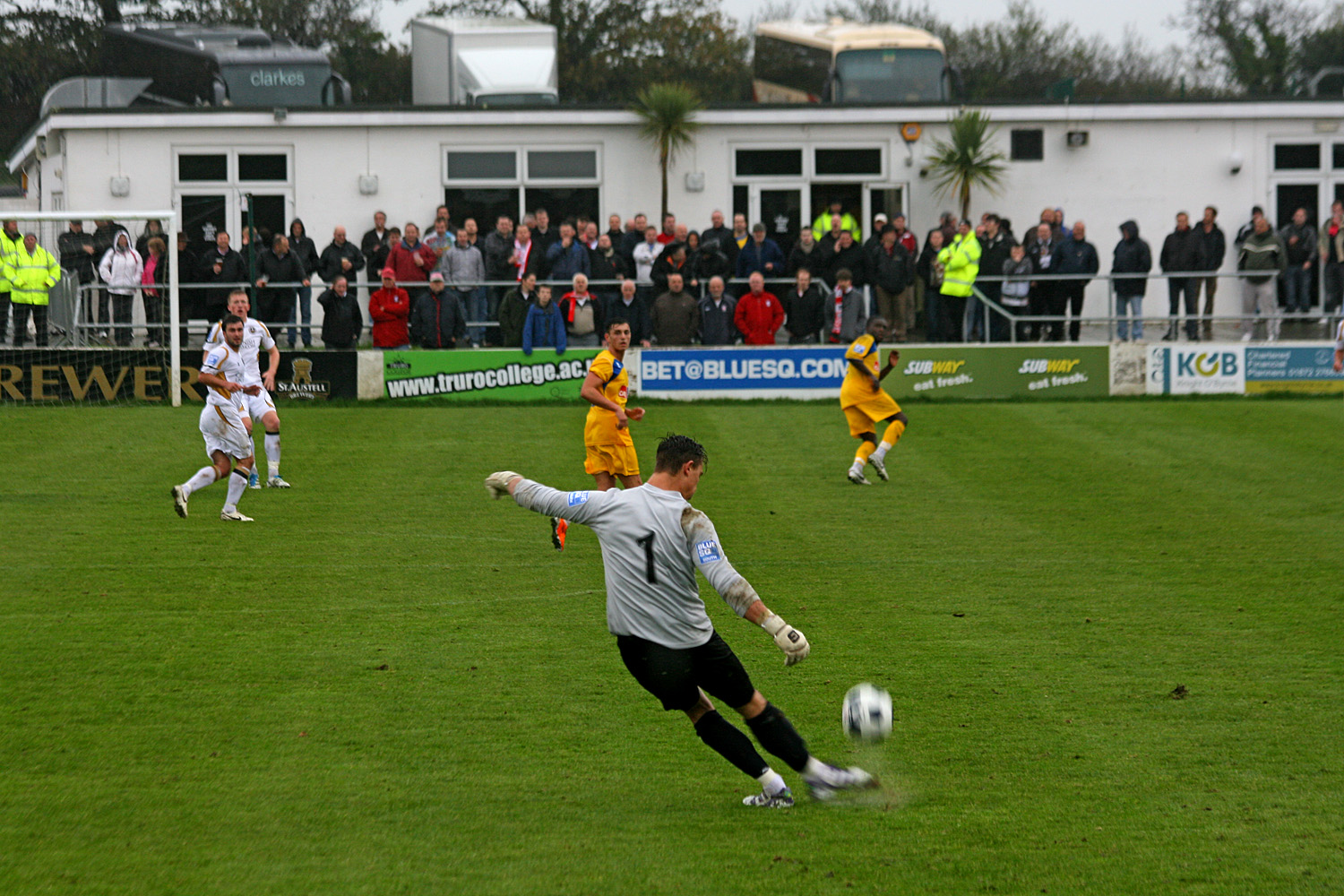
Hanging On: Truro City remains a Conference South venue, as it was for Woking’s visit last season (Photo courtesy of Nick Shaw)

As Mark Twain, once wrote, “The report of my death was an exaggeration.” And there were elements of that in the reporting of troubled Truro City’s final demise late last week.

It’s all been happening at Treyew Road of late, the end already announced when, just after 5pm last Friday (October 19), it emerged that nightclub owners and a taxi boss had stumped up £50,000 to keep the club playing, at least until the end of the season.

On Tuesday night they were back in Blue Square Bet South action, when Staines Town’s Louie Theophanous’ 15th-minute strike sealed a win for the Surrey hosts against their Cornish visitors, leaving the White Tigers 12 points adrift at the bottom of the table after having 10 points docked when they entered administration in August.

Pete and Jason Masters, from the city’s L2 nightclub, and Philip Perryman, owner of A2B Taxis of Truro, decided on Friday afternoon to put up the bond demanded by the Football Conference as a condition of Truro staying in the league.

Yet City boss Lee Hodges continued to face player shortages as his threadbare squad tries to cope with injuries to key players ahead of Saturday’s league visit of Sutton United (October 27).

Hodges himself was out with a hamstring injury while injured striker Stewart Yetton is out until next month. Yet Yetton (so to speak) remained chipper, tweeting that Friday morning, ‘Getting paid this morning feels like a novelty! Roll on the new era of Truro City!’

That quote sums it all up, the club still subject to a transfer embargo as their new backers look to take the club out of administration, but there’s an air of positivity at Cornwall’s premier football club, and it’s clear that – perhaps against popular perception -there’s a real appetite for the Beautiful Game across the Tamar.

Future Hopes: A blustery day at Truro … but what does the future bring? (Photo: Nick Shaw)

There may be rocky times ahead at Truro, but hopefully the crowds will return to Treyew Road, in just the latest example of a club on hard times determined to stay afloat.

It was only a week before Truro’s deadline traumas that Non-League Day was hailed a huge success, a gap in the top divisions’ fixture list leading to bumper crowds all around our local club scene.

But for all the bumper gates on the day – the international break seeing the top divisions without scheduled matches – stories like those at Truro and former Conference high-fliers Kettering Town suggest we can’t be complacent, the latter Northants outfit currently drowning in a sea of CVAs, unpaid bills and knock-on postponements.

For every wonderful tale of achievement in non-league football and grass roots sport in general, there is a cautionary tale elsewhere to pay heed to.

Anyone who has followed the story of Lancashire coastal outfit Fleetwood Town in recent times will know just what can be achieved. It wasn’t so long ago that the Cod Army were looking to escape the nets cast into the lower reaches of the old UniBond League. And just look at them now, the days when Highbury Stadium (to the uninitiated, yes, Highbury Stadium) was crumbling around them and the town was just seen as the end of the Blackpool tram line now long behind them.

You could say the same about fellow Lancashire hotpot/beds of football like Accrington Stanley and Morecambe, and so many clubs from my adopted county have had their day in the sun before, clubs like Bamber Bridge rising from parks football to the summit of the NPL, as did fellow Red Rose minnows Colne Dynamoes a few seasons before.

But the latter’s internal combustion after a 1990 title win and the Conference’s resultant refusal to accept them still serves as a warning of what can go wrong.

However, there is still belief at Truro City, even if the fate of the Cornish outfit following a mesmeric rise to the second tier of the pyramid remains in the balance.

And if nothing else, let City’s plight be a salutary lesson to all local club officials and volunteers that success can’t be taken for granted, and you really do need to cut your cloth accordingly to survive.

An earlier version of this Malcolm Wyatt article featured on the http://www.sportnw.co.uk website on October 15, 2012.

Posted in Football, sport | Tagged , , , , , , , , , | 2 Comments

Welcome to the 21st century, FIFA … now wake up to racism

Race Pioneer: Former England and Liverpool legend John Barnes (Photo: BBC)

RATHER than suffer the highlights of England’s World Cup qualifying draw with Poland last week, I watched BBC genealogy documentary series Who Do Yo Think You Are? as John Barnes jetted off to Jamaica to learn about his family’s part in the battle for the island’s independence.

Along the way, the former England and Liverpool legend grew to appreciate all his maternal grandad and great-grandad had overcome, something he could fully relate to following his own battles as a professional footballer.

Guiding Light: Cyrille Regis was a trail-blazer in his West Brom days

That powerful image of Barnes back-flipping a banana thrown his way on the pitch got an inevitable airing, and brought to mind the Cyrille Regis autobiography I recently finished, an important account of the racism another  trail-blazing black man had to endure in those bad old days of racism in British football – for England, West Brom and Coventry in the ’80s.

I was fortunate at my own club, Woking, not to have encountered such hatred, not least as so many great black players have come through the ranks and excelled there. But I’ve seen examples of blatant racism at various grounds over the years, and it still sickens me. I hate to think what players like West Ham’s Bermudan star Clyde Best had to endure in his day.

Yet we still see plenty of evidence of this cancer, with high-profile cases in court this past year detailing abuse from the mouths of those who should know better – however dim-witted or ‘misguided’. That’s not just players and fans, but also some of the pundits and press shouting from the rooftops this week yet needing to examine their own double standards.

The ignorance we saw last week in Serbia was blatant and shameful, and no one in their right mind should have expected England Under-21s’ Danny Rose to have put up with it.

The Sunderland defender endured a torrid 90 minutes that completely over-shadowed our 1-0 win in Krusevac – amid fans invading the pitch, scuffles breaking out, and Rose subjected to monkey chants, twice struck in the head by stones, then red-carded after the final whistle for kicking the ball into the crowd in reaction to the abuse he received.

Among those to speak out after the disgraceful scenes was Queens Park Rangers defender Nedum Onuoha, who was at Manchester City back in 2007 when he was subjected to monkey chants during an England U21s win over Serbia in the Netherlands, an experience he described as ‘the toughest 90 minutes of my life’.

On that occasion too, trouble broke out as the players left the pitch, the FA later alleging further racist abuse from Serbian players. The FA protested to UEFA, who responded by fining the Serbian FA £16,500 and England £2,000 for their players’ improper conduct.

Clearly, nothing’s changed since, and while things are far from perfect on these shores and we still need to focus on racism and come down hard on it – however casual it may seem – the problems are far worse overseas.

We’ve been punished in the past for crowd problems, and now it’s time for FIFA to finally crack down and ban Serbia and any other nation guilty of race hatred. They’ve been slow to act in the past, and that has to change.

Among those who spoke out in Rose’s defence after Tuesday’s shocking scenes was Professional Footballers’ Association chairman Clarke Carlislesaying Serbia should receive a ‘significant’ international ban for ‘a repeat offence’, while dubbing Rose’s red card ‘farcical’.

He told BBC Radio 5 Live, “Banning them for a start, from any tournament, would be progress but I think if it’s significant – if it’s a couple of tournaments – that would cause that nation to address the issue that has deprived them of international competition.”

His call was echoed by ex-England midfielder Paul Ince, whose son Tom – the Blackpool winger – played in the game, telling ESPN: “If it was me, they [Serbia] would be kicked out for the next five tournaments – European, World Cups – but they will get a little ban and that will be it.”

And Reading’s ex-Blackburn striker Jason Roberts, also on BBC Radio 5 Live, added a forthright: “UEFA have shown they have no stomach for this battle. They haven’t taken this on in the past; I doubt they will now.

“It’s time for players to take action and that’s why they should walk off the pitch because, guaranteed, if that happens things will change.”

We shall see, but rest assured that the eyes will be on FIFA President Sepp Blatter and his cronies these next few days and weeks. So wake up boys, it’s the 21st century, and it’s finally time for you to take racism seriously.

A version of this Malcolm Wyatt article first appeared on the http://www.sportnw.co.uk website on October 18th, 2012.

Posted in Books Films, TV & Radio, Football, sport | Tagged , , , , , , , , , | Leave a comment

The Price Is Wrong (surely)

Fine Fare: Woking fans enjoy the hospitality in the Kingfield sponsors’ lounge (Photo: David Holmes)

“HOW MUCH?” It’s an oft-repeated question in football these days, whether you’re talking about an international or a trip to see your local heroes – covering everything from the price of admission to the quality of a pie.

And anyone who’s suffered a poor half-time nosh or a tedious game over the past few years knows how important these things are.

When there’s a family’s involved too, it’s all the more shocking how much some of these clubs will charge for an hour and a half of questionable-quality football, the players incapable on occasions of trapping wind, let alone 10ft sideways passes.

Suffice to say we’ve all suffered at times, getting home to shake our heads at the whole miserable experience – wondering why we’ve just shelled out a small fortune to actually pay for an ultimately demeaning experience, and what we might have done with that hard-earned cash given the opportunity again.

It’s all part and parcel of being a sports fan and true supporter of course, and you have to take the crunchy with the smooth (any more cliches? no, that’ll do for now). Besides, most of us wouldn’t have it any other way, however much we might moan at times. But sometimes you do wonder why you’ve paid over the odds for an away programme with such half-hearted pen pics of players you already know, a plethora of crap adverts, the bizarre musings of a manager (which would have been enough to see him certified before the days of care in the community), and action pics from a dreadful 0-2 defeat at Rotherham United or Romford.

Then there’s the stomach-discolouring ruddy mess or (alternatively) see-through murky water (and rarely anywhere between these extremes) that the club you’re visiting laughingly calls tea, and a tepid pie that makes you wonder if you’ll ever be able to leave your khazi for the next couple of days if you finish it.

And for some of you out there, it’s not even just a rare treat, but something you subscribed to one glorious summer’s day in May (‘calling all early birds, blah blah’), splashing out on a season ticket at last year’s (already inflated) prices – the resultant booklet of ticket stubs viewed as a community service sentence at times.

Yet we can’t suffer in silence, and it’s all part of being British that at times of woe we take comfort in the fact that there are people out there going through worse experiences. And I’m talking about relative poverty here. You might be paying £3 for a sub-standard pie at your club, but those buggers on the Buttock Road End at Melchester Rovers could be paying 40p more for their inedible half-time treat.

By that premise, a few of us will no doubt feel better after looking at the BBC’s 2012 Price of Football survey, which canvassed 166 clubs in 10 divisions across British football, including the Blue Square Bet Premier and Women’s Super League, comparing prices of  the most expensive and cheapest season tickets and adult matchday tickets as well as the cost of a cup of tea, a pie and a programme, to calculate the cheapest day out at a football match.

Among its findings, we learn that prices in the top four divisions of English football have risen by 11.7% – more than five times the rate of inflation, while the average price of the most affordable ticket in league football went from £19.01 to £21.24 in the past 12 months, and only two of our 92 League clubs offer a day out for less than £20 now (£12 last year).

Some of the findings are surprising, others not so, but I’ll tell you that the most expensive adult matchday ticket is on sale at Arsenal (£126) while the cheapest is at Montrose (£6). The Gooners also market the most expensive season ticket at £1,955 (their cheapest is a bargain £15 short of £1,000), while Montrose fans part with £90.

It’s a good advert for women’s football that their matchday adult tickets range from £4 to £6, with season ticket prices between £22 and £40. But you’ll have to part with £3.40 if you want a pie at Doncaster Belles.

The most expensive cuppa in British football is found in Manchester, both City and United charging £2.50 (as opposed to 50p at Alloa in Scottish Division Two), while Leeds United charge £4 for their matchday programme, which would buy you eight editions of the Inverness Caledonian Thistle alternative.

Yet you’ll need £4 for a pie at Kidderminster Harriers in the Conference Premier, compared to £1 at Alloa, Albion and Forfar (the latter,  incidentally, what you might say with your mouth full at Aggborough when you’re told the price of your hot snack). I should add that the ‘pie’ in question at Kiddie is a large, homemade cottage pie though, and I’d be more than happy to rate it more objectively if Harriers could send me one or invite me down (expenses paid) at some stage to sample one.

Finally, a trip to the Emirates Stadium can cost as much as £134.40, with top-price tickets going for £126 (a £26 rise on last year), a programme (£3), pie (£3.30) and cuppa (£2), while Newcastle United offer the Premier League’s best value day out, with a ticket, programme, pie and cup of tea coming in at £23. Perhaps that’s what those Toon fans are celebrating when they take their shirts off on freezing cold winters days.

This year’s results brought understandable outrage from the likes of the Football Supporters’ Federation, who called for greater efforts to reduce ticket prices and give the benefit of the massive amounts of media income at the top of the game to match-going fans.

That bit about money from all those big financial killings failing to come down through the system shouldn’t really surprise us who have already turned our noses up at top-flight football and watching matches on subscription TV. It still rankles though.

But (particularly after my soapbox-style rant about supporting your local clubs last week) I’ll just add that while we may all suffer for the cause this season, there are those out there paying through the nose to suffer elsewhere. And that should make us feel a bit better about the whole sorry experience.

So next time half a cup of lukewarm hot chocolate splashes on your over-priced 1998 away shirt as your fellow fans go mental when you grab an 87th-minute equaliser at the Stadium of Light, Sunderland, or Victoria Pleasure Grounds, Goole, just remember there are supporters out there far worse off, however much silverware they’ve amassed over the years.

To check out how the figures compare, check out the BBC Sport Price of Football Survey via http://www.bbc.co.uk/news/uk-19842397

A version of this Malcolm Wyatt article first appeared on the http://www.sportnw.co.uk website on October 22nd, 2012.

Posted in Football, sport | Tagged , , , , , , , , , | Leave a comment

Pain game reaches a whole new level

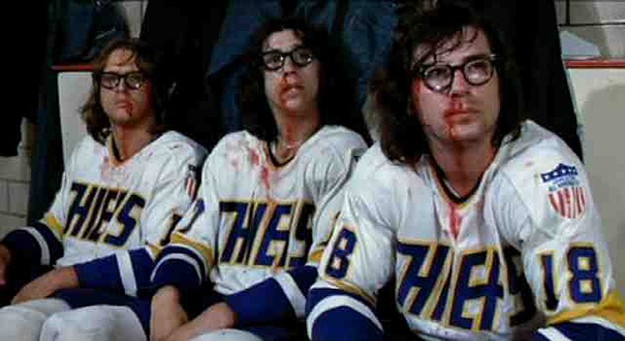
Slapshot Style: Treble chancers the Hanson Brothers redefined hockey

FORGET EL James. If you get pleasure from the pain of others, you need look no further than the 13-man football code.

For rugby league, judging by the 2012 Super League Grand Final, is a sport where you might end up with 50 shades of black (and orange) and blue (and yellow).

From Leeds skipper Kevin Sinfield going out cold but then casually returning to the action moments later, to unfortunate Warrington Wolves prop Paul Wood losing one of his crown jewels after it was ruptured by a Rhino (quite literally), this season’s finale was not for the faint-hearted.

Just in case you missed 30-year-old Wood’s post-match tweets (and I dare you not to suck in through your teeth as you read on):

“Ruptured my right testicle, got a knee 1 minute into the second half, had to have it removed.”

Was that the knee removed or his boy bits? The latter, I’m afraid. He then added:

“Just coming out the hospital to go home … seriously feel like I’ve left something.”

During the same game, Clare Balding tweeted, “Kevin Sinfield gets head-butted so hard he’s knocked flat. Gets up & plays on – incredible.”

Sinfield went on to amass 14 points in Leeds’ 26-18 victory, his ‘sterner stuff’ make-up encouraging further bar talk about rugby types being harder than the rest of us. But there’s plenty of evidence out there that it’s not just the oval ball exponents who suffer bravely for their sport.

Just ask Scott Dann after a similar spherical injury while playing for Blackburn Rovers last year, or the aptly-named Chris Whelpdale about his scrotal split last Boxing Day while turning out for Gillingham. Furthermore, he was back playing within four days. And going back to 1986, there was All Blacks number eight Wayne ‘Buck’ Shelford, who tore his sack (sorry, no easy way of writing that) in an international against France. Sacre bleu.

What counts against professional footballers of course is all that pathetic rolling around that has become commonplace in the top flight these days, blamed on those Continental types now prevalent. Then there’s all those balletic touches – a sleight of feet, perhaps – which make challenges look far worse than they really are, the ‘victim’ hood-winking us into believing he’s been kicked into the air.

And were you ever hurt so bad that the only way to relieve the pain was to roll repeatedly? No, me neither. Roll once and clutch your sore part maybe, but not over and over until you resemble a child rolling down a steep hill.

Sore Neck: But it far worse than Bert Trautmann feared in 1956

Football was different once, and I still wince when I see footage of Bert Trautmann rubbing his neck after saving bravely at the feet of Birmingham’s Peter Murphy in the 1956 FA Cup Final. He famously fought on, his side victorious but the ex-POW later learning he’d broken a vertebra in his neck.

A year later, Man United keeper Ray Wood broke a cheekbone in the next Cup Final, his pitchside-treatment proving good enough to have him back on as a forward in the late stages.

In the ’59 Final it was Elton John’s cousin Roy Dwight, scoring for Nottingham Forest before being carried off on 33 minutes with a broken leg, the remaining 10 men still seeing off Luton Town. A year later it was Dave Whelan’s turn for Blackburn, his leg break not enough to inspire Rovers to victory against Wolves or deter him from signing for Crewe Alexandra. Not sure what happened to him after that though.

Last Straw: Liverpool’s Gerry Byrne receiving treatment at Wembley in 1965

In 1965, Liverpool’s Gerry Byrne broke his collarbone in the third minute but played on to an extra-time victory over Leeds, even setting up a goal for Roger Hunt. Yet that was the last straw for the FA, who finally decided to allow substituted. One sub that is, of course, none of this modern ‘perm any three from seven’ nonsense.

But it’s not really about which sport you follow, but perhaps a very British ability to bear extreme pain (I know, it’s nothing to compared to giving birth, he adds quickly to avoid complaints from his other half) and quietly wallow in the public reaction to your bravery.

It starts at an early age, and I can still hear the horrible thwack that echoed around my school field, bouncing back off the red-brick buildings, as two mates ran into each other while going for the same catch at rounders – an horrific confluence of chin, cheek and teeth. What made that worse was the fact that we all saw it happen a very long second before the victims did.

I could quite easily sketch in extra details about rugby tackles, studded boots bringing tears to the eyes, and cricket balls hurled at speed into their namesakes. But there are more unlikely sports too.

If you think hockey is a non-combat sport, try taking the full force of a hockey stick from teens who’ve spent the last few months watching re-runs of 1975′s Rollerball and 1977′s Slap Shot ice hockey movies. It was never wise to dwell on the ball if you heard the blood-curdling cry of ‘Hanson Brothers!’ behind you.

Yet none of that would have helped Paul Wood as he tried to put his double disappointment behind him.

In fact, I’ll just leave you with his words after the Grand Final: “It does smart a bit when you get hit down there, but this pain wouldn’t subside. I’ll have to look after myself now if I want any more kids – the lads have been relentless in texting me.”

But he wasn’t courting sympathy, and added: “I can take what’s happened. As a rugby player you just do your job until you hear the whistle, there was nothing heroic about it.”

A version of this Malcolm Wyatt article first appeared on the http://www.sportnw.co.uk website on October 8th, 2012.

Posted in Books Films, TV & Radio, Football, sport | Tagged , , , , , , , , , | Leave a comment