Back to reality – the road from Stratford to Woking

Barely a week after the closing ceremony of the Olympic Games, there are concerns about Lord Coe’s ‘legacy’ being derailed by a ruling party he has so long associated with.

But while attempts continue to halt Michael Gove’s plan to loosen legislation regarding selling off school playing fields (check out http://www.38degrees.org.uk), the feelgood factor and inspiration for grass-roots sport and community involvement remains strong, as we look to unearth Team GB’s next generation of medallists.

The Paralympics should keep an international focus on London 2012, even if it might have been better placed before the big event. And I’ve already seen a whole load more cyclists and joggers out on the roads at night, which must count for something. But in the meantime – and beyond – we can all do our bit to ensure a healthy future via our own local clubs, whatever our sporting preferences.

In my case the prime passion has always been football, even though as one of Billy Bragg’s ‘victims of geography’ that involves a tidy trip back to my old neck of the woods in Surrey – to Kingfield, the home of mighty Blue Square Conference outfit Woking, an important part of my life since the non-league club’s 1980s’ forays into FA Cup giant-killing, Isthmian League domination and subsequent elevation to the national stage.

People are confused by that for some reason. ‘Woking?’ they say. ‘So what other team do you support?’ No-one else. Just the Cardinals. It’s my club. Even if I have lived 225 miles away from the ground for the past two decades. I have a soft spot for many more teams – for a variety of reasons – but Woking will always be my team, even if we are barely scraping into the top 100 clubs in England and Wales at present. And while we might not have won too much these last few years, there’s always the hope that we might do again some day.

I’m not too bothered if we never actually make it to the Premier League or Championship, as long as I can enjoy the odd match with friends and family and a quick pint before kick-off, hopefully storing at least a few classic moments in the memory bank for future days. There will be a few poor games this season and beyond, I’m sure, but there will also be afternoons and evenings to savour for all the right and wrong reasons.

In these days of big finance and Stock Exchange flotations for a brand earmarked ‘soccer’, I’m far happier to champion the cause of the little clubs out there, and that’s not being patronising either. I’m talking about any club, amateur or professional – not just football – where often-anonymous volunteers work their butts off in the cause of local sporting development, whether the short and long term reality of their work brings glory or not. In many cases this is for very little if any reward, yet these unsung heroes return week in, week out in a bid to to unearth the next international and hopefully enjoy the odd great moment along the way.

I’m not talking about a level where millionaire footballers with questionable morals turn up for training in their flash cars between nights on the town looking for fake-tan brides. Well, not all of them anyway (it does seem to be a major illness with this sporting breed). While there are plenty of wannabes at the level of the Beautiful Game I prefer, there’s a far healthier sense of reality on show most of the time. And I feel a greater affinity for a club where I can play a direct part in their success. Rather that than being just another punter in a replica shirt advertising a giant organisation paying more heed to the Far East and US trade sectors than those paying through the nose through the turnstile.

Shove Off: Alan Pardew was embarrassed by his touchline angst in the light of his own pre-match ‘Olympic spirit’ talk (photo courtesy of BBC Sport)

I’m not totally writing off the Premier League here, and there were signs in the opening week of the new football season that the Olympic message and ethos has had a bearing on at least some of those big time clubs. A prime example was that of Alan Pardew after Newcastle United’s opening day win over Spurs. Yet it was a rather embarrassed Magpies boss who explained to a Match of the Day reporter that there he was extolling the virtues of the London 2012 spirit beforehand and then during the match made all the wrong headlines for shoving a linesman in his eagerness to dispute a refereeing decision. Pardew later made his apologies to the officials and public, embarrassedly laughed it off and called himself ‘ridiculous’. That should have been the end of it. He still wound up with a two-match FA touchline ban though, and that also seems to be ridiculous.

Less you should feel I’m portraying my own beloved Cardinals as a shining paragon of virtue and great examples of that re-found spirit of sporting fairness, however, I have to report that my opening home game at Woking proved otherwise.

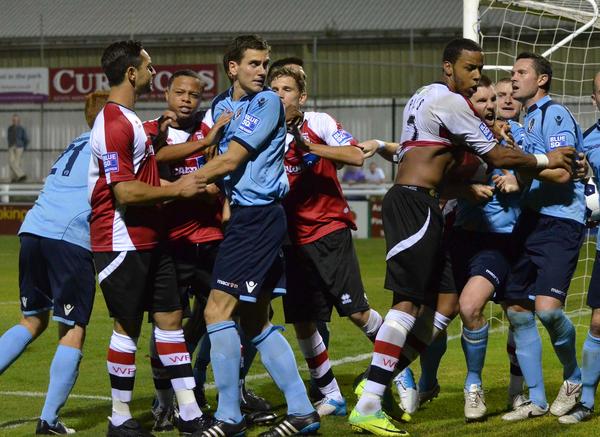
Flash Point: Things get heated between Woking and Dartford after Gez Sole’s penalty (pic courtesy of David Holmes)

There were plenty of niggly challenges and moaning on the pitch, x-rated chants at the Kingfield Road End and good-natured frustration voiced on Moaners’ Corner as we saw a dogged 10-man Dartford side with a hobbling goalie try to hold on for a point. Meanwhile, my boys were deterred at every turn until a Giuseppe Sole penalty settled the affair, with argy-bargy and ‘handbags’ after the trip that led to the spot-kick leading to a brief period of what my pal Jim would call ‘a little bit of unpleasantness’ involving fans, players and stewards.

But that’s sport for you, I guess. It’s a contact sport and It can’t always be about those wondrous moments like Jess Ennis’ and Mo Farah’s late bursts to the front on the track at Stratford. That’s what makes it such an unpredictable and great game too. Sometimes it’s decided by an ill-timed challenge, a less than romantic deflection off an unexpected part of the male anatomy, or a total fluke of a shot.

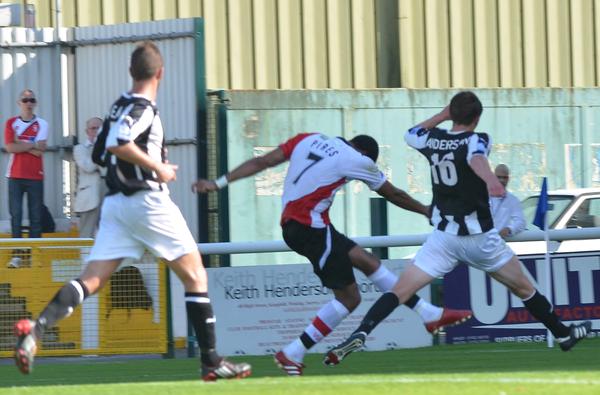
I was back at Kingfield a few days after the win over Dartford to see my boys send a spirited Barrow side all the way back up to the end of the ‘longest cul de sac in England’ without a single point, their early promise and opening goal coming to nothing as the intense heat took its toll, the final straw being a delightful finish from Woking’s sturdy Portuguese-born striker Loick Pires that made it 3-1.

Pires Power: Loick lashes home Woking’s third on Saturday (photo courtesy of David Holmes)

It must have seemed like a 1,000-mile return trip for a commendable Furness away following, let alone the 300 miles they had to endure to get home after a long and tetchy day out in suburban Surrey, experiencing temperatures in the thirties (at the first game I’ve been to where the ref pulled the teams over mid-way through the first half for a drinks break). But they’ll get over it and might even subject my team and several more to a similar fate this season.

Fun In The Sun: The reaction to Pires’ decider against Barrow (photo courtesy of David Holmes)

That’s the beauty of football for me, perhaps in the same way as it for a hockey or rugby fan at turns frustrated and ecstatic about their own favourite waste of time. And just by turning up at your local club, using public facilities or safeguarding council and school playing fields, you’re doing your bit to encourage tomorrow’s sporting stars to come through and ensuring that sporting legacy continues.

Posted in sport | Tagged , , , , , , , , , | 7 Comments

When Daldry and Daltrey took up the London 2012 baton

There was little sign of life at Our House on Monday morning, the latest of several late nights clearly taking its toll after the party to mark the end of a truly spectacular event.

My youngest was battling with her eyelids shortly before the phoenix rose from the ashes of the Olympic cauldron, but it’s fair to say both my girls have put in a few hours at the gogglebox this past fortnight for an event that clearly inspired the nation.

And Stephen Daldry and Kim Gavin’s closing ceremony carried on where Danny Boyle’s spectacular opener left off, a heady mix of great music, culture and drama making us proud to be British again.

To a backdrop of London wrapped in news headlines championing the UK’s unequalled literary heritage, Emile Sande and Stomp supplied the soundtrack as Tim Spall’s Winston Churchill – atop Big Ben – carried on where Kenneth Branagh’s Brunel left off, reading from  Shakespeare’s The Tempest while ‘newspaper taxis’ flanked the Urban Voices gospel choir as they tackled the first of many Beatles numbers, Because, cellist Julian Lloyd Webber played Elgar on the roof of the Albert Hall, Del and Rodney Trotter camped it up as Batman and Robin, and Michael Caine gave his immortal line from The Italian Job.

Nice to see Madness in the mix this time too, airborne saxophonist Lee Thompson still flying after all these years, and how peculiarly grand it was to see the Massed Bands of the Household Division tackle Blur’s Parklife and a pneumatic drill introduce the London Symphony Orchestra and Urban Voices’ version of the National Anthem.

Truly Madly: Cathal, Suggs and co bring down Our House on the big night (screen grabs courtesy of the BBC)

While the Queen couldn’t make it, there were plenty of worthy stand-ins, not least the Pet Shop Boys, projected images of David Bowie and Freddie Mercury, and George Michael and Annie Lennox in person.

Just when you thought this was another old ‘uns gig, One Direction took to the stage – while my youngest harshly covered her ears – but then the Spelbound gymnast troupe took us through the next Lennon-McCartney classic, A Day In A Life, and The Kinks’ Ray Davies led a rousing rendition of Waterloo Sunset, with ‘sha la la’s all round.

We were soon afforded the first glimpses of Damien Hirst’s impressive Union flag artwork, with tears flowing again as the screens showed iconic Games images as Sande reprised Read All About It with the help of 270 young East London voices.

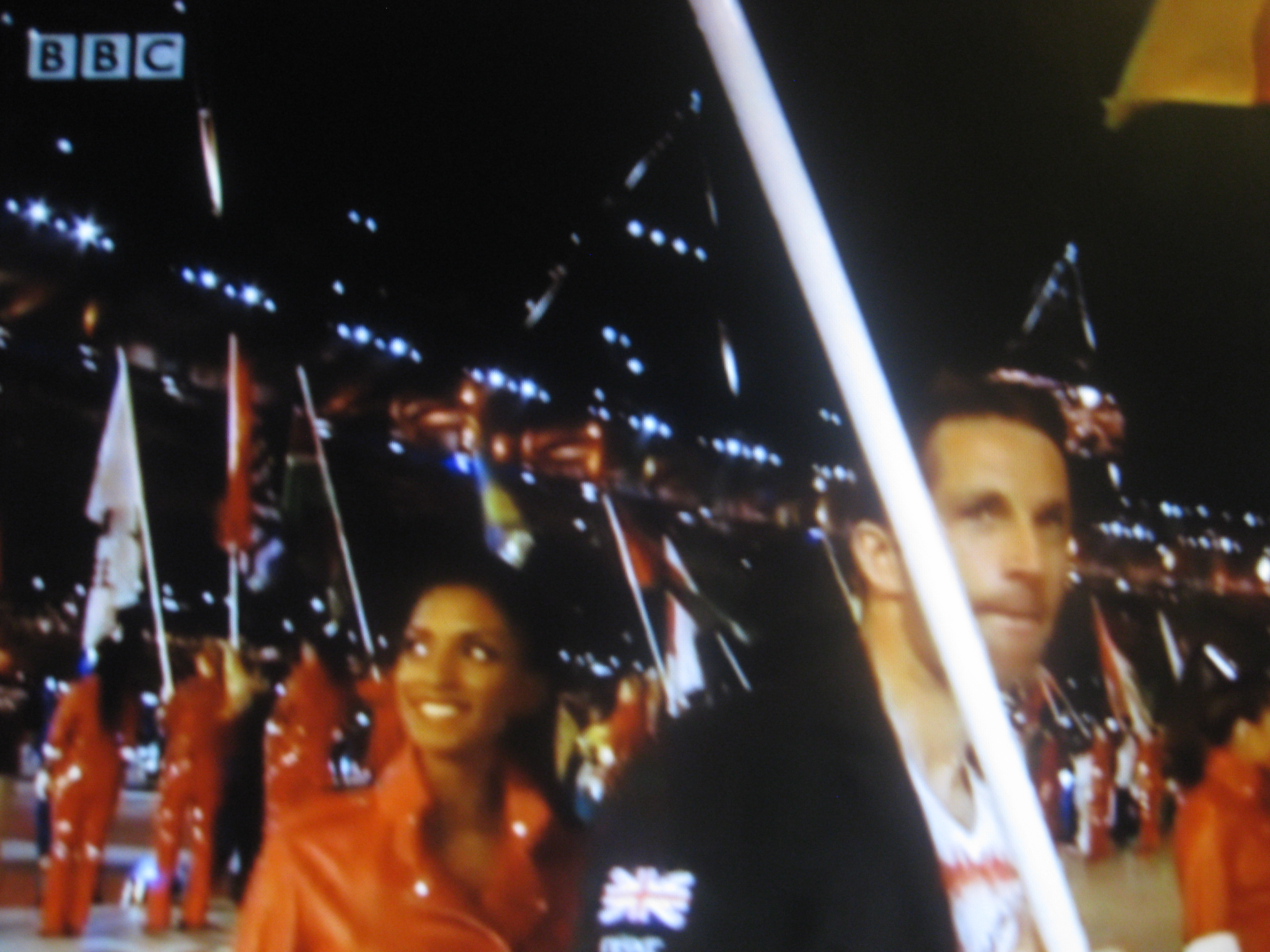
The flag-bearers followed, Ben Ainslie leading Team GB as Elbow upped the ante with the stirring Open Arms and One Day Like This before the stage was transformed again for Kate Bush’s sumptuous heart-pumping Running Up That Hill.

Mast Man: Cornish sailing legend Ben Ainslie leads Team GB in (screen grabs courtesy of the BBC)

There was still time for the business of the day, Uganda’s Stephen Kiprotich and two Kenyan runner-ups receiving their last-day marathon medals before George Harrison’s Here Comes The Sun heralded Kath Grainger and co’s public thank you to the ‘Games Makers’ who’d ensured London 2012’s success.

It was only a matter of time before we heard Bohemian Rhapsody, a brief snatch followed by a touching John Lennon moment as the man himself gave us Imagine on the big screen, with young Liverpudlian choral and signing support, the resultant good vibe even seeing me through George Michael’s Freedom. While his second song, the Bowie Fashion tribute and Annie Lennox’s Little Bird section proved perfect for a ‘comfort break’ and a top-up, I was back for the Kaiser Chiefs tackling Pinball Wizard amid an awesome scooter rally, and hats off to Ed Sheeran and his supergroup of sorts for a pensive Wish You Were Here complete with Pink Floyd-themed tightrope walk.

Just in case there was a danger of the rest of the world understanding this show, on came  Russell Brand for a truly puzzling trip featuring Willy Wonka and the Fab Four (coo-coo-ca-choo) before Fatboy Slim had our pupils dilating, DJ-ing aboard a 50m fluorescent octopus for a storming Right Here, Right Now and The Rockafeller Skank, that followed in turn by celeb limo liggers Jessie J, Tiny Tempah and Taio Cruz, before they combined for Bee Gees tribute You Should Be Dancing.

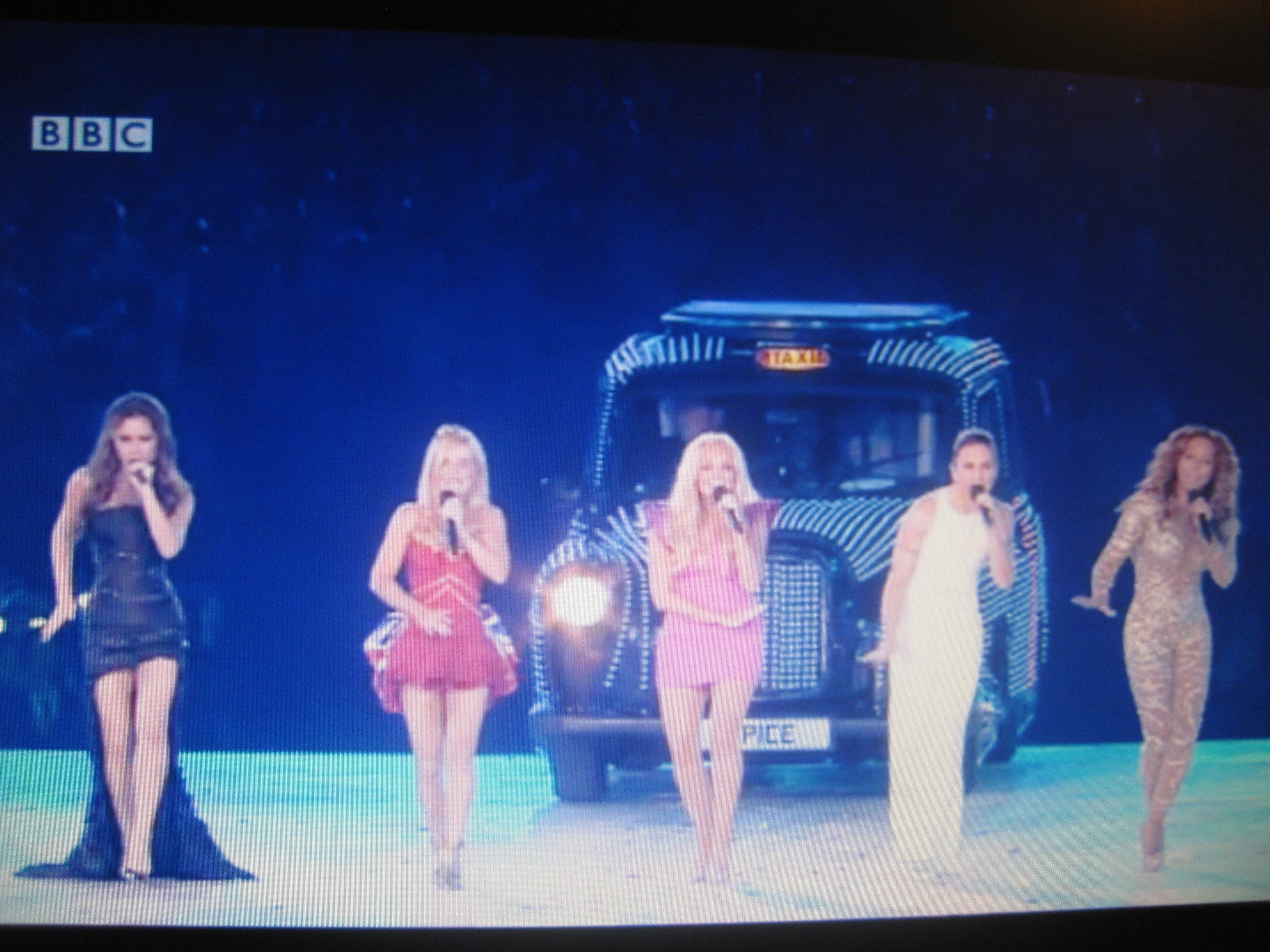
Added Spice: Taxi for the Fab Five, anyone? (screen grabs courtesy of the BBC)

The dance moves continued apace as the Spice Girls hammed it up perfectly for Wannabe and Spice Up Your life, and while no self-respecting jock would have followed that with  Beady Eye and ELO, Liam’ Gallagher’s version of our kid’s Wonderwall and the subsequent Mr Blue Sky somehow did the trick.

A curiously British pageant then took another unexpected turn in a Pythonesque pastiche as Eric Idle led an array of skating nuns, morris and Indian dancers, rugby players, Welsh girls, angels and centurions through alternative national anthem Always Look On The Bright Side of Life.

Muse were next, their Olympic tribute Survival further underlining the wide church that is UK music, one further extended as Freddie Mercury taught us to yodel from above and ex-bandmates Brian May and Roger Taylor tackled Brighton Rock before Jessie J joined them for a suitably stadium-shaking treatment of We Will Rock You.

It was difficult to know where it could go from there, but the London Welsh Male Voice Choir and London Welsh Rugby Club Choir brought a lump to the throat with the Olympic anthem amid ceremonial flag-waving from Boris Johnson, Jack Rogge and the mayor of Rio.

The fact that we were partied out by then meant it was difficult to fully appreciate the following Brazilian taster session – including Pele’s appearance – or Seb Coe and Rogge’s   well-chosen words of tribute. But there’s only so much you can take in on one night.

Neat Pete: Townshend takes us to the climax with The Who (screen grabs courtesy of the BBC)

Yet on the stroke of midnight the cauldron was extinguished, Take That thrilled the throngs and Darcey Bussell’s dancers confused them one more time before The Who finished the party in style with a Baba O’Riley, See Me, Feel Me and My Generation show-stopper – Roger Daltrey leading a glorious twist on Lord Coe’s message, in what proved a fitting end for a celebratory climax to a truly spectacular and wonderfully inspirational Olympic Games.

Posted in Books Films, TV & Radio, sport | Tagged , , , , , , , , , | Leave a comment

Living the dream and the lasting legacy – week two of the London 2012 Olympics

If ever there was a motivational endorsement of everything good that came out of these past two weeks, it was voiced by Lancashire lass Sam Murray late on Sunday afternoon.

Surprisingly fresh from her silver medal performance at the Modern Pentathlon – the last event at the London 2012 Games – the 22-year-old University of Bath graduate confided in Clare Balding just what it takes to be an Olympian.

The determined Clitheroe athlete’s off-the-cuff speech – which couldn’t have been better if it was scripted – touched on how much you can achieve in a short space of time. In her case that involved a pentathlon-speed transition from A-levels to podium, underlining the strength of her message about reaching your goals in life, battling away your detractors, insisting a ‘normal girl’ can get there in the end. And who can argue with that sentiment?

No pressure: Sam Murray on the BBC Breakfast couch with Bill Turnbull and Susanna Reid (pic courtesy of BBC)

Sunday was just the final day of a fortnight packed with such inspirational moments, and  one in which it was also pleasing to hear our third boxing gold medallist – super- heavyweight Anthony Joshua – confirm his bid to remain amateur, for now at least.

So where did we leave the story last week? That seems a few podia away now, and those GB celebrations included three more medals on the track – Rob Grabarz’s high jump bronze, Christine Ohuruogu’s silver in the 400m (after another epic battle with supreme US talent Sanya Richards-Ross, lovingly dubbed ‘Princess Girl’ by my daughters), and Mo Farah’s stunning second gold.

One week on from Super Saturday and its triple gold haul for Jess Ennis, Farah and Greg Rutherford came a fantastic follow-up as Little Mo secured the 5,000m title and bantamweight boxer Luke Campbell also struck gold after a classic bout with Ireland’s John-Joe Nevin, on a day that started with an A1 K1 kayak sprint win for Ed McKeever.

That followed a further moment of sporting history as Nicola Adams took the woman’s flyweight crown, while welterweight Fred Evans secured a silver medal, and middleweight Anthony Ogogo a bronze.

Elswhere, there was Liam Heath and Jon Schofield’s K2 200m canoe sprint bronze, the same honour for Tom Daley in the 10m platform diving, gymnastics pommel horse silver for Louis Smith and bronze for Max Whitlock, Beth Tweddle’s bronze on the uneven bars, the same for the women’s hockey team, and Taekwondo gold for Jade Jones and bronze for Letalo Mohammad.

There was also plenty to savour in equestrianism, topped by dressage gold for Charlotte Dujardin and bronze for Laura Bechtolsheimer, team gold for the same riders with Carl Hester, and gold in the team jump for Scott Brash, Peter Charles, Ben Maher and Nick Skelton. And let’s not forget Andy Murray claiming gold and then silver with Laura Robson in the tennis at Wimbledon. Whatever next?

In a Games in which Team GB got going with Lizzie Armitstead’s silver in the women’s road race cycling, there was gold and bronze for Yorkshire too as the Brownlee brothers showed Northern grit in their first and third place finishes, Alistair winning and bro Jonny having to settle for third after a dramatic 15-second time penalty.

The action continued at the Velodrome with even more historic moments for Dave Brailsford’s top-notch track cyclists, ending with nine golds – including those in the keirin for old masters Chris Hoy and Vicky Pendleton and individual success for younger guns like Jason Kenny in the sprint and his significant other Laura Trott in the omnium.

Add to that Team GB’s sailors carrying on where the rowers left off, Ben Ainslie becoming our most successful Olympic sailor with his Finn gold, and silver in the men’s star (Percy & Simpson), men’s and women’s 470 (Patience & Bithell, Mills & Clark) and Nick Dempsey in the RS-X. Can’t say I would have had a clue what was going on even if I was paddling at Weymouth (or in a few of those events elsewhere if I’m honest), but there you go.

Quite a week really. That makes two in total, and for all those who might take up Morrissey’s argument about ‘blustering jingoism’, this was far more than a nationalist flag-waving exercise. Granted, it’s easy to generalise and see our dominance at Eton Dorney and the Velodrome track as a symbol of Rule Britannia and all things empirical. But amid the patriotic noises at all these venues there was voluminous support for all the other competing nations too.

That includes the respect shown to the Jamaican sprint fraternity, the US sprint sisterhood and emerging talents like Kenya’s 800m sensation David Rudisha, Grenada’s Kirani James in the 400m, tearful Dominican 400m hurdler Felix Sanchez, and Ugandan marathon man Stephen Kiprotich.

The same goes – in equal measure – for some of the many who overcame major hardships and obstacles to get there in the first place, not least South African paralympian Oscar Pistorius and Saudi Arabia’s first female Olympian Sarah Attar. For these two and many more Pierre de Coubertin’s statement that “The important thing is not to win, but to take part” rang true.

Meanwhile, the Dutch and German teams taught us a thing or two about total hockey, bronze medallists Canada and eventual champions the USA fought out a gripping advert for women’s football in their ‘soccer semi’ at Old Trafford, and there were so many other displays in a variety of sports that truly exemplified the Olympic spirit.

We’re off: Our first gold at Eton Dorney (pic courtesy of BBC Sport)

From Helen Glover and Heather Stanning’s rowing gold through to Sam Murray’s modern pentathlon silver it’s been a blast for Team GB and London 2012 as a whole. The locations were great, from the top of Box Hill and the country lanes of my old neck of the woods in Surrey through to Greenwich, Richmond, the Mall and Buck Palace, this was a tourist board’s dream.

In the build-up to these Games, with all its corporate branding and potential free-loading, a lot of us had misgivings and fears, lest we should be witnessing an event advertising the selective austerity UK of Cameron & Clegg, with added financial clout from FatCat Holdings. But while there were elements of that – as is the case with any event of such magnitude in this day and age – Danny Boyle’s opening ceremony set the right tone, and for a couple of weeks we could at least leave our political squabbles on the back-burner and dream, enjoying age-old values of sporting glory and participation, backed by an inspirational belief in all the good things about this island nation and its position of respect within the modern world.

Now of course comes the real crunch, as we watch and wait to see if the vast amounts of money made from London 2012 find their way back to the communities that were promised a long-term future by this great scheme at the planning stage.

A world party that’s cost around the £10 billion mark was backed by then-mayor Ken Livingstone in the hope that it would lead to major Government funding for the East End of London, in a similar way to that Manchester saw with its own redevelopment through the 2002 Commonwealth Games.

Already we’ve heard Government rumblings which the more cynical might see as little more than lip service to soundbites (more PE on the national curriculum, safeguarded playing fields, etc.). Let’s just hope all this about lasting legacies and a boost to UK sport, volunteering and regeneration is not just blarney, and there’s some truth behind the talk.

The London 2012 Olympics saw real across-the-divide success, and made this blogger for one proud of the welfare state that helped hone those talents in the first place. Now we have to build on that and ensure that belief remains, and that doesn’t just mean through the £125 million annual pay-check for UK Sport.

Back on July 27th, internet guru Tim Berners-Lee told us from his keyboard at the Olympic Stadium opening ceremony, ‘This is for everyone’. Let’s make sure that remains the goal from here on in. I’ve been proud to be British these past couple of weeks, and I could get quite used to that.

Posted in sport | Tagged , , , , , , , , , | Leave a comment

40 great reasons to have loved the 2012 Olympics

In no particular order …

1. Danny Boyle’s opening ceremony for setting the tone and leaving me proud to be British; and Stephen Daldry and Kim Gavin’s closing pageant for living up to its high standard

2. Double-golden girl Laura Trott’s infectiously excitable post-race interviews, be it with her track cycling team-mates or just on her own

3. Steve Cram and Brendan Foster’s historic BBC TV commentary as Mo Farah secured his 5,000m gold medal amid a wall of noise in the Olympic Stadium

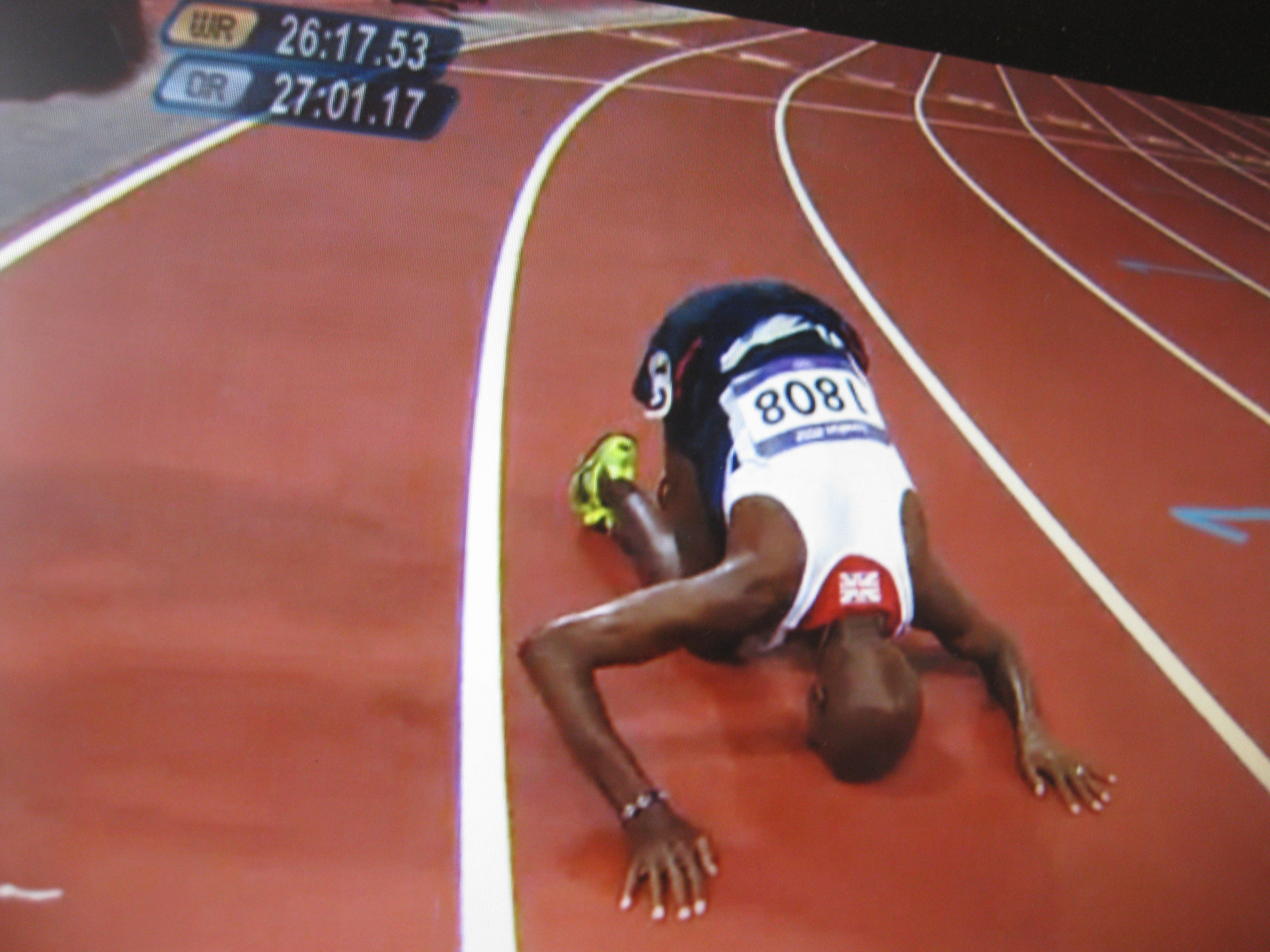
4. Mo Farah and his marvellous ‘mobot’, with his missus and daughter on the track after his 10,000m title

5. Heptathlon pin-up Jessica Ennis: the tears, the winning smile, and pure all-round inspirational tale

6. Jamaican sprint stars Usain Bolt and Yohan Blake and their post-race trackside antics, artists in front of the cameras in more sense than one

7. Ben Ainslie’s Dirty Harry-style ‘and you don’t want to make me angry’ pronouncement on his way to becoming the most successful sailing Olympian of all time

8. Matt Baker’s no-holds-barred excitement on the Beeb at the gymnastics finals, particularly when Oldham, Purvis, Smith, Thomas, Tweddle and Whitlock shone

Motown Moment: Jackson, Johnson and Lewis get excited with the Beeb … big time (pic courtesy of BBC Sport)

9. Colin Jackson and Denise Lewis’ ‘hidden camera’ studio ecstacy during the Farah and Bolt golden track moments, as Michael Johnson struggled to keep calm and carry on

10. Andy Murray learning to have fun in public – too much of a rarity – with help from some shockingly good form from Laura Robson, on his way to two tennis medals

11. Bradley Wiggins and those super sideburns on the road again, from Deepest Surrey to the streets of London and Hampton Court Palace

12. Mrs Brownlee’s boys and their triumphant triathlon antics, not least that tense moment in the penalty box for brother Jonny

13. Manx road racer Mark Cavendish and his impish grin, trying to make sense of it all in the BBC’s Velodrome press box

14. The highly-professional Hugh Porter and his off-mic coughs during a mammoth spell commentating alongside Chris Boardman during the cycling road races

15. Gary Lineker’s post-time trial interview with a wonderfully eloquent and refreshingly down-to-earth Brad Wiggins

16. John Inverdale’s genuine TV interview tears after rowing silver for a gutted Zak Purchase and Mark Hunter

17. Sir Steve Redgrave and his unpaid role carrying exhausted British rowers to the podium after Inverdale’s interviews

18. Rebecca Adlington’s stirring acceptance of her bronze medals after a gruelling 800m freestyle battle in the pool

19. Dominican 400m hurdles champion Felix Sanchez and his tears on the podium, so difficult to watch but perhaps a perfect example of how much that moment must mean

20. All those sprinters playing to the gallery, including Blake’s less than convincing ‘Beast’ mime and a certain team-mate who was nothing less than greased lightning throughout.

21. Radio 5 Live’s commentary team for all those key moments, notably the switch to and from the canoe slalom and double trap finals as we won two more gold medals

22. Nicola Adams, Jade Jones, Gemma Gibbons and Karina Bryant for redefining the term ‘fighting like a girl’ in the boxing, Taekwondo and judo

23. Cyclist Chris Froome, living proof in lycra that it’s not always just about finishing first

24. Gymnast Beth Tweddle proving you don’t always need flamboyance to shine out of the arena – unassuming to a tee.

25. Equestrian Mary King proving age is no barrier when it comes to achieving at Olympic standard.

26. Sir Chris Hoy and Queen Vic Pendleton showing them younger whipper-snappers a thing or two about riding a bike

27. Coleraine rower Ian Campbell after his single scull bronze, a broken man showing us all just what it takes to claim a medal

28. Rowing alchemist Kath Grainger and her persistence paying off as she turns all that silver into gold.

29. The BBC’s radio and TV commentary teams doing their best to explain the more technical sports like diving, gymnastics and sailing

30. Clare Balding for her boundless enthusiasm at whatever sport she’s covering, and her punter-in-the-street explanations as to what the hell’s going on at key moments

31. Proud Olympian Oscar Pistorus for his determination, a perfect ambassador for the forthcoming Paralympics and one who clearly never takes no for an answer

32. Sarah Attar for her historic presence in the 800m, the first Saudia Arabian woman to feature at an Olympic Games

33. Michael Phelps and his swimming pool mastery, taking his total up to 22 medals – 18 gold – to become the most decorated Olympian of all time

34. Tom Daley for proving his doubtors wrong, and for his emotional nod to his late father after his bronze medal

35. Montenegro for taking 34 athletes to London 2012 and coming back with 14 medals – a superior 41% success rate

36. Kirani James for winning Grenada’s first ever gold medal in spectacular fashion in the 400m final, earning his nation a day off in the process.

37. Lancashire lass Sam Murray’s heart-felt advice after her modern pentathlon silver about how we can all get what we want in life if we put the hours in

38. Mancunian pensioner Peter Deary and his unusually iconic Derney bike, leading the keirin charge in the Velodrome

39. Every single Team GB athlete who made it to the podium, for proving what can be achieved with a little hard work, persistence and perseverance

40. Every single Team GB athlete who didn’t make it to the podium, all the volunteers and all those who turned up at London 2012 and during the Olympic torch relay

Posted in sport | Tagged , , , , , , , | Leave a comment

When bronze ambition measures up to golden gongs

When Jess Ennis and Mo Farah somehow found those extra gears and kicked home to secure yet more Team GB gold medals on Saturday night, there were tears of pride and joy up and down this land.

If ever there was a statement that we still have the right to use the word ‘great’ in our title, and underline that vision of this being an Olympic Games for everyone, here it was -two superb sporting products of a multi-cultural UK leading the world.

Crowning Mo-ment: Farah’s finish in the 10,000m proved a defining moment (pic courtesy of BBC Sport)

We’d already seen world and Olympic records tumble and enough GB gongs to hang as bunting in Bradley Wiggins’ homecoming before heptathlon hero Ennis, 10,000m star Farah and long jump jet Greg Rutherford joined the party.

And from Stratford to Weymouth and Wimbledon, there’s plenty more of that to come  these next few days at London 2012.

But for all the wondrous stories and tales of inspiration aired so far – culminating in Saturday night’s track and field master-class – we’re still in danger of losing the true message of the Olympics if we’re not careful.

I guess we’re all guilty of forgetting about our modest initial medal aim as we eye up the leader-board and see how we’re (almost) competing with the big guns of China and the USA. That’s no mean feat when you take into consideration the comparative size of the UK, and it’s also a great advert for Lottery funding.

Greg’s Grace: Rutherford about to strike gold at London 2012 (pic courtesy of BBC Sport)

But for every rousing play of the national anthem and hoisted Union flag, it’s sometimes the less obvious stories and glories that catch this old cynic’s eye. Fantastic a moment as they were, I find myself looking beyond the Grainger, Hoy and Wiggins headlines, seeing more of that old time spirit in the attitude of a few lesser lights.

So step up to the writewyattuk podium Rebecca Adlington, for her rousing acceptance of a bronze medal after a sapping 800m freestyle swim in the Aquatics Centre, complementing that she gained in the 400m free.

Michael Jamieson’s 200m breaststroke silver might have been deemed more impressive, but the Mansfield marvel showed maturity beyond her 23 years (yes, I know, that’s ‘old’ for a swimmer) as she ‘bigged up’ her honour in a post-race poolside chat with Sharon Davies.

The same goes for physically-broken Coleraine rower Ian Campbell after his single scull bronze. A superhuman effort on the water at Eton Dorney left the poor bloke a wreck and he could hardly lift his head as John Inverdale hovered sympathetically with his mic.

In the same boat, so to speak, were ‘defeated’ pair Zac Purchase and Mark Hunter after being pipped by the Danes (painful) at the climax of a thrilling lightweight double-sculls race, the afore-mentioned Inverdale left in tears and Sir Steve Redgrave again called on to help carry a medal winner to the podium.

Perhaps understandably, Purchase and Hunter couldn’t quite see beyond their failure to strike gold and were bereft, yet they had every reason to feel proud of their own vast efforts and salute their opponents.

I felt more empathy for the Polish girls who finished third to women’s double sculls victors Kath Grainger and Anna Watkins, their smiles of delight what this Games should all be about. While Grainger’s tale of try, try, try again should be applauded, all that previous silver was something to be savoured.

You’ll forgive me for not reeling off every rowing medal winner. There’s only so much space here, and again they proved to be world-beaters, putting in the shade all those no-lesser stories involving fellow competitors in such a demanding sport.

Jess Brilliant: First lady Ennis is all smiles for the cameras (pic courtesy BBC Sport)

The same goes for the glut of cycling medal winners, but I’ll add Chris Froome to my list, his mammoth achievement of third at the men’s time trial hot on the heels of second overall at the Tour de France – while the world can barely see past the sideburns of cycling colossus Brad Wiggins.

An honorary mention for Wiggo though, who was quick to praise his team-mate (again) in an illuminating BBC interview with Gary Lineker after his time trial, the man of the moment cool without being cocky, entertaining without preening, and on the whole humble and gracious.

I’ll add Lizzie Armitstead to my honours list too, getting the party started with a silver medal on a day of good old British rain, crashes, toil and pain, and that after the GB boys got their tactics wrong on the road – the rest of the field getting their own back for Paris and all that.

Next up I’ll praise David Florence and Richard Hounslow, who had to settle for C2 canoe slalom doubles silver after being pipped by their own team-mates, Tim Baillie and Etienne Stott.

What a bit of broadcasting magic that proved. I’d only popped out of the house for an hour or so and found myself in the car park at Asda listening to BBC Radio 5 Live’s compelling commentary as they switched between Lee Valley and the double trap shooting at the Royal Artillery Barracks as Peter Wilson claimed the Olympic title. Just who would have thought that would have made great radio?

I can’t leave out the equestrians. How great must it be to collect your silver medal from your Mum, as was the case with Zara Phillips, with your cousins later hogging the TV limelight, telling Sue Barker how proud they were of you.

And how fresh it was to see Mary King strike silver at 51, in her sixth Olympics. Not sure if she’ll go on to take the honour of becoming the oldest Olympic medallist mind, as that will probably remain with Britain’s John Copley, winner of a silver medal in the 1948 engravings and etchings competition, at the age of 73. Yes, 73. Yes, engravings and etchings.

Then there was Euan Burton after his tears following an early exit in the judo, later made up by a silver for his partner Gemma Gibbons – complete with a heart-warming post-bout spirited reaction from US champion Kayla Harrison – and a bronze for Karina Bryant.

I’ve also picked our men’s gymnastic artistic team – Louis Smith, Daniel Purvis, Max Whitlock, Kristian Thomas, and Sam Oldham. Who could forget their superb third place and all the drama of that appeal by Japan that saw the silver snatched away from them? It was worth viewing for the reaction of mega-excitable ex-Blue Peter presenter Matt Baker and his co-commentators alone – a TV commentating gold assured.

That of course is just highlighting those who made it to the podium. Spare a thought for the likes of diving pin-up Tom Daley, not just having to face a narrow defeat but also personal Twitter troll abuse, and so many more.

Then there was Team GB rising football star Daniel Sturridge after his penalty was saved, signalling our quarter-final exit, as was the case with a late miss by Karen Carney for the women the night before. All three will surely bounce back and be all the stronger for the experience.

And less we forget it’s only a Games, on a lighter note my final gong goes to a bit of an outsider, and relates back to the Velodrome drama again.

I could have chosen the men and women for their team pursuit and sprint glories, or Victoria Pendleton for her persistence and superb late charge as she claimed her keirin title. But instead I’m going for that unlikely early leader in that latter event.

He may have looked less than dynamic – the definition of calm itself – for those first relaxed six laps, but in sport there should perhaps always be a respect for the pace-setters. So hats off to the unnamed rider of the Derny motorised bicycle, competing in both the men’s and women’s races and looking like he was just out to the shops for a few last-minute items until he took a wrong turn to end up on the track.

Just when you get wrapped up in sport and start to believe all the hype, here’s something truly bizarre that makes you see through all the expert analysis and talk of lactic acid (which seems to have just been discovered this past week, judging by the amount of column inches and TV analysis that mention it). And that’s okay by me.

If Manx missile Mark Cavendish’s infectious boyish grin isn’t enough to bring a smile to your face, the sight of the mystery man in black on the Derny surely will, not least when the cycling experts find themselves having to defend the bike’s relevance for the umpteenth time.

Author’s note: you may have noted that I refuse to use the words ‘medal’ and ‘podium’ as verbs in the above London 2012 review. It’s a bastardisation of the English language and I’m not having it, even if – like Daphne, Fred, Velma, Shaggy and Scooby-Doo – those medalling kids have ‘gotten away with it’ on the radio and TV every night so far.

Posted in Books Films, TV & Radio, sport | Tagged , , , , , , , , , | Leave a comment

Oh Danny Boyle

Arise Sir Daniel. The Boyle done good at the Olympic Park on Friday. And what with DB’s opening ceremony and the torch relay that preceded it, a lot more of us feel part of London 2012 now – something we might not have imagined just a few weeks back.

While dear old Madge and the DoE looked a little nonplussed at Boyle’s party piece, you really can’t blame them. With a combined age of 177, this was after all just another late night in what’s been a pretty hectic summer … reign, rain or (occasional) shine. But what a triumph that ceremony proved, and what a marvel in this day and age of instant techno gratification that no one let on what was going to unfold.

From Frank Turner’s frankly thankless task as warm-up amid the sheep and milkmaids for the pastoral scene and Tour de France hero Bradley Wiggins’ tolling of the bell, there was hardly a chance to draw breath on Friday night.

Rings True: Danny Boyle nailed it with his Olympic Ceremony spectacular (picture copyright: BBC)

What followed was sublime, the strains of the LSO treatment of Elgar’s Nimrod giving way to Evelyn Glennie leading 1,000 drummers through Underworld’s And I Will Kiss while a lone voice led us through Blake and Parry’s Jerusalem, followed by Danny Boy, Flower of Scotland and Bread of Heaven from choirs elsewhere – need you think this was all just about England.

That musical legacy later included among others Bowie, Clapton, The Jam, The Beatles, The Rolling Stones, New Order, Queen, Sex Pistols, The Specials, The Who, and even Mud and The Prodigy. I for one was captivated. Lest we forgot where we were, there was Forever Blowing Bubbles too. And it wasn’t just Emeli Sande’s gloriously-understated Abide With Me – alongside a visual memorial to the 7/7 victims – and a frail Muhammad Ali’s appearance that tugged at the heart-strings.

Even after the admittedly-long but cleverly-managed parade of competing nations, that climactic cauldron moment and the official speeches – with Seb Coe clearly touched – we still had Paul McCartney’s apt finale of The End and Hey Jude, in what proved a ringing endorsement for a truly great Britain.

What the rest of the world (there was a staggering 26.9 million tuned in here alone) made of it all is a mystery. But so what? Radcliffe-raised director extraordinaire Dan was given the task, and got it spot on as far as I’m concerned. You couldn’t fit 2,000-plus years of history into one stage show, but he came damn close. And anything that questionable Tory MP Aidan Burley doesn’t like is alright by me.

A few months ago the negative reaction to London 2012 outweighed the positive, and few saw how a Games based in the capital could bring this nation together. But it has. the Olympic torch relay seeing to that from day one down in Land’s End. And there was more of the same in the opening ceremony to suggest this isn’t just another opportunity for the far right flag-wavers to try to steal our national identity.

Boyle was accused of left-wing sympathies for the subjects he chose. Well, fair play to him. Much of what he featured I’m proud of – multi-cuturalism, inclusivity, a free health service for all, and a celebration of great music, literature, film, sport and history – all delivered with a delicious British sense of humour.

Even the rain couldn’t thwart us this time, and was quickly repelled before Boyle’s Isles of Wonder film was truly underway, a mass of pertinent images following on and off screen. From the first TV soap gay kiss to – I kid you not – Pot Black, The Archers, Corrie, Fawlty Towers and Oliver, we also had action from iconic films like A Matter of Life and Death, Gregory’s Girl, and Boyle’s own Trainspotting, certainly crossing the UK cinematic spectrum. From casual nods to Milton and the Mini and from Sgt. Pepper to Churchill, the marching Chelsea pensioners and the Suffragettes – at an event where women of all nations will be represented for the first time – all life was here. And all the time those drums sounded.

It’s difficult to tell a nation’s history in short form, but Boyle’s choices seemed to tick the more pertinent boxes. There was Kenneth Branagh for starters as a particularly-smiley Isambard Kingdom Brunel (seemingly at odds with his Wallander persona) reading from Shakespeare’s The Tempest as we toiled through the Industrial Revolution amid smoking chimney stacks and the forging of those iconic five rings. Then there was the impact of the Great War, Trade Unionism, the Jarrow March, and a NHS celebratory dance-along, enough to have David Cameron squirming in his seat.

There was also the arrival of the Empire Windrush and all that led to in our modern multi-faith and multi-cultural history, right through to a cameo for web visionary Tim Berners-Lee and his simple but effective ‘this is for everyone’ message.

We also had the championing of children’s lit (I suspect Boyle collaborator, esteemed  screenwriter and author Frank Cottrell Boyce had a hand in that), not least a Mary Poppins invasion, Voldemort, and JK Rowling’s reading of JM Barrie’s Peter Pan.

Hard as it is for this ageing new wave fan, I even enjoyed Mike Oldfield’s involvement, a world away from the Arctic Monkeys, their Lennon & McCartney cover Come Together accompanied by a sea of glowing moths on bicycles – like a Velodromatic version of ET. I think even Kate Middleton thought she was tripping by then. That humour was always there, and not just in the more obvious form of Rowan Atkinson’s Bean-esque tribute to Chariots of Fire. As star turn Dizzee Rascal himself said, Bonkers.

After the Queen’s splendid cameo alongside Daniel Craig and that genuinely shocking  parachute moment, it was clear we hadn’t seen the last of British icon James Bond. But while Craig was perhaps Connery, the Roger Moore alternative was on this occasion London 2012 ambassador David Beckham, his speedboat entry to the party just a further touch of genius.

I was so proud that my girls made it through this three-and-a-half-hour spectacular, although my youngest was battling with her eyelids by the time Guam were proudly waving to the crowds, let alone Zimbabwe. At one point it seemed that even Devon separatists Torquay had sent a team, but it turned out to be the moon and star of Turkey instead. But eventually – 205th out – there was Chris Hoy and his fellow Brits too, to the strains of David Bowie’s Heroes, and we could finally find out who was going to light that cauldron.

That was a genuine surprise of course, Steve Redgrave passing the torch to those seven young amabassadors. It was an inspired move, and another master-stroke on a night full of them – and no more potent a message that this global event should not be about celebrity endorsement but the legacy of the Olympic spirit and a bright future for all.

Postscript: This should have been on-line by Saturday morning, but the Olympic road race thwarted my attempts. So is this what I’m to expect this coming fortnight? I had good intentions but pretty soon had a call from my sister to let me know where they were stood as Cavendish, Froome, Millar, Stannard, Wiggins et al attempted to get Team GB off to a winning start. Pretty soon I was revelling in the glorious Surrey Hills backdrop as the race took shape, somewhat homesick and certainly proud of my old stamping ground in a perfect event to get the blood pumping. Our boys were ultimately upstaged by Kazakhstan rider Alexandre Vinokourov, but that’s not the full story and nor should it be. My godson was sporting his BW sideburns, and the streets were thronged as the nation turned out in force at the road and lane side. This wasn’t just about sports buffs either, as illustrated by an exchange between my family and a woman who asked them which one Bradley Walsh was, and would he be wearing his yellow hat. And if that doesn’t sum up the fact that the UK is getting behind London 2012, I’m not sure what would.

Combe Dancing: Blogger’s godson dons Wiggo ‘sidies’ in reverential nod to a Team GB folk hero

Posted in Books Films, TV & Radio, sport | Tagged , , , , , , , , , | 2 Comments

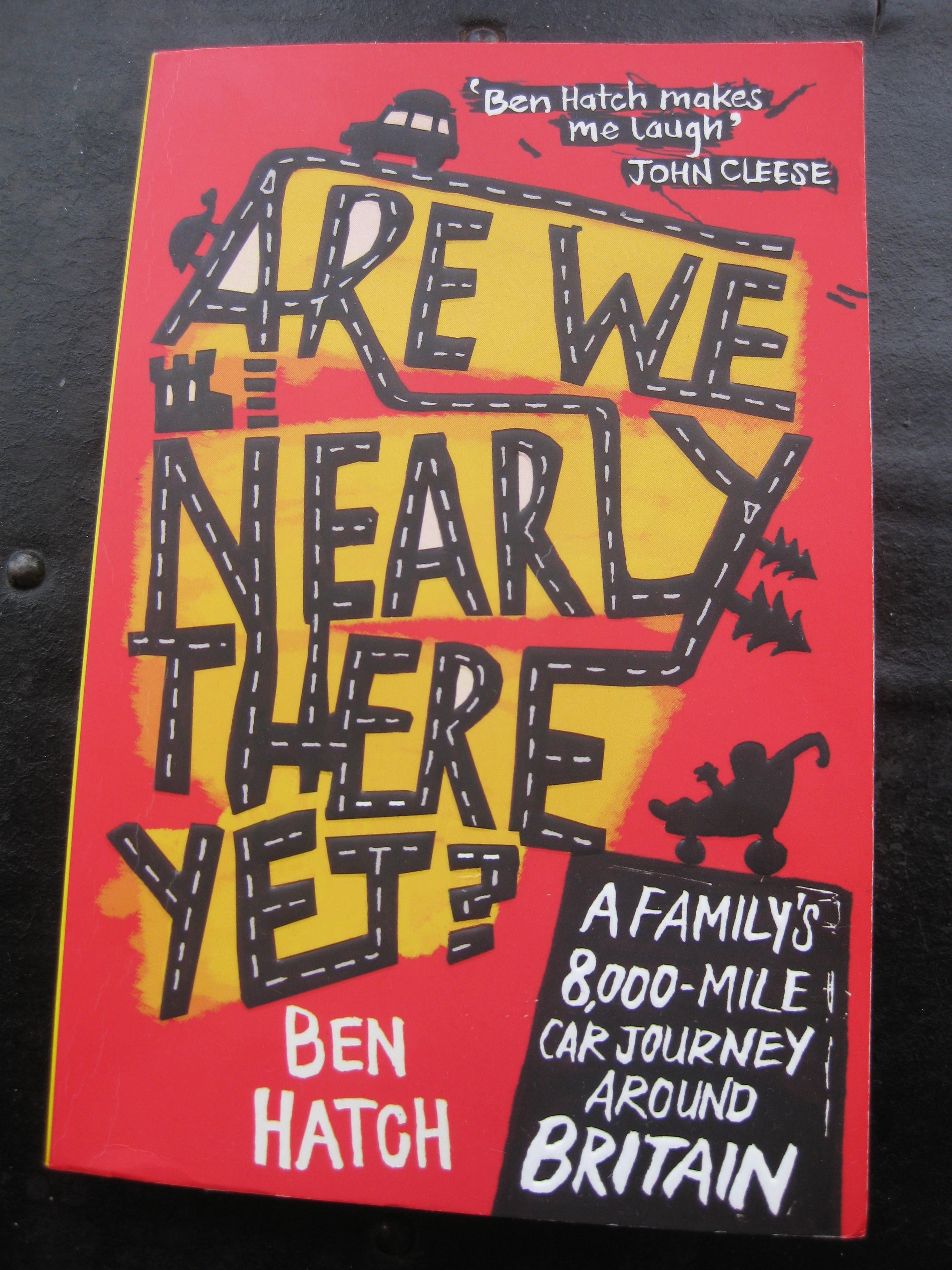
Are we nearly there yet? – Ben Hatch

A chance to enjoy some quality time with your partner and children, clocking up 8,000 miles on a UK tour – with free accommodation and a huge amount of attractions thrown in, all financed by a leading guide book publisher? What’s not to like?

When I saw the remit for Ben Hatch’s Are We Nearly There Yet? I felt quite jealous. But within a couple of chapters I was pretty much thankful it was Ben, wife Dinah and pre-school children Phoebe and Charlie on this mammoth trip, rather than me. For once the reality of the undertaking sinks in, you know this is no picnic – however many free hotel stays, meals and tourist spots are thrown in en route. If the planning was something of a logistical nightmare, the actual tour proves even more sobering.

And just reading Hatch’s account of his family adventure to end all family adventures leaves you feeling drained.

Brand Hatch: The ‘often painfully funny’ Are We Nearly There Yet?

Whether it was opportunism twinned with financial necessity, a spirit of wanderlust or devil-may-care, or just midlife-crisis-with-children that drove the Hatch grown-ups to take on this venture is open to question. But it certainly proved timely, not least with their daughter starting ‘big school’ on their return – the offer to write a British family tour guide for US publisher Frommer’s giving the Hatch clan a golden chance to bond before the reality of September to July school terms kicked in.

Whatever the case, it certainly proved a huge undertaking for a couple who met as regional journalists 20 years before. At times we’re witness to something of a learning curve for these rookie parents, from the moment they leave their East Sussex coastal home in a jam-packed (and soon smelly) Vauxhall Astra to travel the length and breadth of the UK in the name of family leisure time research.

There are certainly useful illustrations of how much children will get away with in trying circumstances. There are occasional victories for the grown-ups, but it’s mostly the kids who rule the roost – exploiting a situation where parents feel guilty for dragging them around such a tortuous circuit – demanding treats by the bucket and spade-load as they move from village to town and city and obscure museum to open-top bus and theme park.

Let’s not get too sociological about it though, even if social scientists could learn a lot through this rather unorthodox case study. We can just be thankful we weren’t there and instead enjoy the tragic-comedy of the journey for ourselves. In short, it’s bloody funny in several places for one reason or other. Often painfully funny.

It’s the author’s delivery that makes it so good, as you might expect from a son of one of the leading lights of British radio comedy – Sir David Hatch. He’s clearly picked up something along the way from his old man, be it through his reportage of the people and places he meets or the everyday vignettes of family life he records.

At times Hatch displays a taste for comic travelogue reminiscent of Bill Bryson or Michael Palin, but there’s a deeper side too, and it soon becomes clear that this is every bit as much a tribute to the author’s father. Along the way are reminiscences of past family holidays, or reminders of his father’s flagging health and battle with cancer via phone calls from the family or emergency trips to his bedside.

This is perhaps the main strength of Are We Nearly There Yet?- the touching anecdotes dealing with a dying parent something many of us can identify with. And Hatch expresses with skill his gratitude for all the good times and a public thank you for a healthy father-son relationship over the years.

One moment the author has you in stitches – a case in point a description of a Scottish family holiday in which his Dad loses his competitive rag while playing golf with his sons – and the next you feel for him as the true nature of the illness is realised – be it in a hospital ward or at the end of a phone.

Hatch may yet have a better book in him, but it’s unlikely to be as raw and personal, and there is plenty to savour here. And I for one look forward to the fruits of his next major road trip, his 2012 European tour – again with his wife and children in tow.

* Are We Nearly There Yet? By Ben Hatch (Summersdale, 2011) is available from all good book shops, amazon.co.uk and other leading internet stores 

Posted in Books Films, TV & Radio | Tagged , , , , , , , , , | 1 Comment

Bradley Wiggins’ tour de force

Allez allez allez! What’s that? A British one-two in the Tour de France? Absolutely. Congratulations to Bradley Wiggins – king of the rue, home and away, and an inspiration to us all.

Surely it won’t be long now before there’s a knighthood, and hopefully more Olympic medals on the mantelpiece at Brad’s all mod cons pad in rural Lancashire – nicely complementing all those other honours on his impressive sideboards.

Sorry. I’ll stop there with the mod and sideburns witticisms, for the first Briton to win the Tour in its 109-year history. From the mountains to the time trials, Wiggins excelled and proved the experts wrong. And his victory acceptance speech proved curiously British too, suggesting a sense of humour we’ve rarely heard and deflecting from that bloody awful Leslie Garrett rendition of the national anthem just before.

It was as good as all over as a race before Wiggo’s final frantic approach on the Champs-Elysees on Sunday, but he was clearly not content to just ‘cote’ home, and the adopted Lancastrian helped team-mate Mark Cavendish, Manx missile and 2011 Sports Personality of the Year, towards his own little bit of Tour history with yet another final stage victory. And on the day Chris Froome secured second overall, Wiggo was quick to big-up his fellow Team Sky riders.

Two-a-penny these top-of-their game cyclists around Lancashire these days. At least that’s how it appears. You can’t go down a local road without bumping in to Sir Chris Hoy, Jason Queally or fellow Team GB Olympic hero Wiggins. Or so it would seem. You certainly would have struggled last week to get past all the TV crews fighting to interview stalwarts of Lancashire cycling clubs or shopkeepers, landlords, barmaids or dentists who may have served or treated Bradders/Wiggers/Wiggo (you decide) these past few years.

As a regional journalist a few years back, I tried to track down the elusive Wiggins myself, but came to the conclusion that while his family address was the village just down the road, he actually lived on his saddle. The closest I got was via a self-styled press officer who jealously guarded all access, not even letting me tell how many children he had. I understand Wiggins is a private man and doesn’t want a stream of journo scum lining his drive, but this was the local rag – not The Currant Bun.

I did catch up with Queally a few times. A lovely bloke too, as I’m sure is the case with our latest cycling hero. Last time we met he was just back from a training ride with Hoy on the West Pennines bordering Chorley. I always liked the idea of these two Olympic heroes being spotted by picnicking families heading up Rivington Pike.

My views on lycra and the horrible shapes it makes on the human arse remain, but I feel proud that I have on my patch a succession of cyclists (would a better collective term be a pedalo? Perhaps Preston’s Freddie Flintoff would know). It seems that they were all lured to Lancs by the state-of-art Manchester Velodrome and some serious hills to stretch those tendons to capacity.

Things may change now there’s a new velodrome at Stratford, barely 10 miles from the Herne Hill track where London-raised Wiggins made his cycling debut 20 years ago, aged 12 (the only remaining London 1948 Olympic Games venue still in use, I believe). But I’m not convinced an exodus of pedal-punishing cyclists will follow from the North-West. For one thing, these riders know just how much comparative bang they can get for their bucks on the housing market up north.

It wouldn’t really matter if they did all move though, particularly now Brad has ensured that love of cycling has transferred to the national stage, something started by Merseyside’s Chris Boardman track pursuit gold at the 1992 Olympics in Barcelona, a major inspiration for Hoy, Queally and co as they spear-headed a veritable explosion of track cycling success at Sydney 2000 and beyond.

Tour Duo: ITV4’s Gary Imlach and Barcelona Olympics hero Chris Boardman compare notes on air

That was helped by the splendid daily coverage on ITV4, with Gary Imlach (whose book My Father and Other Working Class Football Heroes is a superb read, while we’re at it) and Boardman himself keeping us up to date with Wiggins’ and co throughout, from those gruelling mountain climbs to ‘Tackgate’ and beyond.

Wiggins’ own national breakthrough also came on the track, and in my formative years I kind of assumed that road racing was just something those European types were good at, with Belgian Eddy Merckx the big star back then. That perception had changed to some degree by 2002, when I was on hand to see Horwich stage the 2002 Commonwealth Games road races. And while cricket legend Sir Clive Lloyd handed out most of the medals to the Aussies that day (including 2011 Tour de France winner Cadel Evans), there was also a gold medal for Wales’ Nicole Cooke.

Now we’re all fired up for London 2012, hopefully there’ll be plenty more cycling glory to come – on the track and on the road – not least from a strong women’s team including the delightfully-named Wendy Houvenaghel and Jess Varnish, golden girl Victoria Pendleton and BMX star Shanaze Reade, just a few of the names that have helped spread the word even further afield.

So thanks Brad. You’ve sown the seed. Let’s hope that inspired three-week spell on the saddle will now rub off on the rest of Team GB, with plenty more medals to come. And as long as it doesn’t involve a further explosion in lycra sales, I can live with that.

Posted in sport | Tagged , , , , , , , , , | Leave a comment

From boy to man and NME to Catching the sun – the Tony Parsons interview

Tony Parsons: “As a writer, I am happy that people can still get that excited about the written word.”

Can it really be 36 years since Tony Parsons first burst on to the UK music scene as a writer with the NME, answering an advert calling for ‘hip, young gunslingers’? By that stage he already had his first novel under his belt (The Kids, 1976), and was publishing underground paper the Scandal Sheet while moving from job to job in London.

Pretty soon he was championing the emerging punk and new wave scene, chronicling such notables as The Clash, Sex Pistols, Blondie, Buzzcocks, Iggy Pop, The Jam, New York Dolls, Ramones, The Stranglers, Talking Heads, David Bowie, Bruce Springsteen and Led Zeppelin. Those days were later touched on – in fictional form – with 2005’s Stories We Could Tell.

This son of Romford, Essex, also collaborated on The Boy Looked at Johnny in 1979 with fellow NME reporter Julie Burchill, the pair going on to marry. And it was the collapse of that marriage – left as a single parent caring for a four-year-old son in 1984 – that proved a major influence on breakthrough 1999 novel Man and Boy, the first of many successes for a truly impressive writer.

For several years, Parsons struggled to make a living as a freelance writer, but by the 1990s he was a regular on live BBC panel show, Late Review, making Channel 4 documentaries, and writing newspaper columns for the Daily Telegraph then the Daily Mirror. He also published Bare, an authorised biography of George Michael.

Man and Boy, a superb example of Parsons’ trademark ‘fiction as therapy’ approach, touched on his lone-parent experiences and relationships with his folks, proving a word-of-mouth hit and taking a year to top the book charts. It remains his biggest seller, published in 39 languages, and won the British Book Awards’ Book of the Year Prize in 2001.

Since then he’s gone on to write two further Harry Silver books, Man and Wife (2002) and Men From The Boys (2010), alongside many more fine novels touching on similar themes, not least One For My Baby (2001), The Family Way (2004), My Favourite Wife (2008) and Starting Over (2009).

And this year alone Parsons has published the critically-acclaimed Catching the Sun and short-story collection Departures: Seven Stories From Heathrow.

Parsons married his Japanese wife, Yuriko, in 1992 and lives with his wife and a daughter in the capital. He also writes a monthly column for GQ magazine and a weekly column for the Daily Mirror. Yet for all his success, as Malcolm Wyatt found out, he remains extremely approachable and a good bloke all round, proud of his working class family roots and always happy to pass on advice.

MW: It’s proved a difficult time to bring out a new book, with the publishing world caught napping in the wake of 50 Shades of Grey. But Catching the Sun has sold well considering the current financial climate, hasn’t it?

TP: The summer of 2012 probably wasn’t the greatest time to publish a book! 50 SHADES OF GREY is by far the most successful book ever – nothing else comes even close. Not Harry Potter, Stieg Larsson, nothing. So it is distorting the market and sales are down all over – but I figure that you do the best work you can and hope it finds an audience. I don’t know what else you can do. Publishers are shell-shocked by 50 SHADES – truly shell-shocked, and I think it does change things – although nobody knows quite what. I think people like the boxed DVD experience – you can buy all three at once, and you don’t have to wait for a year. Personally, I think it is great that a book can sell 700,000 copies in one week. As a writer, I am happy that people can still get that excited about the written word.

MW: There have been lots of positive reviews for Catching the Sun. Do you still get the same sense of pride you did when Man and Boy became a success? Can you still get excited by a positive review after all those best-sellers? Or hurt by bad feedback?

TP: You are always cheered up by good reviews and positive feedback, and you are always brought down and hurt by snide remarks and sniping. I think what changes is that you build up defence mechanisms – there is no rule that says you have to seek out everything that is written about you. Most of the things that are written about you are best ignored. I am not one of those people who gets into fights on Twitter. I have lots of time for the people who like me, and those that don’t should just keep moving.

Catching The Sun (2012)

MW: Catching the Sun paints a vivid picture of life in South-East Asia. Have you spent a lot of time in Thailand?

TP: I spent a lot of time in the northern part of Phuket researching CATCHING THE SUN. I first went to Thailand 20 years ago, for a wedding, but I have never considered myself any kind of expert of Thailand. I know Japan and China much better than I know Thailand. But I spent a lot of time in Nai Yang, in the north of Phuket, and after a few years of spending time there, I do feel that I know that part of Thailandvery well.

MW: Were you in that part of the world when the Boxing Day 2004 tsunami – an integral part of the story in Catching the Sun – struck?

TP: I have a friend who lives on Phuket, and another friend – a lawyer in Hong Kong– who has a home there. They were both there when the Boxing Day Tsunami struck, although the first they knew about it was when people began running across the highway they were driving on. I spoke to them, and I spoke to foreigners who were on holiday there, and I spoke to the locals about what it was like and what it meant. It is very easy to meet people who were on Phuket that day, because they came from all over the world. Plenty of people who live in my neighbourhood in north Londonwere there, and I used the experience of one of them pretty much as it happened. That is what is in the book.

The other thing I used was my experience of being in a bad earthquake in Japan a few years ago. That gave me a sense of the power of nature – something I never really felt in the country where I was born. I used that in CATCHING THE SUN – that naked sense of helpless panic you feel in an earthquake.

MW: You clearly have a fascination for the Far East, one that shows in some guise or other in so many of your books. With your wife’s cultural background, do you spend much time in Japan?

TP: Over the last few years we have been going to Japan in the summer – I usually stay for two or three weeks, and celebrate my daughter’s birthday at the end of July, and my wife and daughter stay all summer. It has been a bit different over the last 12 months or so because my father-in-law is dying of lung cancer, so we have been going more frequently for shorter periods of time. But I love Japan – everything about it. The culture, the food, the cities, the countryside – and the way that everybody tries to treat everybody else with a bit of human decency. I think that life is mostly made of those small human transactions. Somebody asked Lawrence of Arabia why he loved the desert, and he said, “Because it’s clean.” And I feel like that about Japan. I love it because it’s clean.

MW: I was discussing with my better half who’d play who in Catching the Sun. I went for Ray Winstone as Tom Finn but she pointed out he might be deemed too old now! We agreed instead on Winstone as Farren and Shaun Dooley as Tom. I had Rosamund Pike down as Tess. Do you ever ‘cast’ when you’re developing characters?

The Family Way (2004)

TP: I think that I don’t cast the films anymore because I have had projects fall through at the last moment too many times. Harvey Weinstein bought MAN AND BOY for Miramax; Julia Roberts bought THE FAMILY WAY and got me to write a screenplay. They were both great experiences but in the end they didn’t happen. So I think in future I will just try to make the books stand alone. I did have a meeting with Dev Patel of Slumdog Millionaire fame recently, who likes a script I have written for STORIES WE COULD TELL. But I don’t get carried away with the film stuff. It is hard to make any kind of film, even a bad one. I would love them to all be great films – or no films at all. If it is written in the stars, then it will happen. Often it happens – films of books, I mean – after the writer’s dead, so that would be fine too.

MW: How did the airport ‘writer in residency’ project and Departures: Seven Stories From Heathrow come about? Did you enjoy that alternative short story discipline?

Departures: Seven Stories From Heathrow (2012)

TP: DEPARTURES: SEVEN STORIES FROM HEATHROW came about because they asked me if I would be their second writer in residence. I was a fan of Alain de Botton’s book – he was their first writer in residence – and I thought it would be a bit of an adventure while my wife and daughter were in Japan. A bit of a summer job. Like being a lifeguard. And it was really fascinating because Heathrow was full of surprises – the air traffic controllers were all about 30 years younger than I was expecting them to be, the BA pilot I hung with was from a very working class background – I loved it all, and I thought the collection of short stories I got out of it was pretty good. Raymond Carver, the great short story writer, is one of my heroes and it is quite rare to be asked to write a collection of short stories because there is not much money in it for anyone. But I think good work is never wasted, and I learned something – in fact I learned a lot – by doing DEPARTURES. It is hard to write good short stories. You can’t afford to waste one word.

MW: You said you might have become a ‘£10 Pom’, but your mum ruled it out at the last moment as she would have missed the rest of the family too much. That seems to sum up a lot of your work – wrangles between disillusion, ambition, staying put in the UK or trying to become a success elsewhere. Do you still see yourself as a patriot?

TP: I am a big patriot. I am a British patriot rather than an English patriot, because I have Irish blood on my mum’s side and Scottish blood on my dad’s, and I am proud of all of it. The Union Jack is my flag. I think it is a thing of great beauty. This is my home and the more I travel, the more I realize it is my home. But my dad nearly took us to Australia, and my wife might get me to move to Japanone day – and that would be fine too. I know a lot of ex-pats all over the world – Hong Kong, Australia, Canada, America – and they are the most fanatical patriots I know. Hardly a day goes by when they don’t crack open the marmalade and a Blackadder DVD boxed-set. I think my dad felt bitter disappointment with this country. He was a Royal Naval Commando and most of his outfit were killed on their last raid – Operation Brassard, on Elba. So he sacrificed a lot more for this country than I ever could. This country has been good to me and I don’t have too many complaints about it, although I do think it is run by pygmies who have no experience of the real world.

MW: Are you already making in-roads into the next novel? Can you tell us anything about what’s in the pipeline?

TP: I want to write a straight thriller next. Something that grabs you by the throat and doesn’t let go. I am re-reading all the Ian Fleming 007 books, and I think it is incredible that we are still making James Bond films more than half a century after Fleming’s death. I would like to try inventing a character that strikes that kind of chord. A series – that is what I am thinking about.

MW: How old are your children, and what do they make of your success? Are they likely to follow you into writing or journalism?

TP: My son is 31, and my daughter will be 10 next week. My son works in the gambling industry, and my little girl wants to be an illustrator. She writes really well – especially poetry. Her old man has tried to tell her there’s no money in poetry but she doesn’t listen to me.

MW: How many days a year, on average, will you spend at your desk in London these days?

TP: I am spending more and more time at my desk in London. I have cut right back on foreign promotion. I used to fly all over promoting my books and I do that a lot less these days. I did 5 book tours of America and it would take an awful lot to get me to do another. I think, on the whole, a writer is better off staying at home with his family and his work. It can be nice seeing places that you would not otherwise have seen – like Nashville, or Krakow, or Malmo – but it takes you away from your work and your family.

MW: You’re a big advocate of Twitter and have been for a while. Don’t you find yourself easily distracted by all this 21st Century media gubbins?

TP: I try not to get too involved with the digital life because it just burns the time. I will Tweet if I have something to say, and I will look at the DMs I have been sent once a day. That’s enough. You are better off reading a book.

MW: I was astounded to see you have a big birthday at the end of next year (60)! How does that sit with you? Clearly, you’ve achieved so much to be proud of, on a personal and public front. I guess you’ll never hang up the pen. Do you remain highly motivated?

TP: Writers never retire. We just keep going – even if nobody is interested, we keep going. So that simplifies things in many ways. Retirement doesn’t come up. You just keep writing until it’s your turn to go. What keeps me motivated is that I have a daughter who still has a lot of growing up to do – so I want to stay healthy, to stay successful, to make my golden prime last as long as I can.

MW: Does that motivation and work ethos go back to your working class roots and upbringing?

TP: I think coming from a working class background does influence – I think I am lucky to have the life and career that I have, I know how to count my blessings, and I appreciate that nobody out there is obliged to read my books. If I died today then I would have had a great life, and I know it – and part of that knowledge comes from seeing my father work at 3 jobs so he could get us out of a rented flat into a modest little semi in Essex. I grew up in the shadow of a hero, and I am aware of it every day of my life.

MW: Lots of writers could pass us on the street and we wouldn’t recognise them, but after all those late night and breakfast TV appearances, you’ve become a well-known face. Does that ever get to you? And do people thrust dog-eared scripts at you or half-baked creative writing essays?

TP: I get recognized but it is always on a very pleasant level – people are friendly, they like something you have done, at some point you have made some kind of connection. It’s a good thing. I don’t get a lot of work offered to me to read – I think most people understand that you need an agent to do that for you – writers have enough on their plate with their own stuff.

MW: I’ve just re-read Man and Boy, and was reminded what a powerful but overtly personal book it is. Is Harry Silver the closest we’ve got in fiction to the real Tony Parsons?
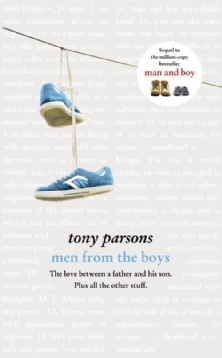
Men From The Boys: The third in the Harry Silver trilogy (2010)

TP: Yes – Harry Silver is probably closer to me than any other character in my books. Certainly Tom Finn, in CATCHING THE SUN, is much more like my dad. Harry is nicer than me, though – I think I have a harder heart than Harry Silver. Although he is me, a lot of the bad stuff is left out – by the time I was Harry’s age, 29 at the start of MAN AND BOY, I had done years in the music business, seen some of my best friends kill themselves with heroin, taken lots of drugs myself, had periods of promiscuity that Harry never had – he is like me in his love for his father and his son, but in some ways he is not like me at all.

MW: Have you ever found yourself analysing why that book hit such a nerve? Nick Hornby did something similar a year before with About A Boy and more followed. Was it just a breath of fresh air to read about real blokes and their turn-of-the century ‘new man’ priorities? We’ve all known people go through messy divorces, parents growing old and the inevitable happy/sad rollercoaster. Yet you write about it so well.

TP: There’s an element of dumb luck involved in any runaway bestseller. The paperback of MAN AND BOY came out in 1999 and people were ready to read that kind of emotional intensity from a man. And the book was quite raw because my mum was dying while I was writing it. That’s where a lot of the emotion comes from – my dad had been dead for a long time when I was writing MAN AND BOY. You can’t stop your life happening to you, and it influences every line, even if you are not aware of it. It took an entire year to get to number one in the paperback chart, and got there on word of mouth and the same day that the next book, ONE FOR MY BABY, got to number one on the hardback chart. You are very, very lucky if that happens to you once in a lifetime. I will write better books than MAN AND BOY but I don’t honestly think I will write anything that commercially successful again. Because when you sell millions you have to write a book that appeals to everyone – even if they only buy it because they are curious to see what all the fuss is about.

Starting Over (2009)

MW: For 2009’s Starting Over, a Guardian reviewer said your ‘specialist subject is contemporary emotional issues which almost every other male writer has ignored’ Is that the secret?

TP: I think that review of STARTING OVER was spot-on – I wrote about these things – fathers and sons, husbands and wives, marriages and jobs, everything falling apart and then trying to put it back together – because I didn’t know what else I would write about. Writers complain about critics but sometimes they see a truth about our work that we haven’t.

MW: What were you reading as a child? How did that reading progress over the years? Was fiction always a big influence?

TP: My mum read me the Rupert the Bear books. That gave me the bug. My dad bought classics – Dickens, Wind in the Willows, Swallows and Amazons, My Family And Other Animals – and some of them I liked, and some of them I didn’t. My mum had six brothers, most of them in the print, all of them great readers, and they introduced me to Ian Fleming when I was 11. And the Bond books were probably the first books I truly loved.

MW: Do you still read widely, and prolifically? Is that essential for a successful writer? What recent publications stand out most? Who are your favourite authors?

Goldfinger: Ian Fleming’s James Bond series remains a big influence on TP

TP: You can’t write if you don’t read. You have to make time for reading. You have to feed your head. I am rereading a lot of things I have read before at the moment – THE SILENCE OF THE LAMBS by Thomas Harris, ROGUE MALE by Geoffrey Household, and I am working my way through the James Bond books. I am near the end of GOLDFINGER.

MW: Did you write from an early age? Was there a specific book that made you think ‘I can do that’ or ‘I want to learn how to do that’?

TP: I always felt that writing was the one thing in the world that I could be halfway good at. But you struggle with it for a lifetime. Getting the story in your head to be the story on the page is still the great magic trick that you never quite master.

MW: Harry Silver made his living in TV. Does any other medium appeal to you other than your TV critic and newspaper column work? Screenwriting for example?

TP: It is all writing to me. Newspapers, magazines, books – it’s all the same, it’s all communication. I would like to write a TV series – and tried it a few years ago with my friend Andy Harries, who produced The Queen and Wallander. But the trouble with film and TV is that you need someone to front a lot of money. I quite like the empty white page you get with books and journalism. No bean counter can tell you that you are not allowed to do it.

MW: Do you meet other writers socially, at least for a coffee on a slow Tuesday? Or is it a solitary business at the writing stage and you save all that for the promo work?

Nick Hornby: ‘Lovely man, beautiful writer‘ (photo: http://www.penguin.co.uk/nickhornby)

TP: The one novelist I used to see socially was Nick Hornby when I was living in Highbury. We used to meet at a Korean restaurant halfway between our homes. Lovely man, beautiful writer, and we lost touch after I moved away. Novelists tend to be lone wolves. I have mates who are journalists, but my closest mates live in Hong Kong, and they are all lawyers. I don’t hang out with mates that much, to be honest. I like being with my family, and I like being alone. I think a writer has to be very happy with his own company.

MW: From the description of Harry Silver’s dad’s appreciation of Frank Sinatra and Dean Martin onwards, music’s clearly always been important to you. Then there were those halcyon late ’70s days when you found your teeth at the NME. That must seem a lifetime away. Do you keep in touch with any journalists or band members from those days? Did you make a lot of lasting friendships?

TP: I still love music but it is a completely different experience from when I was working for the NME and seeing 6 great bands every night of the week. If I see members of The Clash, or Paul Weller, or the Stranglers, or any of that vintage, then we are friendly to each other, but it is not more than that. I don’t keep in touch with any NME journalists, and the musicians that I was fondest of – Joe Strummer, Johnny Thunders, and Phil Lynott of Thin Lizzy – are all dead. So all that is a long time gone for me.

MW: Are you still excited by music today? What was the last great band you saw?

TP: I can’t remember the last gig I saw – I think it was probably a Prefab Sprout gig that my wife took me to a few years back. Or maybe it was Cream at the Albert Hall, which a friend took me too. I was a bit too young to be a fan of Cream in their pomp, so I was happy to see them – it was great. But I would never go to see the comeback tour of a band I loved – Led Zeppelin, the Sex Pistols, the Stone Roses. I prefer to keep my memories intact.

Tony Parsons: “Enjoy every sandwich, kid.”

MW: Finally, would you have any advice for a 19-year-old Tony Parsons? Or is everything life throws at us all just part of some big plan and makes us what we are today?

TP: If I had some advice for the 19 year old me it would be – you can’t believe how quickly a lifetime flashes by. Enjoy every sandwich, kid.

Posted in Books Films, TV & Radio | Tagged , , , , , , , , , | 3 Comments

Am I old enough to read this?

No, this isn’t about that over-hyped EL James book that you only need one hand to read, but the newly re-stoked reading row regarding age classification of books.

Fiction Factory: across the shelves at writewyattuk:hq

Ex-vicar, ex-policeman, ex-roadie and exorcist (or outspoken self-publicist, depending on your point of view) GP Taylor stirred up the hornet’s nest this week from the BBC Breakfast couch, saying children’s books have got too dark and should be age-certified. This from a man who admitted his own recent vampire books were among the worst offenders. Fellow children’s and young adult fiction writers Patrick Ness and comic genius turned successful Young Bond and zombie expert Charlie Higson were quick to disagree, and before the day was out the debate had raged via the social media platforms.

I’ll give Taylor the benefit of the doubt that he was caught on the spot. Let’s face it, we all say things on the spur of the moment and go on to regret them. Having met GP on his rounds at the University of Central Lancashire a couple of years ago, I can vouch that he’s certainly forthright in his views, but interesting with it and certainly inspirational when it came to advocating the old punk ethos of do-it-yourself rather than rely on the major publishing houses for your break. He clearly knows how to court controversy too, and is far from slow in publicising his own back-catalogue en route. But isn’t that publicity gene something all authors need in this day and age to be heard? Blatant self-aggrandisement appears to be the best way to keep a high profile, unless you’ve hit the jackpot with your impeccably-timed mummy porn trilogy.

While there are far too many authors out there quick to jump on bandwagons and write whatever they feel the public wants at that moment in time – from supernatural blood-letters and angel fiction to ghosted works for masquerading celebs – to make a living, there are still great examples of writers out there not just servicing exploitative publishers.

I like to think that category includes one I met this week, the inspirational Irish writer Eoin Colfer, who was passing through Preston during a brief tour promoting the climax of his highly-successful Artemis Fowl series.

I was pleased to learn that Eoin is a down-to-earth good bloke, seemingly unfazed by public appearances while somehow keeping a semblance of other-worldliness about him. It’s a bit of a cliché, I guess, but I felt I was listening to Ardal O’Hanlon at times, the Wexford wordsmith – with his newly-cultivated grey beard – courting an across-the-ages audience with tales of the poor state of Irish TV in the early 70s, his first school disco, experiences with his younger son in a French toilet, and much more. Amiable, entertaining, and perhaps above all a born story-teller.

Fowl Fare: Eoin Colfer’s latest release concludes the long-runing saga of cult Irish teenage criminal mastermind Artemis Fowl

At one stage of the following question and answer session, Colfer was asked about his approach to writing for children and why he never seeked to ‘dumb down’ It was clearly a subject he felt strongly about, and the former primary schoolteacher enthused about how he loved to entertain parents as well as children, get his readers scurrying for dictionaries, and never felt the need to tell young readers what age category they should be at.

There lies the crux of the matter. I’m just two years younger than Colfer, and we were both raised in an era in which you weren’t quite sure where to go after tackling Stig of the Dump and age-old adventures like Moonfleet (in my case) or Huckleberry Finn (in his). As it was, we soon found Douglas Adams (and Colfer ended up writing the sixth of Adams’ Hitchhikers Guide series) and Stephen King.

So were King and British alternative James Herbert deemed age-appropriate for us at the age of 12? I shouldn’t think so. Did that reading choice turn me into someone with a penchant for demonic and paranormal activity, breeding giant rats or releasing chemical vapours to encourage mutilation and general degradation? Not that I can recall. What it did do was open up a wider sphere of reading in the hands of skilled writers, and a world no less scary than that in some of Enid Blyton’s works.

Blyton is an easy target of course. But while I wanted adventure from my books, her world of children being sent off to dubious uncles and aunts and left to their own devices for entire summers meant little to me and certainly less to recent generations. One criticism of current books for children is that we’re more likely to find tales of abandoned children with troubled or absent parents. But I’d rather my kids read skilled practitioners like Anne Fine or Jacqueline Wilson’s measured spins on those situations than those I was brought up with. It needs to be real, however fantastic.

If Taylor himself is heading back from the world of ‘undead’ fiction to more traditional adventure, he’ll do far worse than read some of the better books already out there. And what I’d give to be 12 now and appreciate first time around fine writers like Colfer, Higson, Andrew Lane and Frank Cottrell Boyce.

But we don’t need stickers to tell us what’s on offer, just good judgement and gentle recommendations. All the time we have great librarians – in our schools and out in the community – and responsible parents and carers to help steer children in the right direction, there’s simply no need for age classification.

Ness feels it would be ‘irresponsible’ for young adult novels to ignore the darker side of life. When you get to a certain age it’s important to explore bigger themes like sex and violence. He said ‘if you tell the truth about what’s difficult, that lives can be dark and hard, then when you tell the truth about what’s good, love and hope and friendship, they listen to you and take it more seriously because you haven’t lied about what’s difficult.’

Higson wonders who might police this system of age categorisation: “The Government? Publishers? A new organization? Kids themselves? There’s a wild difference among kids in reading ages, tastes, interests, blood-thirstiness. You can’t have a one-size fits all system.”

If I was that age again and saw a ‘12’ sticker on a book, chances are that I’d not want to be seen reading it. I’d choose one with ’14’, ’15’ or ’16’ on it instead. Would I then be challenged at the counter and asked to show ID? It’s a dangerous precedent. By that yardstick, there’d be a few high school students being told to put those MR James ghost stories or Daphne Du Maurier classics back on the shelf too. Imagine that.

GP Surgery: Taylor’s breakthrough children’s fiction reads

I think I’d rather try and work out if it was a book for me by reading the blurb or getting to know if the author was talking my language. And there’s a wealth of good (and safe) websites and the like out there to help you do that. So what possible gain is there in age categories? The publishing industry toyed with the idea then quietly dropped it last time. Let’s not go through all that again. By all means try and guide a child into appropriate reading, but ultimately let them make that choice rather than some number-crunching bureaucrat or reading evangelist.

Posted in Books Films, TV & Radio | Tagged , , , , , , , , | 6 Comments