

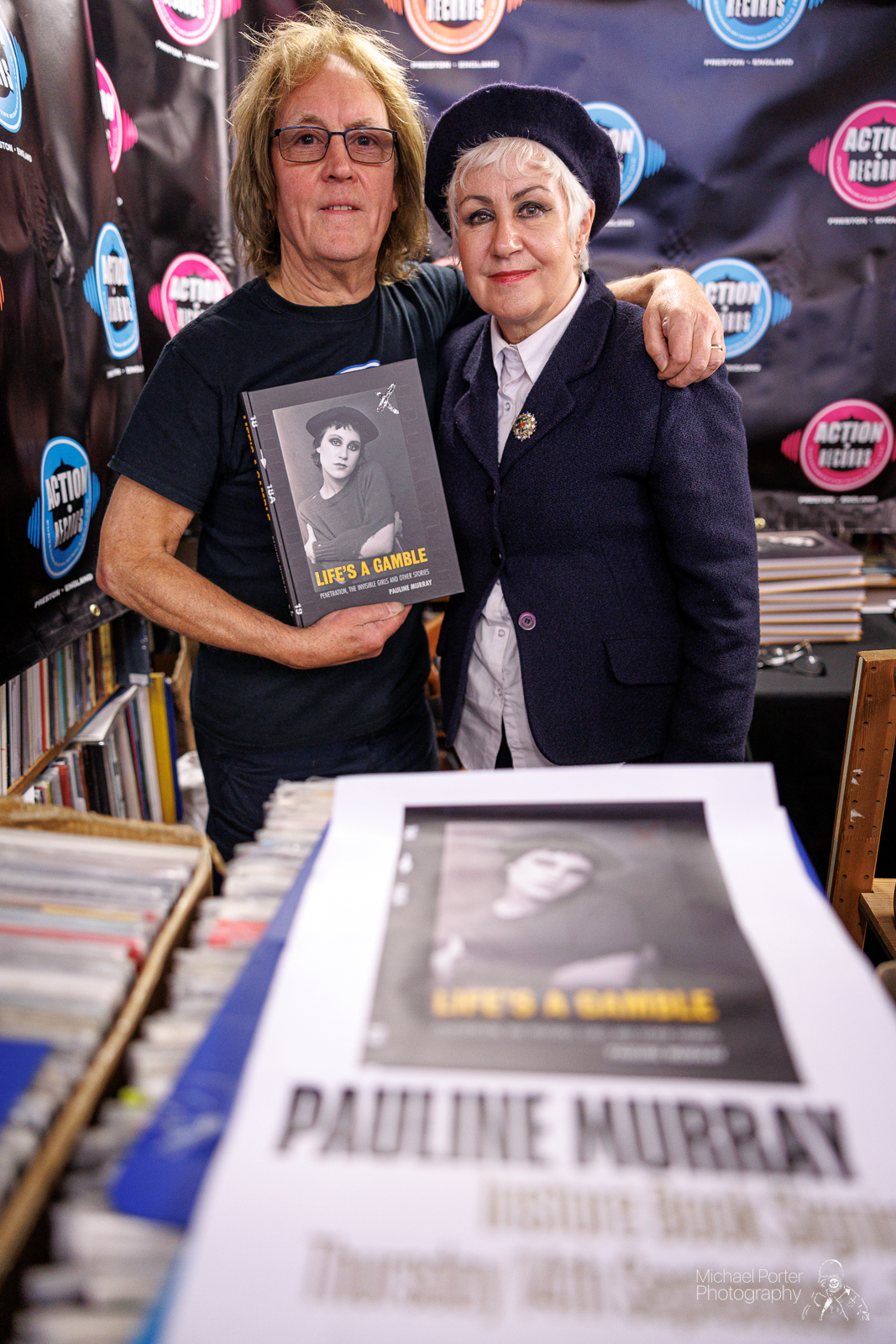
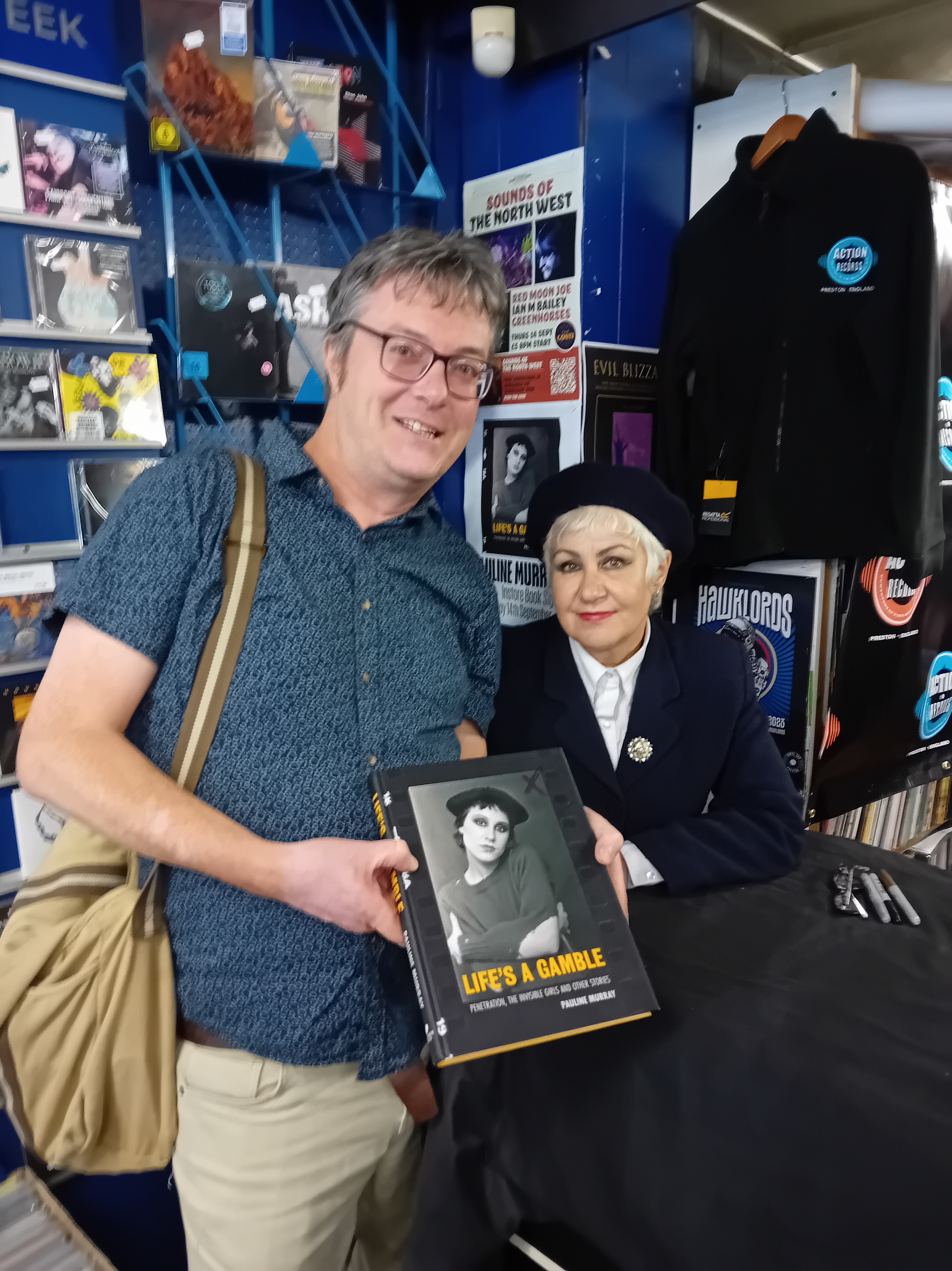
Catching up with Pauline Murray at Action Records in Preston, Lancashire, last week, she seemed somewhat surprised about the positive reaction to her autobiography, and genuinely chuffed that I thought it any good.
Played down reactions and not going out of your way to stand out from the crowd perhaps go with the territory. But Pauline stood out from the start with Penetration, and continues to do so, this trailblazing female artist having stuck by her North-East roots in what was perceived as a London-centric bloke-led scene.
Life’s a Gamble: Penetration, the Invisible Girls and Other Stories, newly published by Omnibus Press, follows the iconic singer/songwriter’s journey from working-class roots in County Durham to national recognition with Penetration then Pauline Murray and the Invisible Girls, revisiting and re-assessing her enduring influence as a key part of the UK punk movement. She emerged on that scene at 18, partly inspired by an early encounter with the Sex Pistols, going on to play alongside her punk peers while navigating the demands of the ‘70s music business then conquering the early ’80s post-punk landscape.
Her memoir also follows her journey towards opening a music studio in her adopted Tyneside base and the story behind Penetration’s 2001 return, throwing in a little faction romance, charting her enduring relationship with partner and long-time bandmate, Robert Blamire. And illustrated with previously unseen photographs and drawing on notes from her teenage diaries, interviews and archive material from her personal collection, Life’s A Gamble chronicles Pauline’s life as an innovative artist now properly acknowledged as a punk rock legend.
Gaye Black, of The Adverts’ fame, is spot on suggesting Pauline has produced ‘a beautifully written down-to-earth account of growing up in the north of England, discovering punk, and making a career from music,’ writing ‘from the heart with no airs or graces’ for a ‘unique perspective of those legendary times and beyond’.
So is another close friend and ally, Helen McCallum, aka Helen McCookerybook (The Chefs, Helen and the Horns), when she adds, ‘In a punk world where some still cling on to their ’77 punk rock personas and barely ever evoked the true spirit of that movement, Pauline was one of those who rode the wave and retained that spirit, forever moving on, never comfortable clinging on to where she’d been before for the sake of the nostalgia. She never loses her punk vision, and serves as an example to up-and-coming musicians of the resilience and tenacity you need to survive and thrive. You’re with her all the way.’
Pauline’s a survivor, for sure, but there’s also an occasional lack of belief in herself that makes me warm to her all the more. Stoicism and fragility in equal measures.
She surfaced amid an era when just being a female in the rock ‘n’ roll world made it all the harder to succeed in your own right and make your name as a bona fide artist. While the real punk message involved DIY ethics and equality for all, there was still that pull to pigeonhole or exploit the pretty lasses in the bands. But she stood firm, letting her music and ideals do the talking.
I wasn’t old enough to catch Penetration or Pauline Murray and the Invisible Girls live first time around, but was pleased to see both bands return in recent years and retain their sense of dignity, cool and purpose, leading by example for another generation. And the fact that Pauline felt like a fish out of water the first time offers came in to play the retro punk festival scene – feeling she had little in common with many of the other acts – speaks volumes. She’d moved on, as the music she was now making suggested.
I’ve read and heard lots about the UK punk scene, to a point where you feel you know where most anecdotes are going. But she provides a fresh perspective, and I learned a fair bit from Life’s a Gamble. Not so much content that put Pauline in a new light, but plenty that told me my gut instincts about her were right.
I’ve mentioned on these pages how I saw Blancmange in late 2017 and was taken by North-East support band Transfigure lead singer Grace’s stage presence, not at all shocked when I learned after the event that she was Pauline and Robert’s daughter. Grace and brother Alex have since both featured with The Invisible Girls (supporting The Psychedelic Furs last year), and now I learn from Pauline’s memoir that her mum was also a performer, albeit with her career dreams curtailed by circumstances. I wonder how much of Pauline’s creative fire comes from that need to prove herself.
The book was written initially with her children in mind, in recognition of losing her own parents in recent years, contemplating the ‘many things I wished I’d asked them.’ Drawn from memory and enhanced via old diaries and scrapbooks of press cuttings, she says she ‘tried many examples of musicians’ autobiographies,’ then ‘realised that I wasn’t Bruce Springsteen, Sting, Debbie Harry or Patti Smith. I was me, Pauline Murray, and would have to tell my own story and pick my life apart in fine detail.’
That in itself provided a challenge – the thought of sharing her story with the wider world ‘filled me with anxiety and I almost gave up on several occasions.’ And that’s a reaction returned to at various points, the not-so-long-since turned 65-year-old coming close to jacking it all in but somehow finding the resolve to plough on, her work ethic never in doubt.
I expected the initial story to unfold in Ferryhill, County Durham, seen as the spiritual home of Penetration. Instead, I found myself a dozen miles further north-west, in a pit village called Waterhouses, largely left to rack and ruin and slowly reclaimed by nature after its colliery closed. And arguably, the genesis of Pauline’s outsider status can be found right there on abandoned Arthur Street, not so far from countryside I’d pass en route to covering non-league football matches 20-plus years ago.
Her father was working down the pit then, prior to that shoeing pit ponies with his father, part of a strong family unit, born into a nomadic travelling community that visited local villages, towns and cities with a steam-fired model coal mine (built by Pauline’s grandfather), receiving ‘a different kind of education in the school of life, outside the confines of conventional society.’
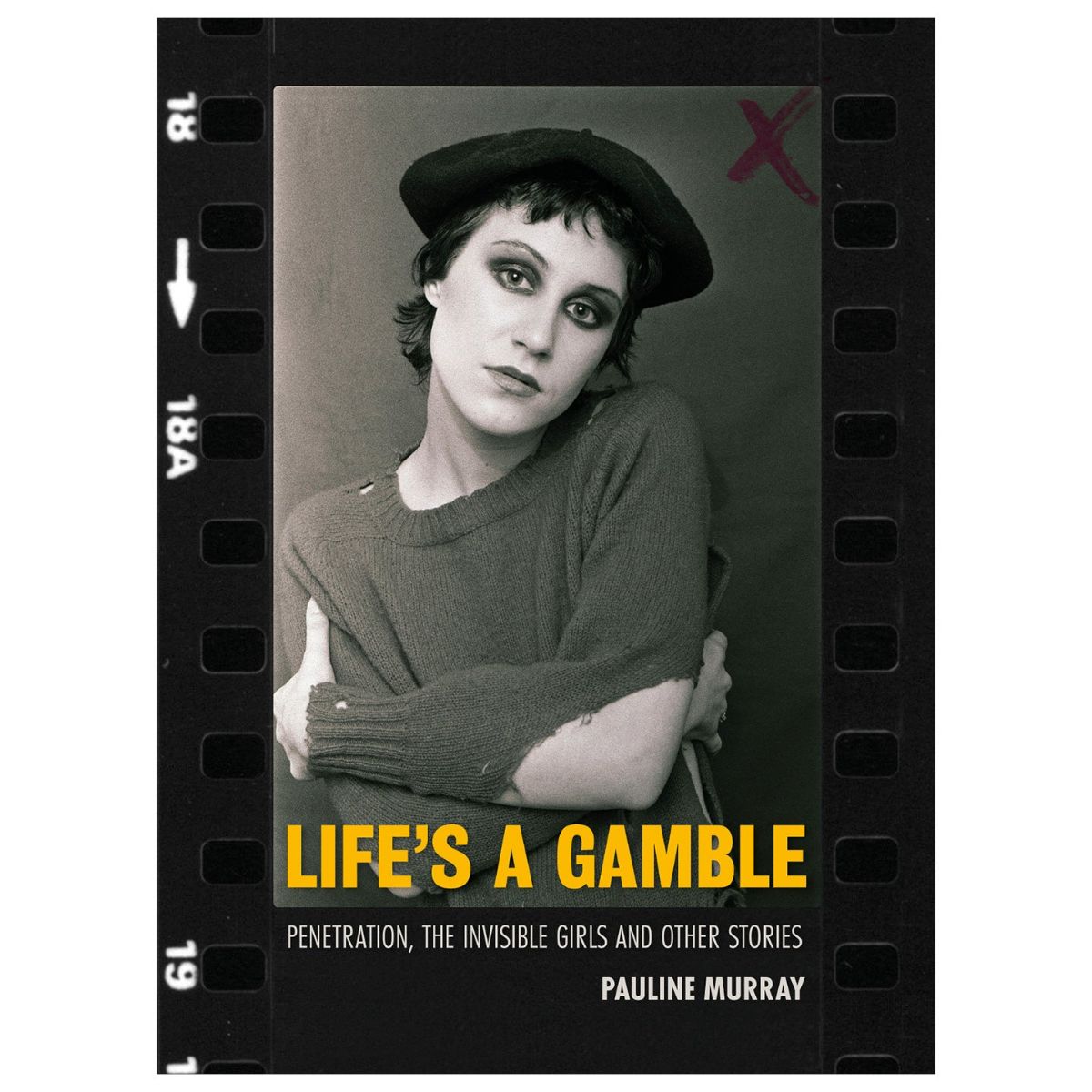
As for Pauline, word has it that she could sing before she could talk, her maternal grandfather ‘music daft’, her mum and aunts dancers and singers as teenagers, part of a touring party entertaining the troops stationed nearby during the war. Her mum, Jean, auditioned and was offered the chance to sing with a big band, but circumstances intervened and in time she married and swapped showbusiness for Woolworths in a bid to make ends meet.
Music and fashion had already made a big impression on Pauline before that move to Ferryhill, her folks market traders by then, this young introvert forced into a fresh start. And it was in her final year at junior school that she first met a young lad from a family that ran the local printing works, ‘a tall, thin boy called Robert Blamire, sat in the next aisle’… one who ‘seemed aloof, reserved and composed, and was smartly dressed compared to some of the ragamuffins in the class.’ Pauline ‘was intrigued and would pick fights with him to get his attention.’
A ‘wayward kid’ by the time she was 10, she was bright enough to head to grammar school, that way at least avoiding conflict with those bullying her at primary school, soon retreating further into music, not least a love of soul, learning chords on a second-hand Spanish guitar her parents bought her, performing three-part harmonies with two other girls at school who also played.
That’s when she met Peter Lloyd at her local youth club, inspiring an early ‘70s broadening of her music education, finding a life outside school, catching bands on her patch such as Yes, Status Quo, T. Rex and David Bowie, the latter making the biggest impression, leading her in turn to Jacques Brel, Lou Reed, The Velvet Underground, The New York Dolls, and Mott the Hoople. Roxy Music followed, an initial appreciation of prog fading, nights out stretching to trips to London to catch Bowie (as he killed off Ziggy Stardust at Hammersmith Odeon) and others, browsing the shops of the Kings Road. Steve Harley and Cockney Rebel plus Be Bop Deluxe also featured in that era of three-day working weeks and power cuts amid industrial unrest, her parents still struggling to get by.
That was also the era when she met guitarist Gary Chaplin, his fledgling band, Image Fatale, including a certain Robert Blamire, always seemingly there or thereabouts. And for all her outside interests, she buckled down for exams, seven O-levels securing a place on an art and design foundation course in Darlington. Meanwhile, she latched on to Patti Smith and listened to John Peel, day jobs helping finance more time away, the NME’s mention of the Sex Pistols indirectly leading to Peter’s drop-in chat with Malcolm McLaren in Sex, the shop he ran with Vivienne Westwood, Malcolm calling ‘a few months later to ask if we knew of any venues in the North-East of England where the Sex Pistols could play.’
The stage was set, Pauline catching key early shows featuring the Pistols, The Clash, and Buzzcocks, an act that would play a key role in the Penetration story. By the end of 1976, they were writing their own material, Pauline adding, ‘I had turned 18, had my first full-time job, and had witnessed the birth and subsequent explosion of punk rock, which proved both an inspiration and a massive turning point for me. I was engaged, had joined a band as a singer and frontperson, and through that had unknowingly reconnected with a person who would be of creative and emotional significance throughout my life. It was as if all these factors had conspired to push me out of my comfort zone and into new and uncharted territory.’
What follows provides that key insight into the punk, new wave and post-punk scene of the late ‘70s, and while The Clash were ‘writing about urban landscapes, tower blocks, hate and war… I was writing about my own environment, which was a cultural vacuum… observing the state of society from a northern 18-year-old girl’s viewpoint. Influenced chiefly by Johnny Rotten’s sharp, angry delivery and Patti Smith’s cool push-out, where the energy of the vocal seemed to originate from somewhere deep inside of the body. But ultimately my own voice came through loud and clear.’
Granted, she’s written this with hindsight, but it seems she retained outsider status, the chapter on 1977 particularly illuminating, pointing out that ‘viewing the London scene from a distance of 260 miles through the lens of the music papers, perception and reality didn’t always match up. We held The Roxy in our minds to be some sort of mythical place and were really excited to be playing there. Seven hours in the back of a Luton-style box van … sitting on equipment that was sliding about, wasn’t the safest or most comfortable way to travel.’ But what we get is a window on that scene, meeting Steve Strange, Generation X, The Jam, The Slits, and many more prime players, Robert at one point turning down Glenn Matlock’s offer to join The Rich Kids.
By June ’77 they’d recorded nine songs on one of many trips to the capital, stocking up on stage gear at Sex, now known as Seditionaries, prestigious support slots leading to much more, juggling late nights with day jobs back home, Pauline in at nine in her clerical role after 5am returns without sleep. And they were making a big impression, Tony Wilson for one taken with their So It Goes performance, filmed at Manchester’s Electric Circus, the band soon signing with a management agency (albeit naively given the terms), quitting their jobs and getting by on £30-a-week retainers.

When the new year dawned, Sounds named them among ‘The Faces of ’78’, and that May they were out on the Buzzcocks’ Entertaining Friends tour, their profile raised further, debut LP Moving Targets following, with hardly a chance to draw breath before follow-up Coming Up for Air and utter exhaustion, by which time ‘the music business had sucked up the energy and creativity of punk and had regenerated itself for the next phase: the 1980s.’
When Penetration split, she was barely 21, but had packed in so much, going into a new decade feeling ‘a heavy weight had been lifted’ from her shoulders after an ‘endless cycle of writing, recording and touring… something that I couldn’t see myself doing for the rest of my life.’ However, she added, ‘I couldn’t give up on music and didn’t even contemplate a change of career.’ Time out was needed, and eventually she bounced back, this time with just Robert in tow, experiments with a four-track recorder at his parents’ house leading to what became the acclaimed Pauline Murray and the Invisible Girls album, Martin Hannett at the controls, a hit LP and tour following, an ‘extreme change in musical direction’ and ‘brave artistic gamble’ pulled off in style.
There was a further gamble as she followed her heart and became an item with Robert, recriminations back home creating new challenges, Pauline ending 1981 with ‘nowhere to live, no recording contract, no money, a new relationship, a broken marriage, and a suitcase of dirty laundry,’ unsure what would happen next. As it was, her new start took shape in Toxteth, Liverpool, the riots on her doorstep, a period of depression following while Thatcher took on Argentina over the Falklands, and ‘secret discussions were taking place about whether to let Liverpool go into ‘managed decline’.’
A return to Tyneside followed, Pauline writing again, but with the black dog soon back at the door. As she puts it, ‘I began to think that they would all be better off without me and entertained suicidal thoughts, and how to go about it.’ Thankfully, she found a way back from the brink, a new batch of more guitar-orientated songs emerging, Paul Harvey entering their lives in what became another enduring, creative friendship, the new-look band rehearsing south of the Tyne.
By the end of ’85 she was playing live again, performing a mixture of new songs and Invisible Girls numbers, a four-track EP on her own Polestar label following as Pauline Murray and the Saint. But by 1987, spirits were back at a low ebb, ‘back to square one again’, ready ‘to admit defeat, face the future, forget about making music, and concentrate on making money.’
There was another LP, Storm Clouds, in 1989, but as the ‘90s dawned, Robert was working full-time for the family printing firm, the pair mortgaged home owners, that following decade seeing her harboured ‘pipe dream of opening a music rehearsal studio’ come to fruition, ‘a supportive space where bands could come together as more of a music community.’ She swapped washing dishes at a local restaurant for running Polestar Recording Studios, and by 1995 they had two children and even briefly ventured into artist management. Then, with the new millennium came that next chapter of the Penetration story, the re-emergence of The Invisible Girls, and even shows as a solo artist (as far away as Australia).
By then, Penetration were ‘a heritage punk band… playing for our own enjoyment rather than trying to re-establish any type of career comeback.’ And it’s fair to say they never got beyond their own station, wonderful as the third album would turn out, a wonderful tale within of the night they played the Shay pub in Halifax a beautifully told illustration of that, that gig deemed the ‘antithesis of the New York Shea Stadium where The Beatles famously played.’
By no means did that signal the start of the end of the story. And nor did the 2009 financial market crash, when the future of her business was in serious doubt. Again, her resolve told, a subsequent move to a new studio base and then that Penetration resurgence via 2015’s Resolution album counting for so much more, 2020 bringing another album, Elemental, back under her own name. And while there may still be twists and turns ahead, as she suggests on ‘Beat Goes On’, as long as she has the energy to crack on, Pauline may occasionally ‘lose the battle’ but will always ‘win the war.’ And I’ll raise a glass to that.
For this website’s 2019 feature/interview with Pauline Murray, head here. And for a review of the Penetration date at Preston’s Continental that followed, head here. For more about Life’s a Gamble: Penetration, The Invisible Girls and Other Stories head to the Omnibus Press website. And for the latest from Pauline Murray, visit her website and Facebook page.


 writewyattuk
An excellent write up on a wonderful band and group of people. I was lucky enough to (just!) about be old enough to see Penetration in 1978 and the Invisible Girls in 1980. I have NEVER seen a poor performance from any of the bands that Pauline and Rob have been associated with. Here’s to many more years – and another Penetration album would be so good!
Ah, that’s great to hear. And thanks for your kind words.