Out of town and out of sorts with the Cardinals

Rising High: Gavin McCallum, watched by Steve Thompson and Garry Hill, gave Woking late hope against Newport (Photo courtesy of David Holmes)

Rising High: Gavin McCallum, watched by Steve Thompson, Garry Hill, Justin Edinburgh and Jimmy Dack, gave Woking late hope against Newport (Photo courtesy of David Holmes)

IT’S supposed to be a good sign. As we drove down to Kingfield from Lancashire last Saturday morning, Tony Blackburn was playing The Jam as we hit Victoria Way traffic.

Some kind of time warp? Almost. It was Pick of the Pops on (ssshhh!) Radio 2 and we were re-living mid-February 1981, when I was 13, with the wondrous That’s Entertainment riding high in the charts and Woking about to go down to a 3-2 London Senior Cup second-round defeat at the hands of Carshalton Athletic (goals by Leather and Levy, stats fans).

It always seems a good omen to hear Woking boys Weller, Foxton and Buckler on a match day, but with Newport’s past reputation, it didn’t bode so well to hear Slade’s We’ll Bring the House Down and the Stray Cats’ Rock This Town (“Turn it inside out”) soon after.

Well, you probably know how it turned out, one of my rare Kingfield trips ending in a 3-1 home defeat, sub Gavin McCallum giving us hope as we went into stoppage time, but the Exiles the more professional outfit on the day and our best chances (just before the break) kept out by ex-Cardinal Lenny Pidgeley.

But that was just part one, for I had two more trips to see the mighty Cards planned for the same week (three in a week – a real rarity for me these days), with Garry Hill’s side passing through the North-West for further Conference Premier dates with Barrow and Southport too.

Note that I don’t say ‘just up the road’ from me. For Barrow is just up the road from Ulverston maybe (the birthplace of Stan Laurel), and Kendal Town at a push, but very few other places. We’re talking the most extreme of cul-de-sacs here. A remote tip of the North West you really have to go out of your way to find.

Furness isn’t the kind of place you go to by mistake, not even with my poor sense of direction, and Barrow AFC are somewhat out there – on a limb. But – despite scare stories of the Barrow boys causing havoc on their FA Trophy quarter-final trip to Woking in 1980 (a 3-1 Cards win, with goals from Field, Fletcher and Eggie James), I’ve found myself pretty well received in this outpost of Cumbria (traditionally Lancashire of course, but that’s another story).
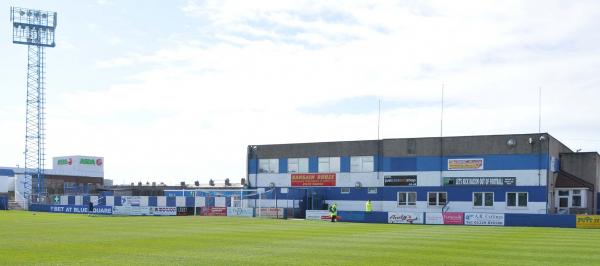
Furness Finesse: Barrow AFC (Photo courtesy of David Holmes)

Furness Finesse: Barrow AFC (Photo courtesy of David Holmes)

On our last match of the winning 91/92 Diadora League season, our 1-0 defeat at Enfield, a few home fans gave us top tips on the dos and don’ts of the Conference, from which I recall the advice to ‘watch yourself at Barrow – the home fans chase you around with loose bits of concrete’. Thankfully, that never proved to be the case, and I tend to find fans of such remote clubs give you the time of day if you’ve made all that effort to get there.

I was toying with the practicalities of my Cumbrian day-trip throughout Tuesday, having only returned from Surrey to my Lancashire base the night before, but after such gloriously unseasonal February sunshine and a day chilling in the back garden, I decided I would go after all.

Huddle Formation: The Woking faithful, including a wind-blown blogger (Picture courtesy of David Holmes)

Huddle Formation: The Woking faithful, including a wind-blown blogger (Picture courtesy of David Holmes)

And while the temperature dropped to two degrees that night and felt colder in the first half as the wind seemed to blow straight off the Irish Sea, I was glad I made the effort. Well, kind of. For while it only involved a 90-minute drive each way for me, it was a shocking 12-hour round trip for most Cards fans, and with precious little to cheer about for the 25 or so of us behind home keeper Danny Hurst’s goal.

Those listening to the BBC Radio Cumbria commentary might not believe that, with all those raucous ‘Yellows’ chants early on. But for all our early promise, we were soon hit on the break and found ourselves behind, with Danny Rowe the scorer, one of two players of the  same name on the pitch bizarrely enough, the other one scoring their second from a free-kick early in the second half. And what with that and Lee Sawyer’s straight red-dismissal for a crude tackle on ex-Morecambe man Garry Hunter, we were done for.

The optimists among us had looked to the same side’s mighty defeats to Mansfield and Southport (shipping eight and five goals respectively), but the nagging doubt was that – like us – they’d also seen off Luton Town at home and Newport County away in the past few weeks. And those of us who visited Holker Street last time around in April 2009 knew they always had plenty of fight about them, despite their lowly position.

Denied Again: Efe Sodje stops another Cards attack (Photo courtesy of David Holmes)

Holker Hit: Efe Sodje stops another Cards attack (Photo courtesy of David Holmes)

As it was, their keeper had bugger all to do all night, the much-travelled Efe Sodje supreme in defence, with every well-timed tackle and race to the ball won with supreme confidence and professionalism. Was he spurred on by the boos he received from the visiting fans for his past days at (whisper it) Stevenage? I doubt it. He just did his job.

It might have helped if we’d managed to get a shot on target of course, but only Kevin Betsy looked like he had the nous to unlock their defence, the Cards clearly missing Billy Knott after his injury against Newport, and finally undone by Sawyer’s dismissal.

Hunter Slayed: Lee Sawyer gets his marching orders and Woking are as good as finished (Photo courtesy of David Holmes)

Hunter Slayed: Lee Sawyer gets his marching orders and Woking are as good as finished (Photo courtesy of David Holmes)

We stuck around of course, but it was not to be, and I really felt for Cards press officer John Moore as he went to search out Garry Hill for a post-match interview. That wasn’t going to be pretty. I flippantly dropped into the conversation that at least I’d be home by half eleven, and Mooresie added that he hoped to be back by four in the morning. That’s dedication for you.

As for Barrow, I can see them staying up after all. They showed plenty of mettle on the night, perhaps forever destined to defy their peers and cling on to national status. In the old days, the open to ridicule re-election process did for them as a Football League club, but when it comes to staying up on merit, they had enough about them on this evidence.

Fly Guy: Brett Williams in an aerial challenge (Photo courtesy of David Holmes)

Fly Guy: Brett Williams in an aerial challenge (Photo courtesy of David Holmes)

As I weaved my way back up the dark old A590, past Ulverston and gradually back towards the M6, I was listening to Bluebirds assistant boss Ash Hoskin giving his thoughts to BBC Radio Cumbria on that night’s 2-0 victory. These days, the ex-Burnley and Accrington striker is No.2 to ex-Rochdale and Luton player Dave Bayliss at Holker Street, and word has it that a lot of those Bluebirds players come up from Manchester for matches. No mean feat in itself when you think of the miles involved.

It was a similar tale for Workington, I seem to recall, but in their case a lot of their players came from the North-East, not least under ex-Newcastle United star Tommy Cassidy. The same could be said for Gretna too when they graced the lower reaches of the UniBond League, before a brief financially-driven flirt with mainstream Scottish glory.

Hoskin spoke on the radio about a determination to bounce back from a poor display at home to fellow strugglers Nuneaton Town, which explained why so many home fans stayed away that night, resulting in their lowest gate of the season (officially 624, and we’ll claim at least the 24).
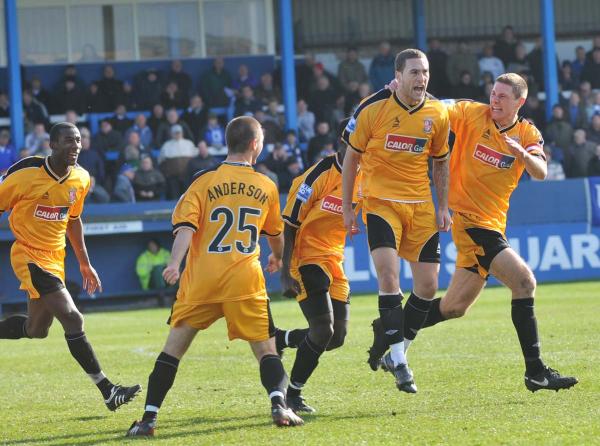
Holker Hit: Liam Marum about to be mobbed after his winner at Barrow in April 2009 (Photo courtesy of David Holmes)

Different Days: Liam Marum about to be mobbed after his winner at Barrow in April 2009 (Photo courtesy of David Holmes)

After a similar dog-fight at Holker Street between the same sides four seasons ago, the Bluebirds somehow stayed up while we floundered, despite winning 1-0 on the day (with Liam Marum on target for Graham Baker’s doomed Cards).

It looks like we’ve already done enough to stay up this time around, just one win away from equalling that 2009/10 haul, although recent whispers about play-offs seemed to die a death after the Newport and Barrow defeats. But who knows. It’s Southport next, and the season’s still young.

Best Hope: Kevin Betsy was the player most likely to undo Barrow (Photo courtesy of David Holmes)

Best Hope: Kevin Betsy was the player most likely to undo Barrow (Photo courtesy of David Holmes)

It’ll come as no great comfort for those who made the long trip to Holker Street, but we’re heading in the right direction. And while Hill’s side might show occasional flaws, you have to remind yourself that’s always likely to be the case when you’re talking about Conference football. That’s why a lot of these occasionally great players aren’t in the Premier League or Championship.As long as we learn from our mistakes, and keep playing the right way … the Woking way.

Teams like Newport show we’ve got a fair way to go yet, and we can’t compete financially with them, Wrexham, Luton or Grimsby for starters. But on our day we offer so much more, and can give any team a battle, as I witnessed first hand on New Year’s Day at Kingfield against Luton, and at Edgeley Park and Rodney Parade earlier in the season. Sermon over. Come on you Cardinals. So, anyone up for a trip to Haig Avenue (snow permitting)?
Posted in Football, sport | Tagged , , , , , , , , , , | 1 Comment

From Florence to Porthaven – stories of secrets, self-discovery and survival

In which writewyattuk runs the rule over two winning children’s books that prove the future remains bright for traditional adventure stories.

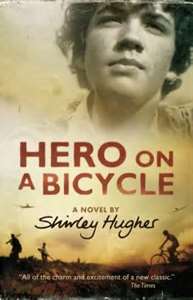
blog hughes heroShirley Hughes – Hero on a Bicycle (Walker Books, 2012)

Shirley Hughes’ first novel – at the age of 85 – seems to break many of the suggested rules of the modern publishing industry professionals and experts.

For starters, her teenage protagonists sometimes sound too ‘grown-up’ for today’s generation, and much of the back-story seems to be there on the page for all to see.

But it works, not least because Shirley knows what it was like to be a teenager in 1944, she remembers how life was in Florence just after the Second World War, and she’s clearly done her research.

The result is a triumph, bringing to mind some of the classic wartime stories of the past – from Ian Serailler’s The Silver Sword, Robert Westall’s The Machine Gunners and Nina Bawden’s Carrie’s War through to more recent successes like Michael Morpurgo’s The Amazing Story of Adolphus Tips, Michelle Magorian’s Goodnight Mister Tom and Judith Kerr’s When Hitler Stole Pink Rabbit.

If I was a teenager today (and I am sometimes) I’d have lapped this up and been inspired to read up more on the Italian resistance struggle and find out more about the scenery Shirley so vividly paints.

blog hughes

Never patronises: Shirley Hughes

Note that last bit – so vividly paints. For Shirley, one of our most celebrated modern artists and revered by generations of readers for her amazing illustrations and classic picture books, has disciplined herself to hide away her paintbox, brushes and pencils this time, instead focusing on the written word. And she does so with great skill.

Shirley’s narrative is comparatively wordy by modern standards of children’s fiction, but she never patronises her readers, and nor does she over-do the sentimentality, keeping it real yet managing to entertain as well as educate. And you get the feeling that Hero on a Bicycle will be required reading for many years to come.

As the front cover quote from The Times puts it, this story has ‘all the charm and excitement of a new classic’, and at once it’s as if we are parachuted into Shirley’s beloved Florence, albeit one occupied by German forces, with the Partisans hidden away in the hills waiting for their chance to strike back, with Allied assistance.

At the heart of all this are the Crivelli family – young Paolo, his older sister Constanza, and their English-born mother Rosemary, each so thoughtfully drawn and utterly believable.

All the best writers have projects living longer in their head than they’d ever envisaged, and you get the feeling this project has been on Shirley’s back-burner for many moons.

blog hughes drawingFor her own back story, I’d strongly recommend the autobiographical A Life Drawing, but for her first proper novel there’s also a website dedicated to this fine tale, complete with many of the sketches she somehow managed to keep out this time around.

Unfortunately, I wasn’t brought up with Shirley’s back catalogue, but those treasured books finally came my way when I became a library regular with my own children, and we were soon on a healthy diet of Alfie, Annie Rose, Dogger, Olly, and all. My eldest daughter’s hit her teens now, but Shirley’s  picture books still regularly see the light of day, not least those for older children (and adults of course!) such as Abel’s MoonStories by Firelight, and The Lion and the Unicorn, the latter also touching on those war years.

Some of those stories have haunting qualities, some bring comfort, some enchant you, and all leave their mark on you, told with such colour and conviction. And now the same author has pulled off that wondrous effect with words alone.

Hero on a Bicycle has all the ingredients for that ‘classic’ label, not least its sparkling narrative, great story-telling, sense of suspense, well-crafted twists, and a deeper portrayal of right and wrong and that occasional indefinable line between the two.

You also sense the determination and spirit that helped see off fascism, while focusing on a family where traditional qualities of Englishness are complemented by Italian fire, and you genuinely feel the weight on our heroic trio in the absence of their ‘Babbo’ at such a key time.

Liz Kessler – North of Nowhere (Orion, 2013)

blog kessler northWhile Liz Kessler made her name as the author of  successful children’s book series featuring Emily Windsnap and Philippa Fisher, she showed another side to her writing craft in A Year Without Autumn in 2011.

In the latter, we followed 12-year-old Jenni’s voyage of self-discovery as she somehow missed a year of her life, forced to put together the lost details in a bid to try and work out how to avoid a family tragedy.

That valiant attempt at modern-day time-travel fiction led to Blue Peter Book Award success, and while Liz continues her mermaid and fairy adventures for younger readers, the St Ives-based author has now returned to time-travel for older readers (and no doubt a few of those who started out with Emily and Philippa too) with the accomplished North of Nowhere, an old-fashioned adventure with plenty of inventive twists and turns.

The story centres around Mia, an outwardly-quiet year eight taken away by her mum during the school holidays – when all she wants to do is hang out and shop with her mates back home -to help run her Gran’s pub in the sleepy seaside village of Porthaven, following the disappearance of her beloved Grandad.

blog kessler autumnLike Jenni in A Year Without Autumn, she thinks – like many teens – she has enough on her plate to cope with as it is. And while she misses her Grandad dearly, she has less time for her less-open Gran, upset at her stoic resolve to carry on regardless, her emotions always in check.

As it is, Mia is far happier out of the way, walking her grandparents’ dog. And it’s through these daytime escapes that she discovers new friends in unexpected places, while embarking on her own quest to retrace Grandad’s steps and uncover a secret past.

One of the main criticisms voiced of A Year Without Autumn centred around how ‘annoying’ she came over in the early stages. A typical teenager, if you like. There was a worrying stage where I felt North of Nowhere was going the same way, and those early chapters imply this is a book for girls. But there’s plenty here for boys, not least as Mia comes into her own and discovers her spirit of adventure with the seemingly out-of-reach Dee, seafaring teen Peter, and his sister Sal.

It’s a story that successfully spans the generation gap, with Mia doing plenty of growing up along the way. In the wrong hands, North of Nowhere could so easily fail, the intricacies of Liz’s plot potentially leaving the author on the rocks and swept to shore. But that never happens.

Growing collection: Liz Kessler is honing her craft

Truly inventive: Liz Kessler

There were times when this 40-something had to stop reading to take stock and question the feasibility. I shouldn’t have worried though, Liz having honed her skills along the way and proving -if it were needed – that writing convincing children’s books is as much a craft as any other genre. And Liz certainly gets her readers’ grey matter going, inspiring their own spirit of adventure and quest for imagination in the process.

While North of Nowhere proves something of a stormy sea to navigate, the author comes through unscathed, handling a multi-stranded plot with dexterity.

And as with Shirley Hughes’ Hero On A Bicycle, the result is compelling and truly inventive.

Posted in Books Films, TV & Radio | Tagged , , , , , , , , , , , | Leave a comment

Dial M for Madnifico

Lining Up: Madness playing Never Knew Your Name on ITV's Jonathan Ross Show

Lining Up: Madness playing Never Knew Your Name on ITV’s Jonathan Ross Show

In a musical age seemingly over-populated by tribute bands and TV talent show cover versions, Madness have no need for one or the other, and remain as sweet on the ear as when they were still wearing … erm, baggy trousers.

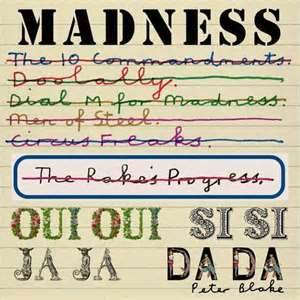
A week on from a host of promo appearances celebrating the release of the second single from Oui Oui Si Si Ja Ja Da Da, I felt it time to finally give my considered thoughts on that latest album here, having purposefully lived a while with the latest Nutty Boy waxings before delivering a verdict.

And while maybe in parts it’s not quite up there with the beyond-compare Wonderful and The Liberty of Norton Folgate, I’d certainly put it alongside Keep Moving and Mad Not Mad … and that’s high praise indeed from my point of view.

“I’m in love, but you drive me mad, be so sad to be losing you”

From the off, the band take a pearler of a shot at classic pop with two Mike Barson singles, the first, My Girl 2, a touch of chirpy ’60s soul and town hall pop worthy of a Motown Chartbusters compilation, shades of Can I Get A Witness or even Tainted Love juxtaposed with all the fun of the fair, and proof that for all their acquired sophistication, they can still write perfect three-minute hits.

mad never knew“It was very late in the discotheque, I was feeling blue as I sometimes do”

If track one is My Girl 2, Never Knew Your Name is Embarrassment 2, with all the charm of an early Maddy Mob hit coupled with the feel of an European art-house film soundtrack, complete with treasured staples like Barzo’s trademark piano and Lee Thompson’s underlying saxophonics, transporting their brand of ’80s romance 30 years into the present.

“Just faint wafts of nostalgia blowing gently on the breeze”

If that suggests a retrospective album, Suggs and Chrissy Boy’s La Luna El Mariachi moves us towards the era of The Pogues’ Fiesta or Kirsty MacColl’s Tropical Brainstorm, but with unmistakeable Camden-bred quirks among the Latino/Spanish theme. In fact, all that’s missing from this musical smorgasbord is a guest narration from late great Ian Dury.

“Make a stand for what is true, try to be decent in all that you do”

Taking us on to the mid-80s incarnation of the band’s output, Suggs and Cathal’s How Can I Tell You offers something of the feel of Wings of a Dove or It Must Be Love, although in this case Labi Siffre’s message gets a 21st-century lift, and you half expect the curtain to rise at the back of the stage to see the London Gospel Community Choir giving it their all.

“Sometimes you’ll feel so low, you know you’re losing your mind”

MADNESS PICEvery Madness album needs less euphoric moments to truly make it real, and the mood changes on Woody’s Kitchen Floor, with something of a Terry Hall presence detected, though perhaps without that added Jerry Dammers’ sense of menace – even their down moments ultimately joyous and life-affirming these days, the Grey Days behind them.

“If you keep misery as your company then you might as well be dead”

For all the after-show lows experienced in past days, there’s an overwhelming need from the band to promote survival and the positive touch now, and that’s nicely illustrated on Cathal’s Misery, a 50-years-on twist on Prince Buster’s classic ska version of Enjoy Yourself, augmented by elements of music hall singalong.

“Dreams of life beyond the gates and far from this town”

Sofa Antics: The Nutty Boys with JR (Photo courtesy of ITV)

Sofa Antics: The Nutty Boys with JR (Photo courtesy of ITV)

Monsieur Barso’s tinkling beat returns on Woody’s Leon, inspiring further echoes of the Madness of yore in a song reminiscent of the band’s portrait of park and street life on One Better Day, poignant lyrics complementing pensive strings and joyous harmonies, with an added Beatlesome finish.

“Look at the debris and what we have become”

The big sound returns for Lee and Woody’s Circus Freaks, as multi-faceted as the band themselves, with more than a whiff of the new-found worldliness of Keep Moving and Mad Not Mad, and much of the accomplishment that followed in the 1999 reformation.

mad oui“Once in every lifetime you get the chance to take a star from up above”

Yet Madness didn’t get to that stage without keeping their finger on the pulse of dynamic 45s, and Cathal’s So Alive is just the latest superb example – a stick of (pop) rock with ‘hit’ written all the way through, at least it would be in a perfect world. I for one see a busy dance hall, and the label of a Trojan single rotating on the turntable. In fact, uplifting’s too weak a word here, Suggs and Cathal’s glorious twin assault on the vocal duties underpinned by gorgeous brass and harmonies. And if that searing chorus twist doesn’t grab you by the tear ducts, perhaps nothing will.

“Deserted streets, and burning cars, familiar shops I know so well”

Just in case you’re getting carried away at that stage (like me), Woody’s Small World takes you back down a peg, its bitter-sweet sentiments perhaps serving as a window on the August 2011 Riots, in what appears to be a Ghost Town for today’s Britain, again perfectly paced, and this time with sensuous backing vocals from Siobhan Fitzpatrick.

“He had his own kind of flavour, He walked like a stepping razor”

Like the band at their potent best, Cathal’s Death of a Rude Boy takes a while to grab you but slowly gets under your skin, again showing many of the elements already mentioned, from Dammers and Dury to a Blue Beat and Two Tone rhythm. And I guarantee this is the one you’ll still be singing around the house the next day. Natty.

“Our pop star friends have all gone home, or maybe just out and about”

While Mike and Suggs’ Powder Blue is listed as an extra track here, it follows on perfectly, and is another song that brings Mad Not Mad back to mind, and showing us perhaps where the band are at this point in time – lifting the lid on the reality of London life that Madness have so beautifully chronicled these past three and a half decades.

“Free falling through the years, but I’m still on my feet”

mad my girl 2And what with that, the following statement of intent that is Mike’s ska-driven Black and Blue and the closing Clanger-Winstanley mix of opener My Girl 2 – complete with oodles of wonderful brass and organ, North London’s finest are away again. But as the back page of the CD booklet implies …. this is a musical adventure ‘to be continued’. And I’ll say yes in many languages to that.

Oui Oui Si Si Ja Ja Da Da by Madness is on Lucky Seven Records and available from all good record stores and online, as you might have already guessed. 

Posted in Music | Tagged , , , , , , , , , , , | 2 Comments

All that way for nothing? Not necessarily

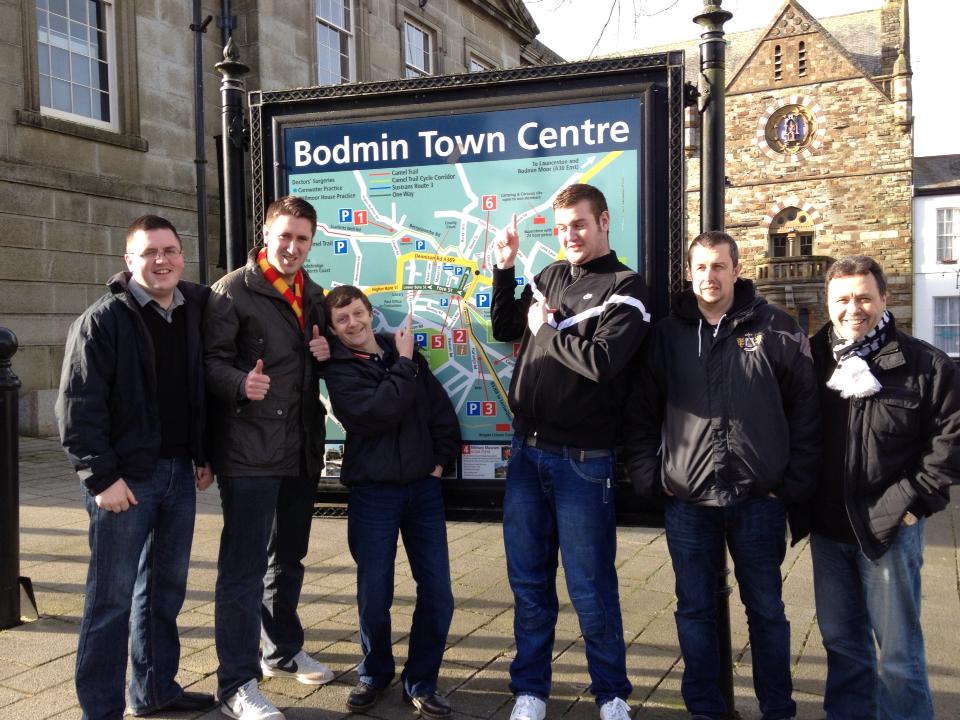
In Town: Some of the faithful Colliers fans, pre-match in Bodmin (Pic courtesy of Brian Shotton/Ashington AFC)

In Town: Some of the faithful Colliers fans, pre-match in Bodmin (Pic courtesy of Brian Shotton/Ashington AFC)

SPARE a thought for Ashington AFC, dumped out of the FA Vase last Saturday after an ultimately unsuccessful 702 mile round-trip to the Cornish moors.

On a weekend when so many gargantuan efforts by fans and club officials came to bugger all, this was the fixture that stood out as the obvious example of  ‘all that way for nothing’.
After all that snow on Friday, most of the country’s non-league pitches were deemed unplayable – and many of those scheduled games were called off a day early to avoid ‘unnecessary’ travel.
Some kept us wondering for at least another day, and – not so far from my own backyard – spare a thought for all those volunteers at AFC Fylde’s Kellamergh Park, who cleared the surface snow only to find what lay beneath was eminently unplayable.
And in one of those quirks of geography, surely you’d have got a good price on Lancaster City’s being the only fixture that went ahead in the whole of the Evo-Stik League and North West Counties League – not least after  snowdrifts over the Cumbrian border and all those hours motorists sat on the M6 further south the previous night.
I wonder just how many phone calls were made between club officials regarding Ashington’s crucial fourth-round cup tie at Bodmin Town’s Priory Park on Saturday, especially after reports of heavy rain in Cornwall.
Only a few days earlier, poor old Truro – who have had more than their fair share of footballing pain this season – had to turn back after being stuck in a blizzard in Taunton, leading to the late cancellation of their midweek Conference South clash at Eastleigh.
Yet there was no respite for the Colliers’ fans and officials heading west days later, and the few words about the match on Ashington’s official website on Monday morning spoke volumes about the experience for the visitors.
“Goals from Glen Taylor and Matthew Grieve were not enough to prevent the Colliers from dropping out of the FA Vase at the hands of Bodmin Town. Full report to follow.”
Needless to say, two days after the experience, there was still no report, which makes me wonder if there was still a Colliers fan in a darkened room somewhere trying to find the right words to put the sorry experience down on paper.
Gary Middleton’s side had to brush themselves down from the experience and think about a Tuesday night trip to Billingham Town in the Ebac Northern League Division One, a comparative breeze at 49 miles each way. And I can report here that they went on to win that encounter 4-2.
Meanwhile, Bodmin, top of the South West Peninsula League and enjoying a free-scoring season so far, can sit back and wait to see who’s next down the A30 for a last 16 fixture.
This weekend, Wisbech Town are set to leave the Fens and head 120 miles for Dudley in the West Midlands to face Gornal Athletic. If successful, they’ll then need to embark on a 650-mile round trip to find Priory Park the following weekend.
I’m guessing at that point there’ll be a few questions asked by loving partners of Fenmen players and fans, wondering if they really are heading off to footie matches rather than embarking on long-distance affairs or stag weekends.
However, on a weekend when a few precious FA Cup moments helped re-define the perception of modern football after that pathetic League Cup fiasco at Swansea City v Chelsea in midweek, there seems to be plenty of old magic still in the FA Vase.
Just ask the AFC Fylde fans who saw their side – then in their Kirkham & Wesham guise – at the new Wembley in 2008 (a year after Truro fans triumphed in that same stadium), or the Colne Dynamoes supporters who enjoyed success at the old Twin Towers 20 years before in the same competition.
But always bear in mind Robert Louis Stevenson’s words that – as Ashington fans will probably admit – sometimes ‘to travel hopefully is a better thing than to arrive’.

This is a copy of a Malcolm Wyatt article that first appeared on the http://www.sportnw.co.uk website on January 28th, 2013 (hence the North-West bias), and is reproduced here with the permission of the author and the original website creator. So there.

Posted in Football, sport | Tagged , , , , , , , , , , , | Leave a comment

Tweeting at the match? What’s the world coming to?

twit1A RECENT story on the Evo-Stik Northern Premier League website (well, it was rather a slow day in non-league football circles at the time) suggested FC United of Manchester are riding high in a ‘prestigious’ league table of the world’s most followed clubs on Twitter.

According to folos.im and its League Table of Twitter Followers, Barcelona lead a list of 1,764 clubs worldwide at present, with nearly 7.9 million followers, ahead of Real Madrid, with more than 6.5m, Turkey’s Galatasaray with 2.1m, then Arsenal, fourth, and Chelsea, fifth, boasting more than two million each.

For the record, Liverpool are seventh (1.4m), Manchester City 13th (681,500), Spurs 20th (347,400), Newcastle United are 34th (172,700) and Everton are 42nd (142,200).

twit6FC United are 154th on that list, with just shy of 30,000 followers. And that’s no mean feat for a club currently three levels below League Two, and strikingly, they stand one place above Championship leaders Cardiff City.

But there are notable exceptions from that list – including quite a few giants of the game, of course, not least Manchester United, Morecambe and Barnoldswick Town.

That might just be because the statistics – updated daily, apparently – are only based on follower counts for official football club Twitter feeds (and not including mentions or hashtags, incidentally).

Yet perhaps it’s put together by someone with an understandable dislike of the Glazer family’s involvement at Old Trafford too, as a quick look at those clubs mentioned show Man U’s official Twitter site actually has 82,500 followers,which would place them 68th – nestling between Mexico’s Tijuana (another team with lots of brass) and Spain’s Real Betis.

twit2As for the Shrimps, they don’t appear to have an official Twitter site for some reason, and for the record the same applies for the mighty Barlick.

You’ll be pleased to know that the Premiership’s non-league tribute act Wigan Athletic creep into the top 100, their 55,000 followers taking them to 95th place, with Bolton Wanderers 124th on account of their 37,100 followers, just six places above Arsenal Ladies and their 35,200 followers.

FC United are in fact four places above Indian export Blackburn Rovers, who have 28,600 followers. But Burnley fans can stop sniggering right away, as they’re 308th in the pecking order, their 10,200 followers seeing them sandwiched between South Australian footballing giants Melbourne Heart and South Melbourne.

Of further Lancashire interest, Blackpool are in 214th place, with 18,500 followers, although that’s not so far above the world’s oldest football club, Sheffield FC of the Evo-Stik NPL First Division South, who are in 221st place (17,700).

twit3Preston North End  fans won’t take too kindly to being 340th with their 8,900 followers, not least as that’s just 25 places above re-formed Chester FC (7,900).

Who else? Fleetwood Town are 410th (6,500), North West Counties League-based fans club AFC Liverpool are 432nd (5,900), Southport are 63oth (3,000), Marine 733rd (2,300) and AFC Fylde 833rd (1,800), with fellow Evo-Stik NPL club Ramsbottom United just 30 followers behind the Coasters in 841st.

Carrying on that latter theme, Lancaster City are 963rd (1,400) and Bamber Bridge 1,013th, the mighty Brig’s 1,270 followers seeing them with one more follower than next-placed Austrian outfit Wacker Innsbruck. Fascinating, I hear you say.

twit4You’ll forgive me if I stop there, although I did have a quick look at the bottom of the table, where I found Worthing and Scotland’s St Andrews United in 1,763rd and 1,764th respectively. Both had zero followers according to the site, which takes some doing.

That said, a closer look by this investigative journalist saw they both had more than 300 in reality. So I’m not saying there’s anything in all these damn lies and statistics, although it does just goes to show …. well, something I guess.

And on a weekend when snow and frost ruled out any action at so many North-West clubs, it was at least a league table I could look at and pretend I could do some expert analysis on. Which seems to be enough for some TV pundits or lobotomised callers on Radio 5 Live’s 606 Show these days.

twit5Twitter, eh. Remember in the old days when the most high-tech it all got was a goal update on Teletext? When those of us with dodgy TV aerials thought Jan Aage Fjortoft  was scoring for nearly every club in the country if the wind was blowing in the wrong direction?

Ah. Those were the days, and even if you couldn’t make it to a match, you could at least have a look at the results coming in while browsing in Comet on the way home, while clutching your HMV and Jessops bags. Tell the kids of today that though, and they probably wouldn’t believe you.

This is a copy of a Malcolm Wyatt article that first appeared on the http://www.sportnw.co.uk website on January 20th, 2013 (hence the North-West bias), and is reproduced here with the permission of the author and the original website creator. So there.

Posted in Football, sport | Tagged , , , , , , , , , , | Leave a comment

Introducing The Sha La La’s

0 (1)

Heads Up: The Sha La La’s, namely (from the left) Lou Lucano, Darron Robinson and John Piccirillo

HOT on the heels of the year Bradley Wiggins helped put Mod and 6Ts style back on the international stage, it’s nice to know there are a few bands out there determined to add a new spin and twist to a time-served musical force.

And just a month or so after the latest deluxe re-issues featuring The Jam, I can assure you – on the strength of The Sha La La’s first four-track E.P. for Royale Records – the flame still burns in certain quarters.

Think back to the urgency of Weller, Foxton and Buckler’s first LP In The City, and speed 35 years forward (yes, it’s that long) to find a similarly-driven trio inspired by that spirit of classic soul and high-octane guitar-based r’n’b.

Pressing On: The Sha La La's debut release

Pressing On: The Sha La La’s debut release

Where The Jam’s seminal debut material showcased everyone from Small Faces and The Who through to Wilson Pickett and Otis Redding, all that and more is woven into the grooves of this South-East three-piece’s latest output.

I’ve watched Darron Robinson and John Piccirillo’s musical odyssey from near and far longer than I care to imagine, back to the days of former incarnations A Month of Sundays and Sweet Life, where they formed a happening trio alongside guitarist Malcolm Smith in the late 1980s.

At that time I was behind the Captains Log fanzine, helping spread the word about a clique of happening bands, while they were treading the boards around London and the South-East, somehow never quite making the big time – for all their respective live power, record company promises and nailed-on publishing deals.

For all that earlier disappointment, Darron kept recording and trying to find his way back, and I’m pleased to say – all these years on – that his latest combo still have that spark, splendidly augmented these days by Lou Lucano on guitar, and sound every bit as fresh as they did back then. In fact, even more so in certain respects for the more stripped-down sound they now offer, as shown on this debut release.

Strings Attached: Lou Lucano

Strings Attached: Lou Lucano

Lead track (Keep On) Risin’ Up To Love is pretty much a sparkling statement of what this three-piece are all about, with shades of The Who’s I Can’t Explain and the feel of a Weller classic. And you could so easily see Otis giving this fine track his all on Ready Steady Go way back when, complete with on-the-sport dance moves.

Next up is Something I Can’t See, the track that first turned me on to The Sha La La’s, sharper than a trip down Carnaby Street in the dim and distant, all those fantastic influences to the fore again.  From Darron’s typically soulful-yet-fiery lead vocal and falsetto backing to the chop-guitar chords, rumbling bass and underlying drumming keeping it all together, we have something of a statement of intent.

Then there’s Losin’ It, which has the touch of a James Taylor Quartet cover of a long-forgotten cult TV theme, but with a little added zip and plenty of old Motown, Northern Soul and Stax magic in there too, taking me back to Oxford Street’s 100 Club and all those Kent Records’ re-issues.

Beat Master: John Piccirillo

Beat Master: John Piccirillo

And finally we have Twenty Five, another cracking track that could so easily have been recorded in 1962 as half a century later, to the point where you have to check the label to see the writing credits don’t read Marriott/Lane, Weller or even Darron’s namesake William ‘Smokey’ Robinson.

There are other influences here too, from angst-soul politicos The Redskins right back to Dr Feelgood – hence the band’s apt ‘somewhere between Detroit and Canvey Island’ maxim, with this trio doing Wilko Johnson’s legacy no disrespect whatsoever.

What’s more, The Sha La La’s sound every bit as fresh and new today, while offering a subtle nod to nostalgia and a salutary lesson in retro at its best.

Still Burning: Lou, Darron and John in action

Still Burning: Lou, Darron and John in action

I think they’ve managed to put all that down on record now, but you can judge that for yourselves, by checking them out live or having a listen to The Sha La La’s debut EP (Keep on) Risin’ Up To Love, out this week on Royale Records. To secure a copy, head here

FB2And for more detail about the band, including forthcoming live shows, try this link or have a quick gander at the band on film here

Posted in Music | Tagged , , , , , , , , , , , , | 2 Comments

Rambling on … after all these years

Woking Class Hero: Battle of Britain Class 34057 'Biggin Hill' exits Woking in September 1966 (Photo courtesy of Dave Salmon)

Woking Class Hero: Battle of Britain Class 34057 ‘Biggin Hill’ heads off for Basingstoke in September 1966 (Photo courtesy of Dave Salmon)

My Dad was only on the railways for eight years, but that 1953/61 spell as loco cleaner then fireman meant so much to him, and despite his following three decades as a postman, he never lost his love for steam.

I often wonder what would have become of him if he’d taken a different path, but instead  he oversaw from a close distance the steam engines making way for diesels and electrics,  having quit in a bid to seek a better wage for his growing family.

While his link with that world was partly severed in the early ’60s, the next generation of railwaymen witnessed first-hand the end of steam, including fellow Guildford-based fireman Geoff Burch.

Like my Dad, Geoff loved trains from an early age, watching ‘coffee pots’ and ‘flat tops’ pass the classroom window on the Guildford to Woking line, or visiting Brookwood, Reading, Woking and the capital with his trusty Ian Allan ABC spotting guide, hanging out at the Chalk Farm loco sheds, Kings Cross, Liverpool Street and Waterloo, getting his fix of A4 Pacifics, Britannia class locos, Castles and Kings.

Geoff's Story: The Ramblings of a Railwayman was published in 2011

Geoff’s Story: The Ramblings of a Railwayman was published in 2011

In time, Geoff plucked up courage to speak to the drivers, with cab invites ever more frequent, finally leading to his own footplate days, as told in detail in his epic 2011 publishing debut The Ramblings of a Railwayman, covering his career journey from April 1961 to July 1967.

Athough my Dad moved on within six months of Geoff’s arrival, they shared a history and deep love and respect for all they saw and those they worked alongside – man and machine.

Geoff conveys all of that and more in his original memoir and newly-published follow-up Further Ramblings of Railwaymen (2012), a further epic providing valuable insight into that love of steam that was the dream for so many boys – the hope of one day becoming an engine driver, despite all its hard toil and unsocial hours.

While my old man watched from a distance as steam locos were in many cases needlessly scrapped – on the whim of a short-sighted ‘progressive’ Government in those dark days of the Beeching Report and all that – Geoff was there for those memorable last days.

His first book is all the more significant for its description of many of the characters who made the railways tick in the ’60s. This is no cold memoir about gauge measurements and engineering know-how. It is primarily about the working man. The fact that the author was a keen photographer helps, and as well as recording his early career with his camera, he stayed in touch with other railwaymen who did the same.

That included fellow firemen Alex McClymont and Dave Salmon, whose memories and pictures feature in his follow-up, and Lew Wooldridge, who had the foresight to  capture those halcyon days on 8mm cine film, recently released on DVD thanks to John McIvor and  SVS Films (with a link here).

Rambling King: Geoff Burch can be proud of two fine works of railway memories

Rambling King: Geoff Burch can be proud of two fine works of railway memories

Many stills of railwaymen from that film made their way into Geoff’s labour of love, and that film and these two books perfectly encapsulate the era and give a moving (in more ways than one) record of an important era in our recent industrial past.

Geoff’s own railway career outlasted many of those locos (the ones no one could restore at the time), a transfer to Woking’s traction department in the late summer of 1967 as a ‘second-man’ leading to in-house exam success and eventual  promotion to driver status at Effingham in 1972, with later spells at Woking and Waterloo.

In time, he moved to the training side, and while privatisation led to the end of a 33-year career, he kept in touch with old workmates during a new chapter at Surrey Police, before returning to the rail industry in 2004.

Geoff’s first book covers his formative and firing days, the text and photos cataloguing day-to-day duties, his apprenticeship and working visits to London’s Nine Elms depot and those at Feltham, Reading, Fratton and Redhill, as he moved through the links.

Grateley Days: From left, Bill Brain, Dave Elston and Geoff Burch take a break on the last day of steam, July 1967 (Photo: Geoff Burch)

Grateley Days: From left, Bill Brain, Dave Elston and Geoff Burch take a break on the last day of steam, July 1967 (Photo: Geoff Burch)

Among the more poignant photographs (and there are lots of superb shots) are those taken during those last days of steam, from 1965 onwards, on the doomed Guildford to Horsham line, then in more detail in 1967, including one taken across from the road I grew up in at Shalford, and several from the final Salisbury run on a baking-hot, emotional mid-July day, while hundreds lined the bridges and trackside en route.

Those halcyon days were also recorded on canvas by famed railway and wildlife artist and  preservationist David Shepherd, and he wrote an introduction to the first book, while respected railway photo archivist Mike Morant does the same for the follow-up.

What sets these books apart from many others in a congested market is his first-hand focus on the ordinary men who worked these lines. The publication of the first book would have been enough to secure Geoff’s place in steam railway lit, and his latest takes that  further, with a wealth of  superb photographs – many previously unpublished – illustrating these personal ‘rambling’ recollections.

geoff Cover

Following Up: Further Ramblings of Railwaymen was published in late 2012

All those featured worked alongside the author at some stage, but while predominantly featuring Guildford, other Southern regions are covered too, as Geoff encourages his fellow railwaymen to commit their memories and photographs to print.

There’s a strong sense of brotherhood and solidarity throughout, and while the emphasis is on the post-war days of steam, there’s a respectful nod to railwaymen whose service started long before, some having signed on before the Great War.

It would take too long to detail each contributor’s story here, but Limerick-born Guildford recruit Pat Kinsella, the first featured, is as good an example as any, his memories of those early days as a cleaner and fireman including episodes such as the day his crew attempted a charge on Pinks Hill with an overloaded cement train, firing school exploits, carrying a circus train from Ascot West to Kingston, and countless conundrums amid snow, fog and smog. Then there’s his impassioned defence of an older generation of railwaymen wrongly labelled ‘conscientious objectors’ during their Second World War home service.

The afore-mentioned Alex McClymont and Dave Salmon tell similarly vivid stories of their initial days of service, with the wealth of great photographs they took in Guildford, Basingstoke, Woking, Weybridge, Nine Elms, Kings Cross, Waterloo, Clapham and Fratton, as well as further afield in further afield at Oxford, Crewe, Trafford Park, Edge Hill, Northwich and Workington, having proven invaluable. One taken at the deserted stores at Guildford is particularly evocative.

Cabin Fever: Jeff Cook and Alex McClymont put the squeeze on fellow railwayman Pat Kinsella

Cabin Fever: Jeff Cook and Alex McClymont put the squeeze on fellow railwayman Pat Kinsella

Brian ‘Brush’ Davey adds great tales and his own photographs, detailing various encounters and fellow personnel, from the story of the leaking ale barrel to an unexpected meeting with the Surrey Union hunt, and helping transport a farm from Surrey to Devon.

Tim Crowley’s ramblings stretch from bygone days in his native County Cork through to the preservation era at the Bluebell Railway, including his progress from firing to driving via Ashford, Nine Elms and Woking.

Guildford railwayman Roger Hope also tells compelling tales of his firing days, not least those hair-raising moments when it can all go wrong on the footplate, while Eric Hern adds a vivid picture of life on the country lines from his days at Petersfield before guard duties took him to Guildford.

It’s a similar journey for Jim Wattleworth, from his early days when the Isle of Wight had a whole network of branches and beyond redundancy in 1955 to a whole new set of firing memories at Nine Elms, Fratton and Guildford.

Then we have Bob ‘Ben’ Cartwright taking us from his formative rail exploits at Eastleigh through to his traction days then more recent Mid-Hants volunteer duties, giving a detailed account of life that underlines how it wasn’t all roses, despite all those enjoyable moments.

Fred Johnson is another who went the distance, eventually leading to instruction duties, his ramblings here centred on his days based at Salisbury, from 1948 onwards. And finally there’s Denis Turner’s description of firing duties at Weymouth and post-steam driving days at Dorking before he gave up the ‘juice’ for a later career as a police dog handler.

BR Standard Class 4MT 76067 at Shalford in Spring, 1967, with Bill Brain and Geoff Burch set to return to Guildford (Photo courtesy of Geoff Burch)

BR Standard Class 4MT 76067 at Shalford in Spring, 1967, with Bill Brain and Geoff Burch set to return to Guildford (Photo courtesy of Geoff Burch)

Once again, Geoff incorporates great photographs from David Christie and Gerald T Robinson, among others, giving us a window on a bygone era, and ultimately delivering a valuable record for prosperity.

As for the author, he’s certainly packed a lot into his official ‘retirement’ since 2009, and work is already underway for a third publication, offering a different dimension again, but one no less worthy.

In a genre where you tend to find extended caption books or windy wafflings, rarely do you get such a mix of the best of those elements – with the tales told often as stirring as the photography. And while these ramblings might not be for everyone – some may get lost in the detail here and there – they act as a superb testament to such a wonderful bygone era.

Update (November 2014): The Ramblings of a Railwayman has completely sold out in hardback but is still available as an e-book for £6.99 or on CD for £7.99. The remaining copies of the Further Ramblings of Railwaymen hardback are available at a bargain half-price of £12.50 as well as in e-book format (£6.99). For the hardback, add £5 per book for postage and packaging, enquiring via geoff.burch@hotmail.co.uk. Copies of the second book are also available at Ben’s Collectors Records, Tunsgate, Guildford.

Geoff Burch is also regularly out and about giving talks around Surrey and Hants on his books. Check his http://www.ramblingrailwayman.co.uk/ website for details of those events and much more.

Posted in Books Films, TV & Radio, Railways | Tagged , , , , , , , , , , | Leave a comment

Will the last one out please switch off the turntable?

Vinyl Junkie: What's left of the writewyattuk LP collection

So, another high-profile retailer is in administration, possibly on its way out to pasture after all those years on the high street. HMV. And this time it’s one that formed an important part of my past.

It takes me back to those days of unlimited spending. I was on an OK wage, living at home, and had disposal income. Couple that with some form of C of E guilt (I can’t claim the Catholic version), and you’ll understand I was buying at least three LPs at a time from HMV back then.

Confused? Well, an album is hard to hide from your folks or work-mates, so it always made sense – to me, at least – to buy more than one at a time. That way at least you’d have something to feel guilty about. And with three LPs (or ideally just a 12″ single on either side of your album) you could at least pretend you’d spent a bit less. All part of denial as a vinyl junkie, of course. But at least I’m still here to tell the tale.

In later days, secretive purchases of CDs proved comparatively easy to get away with. But with long-playing albums on glorious vinyl, you needed more than a big overcoat to avoid unwelcome questioning. “Spending money on records again? You could put a deposit on a house with all that cash you waste. You can’t possibly listen to them all.” That kind of thing.

Hiding purchases from workmates was a bit different, and I quite enjoyed the attention really. “Oh no, what’s he got this time? Something by The Streaming Nosebleeds or The Vibrating Cockerels?” No. The actual band and album titles were far better than they could imagine. “Half Man Half Biscuit? What the hell’s that about?” “Close Lobsters? Are you deranged?” “The Wedding Present? Ooh! Have you set a date?” “Hothouse Flowers? They’ll never come to anything with a stupid name like that!” Oh really? “Anyway, what’s wrong with Billy Joel, or Tina Turner?” I’d finally snap of course. “Well, how long have you got? Only I want to get home and listen to The Men They Couldn’t Hang.” Great days.

A lot of those LPs came from HMV in Guildford. Around that time I started frequenting a  record shop by the bus station, run by my mate Ben, who catered for my 60s soul, 50s rock’n’roll and various other off-catalogue purchases. But there were also a lot of indie albums that came straight out of the rack at HMV.

I toyed with Our Price for a while, but it was never a first choice. I can’t ever recall anything other than a quick thumb-through at a Virgin Megastore or Tower Records during trips up to London. Too many people, and always the reality of forgetting what was actually on my list when I finally found enough space to browse.

Woolworth’s was another favourite, no holidaying in Cornwall, Devon or Wales complete without a go at the pick’n’mix and a cut-price record. The same went for occasional visits to the main drag in my adopted Lancashire or back in Surrey. I remember being in Woolies in Fishergate, Preston, a few days before it closed. Mayhem. I think I got a Rick Rubin-produced Neil Diamond CD and the Robert Plant/Alison Krauss collaboration. Both great albums, but I also remember the scrum and indecency of my fellow shoppers. The staff looked a little bemused and hurt, and it just seemed wrong to be part of that whole riot. Never again.

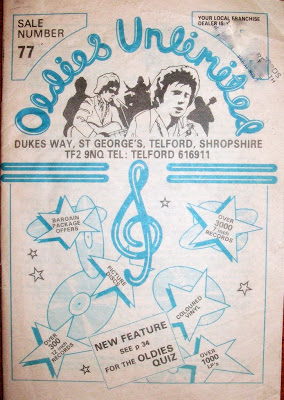
Oldies Unlimited: The Telford mail order firm was a winner with this blogger (Pic courtesy of http://tracklister.blogspot.co.uk)

Oldies Unlimited: The Telford mail order firm was a winner with this blogger (Pic courtesy of http://tracklister.blogspot.co.uk)

I have to say there were lots of mail order purchases too. Get that, kids. Not internet purchases, but actual mail order. Oldies Unlimited was brilliant for all those superb ’60s and ’70s singles, even a few ’80s ones by acts I had no real desire to buy albums by – not so much one-hit wonders as soon-forgotten often kitsch classics.

By the time I took The Fall’s advice and Hit the North, it was Action Records in Preston for me, and breaks in North Wales wouldn’t be right without visits to Cob Records in Porthmadog. Meanwhile, my mate had his own shop in Guildford by then, and Ben’s Collectors Records remains my first port of call, despite a 480-mile round trip these days. The same goes for any independent record shop with affordable prices. Long may they survive – whatever the economic climate.

It was a long time before I even switched to CDs, let alone turned to internet buying. And I think I’ve only paid for about four downloads over the years, normally obscure singles that don’t appear on anything else. I’ve borrowed a few albums from local libraries, but it took me a while to get into Amazon and eBay. Now, heavily-diluted spending power means I’m mostly a bargain hunter at charity shops, prepared to sift through all the Daniel O’Donnell discs to find the odd unexpected nugget.

I actually went for a job at HMV while still a student. It seemed like the perfect job for me at the time. Lots of surly blokes with not much to say (I could do that), and now and again a gorgeous girl behind the counter with a nose ring and a lovely smile. In later days, it was more likely the surly blokes had the piercings, and probably everywhere but their nose. But it was different in the ’80s.

I seem to recall that in the interview they saw right through me. However hard I tried to convince them I was trainee management material, they knew full well I just wanted the staff discount and had no ambition to get into ‘retail’ or run their shops.

Spy Guy: Billy Bragg's first mini-LP was released in 1983, two years before the blogger met him

Spy Guy: Billy Bragg’s first mini-LP was released in 1983, two years before the blogger met him

My other main HMV anecdote involves a signed copy of Back to Basics by Billy Bragg, after a meeting with the so-called big-nosed bard of Barking in HMV Guildford in March 1985, ahead of  an appearance at Guildford Civic Hall that evening and Top of the Pops two days later performing Between the Wars. The anoraks among you will be thinking that doesn’t quite add up. But bear with me.

I’d been a Bragg fan since his first John Peel session in the summer of 1983 , and two years later handed over my vinyl – first LP Life’s A Riot with Spy vs Spy and follow-up Brewing up With Billy Bragg. Probably his new hit EP too. He signed it there and then, but I later decided to offload those and downsize for a signed copy of Back to Basics, a 1987 vinyl compilation featuring all 21 of those recordings. Probably not my most astute financial move.

Anyway, I remember being in a very long queue at HMV in Swan Lane, Guildford – on the site of the former Doll’s Hospital where I once bought plastic soldiers for in-house Second World War re-enactments. When I finally got to the front (having rehearsed my words several times) I blurted out, “So what’s it like to have a chart-bound sound, Billy?” It was supposed to be funny. Ironic, really. And it didn’t need an answer. Having read all his interviews, I expected a clever one-liner about how he’d changed his views and was now going to swap his modest approach to rock’n’roll for stretch limos while drinking champagne out of groupies’ smalls.

But maybe I was a bit too earnest in my delivery, because he took a good look at this skinny 17-year-old (with the sort of personal eye contact you wouldn’t expect from Bono) and told me what he thought I wanted to hear. “To be honest, it’s not really any different. I’m still doing what I want to do, whatever number I’m at in the charts.” Something like that, anyway. I didn’t know where to go from there, so probably just went red, smiled and turned on my heels with nothing more than a mumbled, ‘Thanks, Bill’.

On Record: Ben Darnton outside his popular Tunsgate shop in Guildford

On Record: Ben Darnton outside his Tunsgate premises in Guildford

A brief conversation with Ben (pictured, left) today revealed a visit by Paul Young to that same HMV store when No Parlez came out too.

I won’t really be mourning HMV, because I’ve outgrown them, as they in turn outgrew me. I will no doubt be looking to see what turns up on the internet if they go under, but really don’t want to be some kind of reaper when there’s all those lost jobs involved.

I was never comfortable in camera or gadget outlets, as there’d always be some spotty oik or slimy salesman trying to sell me a warranty I didn’t need or upgrade to the next model, so I won’t miss Comet or Jessops. But HMV was part of my life once – or at least part of my working lunch hour.

So I’ll at least raise a glass here to all those who have served the firm’s major high street stores over the years, not least knowing from my own spell in Boot’s, Guildford, just what stuck-up arses there are out there demanding service from under-paid shopworkers.

And maybe I’ll play A New England or Strange Things Happen to mark the occasion.

While I’ve give my own spin, you might also appreciate David Hepworth’s slant on HMV et al – in an article first published a few days after the Jessops crash, and since modified. There’s a rinky-dink dink here

Posted in Music | Tagged , , , , , , , , , , | 6 Comments

Inspector Rebus’ 25-year rocky odyssey

In which writewyattuk runs the rule over Standing in Another Man’s Grave, the latest bestseller from acclaimed Scottish crime writer Ian Rankin.

There was a lot of expectation about Ian Rankin’s latest Rebus novel, with plenty of pre-publicity thanks to the BBC’s Alan Yentob Imagine feature on the author and a literary tour that ultimately led to a No.1 hardback bestseller spot at Christmas.

Having spent a few days over the festivities reading the end result, I can say it was well worth the attention. But rather than just covering the 19th Inspector Rebus novel on its own merits (at least I make it 19), I also returned to Knots & Crosses, the first novel featuring the detective – published 25 years before – for a little ‘compare and contrast’.

I wanted to see how much has changed in John Rebus’ world since that debut, and more to the point how Rankin’s writing has evolved. And I found something of an odyssey for an author whom in those intervening years has become something of a master in his field.

rankin knotsWhile Knots & Crosses had its flaws and pitfalls, it still stands up to scrutiny, not least as a pen-pic of Edinburgh and the author’s world back then. And it was definitely what its author wanted it to be – a page-turner, like every Rankin novel since.

It was his first effort at the genre, and despite a strong hook and plot, somewhat flawed by the author’s inexperience at that point, the drama more poorly executed than you’d expect of Rankin today, not comparing favourably with the later books in his impressive canon. But all novelists make errors, and Rankin clearly learned from his, slowly but surely becoming the fine writer he is today.

He too acknowledges mistakes within Knots & Crosses, not least a subliminal need to parade his literary influences within. His already-jaded detective is a tad too well-read to be credible in places, and his thoughts (written in third person limited omniscient mode, students might say) on the page a little too flowery here and there.

Furthermore, descriptions at key moments are way too deep, for example the climactic subterranean scenes beneath the Central Library, with Rankin yet to take on board the literary trick that ‘less is more’ and ‘show rather than tell’.

The same goes for descriptions of Rebus’ one-night stand, written by a 27-year-old writer fresh from his postgrad studies rather than a detective just turned 40. I wonder how a 52-year-old Rankin would write those scenes now.

I should also pick Rankin up on his depiction of investigative journalist Jim Stevens, his character more drawn from film noir and a diet of TV than any newsroom I knew, although – admittedly – times had changed by the time I became a journalist a decade later.

But for all that, Rankin can still feel proud of his Rebus debut, and 25 years on has clearly learned so much about his craft on the evidence of Standing In Another Man’s Grave.

books rankin graveFive years after we thought we’d seen the last of Rebus in Exit Music, his unlikely hero is a civilian in a cold-case unit, looking into unsolved deaths dating back a decade or so, but increasingly keen to return to his old CID habitats.

A turn of events sees Rebus taken out of his Edinburgh comfort zone, as far from his local pub as ever before, traversing the A9 in his trusty Saab, digging for clues and getting to know a larger-scale Scotland at last. It’s a shame in a way that didn’t happen earlier, if only to give the real-life regulars at the Oxford Bar a break from all those visiting Rebus tourists from around the world.

The latest novel certainly boasts a number of well-drawn characters, our gruff semi-retired detective nicely complemented by those around him, notably DI Siobhan Clarke, but also in smaller measures Malcolm Fox of ‘The Complaints’ – the subject of two previous books – and a host of gangland demons (and I think Rebus would prefer gangland demons to golden daffodils), from old school villains like Ger Cafferty through to a new breed of Edinburgh crims.

Again we have the musical name-dropping we expect from Rankin, something of a signature theme over the years, most obviously here through talk of the late Jackie Leven – to whom the book is fittingly dedicated -and the mis-heard lyric in the title. But there’s also the various Led Zep puns Rebus peppers his conversation with, marking a distrust of his latest adopted boss, James Page.

It’s not just Page, with the majority of police middle management (‘showroom dummies, in Rebus’ parlance) getting similar treatment, and deeper nods to the way the game has changed over the years on both sides of the law (and the corruptive elements in between). Meanwhile, Rebus offers a positive case for the old methods and gut instincts in these modern days of psychological profiling and various technological and social media advances that otherwise suggest his ways no longer relevant.

That battle between historic and advanced methods is mirrored in the criminal underworld rebus often delves so close to, an analogy of old versus new also illustrated by Rebus’ (and Rankin’s) championing of vinyl over digital downloads – this music aficionado clearly not quite ready to dispense with his world in deference to the latest gadgets and fads. Which makes me wonder if we’ll see a Rebus book called The Needle and The Damage Done at some point.

Again – despite his stubborn views and general antipathy towards those around him – I think we like to think we ‘get’ John Rebus, feeling at one with the old curmudgeon as he sticks two fingers up to the number-crunchers and career-minded cronies, preferring his own time-proven approaches to catching baddies.

Master Mind: Ian Rankin

Master Mind: Ian Rankin

What’s more, there’s plenty of trademark Rankin humour between the lines of his latest ‘tartan noir’ thriller, and such is the master’s craft that you can taste and smell the stale cigarettes, the dregs in the whisky bottle, and the recently-disturbed earth at the remote locations Rebus’ investigations inevitably take him to.

And while his short, sharp chapter style ensures you feel the need to at least tackle a few more pages before you turn out the light at night, all that pace would be pointless without the kind of intricate, multi-stranded plot Rankin has learned to pull together with such skill.

Getting back to that comparison with Rankin in 1987, he clearly no longer feels a need to be overly-clever, and is all the better and more creative for that, his finely-structured prose and ever-believable dialogue taking you right to the heart of each and every page.

Standing In Another Man’s Grave by Ian Rankin is published by Orion Books and available from all good booksellers (and plenty of shabby ones too). And for the writewyattuk feature on Ian Rankin’s December visit to Preston, head here

Posted in Books Films, TV & Radio | Tagged , , , , , , , , , | Leave a comment

Josh and Phil playing the fame game

Rising Star: Josh Charnley’s been on the radar a few years now (Pic: http://www.wiganwarriors.com)

Rising Star: Josh Charnley’s been on the radar a few years now (Pic: http://www.wiganwarriors.com)

At the school just down the road from me, it seems barely a few weeks go by before talk of another visit from a famous ex-pupil.

In this case I’m name-checking Manchester United and England star Phil Jones, a regular visitor to his old high school in Leyland, Lancashire, and clearly someone with happy memories of his blazer days.

I can’t pretend to have unearthed the 20-year-old’s sporting talent, but at least saw him breaking through at Blackburn, in the days before Shebby’s Circus came to Ewood.

The Leyland teaching establishment’s famous ex-pupils also include ex-Blackpool, QPR and Burnley defender Clarke Carlisle, once dubbed Britain’s Brainiest Footballer – something proved in recent years through his role at the PFA, let alone through his earlier academic prowess.

I’m sure we’ve all had brushes with stars in the making, and it makes me feel better about some of the tonkings my old Guildford school side got knowing that Spurs star David Howells was among those who scored a hatful against us. As a left-back regularly left for dead on such occasions, that at least gives me some solace.

My brother-in-law tells a similar story about facing Godalming-born and bred future Ipswich and England defender Mick Mills, while others from my hometown talk about Chelsea hero John Hollins, and one mate still has palpitations re-living five-a-side encounters against Ron ‘Chopper’ Harris.

But from my regional reporting days, I know only too well that while some make the grade and remain in the realms of the ‘local boys and girls done good’, others never quite make the grade.

Leyland Lad: Phil Jones has reached the big time (Pic: http://www.manutd.com)

Leyland Lad: Phil Jones has reached the big time (Pic: http://www.manutd.com)

Of those who do, some quickly put distance between themselves and their old haunts, while others waltz into an area and gain hero status, like a certain Sir Bradley of Wigginsville, born in Belgium and brought up in London, yet quickly adopted by Lancastrians, not least after promises to put his SPOTY award behind the bar at his village pub.

Then there are others who never sever their links with their old patch. Bill Beaumont is a prime example, finding fame and fortune after swapping the Fylde for England and British Lions and regular TV work, yet still putting in the hours at the family mill in Chorley, while watching his own lads’ exploits on the rugby pitch nearby.

I could add similar sound reports for many more big names who prove all-round good guys face to face, including Olympic medalists Jason Queally and Jeanette Brakewell, and Paralympians Graeme Ballard and Natalie Jones.

Then there are those you see rise through the ranks, from Chorley and Lancashire cricketer Tom Smith to golf’s Nick Dougherty, both of whom have plenty of time to be at the top table one day.

And while you have to take doting parents and grandparents with a pinch of salt as they praise their loved ones, now and again some make the grade – as certainly proved to be the case with a young rugby league international on my patch.

While I was covering the international exploits of code-crossing rugby legend Jason Robinson – another one-time Leyland resident – the nearby Chorley Panthers junior RL club was nurturing its own stars of the future.

I hate to think how many junior rugby league reports I subbed over the years, but certain names cropped up again and again – from Under-7s level onwards – including the Tomkins brothers, who would later find fame at Wigan.

Meanwhile, on the terraces at Chorley FC, one doting granny spoke with pride about her ‘Josh’, evidently a wiz on the rugby pitch from the age of six.

If you believed those club reports, each player was a world-beater, and – believe me – they all got mentions every week, from ‘man of the match’ to ‘best effort’ or ‘coaches/supporters’ choice’. And the thought of all these ‘big units’ barely in infant school, making ‘bone-jarring tackles’, brought many a wry smile from us cynical hacks on the sports desk.

Yet my Magpies veteran always told me how she appreciated the write-ups on her grandson, even when just a one-liner, and no doubt her scrapbooks were bulging at the seams by the time he made his Wigan Warriors debut.

Now – on the eve of the 2013 Super League season – I find that golden boy, Josh Charnley, a key component at the DW Stadium, having represented the region and the county by the time he was 16 and quickly making the grade at club level too.

He made the right wing position at Warriors his own in 2011 with a 27-try breakthrough season, his pace and skill soon seeing him decorated with the club’s young player of the year award.

That same season he earned a place in the England Knights squad, scoring against France, and in July 2012 scored a try for an England select team against the Exiles, and with Wigan finished the 2012 season at the top of the pile, their leading scorer with 31 tries.

In fact, ‘Little Josh’ now weighs in at 99kgs and is 1.80m high, and made his first full international appearance 15 years after his Chorley Panthers debut, scoring four tries last October as England thrashed Wales 80-12 in Wrexham, and also scoring as England beat France 48-4 in an end-of-season triangular tournament.

There will always be plenty of proud grown-ups prepared to tell you their little sods are internationals in the making, but bear in mind that some really will make the grade, with Phil Jones and Josh Charnley two fine examples and potential 2013 star turns.

A version of this Malcolm Wyatt article first appeared on the http://www.sportnw.co.uk website, and is reproduced here with the permission of the site and the blogger himself.

Posted in sport | Tagged , , , , , , , , , , , | Leave a comment