The Cardigans: from indie roots to Gran Turismo and beyond – the Nina Persson interview

Nina Persson was between rehearsals with The Cardigans at home in Malmö when I called, getting set for four UK dates revisiting the band’s best-selling album Gran Turismo in full, 20 years on.

Including the singles ‘Hanging Around’, ‘Erase/Rewind’ and ‘My Favourite Game’, this was arguably the record that catapulted the band to the next level, going platinum in the UK, shifting more than three million copies worldwide, and seeing them nominated for seven Grammi Awards back home.

Word has it that this will be the first time the Swedish outfit have properly toured in 11 years. Have the songs come back to them easily enough, I asked vocalist/lyricist?

“Yeah, and we’ve played those songs since, so it’s not that tricky. We’re familiar with them. We played this album in full for a festival in Hultsfred a few years ago (in 2012). And we’ve rehearsed quite a bit in the last two years, so we’re not too rusty. We know what we’re doing and when we do a new set of shows we want to do it the best we can anyway.”

When you’re back up on stage playing those songs, does it take you right back to how it was first time around with Gran Turismo?

“The thing is that it was 20 years ago when we played these songs when they were new, and I actually don’t remember much from that time. They were very different times. I also didn’t feel very well at the time, and the songs were so current to me and were open wounds almost. It’s easier to perform them now. I have thicker skin!”

Early into our conversation, Nina broke away for a quick word with her son, just back from school, eight-year-old Nils another indicator of how much her life’s changed since the last Cardigans album in 2006, Super Extra Gravity.

Within a year she’d starred in her first movie, Swedish romance Om Gud Vill, and had a hit guesting with the Manic Street Preachers on the splendid ‘Your Love is Not Enough’. But in 2009 Nina was diagnosed with cervical cancer, undergoing surgery, Nils safely arriving the following September after three attempts at in vitro fertilisation.

Solo Act: Nina Persson’s last most recent LP was released in 2014

Since then there’s also been a solo album, 2014’s Animal Heart, and a year later Nina and husband, American songwriter and author Nathan Larson, relocated back to Malmö after a long spell in Harlem, New York City.

But let’s go back to 1998 and Gran Turismo. I saw that album and 2003 follow-up Long Gone Before Daylight as far darker than those that came before – Emmerdale, Life (which included five songs revisited from the first album for wider release) and First Band on the Moon, the first Cardigans record I splashed out on, inspiring me to go back and properly catch up on the earlier tracks I’d missed. And all three albums had a lighter, quirkier air.

“Mmm. Yeah.”

Was that just an indication of where you were at the time that the songs got slightly darker?

“Yes. Very much so. And we also felt that after First Band on the Moon and the song ‘Lovefool’ became such big hits, we had to spend so much time talking about those, that we really felt tired of them. When you have a big hit like that, you can really get connected with one song, and the image of us then was happy-go-lucky, funny, ‘60s looking, whatever … which was not at all something we identified with very well, that perception of us.

“And we started to use different ways of recording. That was the first time we started to work with computers, early in the days of Pro Tools. So that was really inspiring too. We started to think of bands like Depeche Mode and that type of music as well.”

I loved those early albums, but this was seen in some circles as a bit of a step up to the big time.

“Yeah, and we wanted to really do something different.”

Yet that band creativity was always there. You were a competent outfit from the start.

“Yeah, and now we had a new approach with a whole new set of toys, which was fun.”

If Gran Turismo was about trying to find their place in the world, as Nina has suggested, the band certainly seemed to be accepted further afield and taken more seriously with that record.

“Erm, I don’t know. I think with First Band on the Moon things really exploded, but this was almost something where we felt we were taking a sideways step rather than upwards.”

I see that. You could have easily written another album of ‘Lovefool’ type songs, but chose not to.

“Exactly, even though very vocally record companies were requesting such!”

And there were no signs of any Black Sabbath covers on this one.

“No, that was something we’d happily done earlier, but then … as soon as someone starts to expect things from you, you stop doing it. We did two, and people were like, ‘Ooh, what’s the next one going to be?’ And we were like, ‘Fuck off!’”

Have you got good memories of past UK visits. Only I’m guessing you were spending as much time here as at home at one stage.

“Oh yeah. Very much, and we formed the band, sort of, because of British bands. That’s what we all had in common. The British scene was fantastic at the time, and we were all about it.”

I was going to ask that, because if you go back to Emmerdale and the early recordings, you had a style recognisable to yourself from the start, but ‘Rise and Shine’ and ‘Over the Water’ in particular have the air of WriteWyattUK favourites The Sundays for me.

And at other times on the first couple of albums I hear several other influences, such as The Sugarcubes and also Catatonia in places. What were you listening to then?

“Well, the reason I was accepted into the band, basically, was because I owned a Stone Roses and a Sundays record.”

Was the latter Reading, Writing and Arithmetic?

“Yes, but shortly after their second album came out. And they’re still one of my favourite bands ever. And collectively we were huge Smiths fans. Very much, and The Charlatans, The Stone Roses, and Blur of course.

“When we made Gran Turismo, I remember sitting and listening to the last Sundays record. That record came out about the same time. Harriet Wheeler meant so much to so many women in my generation.

“And there’s also the Swedish artist, Stina Nordenstam, her record came out around the same time, and if you listen to her music you’ll totally hear what I copied in it!”

I was surprised looking back to see that while your albums clearly sold well at home, like here it was the previous LP’s ‘Lovefool’ that was your first big hit single in Sweden. Was your own nation slow to catch on?

“Well, ‘Lovefool’ was released twice, first when that record came out, when it did okay, then around a year after it was included in the movie, Romeo and Juliet. That’s when it was released in the US and that’s when it really reached a whole different level, even in Sweden. And that film was obviously popular everywhere.”

Incidentally, that late 1996 film soundtrack album also included a track by the afore-mentioned Stina Nordenstam and fellow Swedes The Wannadies too.

Am I right in thinking it was barely two years between you first getting together and that first album?

“Yes, we formed in 1992 and that first record came out in ‘94.”

So you were around 18 when the band formed?

“Erm … yes.”

How did you get to be in that position where the band saw your record collection and took a punt on you as their singer?

“Well, the town we lived in was quite small – it’s grown quite a lot since – so I guess we all knew of each other and went to the same high school.

“Me and my friend, who was in the band in the beginning, we started to just sit in his house, making up songs and listening to records. He heard about these guys forming a band and wanting women singers and we sort of auditioned together.

“But I knew most of them. I didn’t know Peter (Svensson) but knew most of the others. In our town it was a little like if you were listening to something like contemporary rock, rather than Christian music, you got together, because there weren’t many of you.

“Me and my friend came with two songs – we came with ’Rise and Shine’ and another, ‘Pooh Song’ (which featured on the ‘Rise and Shine’ CD single).”

I’m not sure who the friend she mentions was (I know – I only thought to ask later), but it was guitarist Peter Svensson and bassist Magnus Sveningsson who founded The Cardigans, with both more into hard rock when they joined forces. If I sound vague there, I did try to check up later, watching a documentary on the band online, but it was in Swedish with Japanese subtitles, so I was a bit lost. There were some images of the band Kiss in the introductory interviews though. Maybe someone could help enlighten me.

Word was that the founding duo grew tired of metal and decided to form a pop band with Nina, an art-school friend who had never sung professionally, plus keyboard player Lars-Olof  Johansson and drummer  Bengt Lagerberg. The rest is history.

Nina’s not credited on that first album as a lyricist. In fact, the first songs with Persson co-credits are on Life, including the single, ‘Carnival’. But there was no stopping her from there.

“I gradually wrote more and more. By the time of Gran Turismo I would pretty much say that if I don’t get to write all the lyrics, I’m gonna quit! I felt I had to talk so much. I understood at that point there was no getting away from having to do all the interviews, so if I can happily do those, I should get to write everything so I had something to talk about.”

Journalists are notoriously lazy with their research. How long would it be in interviews with foreign reporters that they’d get round to asking you about Sweden’s most famous musical export, Abba?

“Ah, it happened all the time. It was inevitable. At that point also Roxette had made a dent on the world, and Ace of Base. In a country like Sweden where we’ve had a limited output of music, of course. I mean, if you were Dutch you’d have to talk about Shocking Blue!”

Although, I guess where you were based you were perhaps closer to Copenhagen than Stockholm.

“Well, we moved together as a group to Malmö, where we still live, just across the water from there. But Agnetha (Fältskog) from Abba was from the same town as we were, Jönköping.”

Nina first moved to Malmö with her bandmates in 1994, returning to her adopted coastal city after a decade in America, three years ago. What inspired her move back?

“It had very much to do with the fact that we had a kid, when it was time for him to start school. We started to navigate the school system in New York, knowing we had really good free schools here … and healthcare and everything.

“We were also isolated a little in New York. There’s more of a community here, which I like. This sounds kind of silly, but me and the drummer and the keyboard player of The Cardigans live in the same building now.”

Now I’m imagining something a little like The Beatles in Help – seeing you all enter the building by your own front doors, but it’s shared living space inside. Am I right?

“Erm … we each have our own apartment in the same building!”

I’ll believe her. And going back to that relationship with British culture and specifically the inspiration for the name of the first album, do you still watch UK soap operas to pass the time between band practises?

“No, I haven’t seen a British soap in ages. But it wasn’t too long ago that I was somewhere where there was a TV and Emmerdale was playing and I watched an episode. Is it still running?”

I believe so, 46 years after the first episode. I’m probably not the best person to ask though. It’s been a while since I caught up. I still delight in calling it Emmerdale Farm, annoying people by asking if Annie, Pat, Sam, Joe and Jack Sugden are still around, with Amos Brearly and Henry Wilks behind the bar at The Woolpack, and Alan Turner and Seth Armstrong still working the estate.

Okay, that’s not strictly true. I’m aware of the Dingle family, and know that Paddy the vet is a big Evil Blizzard fan on his days off. But that’s about it, so I change the subject, in case Nina is expecting an update.

So where do you go from here, after these four UK dates? I can’t see you as some legacy band, happy to just play the old hits. Is there new Cardigans material coming together? Or will it be a case of ‘back to the solo career’?

“What we’ve been doing for the last few years is a couple of shows every year, and that’s been really great. We all have different musical projects and different day-jobs.

“And there won’t be any more Cardigans records, I’m pretty sure. But we’ll keep doing little tours and shows as long as it’s fun, as long as we can do it well and feel that it’s something that’s current to us.”

Meanwhile, the material has stood the test of time and still sounds fresh all these years on. Was there a Cardigans record you felt for one reason or other slipped the net and deserved to be far better known or received?

“Not really, but I really liked our last record, Super Extra Gravity. I think that record really came out and got a little lost in that time of transition between records and streaming and that. We weren’t used to that kind of new marketing you had to do, and I think of lot of things played into it. I think that deserved a little more.”

And does having Nils around make life different for you?

“Yeah, it does. Very much. But also I think it makes me realise how much you can still do. I’m going away tonight to do a show, and he’ll probably come along, because he thinks it’s fun. So it’s all very different, but you can do much more than you think.”

Live Presence: The Cardigans, seen here live in Finland in 2015, and all set for a UK return in early December 2018.

The Cardigans’ December 2018 UK dates are at Manchester Apollo on Monday 3rd, Glasgow Academy on Tuesday 4th, Birmingham Academy on Thursday 6th, and London’s Hammersmith Apollo on Friday 7th, supported each night by Moto Boy and Jenny Wilson. For ticket details go to the band’s website or follow this Facebook link. 

Posted in Books Films, TV & Radio, Music | Tagged , , , , , , , , , , , , , | 5 Comments

The Comeback: Elvis and the Story of the ’68 Special by Simon Goddard – a WriteWyattUK review

I wasn’t quite sure what to make of The Comeback: Elvis and the Story of the ’68 Special at first. I felt I already knew plenty about the event and circumstances surrounding it, even though I was barely a year old when this landmark NBC TV broadcast as good as saved Elvis Presley from the brink of cultural oblivion after a decade in the wilderness.

I’ve been put off in the past by the more intimate music and film biographies, unable to see old stars in quite the same light again. And there was a danger here that any rose-tinted shades-wearing vision of Elvis as mere innocent rock’n’roll sensation would be coloured purely negatively. But despite plenty of warts’n’all detail, I took from this book a degree of empathy and sympathy for the subject.

The ’68 Comeback Special was aired during an era that’s long since interested me, yet I’d not really put the whole picture together the way Simon Goddard does in this Omnibus Press publication. Not having truly experienced that scene first-hand, it hadn’t struck me to equate all that was happening in America and overseas at such a key time with the dwindling relevance of Elvis Aaron Presley, something of a yesterday man by then.

Before his GI service and early forays into Tinseltown, this kid from Tupelo, Missisippi, meant so much, but the promise of those seismic recordings at Sun Records in Memphis as a 19-year-old in 1954 and iconic early albums for RCA Victor were soon sacrificed in favour of a second-rate film career.

I first shelled out on the vinyl version of the ‘68 Comeback Special in the mid-‘80s, when I was around the same age as that truck driver who recorded for Sam Phillips, an extended CD version following sometime in that next decade, while a VHS version taped off the telly was later converted to DVD. Picking up this book, I expected little more than a companion piece. It is too, but 300-plus pages later I felt I better understood the subject matter, enriching that listening and viewing experience all the more, 50 years after the King’s triumphant return.

The younger, pre-Army, pre-Hollywood Elvis always interested me more, but this was a key part of the tale, signaling a masterful re-emergence of an icon of whom John Lennon bluntly asked three years earlier, ‘Why don’t you go back to making rock’n’roll records?’ And while Goddard’s colourful style had me unnerved initially, he’s as good as nailed it. I half-expected a straight rehash of what was already out there with extra historical hindsight, but this goes deeper, early perseverance with the style paying off.

It’s difficult now to imagine just how much of an impact Presley made on a captive nation … and world. According to Lennon, ‘Before Elvis there was nothing’. And as Goddard puts it, “The thing called Elvis Presley had blown up over 70 million American homes in the Great Cathode Ray Apocalypse of 1956. A white-hot fireball of thermonuclear sex, joy and abandon, turning the same television screen that once framed Lassie, Lucille Ball and The Lone Ranger into a weapon of mass destruction.”

By March ’58, however, he’d become ‘just another shaven-headed schmuck in khaki’, losing his mother ‘just four months after an Army barber sheared off her baby’s sideburns’. And as the author puts it, ‘Something of Elvis that would never grow back died with her. Her middle name was Love and he’d know no greater’.

By the time he’d left the Army, two years on, Elvis was well and truly off the pace, as seen in his somewhat awkward input for ‘It’s Nice To Go Trav’ling’ on The Frank Sinatra Show alongside the host and his daughter, Sammy Davis Jr., and comic Joey Bishop, a sergeant’s uniform seemingly not the sole reason for his stiff approach. As the author put it, ‘This was not Elvis Presley. This was his cadaver laid out in the wrong clothes. a confused zombie in military dress.’

While I agree with that, I’m rather partial to his duet with Ol’ Blue Eyes on the same show, Frank tackling ‘Love Me Tender’ with his own sense of swing, while Elvis pitches in with ‘It’s Witchcraft’. I’d say there’s chemistry there. As Sinatra put it, ‘We work in the same way, only in different areas.’ And I’m pretty sure you could go through those early ’60s years and find more examples of a performer occasionally on his game. But Goddard’s viewpoint still rings true.

Touted as a ‘genre-busting modernist rock’n’roll fable’, this claims to be ‘the definitive account of how it took Elvis eight years on the big screen to lose his crown, but just one magical hour on a small one to win it back’. That’s fair comment, and he certainly takes an original approach, often-hyperbolic imagery helping us become flies on the walls amid Presley’s palatial surroundings, immersed within that suffocating bubble, better able to examine just how it must have felt for the King of Rock’n’Roll to struggle to re-find his relevance amid an ocean of pill-popping wasted opportunity.

His was a stratospheric career climb strangled in its infancy by a dodgy Dutch immigrant turned despot – described herein as ‘the psychopath Andreas Cornelis van Kuijk in his masterful disguise as Colonel Thomas Andrew Parker’ – who should never have been allowed past US customs, let alone beyond his circus freak-show roots and given access-all-areas opportunities to steal Elvis’ fortune from in front of his nose.

Goddard tells the story in often-garish detail, the reader strapped into one of Presley’s dodgems as he suffers his great fall from rock’n’roll sensation to GI drop-out, a miserable existence proving the notion of riches not bringing happiness. We follow the trail from Army discharge to iconic black leather resurrection, the horror of all those poor movies finally discarded as a truly special performer got back to what he did best, re-discovering his freedom in the process and ultimately disarming the Colonel.

Elvis was never strong enough to do that on his own though, and that’s where the true heroes of the tale come in, with director Steve Binder and producer Dayton ‘Bones’ Howe prime players in a TV production team – also including exec. producer Bob Finkel, plus writers Allan Blye and Chris Beard – that somehow managed to hoodwink Parker into believing he was getting what he asked for while privately inspiring performances of a lifetime from the man himself. For it was this NBC collective that had the bottle to somehow work their way into the cold heart of the Presley enterprise and cajole the King into returning to the place where he rightfully belonged.

Many probably felt it a lost cause. The world had moved on a few cogs. Surely there was no place for this poor white Southern boy and ‘50s relic in a world where we’d just lost the inspirational Martin Luther King and influential Bobby Kennedy, and where the likes of The Beatles, Bob Dylan, Harry Belafonte and major players in hippie culture and the Civil Rights movement were redefining expectations in late-‘60s America, a vast nation soon unravelling and waking up to the horror of Vietnam and backward domestic policies, its regional racist identity finally challenged.

Amid all that Elvis had become – to use more modern parlance – a tribute act to himself, piling on the pounds, increasingly popping those pills, alienating his young bride while bedding co-stars and generally drifting, working his way towards an early grave, confused en route in his bid to find answers and true meaning, growing less and less relevant.

Various factors are given due credence in examining Elvis’ slip away from the real world, not least increased habit-forming reliance on pharmaceutical help – his uppers and downers going with him everywhere. The author writes, ‘Elvis picked the colours of his chemical rainbow with a scholar’s care but a gastronome’s appetite’.

While acting roles continued to roll in, one he truly craved – West Side Story, playing Tony alongside his ex, Natalie Wood – was denied him by the Colonel at a time when ‘The Sixties were becoming THE SIXTIES’, Elvis instead ‘stood in Studio B of Radio Recorders on Santa Monica Boulevard singing about marsupials’ (referring to 1963’s ‘How Would You Like To Be?’ from It Happened at the World’s Fair).

He continued to look elsewhere for kicks, a love of reading blossoming, favourite books including Bette Davis’ The Lonely Life, ‘because it sounded a lot like his own’. Meanwhile, ‘The Girl He Left Behind’ at the Rhein-Main airbase in Germany was now at Graceland but largely ignored, Elvis’ extra-curricular activity including plenty of time with Ann-Margaret (‘the sex of a thousand bordellos concentrated in four foot and four inches of Swedish-American’), who secured his lustful attention after being cast as ‘Rusty’ in Viva Las Vegas. Yet while ‘they peeped and hid and purred and crawled in their infatuated Eden, in the real world they’d left behind half a million feet marched towards the Lincoln Memorial in Washington, DC,’ where Dr King delivered his historic ‘I Have a Dream’ speech.

Then came November 22nd, 1963, and JFK’s murder, Goddard remarking how ‘six days later the film Fun in Acapulco opened its invitation to Americans pole-axed with grief, to take what solace they could from Elvis Presley singing ‘(There’s) No Room to Rhumba in a Sports Car’.

Meanwhile, a continued search for definitive answers and true meaning saw Elvis seek out a new guru, stylist Larry Geller, while escalating interest in communing with God, the King barely 30 yet already suffering mid-life crises while the Fab Four stole his thunder, considered in some circles ‘bigger than Jesus’ and accordingly inspiring a cherry-bomb firecracker attack during a visit to Elvis’s adopted home city, Memphis, the Liverpudlian visitors quickly convinced of a need to retire from live performances.

Every few pages new Elvis obsessions are introduced, the animals he collected notoriously including Scatter the chimp, aka Coconut Head, Goddard earlier musing over the shallow sadness of ‘a 27-year-old millionaire film star getting his kicks from watching a sex-crazed alcoholic chimpanzee made to hump a stripper on his living room floor’.

As time went on Elvis was knocking out even worse movies, songs like ‘Old Macdonald’, ‘Yoga is as Yoga Does’ and ‘Smorgasbord’ seeing him sink to new depths. But Goddard concedes that there was the odd gem, rightly citing his take on Bob Dylan’s ‘Tomorrow is a Long Time’, the South Wales-born writer also stressing the importance of the emerging Tom Jones’ own stage presence on Presley’s road back to relevance.

Marriage to Priscilla followed, influential players in Presley’s life seeing fearing conservative America might turn against him if she ‘continued living with Elvis in ungodly sin’. Yet Elvis’ version of settling down involved ‘impulsive horse-buying’, building ‘a seven-room house at the rear of Graceland’ for a stable barn. Goddard writes, ‘He called it his ranch but it was more a retreat, a landlocked ark to fill with friends and horses, away from the flood of unbearable reality.’

Around then the idea of the TV special was floated, Nancy Sinatra’s Christmas ’67 special, Movin’ With Nancy, leaving the Colonel imagining his own boy’s version, involving ‘Silent Night’, fake snow and carol singers, Elvis in the glow of a hearth, hanging a bauble on a branch, smiling at the camera and wishing viewers a wonderful New Year. One hour of old rope. Goddamit, for a million dollars if they wanted he’d even make the boy dress like Santa Claus’.

And yet his co-star in that year’s Speedway had moved on some distance, Goddard noting, ‘Seven years earlier Nancy had been there at Fort Dix to welcome him home from Germany: a decorous daddy’s girl with short brown hair and modest make-up dressed like a Fifth Avenue secretary. Now she was the Summer of Love’s Pussy Galore; a platinum-blonde sex kitten purring sly putdowns in dominatrix boots’.

A big-money deal followed, but Parker’s safe, cliched vision was far from the end product. For 1968 was around the corner, Goddard setting the scene perfectly, homing in on Dr King and Bobby Kennedy’s murders, and examining in detail an earlier example of Binder’s behind-the-scenes influence, working on a show with Petula Clark and guest Harry Belafonte, the pair’s duet and Pet’s spontaneous arm-linking with the Civil Rights activist for ‘On the Path to Glory’ leading to issues with Plymouth Motors’ ad manager, in turn provoking a creative stand by the artists and director to defy their racist sponsor’s attempt to throw the scene out. Yet all too soon, events overtook, the world rocked days later by a far bigger moment, the murder of Martin Luther King’s murder.

One of the more intriguing scenes retold is of Binder encouraging Elvis during the planning stage for his show to leave their office suite and take an unsupervised walk on the Strip, the King incredulous at the fact that he wasn’t subsequently mobbed, seemingly going unrecognised, Binder’s gamble paying off, providing all the ammunition needed to ensure this fallen star had a point to prove on national TV,  the ‘Ghost of Sunset Strip’ vanquished.

By the time they were ready to film, Bobby Kennedy was gone too, nine weeks after Dr King and four and a half years after his brother. I’ll shy away from the detail from there, but there’s plenty more technicolour detail to come, not least the story behind Earl Brown’s ‘If I Can Dream’, the songwriter – to the Colonel’s chagrin – perfectly taking up Binder’s brief ‘to write something with a social message, much like he’d done for Harry on Petula, strong enough to make its point yet not so strong that it wouldn’t get past the nervy network censor and even nervier sponsor’. And he adds, ‘Earl knew exactly what Steve wanted, and what Elvis needed’.

Goddard gives insight into the recording too, not least the importance of a reunion with Scotty Moore and DJ Fontana, and throughout this story the author tells it all in such detail that you get the idea he might actually have been there at Graceland and on the studio set. Yes, I found the style jarring at first – obsessive, almost drooling at times in describing the main man’s sex-god status – but that’s a key part of it all, and you get real insight into the shabby detail, picturing Priscilla mooning around this vast tomb of a property while Elvis is up to no good with his hangers-on, yes-men and various leading ladies he shared much more than those film sets with.

Somehow though, I ended up appreciating Elvis as much as before. Even when wincing at his misguided and misled actions, he generally has your sympathy, however many wrong turns are taken, coming over as a victim and underdog you’re willing to back rather than some distant, vaguely-notioned, easily-led, ignorant yet powerful demi-god, right as that description is too.

We’re talking cries for help, from a vulnerable character still grieving for his mother and flailing around in a desperate attempt to find that elusive true purpose. And thankfully that amazing voice was heard again. I’m not sure if it was properly heard beyond ’68 in quite the same way (although the From Elvis in Memphis LP that followed stands up to inspection), the whole story famously over within another decade. But it was heard all the same, despite those damaging years in which chances were that he might not even have come out of his creative coma.

Both the restored film and audio versions are testament to the fact that this did all actually happen, and those performances still ring true. And now we have the underbelly of that story examined, enough to leave me keen to catch up on Goddard’s own back-catalogue, which also includes works on David Bowie, The Rolling Stones, Morrissey and The Smiths, and Simply Thrilled, his take on the Postcard Records story.

The Comeback: Elvis and the Story of the 68 Special by Simon Goddard is published by Omnibus Press, priced £18.99 in hardback, available from all good bookshops and online.

Posted in Books Films, TV & Radio, Music | Tagged , , , , , , , , , , , , , , | Leave a comment

Forever switched on – back in touch with Andy Kershaw

Two Johns: Andy Kershaw reliving his days at Broadcasting House with John Peel and John Walters at a 2012 event.

It’s been 35 years since Andy Kershaw left West Yorkshire’s Radio Aire, redundancy from his promotions manager role in November 1983 proving the catalyst for a wealth of  adventures in rock’n’roll and broadcasting.

“Was there ever a more productive sacking, Malcolm?”

The former University of Leeds ents sec. started the next phase of his career as singer-songwriter Billy Bragg’s driver, roadie and tour manager, handed the keys of manager Pete Jenner’s battered Volvo estate in early 1984. Happy days?

“Very happy, yeah. I look back at those days with a lot of fondness.”

Which musicians did you have most fun working with in those days? Billy? Or (in his Roundhay Park, Leeds, concert promotion years) with the Rolling Stones (1982) or Bruce Springsteen (1985)?

“Well, I wasn’t working with Bruce and the Stones as closely as I was with Billy. I was working on their gigs rather than with them. But in their different ways they were all extraordinary experiences.

“We’re going back 36 years with the Stones, and even then it was the most extravagant operation in rock’n’roll. And I dare say it’s become even bigger, more extravagant and more preposterous since. That was 1982, and I now categorise it as the most farcical fortnight in my life.”

Flicking back through No Off Switch before picking up the phone to speak to you, I was reminded that you worked on an Ian Dury show at Leeds at one stage too (December 1980). Another amazing performer and artist.

“Oh yeah. There were some characters in rock’n’roll then, and by God we could do with some now.”

Go on. Admit it, dear reader. You were reading those responses in your own take on Andy’s distinctive accent, the 59-year-old from Littleborough, Rochdale (younger brother of fellow BBC radio presenter Liz Kershaw, or ‘Our Elizabeth’, as he’d have it) instantly recognisable on the box and the wireless, having become a TV regular since joining the revamped Whistle Test in 1984 then co-hosting the BBC’s TV coverage of Live Aid the following year, when he also joined Radio One and started his long association with that medium.

Along the way, he became close to fellow presenter John Peel and producer John Walters, and – he left Radio 1 in 2000, by which time he’d also featured on Radio 4 – over the years also served Radio 3 and the BBC’s World Service.

Did he realise it’s now been 14 years since we lost Peel and 17 since Walters’ departure? And that both would have been turning 80 next year?

“Would they now? Crikey. I still expect the phone to ring at 2.15 every day, Walters on, ‘Did you hear The Archers?’ straight after. I miss them both, still. Everyone forgets that about Walters, not just a great producer but a great broadcaster in his own right. They were both great eccentrics of broadcasting.”

And do you keep in touch with your first proper rock’n’roll employer, Billy Bragg?

“Not really. I suppose our lives diverged. He sits in his castle on a cliff in Dorset, while I’m still scrabbling around for a job here and a job there.”

Home for Andy is Todmorden, just six or so miles from his roots but now on the White Rose side of the Lancashire/Yorkshire border. Last time we spoke, I reminded him, his vast vinyl record collection was in storage and he was working on the shelving to move it in. Did that finally happen?

“Err, no, not yet. We had to come to an uncomfortable decision that if the vinyl’s going to come home, I’m going to have to build an extension. I’m serious. And the problem is getting the money together to do that.”

Bush Craft: Andy Kershaw in the Kalahari, Namibia, 2010, for BBC Radio 3’s Music Planet (Photo: Marvin Ware)

Andy’s lad Sonny’s now 21 while daughter Dolly’s 19. Have either followed his lead into broadcasting of some description?

“No indications of that at the moment. Dolly’s at Sussex University doing zoology and Sonny’s working as an administrator for Centrepoint, the homeless charity in London.”

And you’re proud of both, no doubt.

“Very.”

Getting back to that proposed new extension, the occasional pay-slip from his contributions to BBC 1’s The One Show now and again must help.

“Yeah … the roving reporter.”

And this summer you became a regular correspondent for that show from Coniston Water in the Lake District.

“Well yeah, I took the idea of the Bluebird restoration to them when I found out it was nearing completion. I’ve made three films about Bluebird now, and become deeply involved in it … emotionally involved, even.

“I’m afraid I’m old enough to remember the moment when Donald Campbell was killed, hearing the news. And when I was a kid, he was a fairly big figure in British life.”

Beach Boy: Andy Kershaw takes time out near Nouakchott, Mauritania, 2005 (Photo: Roger Short)

Although I was born during the year of the Bluebird disaster, I’d later tell people – perceiving street cred from a Campbell connection – that I was named after Donald’s father, Malcolm Campbell. Fact was that it was more likely composer, organist and conductor Malcolm Sargent though. And only later did I discover more about Campbell Sr.’s loathsome right-wing politics.

“Well, Malcolm Campbell – for all the research I’ve done – there’s hardly anyone who’s got a good word to say about him. He was a thoroughly horrible man.

“Donald on the other hand – and of course there are far more still around who knew him – everyone I spoke to who knew him speaks of him with nothing but warmth and affection, saying what a lovely bloke he was.”

He obviously had that drive of his father’s, if nothing else.

“Oh, he did, but he also had charm and consideration for other people, which his father didn’t have.”

What do you think it was about the Bluebird story that really grabbed your attention and so many more of us? I suspect it was something we also saw in that same era with the Apollo and Soyuz space programs.

“Exactly. you’ve hit the nail on it. It was a time of human endeavour, and adventure and achievement, and people doing implausible things like that. Now of course we live in a country that is ‘risk-averse’, I think the phrase is. And boring.

“Everyone will now think of reasons why things can’t be done rather than thinking of ways to make things happen. They were very different times and very different characters. And I have huge admiration for those kind of people … including the American astronauts and Soviet cosmonauts.”

Real Buzz: Andy Kershaw meets and interviews another hero, Buzz Aldrin, on The One Show, 2015 (Photo: BBC)

Andy was set for a return to Coniston the weekend after we spoke for a Sports and Social Club event, another of his The Adventures of Andy Kershaw shows, the next of which is at Sale’s Waterside Arts Club on Friday, November 23rd (see details below). So what do the punters get on these occasions?

“It’s an audio-visual presentation, about two hours of significant moments in broadcasting and life on the front-lines of rock’n’roll over 35 years, and almost as long on the front-lines of some of the world’s most extreme countries.”

He’s also returned to promoting gigs of late, it turns out, putting on a recent date with The Oldham Tinkers, the stalwart folk band with whom he’s enjoyed a long association, at a venue not far over the Yorkshire border from his home.

“Yeah, only as a big Tinkers fan though. They’d come in and do sessions on my programme on both Radio One and Radio Three. John Howarth, one of the founders, rang and told me they wanted to do a gig in Hebden Bridge, and asked where they should play.

“I told him there was only one place they could really, the Trades Club, a really nice venue too. He asked me to see if they’d have them. I rang up, and when I was asked, ‘Who are the Oldham Tinkers?’ I said, ‘Listen – if I’ve got to explain … let me hire the venue’.

“So I’m still promoting after all these years. I booked the venue, got the posters printed, and spent two days plodding around Hebden Bridge getting them in loads of shop windows.”

At this point, I talk to Andy about another shared interest, that of The Clash. in fact, I’ve used a quote from his No Off Switch biography in my (warning – blatant plug alert) soon to be released biography of the band (available for pre-orders via this link), in which he talks glowingly about the band’s appearance at the University of Leeds in January 1980 on their 16 Tons tour, marking the release of London Calling, concluding, ‘After that gig I came to realise anything that followed in the name of rock music was by definition, at best second-rate, and probably pointless.’ Does he still stand by that assessment?

“Generally speaking, with one or two notable exceptions … and there will always be Springsteen and the E-Street Band. Because there’s no greater embodiment of not just the spirit of rock’n’roll but the history of American popular music in one concert than you get with a Springsteen and E-Street Band concert.

“But certainly in terms of British rock’n’roll, I’ll stand by what I say in the book. It all seemed rather pointless after The Clash split up. Who could you go and see for that excitement?

“There’s nothing shaken me for a long time. I wish there were something to shake me. My ears are certainly not closed. My radar is always on. But I’ve not heard anything that’s thrilled me to the core. The last act I came across that I thought, ‘Wow!’ was when I came across Tinariwen at the Festival in the Desert, 100 miles north of Timbuktu, in 2003, when nobody outside of the Sahara had ever heard of them.”

Korea Opportunity: AK with a 90ft tall bronze Kim Il Sung, Pyongyang, North Korea, 2006 (Photo: James Parkin)

Talking of past influential moments, I’ll go back a little further. Does Slade’s ‘Mama Weer All Crazee Now’, the ex-jukebox single you bought off a stall on Oldham Market for 30p in September 1972 and made such a huge impression on you back then, still get aired at Kershaw HQ?

“Oh, from time to time. It’s still a good loutish record … and by God we could do with some loutishness in rock’n’roll now. It’s all so bloody polite.”

And isn’t it time we had a follow-up of some description to 2011’s No Off Switch?

“Ha. Yeah, you may be right. There’s certainly enough material.”

Continuing the story, or trying something completely different?

“Well, I was only able to put a fraction of those foreign adventures in No Off Switch. I decided to concentrate on four very significant places – Zimbabwe, North Korea, Haiti and Rwanda. So I suppose the follow-up book would be a collection of foreign travels.”

And is there a game plan these days, with life and career ambitions still to tick off?

“I just love reporting. I always have. So at the moment as a roving reporter for The One Show every day is different. I’m in a different place, meeting different people, covering a different story. I’ve always been driven by curiosity and a need for stimulation. And it satisfies both.”

Well, that certainly comes over. I mentioned your recent Coniston reports, and there was definitely an excited schoolboy out there by the lake, mic. in hand. In fact, it could still be that fresh-faced lad – this John Noakes for a new generation – I first saw introducing the video for The Long Ryders’ ‘I Had a Dream’ on Whistle Test in early 1985.

“Ha. Oh, nothing’s changed. No. I’ll never grow up.”

Dune Rider: AK tries to recall where he parked his bike, Algeria, 2010, for BBC Radio 3 (Photo: Tim Parkin)

For a link to the previous WriteWyattUK feature with Andy Kershaw, from October 2013, head here.

The Adventures of Andy Kershaw calls at Sale’s Waterside Arts Centre (0161 912 5616) next Friday, November 23rd. For ticket details try here. And for all the latest from Andy, head to his website and keep up to date via his Facebook and Twitter pages.

Posted in Books Films, TV & Radio, Comedy & Theatre, Music | Tagged , , , , , , , , , , , , , , , , , , | 1 Comment

Hugh Cornwell – Clitheroe, The Grand


Grand Evening: The Grand, Clitheroe, the night Hugh Cornwell came to town (Photo: Peter Gresty)

Apparently, four punters needed St John Ambulance medical attention in Kendal the night before I got to see Hugh Cornwell and his band’s two assured sets in not so far off Clitheroe.

With that in mind, Hugh told the audience at The Grand to keep an eye on those around them during part two of the proceedings, suggesting we might step in and loosen any clothing if need be.

Thankfully there was no Death by Strangulation this time around, a dose of honest, old school r’n’r proving just what the doctor ordered (and I don’t necessarily mean Hugh’s recent comrade-in-arms, John Cooper Clarke). Besides, as the headline act continues to claim in his defence, ‘The worst crime that I ever did was play some rock’n’roll’.

It’ll be 38 years next February since I first caught him live, at that point already in his seventh year with The Stranglers, their 16th single on its way to becoming their biggest hit.

If there was a level of thinking then that the success of ‘Golden Brown’ suggested a slip towards the mainstream, that was quickly kicked into touch. And neither Hugh, who remained on board until 1990 (10 more top-40 hits following) or his old bandmates have shown signs of mellowing since.

More to the point, he remains a creative force, as proven by the strength of his most recent releases, his continued love of the three-piece on this occasion seeing him with his latest learned ‘tag team’, Pat Hughes (bass) and Windsor McGilvray (drums), lecturers at Guildford’s Academy of Contemporary Music when not touring with their Wiltshire-based main-man.

From the walk-on music – a glorious brass-led instrumental ‘Totem and Taboo’ (is that available for general consumption, Hugh? Only I want one of those, so to speak) – there was a real buzz of anticipation at a cracking venue among the Ribble Valley’s more culturally clued-up clientele and a few cross-Lancs border stragglers.

The headliner said later he found the crowd a tad too polite, disinclined to get raucous, a little hard work. I’d like to say in their defence that a fair proportion of the assembled were getting on a bit, but our special guest had a few years on most of us, yet shows few signs of flagging at the grand age of 69.

Best Seat: Hugh Cornwell’s drummer takes in the view at The Grand (Photo: Windsor McGilvray)

On this occasion, he took a seemingly-brave step of playing an entire set of solo material before whipping some old Stranglers numbers into shape. And it worked so well, both parts of the evening proving his continued relevance.

This quality locked-in trio took off with ‘Pure Evel’, Hugh’s hymn to Butte, Montana stuntman/ ‘70s TV showman Evel Knievel, the opening track of his new LP followed by ‘Leave Me Alone’, one of two selections from 2000’s Hi Fi, then ‘I Want One of Those’ from my favourite of his solo works, Totem and Taboo.

New album title track ‘Monster’ was next, his tribute to godfather of special effects Ray Harryhausen surely a hit in any other decade than this.

He returned to 2012 for the Kinks-like ‘Stuck in Daily Mail Land’, while we headed back 30 years for ‘Getting Involved’ from first solo outing, Wolf, at that point deemed a side-project, then bang up to date again for ‘The Most Beautiful Girl in Hollywood’, honouring classic movie bombshell Hedy Lamarr.

Hugh’s heroes and villains theme was not confined to 1977’s No More Heroes and the new album, as proved by his respectful nod to Love’s Arthur Lee and his five-plus years in stir in ‘The Prison’s Going Down’, another 2000 cut.

Then came an impressive final section, Monster’s nostalgic ‘Bilko’ (‘Psycho Wacko Bilko, Sergeant Ernest Bilko’) leading us to a mighty three-song closing salvo, 1999’s ‘Black Hair Black Eyes Black Suit’ leading into 1979 Nosferatu cut, ‘Mothra’, with Hugh and Pat prowling the stage and Windsor calling the beat, Ginger Baker-style, this shit-hot trio somewhat joined at the hipsway.

And although lumbering Monster closer ‘Duce Coochie Man’ (‘I’ll make the trains all run on time, I’ll drain the Pontine Marsh. Believe me, it will work out fine, life won’t be so harsh’) conjures up the vote-winning spirit of Benito Mussolini, you can’t help but draw parallels with a certain modern-day excuse for a US president.

Signing Off: Hugh Cornwell practises for another night signing anything we care to put in front of him

The crowd response was always going to be more animated in set two, ‘Strange Little Girl’ and ‘No Mercy’ leading the way before Hugh’s trio slip up a gear for ‘Hanging Around’ and ‘Nuclear Device (Wizard of Oz)’, decades peeling away.

Yes, I’d like to see Jet back there, I’ll never tire of JJ’s bass throb and showmanship, and it’ll never be The Stranglers without Dave Greenfield’s keyboard majesty … but you can scheme all that into your mind’s eye. And this format also works so well.

‘Golden Brown’ was a revelation, more Nouvelle Vague than the original yet somehow more atmospherically fitting, that defining moment followed by a glorious run through the timeless ‘No More Heroes’.

It was a blast to hear ‘Skin Deep’ too, Hugh soon strolling back down the years again, rather unlikely 1980 choice ‘Thrown Away’ followed by another major highlight in (Get A) Grip (On Yourself)’, like ‘Hanging Around’ recorded 42 years ago yet still so fresh.

Dispensing with the standard notion of slipping off stage, waiting for shouts for more and duly returning, our guests stuck around up there, finishing with 1978 Black and White statements of intent, ‘Nice’n’Sleazy’ and ‘Tank’.

While there was no sign of the enemy cutting down all the power, there was a curfew after all. But instead of kicking off, the more committed instead took up Hugh’s offer to ‘sign anything you put in front of me’, more than happy to wait patiently in line for a few minutes at his side. Yep, times have changed, but he’s still the man.

Three’s Company: Hugh Cornwell on stage at The Grand in Clitheroe with ‘tag team’ members Windsor McGilvray and Pat Hughes (Photo: Peter Gresty)

For this website’s most recent interview with Hugh Cornwell (and links to past features with the former Stranglers frontman) head here. For the WriteWyattUK take on Hugh’s visit to Preston’s 53 Degrees in 2013, head here. And details of the remaining dates on Hugh’s tour can be found here.

  • With thanks to Windsor McGilvray for a reminder of the full set and his photo, and to Peter Gresty for his images from the night. 
Posted in Books Films, TV & Radio, Films & TV, Music | Tagged , , , , , , , , , , | 3 Comments

Behold what she has done – back in touch with Hazel O’Connor

Glass Structure: Hazel O'Connor in her breakthrough role as Kate back in 1980

Glass Structure: Hazel O’Connor in her breakthrough role as Kate back in 1980

Hazel O’Connor was at home in County Wicklow when I caught up with her, after a long haul from a gig in Taunton, Somerset, including a late-night Holyhead-Dun Laoghaire ferry.

“My boat got me in about half past midnight. It’s quite a palaver, but I don’t like flying, y’see.”

That followed eight shows in two weeks for the still-busy 63-year-old, me asking what happened on the ‘Eighth Day’ when ‘machine just got upset’, and Hazel turning Dalek-like as her mobile phone reception plummeted.

But she soon walked to a different part of her house, telling me, ‘Don’t panic, Mr Mainwaring!’ And this being Hazel – our last call in 2014 lasted over an hour and the next bill made for startling reading – a long conversation about her dogs followed.

‘How did I end up with two girl dogs? Last time we spoke I had three, and the other was a boy, a good calming influence. Now I’ve got two crazy women, one’s a Labrador-boxer – with that kind of trembly bottom lip, that really kind of upset face – and the other’s a black Lurcher, who likes to hump and kill … which is not great, because I’m a vegetarian!”

Welcome back to the world of Hazel O’Connor, our next segue heading into more canine talk from both of us, her sweetly telling me, ‘Ah, thank you for giving a rescue dog a home. That’s what I end up doing all the time. He must be so happy.’

While hailing from Coventry, Hazel’s been in the Irish Republic since 1990, and has a base in the South of France too, handy for regular European dates.

“I always try to do a show nearby, where there’s a really nice arts theatre, but it’s hard work organising it sometimes. I love being in France though, and love hanging out at my place.”

Now Hazel has another run of shows over here, involving screenings of a digitally-remastered uncut version of her breakthrough film, Breaking Glass, followed by a Q&A, a live band performance, then a special ‘meet and greet’, after just a few days back home.

“It’s quite extensive. We’re up in Scotland, and all over the bloody place! The last two weeks it was myself, Clare (Hirst, saxophone, who’s also played for The Belle Stars, The Communards, and David Bowie) and Sarah (Fisher, keyboards, previously with The Eurythmics). We were doing what we were in the first part of this year – an up close and personal thing, and we’re back out on the road in 12 days.”

This time it’s the same trio, but with percussionist Josh Blackmore too.

“I got involved in more acoustic music after seeing Elton John with Ray Cooper, which was bloody amazing, featuring all the songs I loved of his, the percussion and piano working so well together. So I wanted to do that this time with tracks like ‘Eighth Day’ and a couple from my new album.”

The new album is Hallelujah Moments, set to be available (on download only) shortly, but this month’s shows are all about the film that led to Hazel’s big break and changed her life, not only making the lead role in Breaking Glass – released just after her 25th birthday – her own, but also writing the songs. Yet last time she told me she’d barely made a penny from it. Is that still the case?

“Pretty much, yeah.”

And yet the tie-in LP went double-platinum over a 38-week chart run, songs like the powerful ‘Eighth Day’ and ‘Will You’ still resonating. The interest clearly remains. It’s had a long shelf-life.

“Yeah, it’s just a shame that the amount of royalties that came from it would have really reached their peak in the first couple of years, and the record company I was in litigation with for so long kept reaping the benefits of Breaking Glass, even though they went into liquidation in 1987 and had been totally dissolved by 1992.

Eighth Day: Hazel O’connor in Breaking Glass, 1980. ‘In the beginning was the word’.

“I’ve just been looking at all the contracts, because I’m having a bit of trouble with something else they did back then which has had repercussions. They hadn’t told A&M Records, who put out Breaking Glass, that they were insolvent, so they kept taking the royalties that should have come to me, putting them in their own pockets I presume. It was only in 1996 that I started to get royalties from Breaking Glass, by which time it had peaked.”

Do you remember the first day of filming? Only it was a huge leap for you at the time.

“Jeez. I can’t even remember the first day. I do remember the first day we recorded a music scene though. We did many music scenes in the first few weeks, I reckon that was so (writer/director) Brian Gibson could make me feel safe and relaxed. But they called in about 200 punk extras from Brixton to this production village where we were in Cricklewood, and they built this pretend pub, giving the young ones alcohol from 8.30 in the morning.

“By the time they were ready to film the first shot at around 11.30, the assistant director said (adopts posh voice), ‘Okay everybody, do something really punky’. That sounded a little patronising, and when they heard the words ‘rolling’ and ‘action’ they did just that, destroying the set, which then had to be re-jigged until about half three in the afternoon. Of course, after that they weren’t given alcohol again!”

What were your first impressions of your co-star Phil Daniels, by all accounts a Jack the lad back then, fresh off the set of previous hit, Quadrophenia.

“I thought he was great. They’d already chosen me as the lead and were giving me the benefit of viewing my potential leading men, so I sat in on auditions for the guy who would play the manager. They told me Phil Daniels was coming in, and I’d seen a print of that film.

“He came in wearing one of his Quadrophenia suits, as that was his last job and he’d got his wardrobe, so he had his Mod suit on. He quickly scanned the script he was supposed to speak from, which included the line, ‘Voila, Kate – a new flat!’ And I understand this as I’m dyslexic myself, but he stood there and went, ‘Viola, Kate – a new flat!’ And everyone cracked up laughing. He did it with such aplomb.

“Yeah, he was something else – very witty and funny and a clever actor, and he was very kind to me. He took me to his acting school in Islington (the Anna Scher Theatre) and helped me a lot with my acting, trying to be up to his standard.”

Live Presence: Hazel O’Connor as Kate in Breaking Glass. Phil Daniels’ viola not pictured.

How about Jonathan Pryce? There was another big name in the making.

“My God – Mr Perfect Actor! They were both perfect actors in different ways. And bloody hell, Jonathan just became ballistic from there in his acting. He too was wonderful and lovely. I just had to keep watching how those guys – really, really good at what they did – did it, trying to learn from them. A great experience. I really benefited from them.”

When was the last time you watched Breaking Glass from start to finish?

“Mmm. Quite a while now. I get a bit upset.”

Was it a bit too close to home with its subject matter, drawing on a few of your own experiences?

“No … just because I was slimmer then. Ha! It’s just a woman thing really.”

I suppose I get that. We all look back at photographs, wondering where the years have gone. And with moving images …

“It’s terrifying! You can really whip yourself about stuff like that, so I tend to be careful about what I look at, what I believe … including press. Good or bad, it’s just subjective really. It’s the same being in a film as a young woman. And now I’m not a young woman now.”

Hands Up: Hazel O’Connor gives it her all on the stage.

Last time we spoke, you were out on the road with old friend Hugh Cornwell, the former Stranglers front-man, who funnily enough was another former interviewee I spoke to again just a week or so ago. And like you, he’s still doing the rounds and coming up with new material all these years on. Neither of you are wholly reliant on past material.

“I think it’s great if you can make you money as a legacy act. I’ve got nothing against that, but again I haven’t had that fortune to do that. I have to just get on and work.

“And I’ve been very lucky to be able to work with Clare and Sarah for 10 years now. I could get lazy, but they push me, and Clare will say, ‘When are we gonna make another album?’ I need that.

“This year I made my album in Ireland, because I wanted to do duets with different people, and I invited them to come over and play on it, doing a gig over here to justify them doing that. It was something I wanted to do, and I was off my feet for three months after a foot operation. I wasn’t allowed to walk and was going crazy.

“I like to be busy and the fact that I could just sit there on my sofa watching box-sets with my foot in the air for three months was all too much for me. But my neighbour is a really good record producer with a lovely little studio, and I decided to make an album, and he was kind enough to come and fetch me then bring me home after around two sessions a week. And I was really thrilled with the results.”

That got me thinking about Tony Visconti, who produced the Breaking Glass soundtrack, which kind of inevitably brings me on to the loss of his good friend and collaborator David Bowie since we last spoke. A huge influence on her, and someone she got to know (see the previous WriteWyattUK interview with Hazel for details, not least her past role as ‘hairdresser to the stars’).

“Yeah, the whole idea of the evolvement of that artist in Breaking Glass was trying to follow the Ziggy Stardust story in a way, and how the characters slowly become what they’ve created, having lost themselves in the characters they are portraying.

“We watched lots of David Bowie stuff just to get ideas, and having Tony Visconti produce the album was just like my dream come true.

“But yeah, very sad, and of course Clare played with David, and when it happened she told me, ‘I just thought I’d play with him again’. And with me, I always thought I’d see him again. It goes to show that you can never take anything for granted.

Breaking Glass: Hazel O’Connor as Kate in the film that made her name

“The more you experience in life, the more you have to get clued into the idea that it’s not forever and you have to treasure every single person that you treasure – good and bad, warts and all. Otherwise, you might blink and it’s gone.

“And that was such a weird time. Some of the best people, or those I consider the best, disappeared – David, Prince, George Michael … so it’s carpe diem, all the time.”

Talking of those we’ve lost, I was thinking about Joe Strummer back in 2002, someone I’ve written a lot about in recent times …

“Joe was amazing. I thought he was lovely. And he shouldn’t have died. I could sit here and say that about so many people, but … we’re all gonna bloody die!”

Well, I was going to ask about you and the Roxy scene in Covent Garden, seeing as The Clash played their part in that, the first to play there on New Year’s Day, 1977.

“I wasn’t part of that, actually, but the guy who ran the Roxy, Andy Czezowski, and his wife were friends of mine. They managed The Photons, also including Steve Strange, a band that included an ex-boyfriend of mine.

“Andy and his wife were so kind to me. That’s my Roxy link, but I’d go to the 100 Club and The Marquee. I wasn’t an original Roxy-goer. I wasn’t in that first draft of amazing people. I was a follower.”

You had a link with fellow Coventry outfit The Specials too, at one point managed by Bernard Rhodes, as per The Clash. It always seemed quite a small scene to me.

“Yeah. But there again, once I’d been plucked for the film, the scene kind of disappeared from me. My experience of those Covent Garden days was because of this ex-boyfriend really. Otherwise I’d just go out and see people. I was a fan. I wasn’t part of a scene.

“Then I signed with Albion Records, and they paid Glenn Matlock, Rusty Egan and Steve New … well, Clive Langer did. He produced my first single, and those were the lads he’d always employ. I knew them anyway as my brother Neil was in The Flys, who supported the Buzzcocks and The Rich Kids. So I knew them from Neil really.”

When was the last time your home city, Coventry?

“Oh, a couple of weeks ago! I go in and out all the time. My Mum’s buried there, so I stick flowers on her grave and see a few friends. It’s like a central stopping point for a person who doesn’t fly. When I drive to England, like at the beginning of this tour, I’ll go to Coventry first.”

With time for a few words at the graveside?

“Always. I don’t think people are where their graves are, but they seem to be a good focal point.”

Have you unearthed much family from your Dad’s side since your Irish move.

“I’ve loads of family over on the West of Ireland, but I so rarely get over there. I guess what happens in life is that your friends become your family though. I’ve still got a half-brother in Coventry, and it’s lovely when I see him. Apart from that, my family are my friends. I haven’t seen my brother Neil for nearly a year now, after he came over to play on my tour last autumn. That’s a bit sad, but we get what we get in this life.”

While we can’t get you to sit down and watch Breaking Glass, what for you would you say was the best music film ever made?

“The best music film ever? Cabaret. I don’t like musicals and hate when people burst into song … unless there’s a reason, but Cabaret kind of fulfilled all those reasons and I thought it was really stylised and really cool.

“And the other one would be The Rose. I thought Bette Midler was outstanding. Beautiful. And then I’m thinking of This is Spinal Tap. Ha! Actually, I love any films about a band, and any musical films where they’ve made sure the music is not just, ‘I’m going to start singing now!’ is fine by me.

“Except I have to allow for West Side Story. There are always exceptions to a rule!”

Time Out: Hazel O’Connor, enjoying a few moments to herself before the next set of dates.

To look back on my November 2014 interview with Hazel O’Connor, head here.  And for details of the Breaking Glass tour and news of the new LP, head to Hazel’s website and Facebook page.


Posted in Books Films, TV & Radio, Comedy & Theatre, Music | Tagged , , , , , , , , , , , , , , , | 1 Comment

Blancmange – Darwen Library Theatre, November 7th, 2018

Platform Soul: Neil Arthur, Paddington, bare feet, waiting for his connection (Photo: Piers Allardyce)

If you’ve not yet caught up with Wanderlust, the latest album from Blancmange, you’re missing out.

After several weeks’ rotation around the house and in the car, I put it to one side for a couple of weeks. But now it’s back, and provided the soundtrack for my latest M65 and A666 (that’s Blanc Burn Road, rather than the trunk number of the beast, by the way) meanderings, as I headed back to the Far East (Lancashire, that is) for the return of Neil Arthur to his old stomping ground.

Don’t get me wrong. Darwen’s Library Theatre is a cracking venue, with friendly staff, and the sound was pretty much perfect all evening (not least thanks to the band’s own Adam Fuest). It’s just those seats that get in the way. You can’t fail to be moved by Blancmange’s pounding rhythms, yet – not least when you’re 6ft 4ins – you feel sheepish blocking the other punters’ view through your lesser-honed moves.

When perennial pop exclamation mark ‘Living on the Ceiling’ arrived three tracks from the end we were finally up, but really needed to be down the aisle to properly wig out to the ever-mighty ‘Feel Me’ and main set-closer ‘Blind Vision’, Neil and his bandmates taking a bow all too soon.

I hate to point it out, but the average Blancmange fan is getting a little long in the tooth. Yet there were plenty of next generation fans in Darwen (including my 16-year-old daughter), and thankfully the likes of Neil’s lad, going under the DJ handle, Kincaid, are helping turn on new audiences to these highly-influential masters of electronica.

Blancmange certainly deserve that ‘discovery’. Forget age. The music is timeless and pervades youthful energy, with a case in point the new LP’s lead track and Wednesday’s opener, ‘Distant Storm’, going down well with my afore-mentioned youngest.

Arthur’s Seat: Neil Arthur was back on old ground in Darwen. The Tower and bus stop at Woolie’s are out of shot.

While there was initial disappointment at bare-footed guitarist David Rhodes not being on board this time, Neil had quality service from long-time collaborator Oogoo Maia and electronic percussionist Liam Hutton. And while those two brought the average age down somewhat, I still reckon their effortlessly-dapper boss, who turned 60 back in the summer, has a painting in his attic that ensures he fits in perfectly.

As he was last October, the front-man was emotional at times, back in a town he left at 18 for a capital city paved with golden opportunities, truly ‘locked in’ beneath the shadow of Darwen Tower and familiar moorland surrounds, among a few old friends and neighbours.

There was plenty of banter between stalls and stage, one local asking if the returnee had visited his old school, letting on that he knew the keypad combination if need be. And the esteemed guest admitted he was wary of returning to the adjoining library, fearing colossal fines for any books that he never returned.

But Neil – like Blancmange co-founder and long-time creative partner Stephen Luscombe – was never about standing still too long, and selection-wise there was plenty of focus on the new record, the surging ‘In Your Room’ helping set the scene before a slip back through the years to Mange Tout’s brooding ‘Game Above My Head’, a perfect fit before new number ‘Not a Priority’, Oogoo stepping up commendably in album guest Hannah Peel’s absence.

Next up was a personal favourite from last year’s splendid Unfurnished Rooms, Neil showcasing his nifty footwear on the quirky, hypnotic ‘What’s the Time?’ Incidentally, I’m still listing all the things I’ve never owned and never said.

From the first album there was the intense ‘I Can’t Explain’,  the first Lydonesque moment on the night, before Wanderlust’s hymn to 21st century technology, ‘I Smashed Your Phone’, then another stroll back to a long, long, long, long, long, long time ago for Believe You Me’s ‘What’s Your Problem’.

The emotive ‘Wanderlust’ also impressed, another great example of how the album of the same name showcases this band’s continuing creative peak, while we were playing Happy Families again and returning to Neil’s roots for ‘I’ve Seen the Word’, in his old backyard, so to speak, before a sideways sweep to bring in his Fader project with Benge, ‘I Prefer Solitude’ a welcome set addition.

From there we stretched back through the decades, last year’s haunting ’Anna Dine’ followed by another of my personal highlights, an impassioned ‘Last Night (I Dreamt I Had A Job)’ from Commuter 23, then the afore-mentioned late flurry of hits.

They weren’t quite done, returning once more for an impassioned ‘Waves’, then goodbye. But I’m kind of taking it for granted they’ll be back, something Neil hinted at while mentioning David Rhodes’ absence. Besides, he’s still creating great albums year on year, and we’ll be there at short notice to see them honoured live. ‘Crack on, lad’, as they say in these parts.

Mange Two-Wheelers: Commuter 23 sporting David Rhodes’ footwear (Photo: Piers Allardyce)

For the most recent WriteWyattUK interview with Neil Arthur, head here.

Blancmange’s November tour continues with dates at Edinburgh Voodoo Rooms (8th); Glasgow Oran Mor (9th); Newcastle The Cluny (10th); Brighton The Old Market (15th); Southampton Brook (16th); Dover Booking Hall (17th); Wolverhampton Robin 2 (22nd); Gloucester Guild Hall (23rd);  Northampton Roadmender (24th); Leeds The Wardrobe (29th); and Derby Flowerpot (30th). For more details, head to www.blancmange.co.uk and keep in touch via Facebook, Twitter, and Instagram.


Posted in Books Films, TV & Radio, Comedy & Theatre, Music | Tagged , , , , , , , , , | Leave a comment

Two Preston Nights to Remember, part two – Girls in Synthesis / Erskine Brown – Preston, The Ferret

Eye Contact: Girls in Synthesis’ Jim and John thrill The Ferret, so to speak (Copyright: Gary M Hough Photography)

You know you’re at an intimate gig when, stood by the bar with pint in hand, a manic bass player frantically threads his way past you, mid-song.

I’d have happily paid the £3 on the door (three quid, I tell you – there’s value for money writ large) solely to witness the bemused look on one punter’s face as he headed to the exit and had to step over that same band member, on his side on the floor yet somehow still not missing a note.

Welcome to the intense world of Girls in Synthesis, up from that there London village, dropping by in Lancashire for a night of extremely compelling noise terror, the band proving trademark raw, and surely on the precipice of big things.

Apologies if the words ‘frantic’ and ‘intense’ appear again here, but that’s how it is with this frenetic (another word likely repeated) three-piece. Keep music live? They wouldn’t know any other way.

Influences? They mention Crass, The Fall and Gang of Four, and there are hints of solo Graham Coxon. But for me that’s all overwritten by the spirit of early Wire, to a point where I felt at least a couple of songs were about to head into the short-sharp-shock treatment of ‘1-2-X-U’.

That never quite happened though, this three-piece very much their own animal, the chemistry between them clear to see, making it rather surprising they’ve only been around two years.

Close Quarters: Girls in Synthesis – Jim, Nicole and John – in step (Copyright: Gary M Hough Photography)

I mentioned extreme noise, but that belittles their integral understanding of melody, structure, barbs and hooks. For all their DIY thrash and self-styled ‘obtuse punk’ sensibilities, here’s a band as clever in parts as the afore-mentioned Wire or early XTC, and at times stoking the fire of a young Jam newly enthused by Dr Feelgood and The Who. In short, this is one switched-on, highly-attuned trio.

Visually, you might see the post-punk stylings – industrial-grade factory work-shirts and half-mast trousers – and expect them to sound more like Joy Division. But while there’s a nod to Ian Curtis’ catatonic dance patterns in their frenetic (there it is again) movement, there’s something far more stripped back, lean, mean, driven and dynamic.

At the back, Nicole Pinto (if you ever wondered how Patricia Arquette would have suited punk percussion duties …) put down the powerhouse beat somehow keeping this collective in line, her drums and John Linger’s guttural bass totally calling the shots, her focus barely leaving her bandmates.

That eye contact is integral between all three, guitarist Jim Cubitt – part-Ralf little, part-Kevin Rowland – with pupils fixed on co-vocalist Linger, while his co-songwriter threaded right back on to his fellow front-man.

When I mention front-men, we’re talking front-of-house. Promoter Marcus Parnell (of The Common Cold and Dandelion Adventure indie fame), asked us to come on in, get in their faces, feel the heat. But they were already one step ahead, getting in ours instead.

At times it’s as if Pinto had her attack dogs on a long lead. You were never more than a heartbeat from being taken out by a headstock. But they were totally in control, their intuitive choreography more than a match for the pumped-up energy.

Floorboards Up: John Linger answers the question, ‘Bass – how low can you go?’ (Photo copyright: Roland Jones)

As the set gathered space (not as if it was ever in lower gear) Cubitt and Linger (they sound like estate agents, but sure as hell ain’t) were ever more part of the crowd, the barrier between band and awed fans truly torn down.

I seem to recall all three were briefly on the low stage. Not for long though, soon carrying their mic. stands back and forth, Linger crouching to add lines as his slipped – yet still not missing a note – and even climbing the bottom stairs at one stage, never losing that eye contact.

The impassioned vocals are sometimes imploring, other times angry – neatly complemented by that searing guitar and feedback – but always spell-binding, and from the moment they launched into the title track of forthcoming ‘Fan the Flames’ EP we were caught in the headlights.

The despair-ridden incendiary charge of ‘Splinters and Rust’ from the first EP further gripped us, while the new release’s ‘Howling’ took us into performance poetry territory, and apocalyptic warning shot ‘We Might Not Make Tomorrow’ mesmerised, more than a little Devoto-era Buzzcocks represented.

Then we had the seething ‘Sentient’, its ‘no choice’ mantra suggesting something of a 21st century take on ‘Career Opportunities’, followed by the burbling bass-fired ‘The Mound’, the two front-men filling any gaps on the dancefloor, the engine room rhythm still pumping, the aural assault continuing.

Finally, ‘Internal Politics’ fired the last salvos in a mighty sound barrage, our guests leading the applause, a shell-shocked audience without the energy to convincingly shout ‘more’ themselves.

Television Personalities: John, Robert and Jack send smoke signals (Copyright: Gary M Hough Photography)

Soon enough, fellow three-piece Erskine Brown had the unenviable task of following that, and it was always going to be a near-impossible task. Yet this self-styled psychedelic industrial synth-punk combo gave it a good go in a commendable stage-turn.

Gremlins in the works made it that much harder, yet the debut live shift from Jack Harkins (vocals, bass, also with The Common Cold), Johnny Ligament (guitar, synths, sounds) and Robert Dunne (drums) ensured they played their part on an entertaining night.

Local lads Erskine Brown may be (with the name familiar to Rumpole of the Bailey fans, and yeah, I know what you’re thinking – typical rock’n’roll influence), but the influences are more global and all bely the vocalist’s age, and again there are signs here of something special.

There was a nod to Public Service Broadcasting with the nicely-spliced film clips on the big screen behind (and who could fail to be warmed by seeing footage of Bamber Bridge FC running out against the Czech Republic in 1996?), and that proved a welcome distraction when the dreaded ‘technical difficulties’ kicked in beyond promising opener ‘Cabin Fever’.

It was never going to be the longest set, but it was curtailed far too soon, the guitarist having a ‘mare with the electrics. They finally kicked back into gear for the mighty, Stranglers-esque ‘Don’t Want it’, and while the Dave Greenfield-like keyboard touches on the recorded version were missing, a pared-down version still impressed.

As it turned out, they were soon forced to give up the ghost, the gods seemingly against them on this occasion. But they’ll have learned from the experience and be back all the stronger, their next appearance already looking promising.

Knees Up; Girls in Synthesis nail the choreography (Photo copyright: Gary M Hough Photography)

For details of how to get hold of new Girls in Synthesis EP ‘Fan the Flames’ and catch the band live head to their Bandcamp page or keep in touch via Facebook. And for th elatest from Erskine Brown head to https://www.facebook.com/erskinebrownband/


Posted in Music | Tagged , , , , , , , , , , , , , , | 1 Comment

Two Preston nights to remember: part one – The Men They Couldn’t Hang, Preston Guild Hall

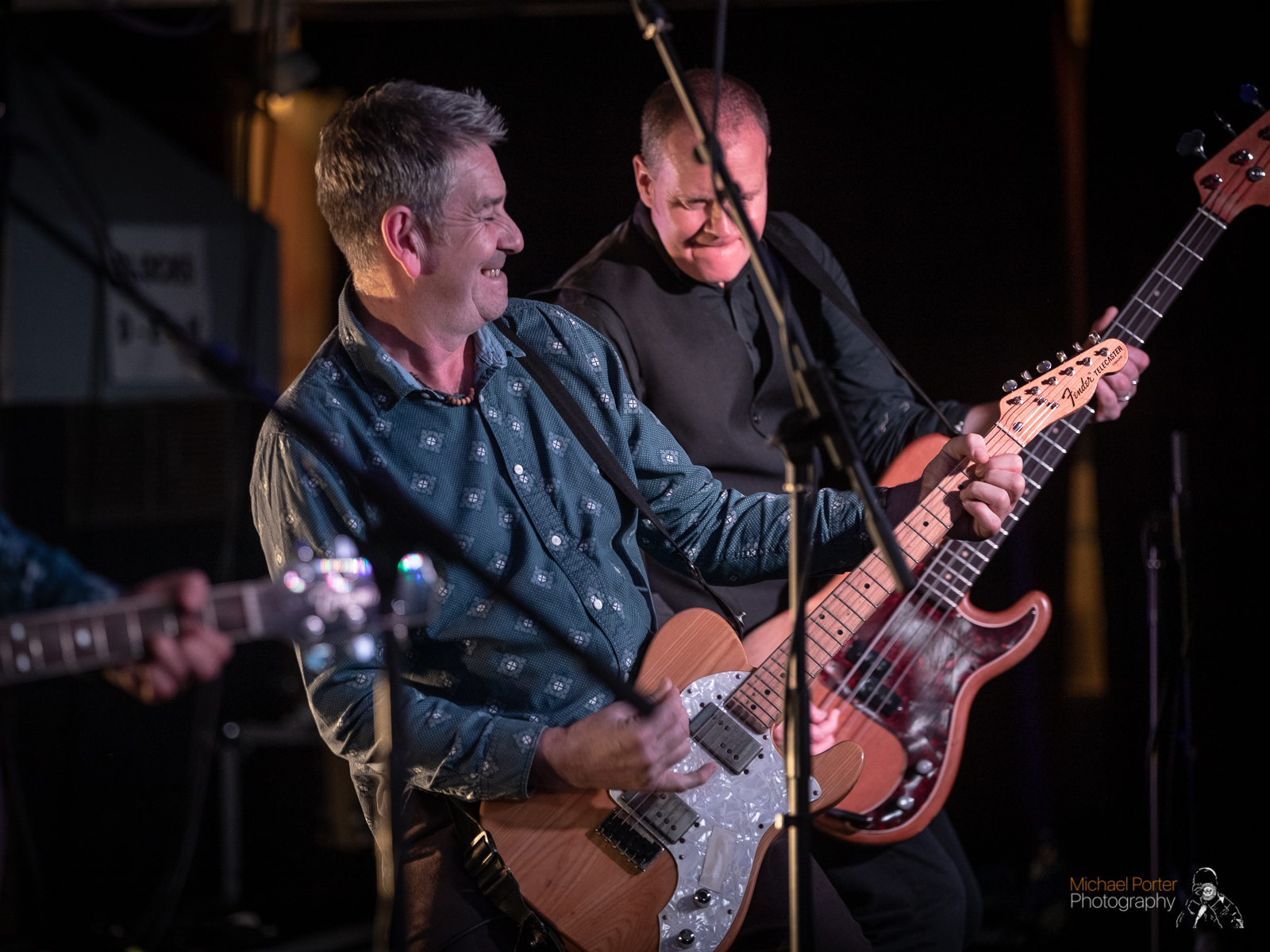
Lining Up: The Men They Couldn't Hang, live at Preston Guild Hall. From left, out front, Tom Spencer, Paul Simmonds, Phil Odgers, Stefan Cush, Ricky McGuire, with Jon McLaren-Odgers on drums (Copyright: Michael Porter Photography)

Lining Up: The Men They Couldn’t Hang at Preston Guild Hall. From left, out front – Tom Spencer, Paul Simmonds, Phil Odgers, Stefan Cush, Ricky McGuire (Copyright: Michael Porter Photography)

It seems a little arse about face to start a review with the opening encore, but it was Eric Bogle’s ‘The Green Fields of France (No Man’s Land’) that sent shivers up the spine on Saturday night.

A song The Men They Couldn’t Hang introduced me to in 1984 can still silence a room. And that takes some doing when sections of the audience are wont to talk through the quieter moments.

‘Green Fields’ seemed all the more poignant when we’re about to mark the centenary of the Armistice, the song – and Stefan Cush’s interpretation of it – as powerful today in questioning why this never truly did become the war to end all wars, slaughter on both sides still difficult to get your head around, not least when we’re all too quick to forget the grim reality and plunge head-first into the next conflict.

If you know the original, you may recall its Scots-born Australian writer – now 74 and Adelaide-based – wrote it five years after 1971’s ‘And the Band Played Waltzing Matilda’, a further harrowing expose of the cost of war I first heard in 1985, when it was delivered in similarly-stirring style by The Pogues.

And while Bogle made his point perfectly in a more understated way on both songs, it was Cush’s more emotional delivery on ‘Green Fields’ that made me sit up and take notice.

Quo Quota: TMTCH’s Cush and McGuire emulate Rossi and Parfitt (Copyright: Michael Porter Photography)

Written 60 years after ‘Willie McBride’ lost his life in France, here we are 42 further years on debating the merits of our European union, the far right growing stronger again, The Men They Couldn’t Hang still speaking out, their ‘80s alternative anthems as relevant today as when they were first voiced.

Take for instance ‘Ironmasters’, Paul Simmonds’ tale of the Chartists as powerful today, a true fanfare for the common man. Then there’s ‘The Ghosts of Cable Street’, afforded extra poignancy after the death of centenarian Max Levitas, the last of the protest leaders in that laudable East End battle.

On a similar front, we had further early TMTCH highlights ‘Going Back to Coventry’ and ‘Shirt of Blue’, on a night when they kicked in with ‘Gold Rush’, a fellow Simmonds How Green is the Valley favourite.

The first record was well represented too, Phil ‘Swill’ Odgers finding his voice on ‘A Night to Remember’ and soon tackling ‘Hush Little Baby’, both of which made me realise in ’85 there was far more to The Men than just polemic (great as that was). And we also got ‘Wishing Well’, a song I mistakenly thought was their own until its writer, Nick Lowe released his version. Yet, like ‘Green Fields’ it quickly became theirs.

From third LP, Waiting for Bonaparte there was ’Bounty Hunter’, ‘Smugglers’, and ‘The Colours’, crowd favourites all, while from Silver Town we had ‘Rosettes’. But this was no legacy act night out, and we had a brief taste of 2014’s The Defiant in barndance-storming ‘Raising Hell’, and five great cuts from the new album, the splendid Cock-a-Hoop.

Drum Major: The Men They Couldn’t Hang’s Jon McLaren-Odgers shows his support for the Grenfell Tower victims (Copyright: Michael Porter Photography)

When Cush barks out the earlier classics, you wonder how his voice has ever lasted, but he was perhaps at his best – with new-found vocal maturity – on the self-penned ‘Salutations’. For a moment it was as if Springsteen and the E-Street Band had ridden into town.

Similarly, ‘Sirens’ offered a perfect introduction to the strength of the new material, while Swill’s ‘Three Ships Sailing’ – with just Simmonds for company – deserved far better from those who took the opportunity to catch up with old mates mid-hall, on a night when the band struggled with the acoustics, the venue seemingly conspiring against them, the sound-man kept busy. A similar fate befell Cush as he tackled Simon and Garfunkel’s ‘The Boxer’, delivered in Billy Bragg-esque style on his Telecaster.

‘Arrow’ certainly hit the target, Swill in fine form (his voice ever richer) and the band truly dynamic, providing further proof that this six -piece – as they were on this occasion – have plenty more gallons in the creative tank.

Four songs later they were away, the solemn ’Green Fields’ – and I was amazed how many of us knew every line – followed by the wake, and a number that’s been there since day one, our visitors seeing us home in style on ‘Walkin, Talkin’’. And on the evidence of this outing, hopefully there will be several more nights to remember in their company.

Saturday Soul: The Men They Couldn’t Hang live at Preston Guild Hall (Copyright: Michael Porter Photography)

Several of the remaining tour dates are now sold out, but for remaining ticket details and more on new LP Cock-a-Hoop and other projects, try their website and keep in touch via Facebook, Instagram, or Twitter. And if you missed this site’s recent feature/interview with Phil ‘Swill’ Odgers, head here.


Posted in Books Films, TV & Radio, Music | Tagged , , , , , , , , , , , , , , | Leave a comment

From record shop pilgrimages to transatlantic discovery – talking The Decemberists with Colin Meloy

Band Substance: The Decemberists return to the UK and mainland Europe this month (Photo: Holly Andres)

This weekend, The Decemberists leave Portland, Oregon for their latest UK and mainland European tour. But don’t expect them to have worked on the set these last couple of weeks. As vocalist/guitarist and occasional children’s author Colin Meloy explained, “We’ve been touring this record since March, so no rehearsal is necessary!”

So are they shit-hot as a band at present?

“We’re definitely as shit-hot as we’re gonna get!”

The Decemberists formed in 2000, Colin quitting previous band Tarkio in Montana to move to the Pacific Northwest coast, meeting Nate Query (bass guitar), who in turn introduced him to Jenny Conlee (piano/keyboards), the trio initially scoring a silent film together.

Colin already knew Tarkio fan and fellow guitarist Chris Funk by then, and he added pedal steel on the first two Decemberists releases before officially joining in 2004, the current line-up together since John Moen became their third drummer in 2005.

The rather splendid I’ll Be Your Girl, released in Spring 2018, is their eighth album in 16 years, the band having first dipped their toes in the water with 2001 self-released EP ‘5 Songs’, playing a hotel gig the night before to raise enough to afford studio time, its tracks put down in under two hours.

And from dates with full orchestral accompaniment to live support for Barack Obama at a presidential rally, late night US TV appearances, work with REM’s Peter Buck, 2011’s Best Rock Song nomination for ‘Down by the Water’ at the Grammy Awards, sixth album The King Is Dead debuting at No.1 on the US Billboard 200 that same year, and ever onwards, it’s been a blast.

The band also contributed a song to 2012’s The Hunger Games soundtrack, made a cameo appearance on The Simpsons – presented as hip new music teachers of Springfield Elementary, the episode’s theme music performed in true Decemberists style – and performed on a 2014 series finale of hit NBC comedy series, Parks and Recreation. And while their song for the Hamilton soundtrack was squeezed out in the end, I’d recommend anyone to track down the mighty ‘Ben Franklin’s Song’. Written by the play’s creator Lin-Manuel Miranda in what he envisaged as a Decemberists style, it’s American history with attitude, you could say. Something The Decemberists have become experts at.

Colin was at home in Portland when we spoke, looking ahead to a tour opener at Vicar Street, Dublin, on November 4th, with six UK dates following, then two in the Netherlands before a Berlin finale at Astra Kulturhaus on November 16th. Does the travel get a little wearing these days?

“Erm, you know, I go back and forth. Sometimes it’s hard, certainly dealing with jetlag, especially after you’ve been doing it for a while. In the early days, your excitement at the novelty of what you’re doing would carry you through, but now … it’s another tour … but with the crowds, it always feels a little different.

“We always spend so much time in North America, and so little time over there that it’s always a little exciting to be playing to UK and European crowds.”

And this side of the pond was home to so many influences that have informed The Decemberists’ music, after all, a few of whom are apparent listening to the latest album, the John Congleton-produced I’ll Be Your Girl, which opens with the anthemic ‘Once in My Life’, its video directed by Autumn De Wilde, described as her ‘love letter’ to her 7ft 2ins tall, size 22-booted brother Jacob, who stars in it, has auditory processing disorder, ‘likes to dress up as Chewbacca, but ‘is not a basketball player’.

As Colin put it, “We were searching for a video idea that would somehow capture the spirit of the song. In my mind, the song is a meditation, a plea to the cosmos that I imagine everyone, at some point or another, has made. We asked our old friend and collaborator Autumn to pitch an idea and she came to us with a simple but powerful story: a depiction of her brother Jacob, a man who has lived with physical and intellectual differences his entire life, dancing in the streets of Los Angeles. The song, in this light, becomes more than just a celebration of sadness, but suddenly a longing holler to the universe against one’s perceived otherness.

“This idea is particularly close to me as I’ve witnessed how the world sees my son Hank, who is autistic. When I’m out in public with Hank, I’m acutely aware of the world’s attachment to social and behavioral norms; in these situations, Hank’s otherness can suddenly be put in stark relief. Through the lens of Jacob’s joyful and defiant movement in Autumn’s video, we see a man shrugging off the constraints of an unaccommodating and judgmental world and truly reveling in his body and mind.”

There’s a powerful message there, and while I’m no great fan of MTV-like promos that are so strong image-wise that you focus on the video’s story than self-interpret the message of the song, I concede that they created a powerful short film here.

“Well, it was really a challenge trying to find a video, getting submissions from people. If it’s taken too literally … one idea involved a woman in a casino who just wants to win. And while that interpretation’s universal, it becomes almost too trivial.

“Other versions had nothing to do with the song and felt like it did a disservice to the message. So we asked Autumn to come up with an idea, and it seemed to be this perfect bridge, where it wasn’t so literal yet it did convey and add a kind of extra dimension to the song.”

And it seems to have struck a nerve with the wider public.

“I think so. We’ve had a lot of nice comments from people.”

And the idea drew a few parallels with your own family experiences.

“There was that kind of a personal aspect to it, but I wasn’t thinking of Hank when I was writing the song and wasn’t really thinking of myself. But I played it to my wife, Carson, as I do most songs, and immediately she said, ‘Do I have a right?’ It only occurred to me at that point that it might be presumptuous given my privilege as a straight, white male in the United States to say, ‘For once in my life, could just something go right’.

“But it’s not really meant for me, it’s meant as some kind of universal plea.”

Don’t take this the wrong way, but that’s perhaps the album’s lighter-waving, stadium-filling Snow Patrol-like moment, as opposed to track two, ‘Cutting Stone’, where you seem more at home wearing your folk revival influences on the sleeve. And across this album we get to hear many sides of The Decemberists, perhaps more so than before.

“Erm, I feel that we’re just making the music we’re making, putting out the best record we can. It does jump around a bit, but …”

In a very good way.

“Yeah, I guess that’s probably true.”

I mention a folky feel, but the fretless bass and synth on ‘Cutting Stone’ take the song a different direction, suggesting something late ‘80s, and … whisper it, a reinvention for the band. And that’s kind of confirmed with the mighty Depeche Mode meet OMD and New Order ‘80s synth-rocky, power-pop of ‘Severed’, while next track ‘Starwatcher’ brings to mind a more mature, 21st Century James, something that’s also apparent on the deceptively-powerful yet still folk-driven ‘Tripping Along’, Colin’s vocal bringing to mind Tim Booth as much as Michael Stipe for me. And then there’s the ‘60s psychedelia of the equally-splendid ‘Your Ghost’, suggesting Syd Barrett-era Pink Floyd alongside traces of ELO and Queen-like pop. Yep, on that side alone I think it’s fair to say there’s something for everyone.

“Yeah, we’ve always had a tendency to do that. We’ve been described as a record collectors’ band, often finding different things in our collections that we were obsessed with at the time.”

That continues on the other side, with a little of the quirkiness of past WriteWyattUK interviewees They Might Be Giants on opening cut ‘Everything is Awful’, an eminently-singable ‘It’s the End of the World As We Know It (And I Feel Fine)’ like ditty celebrating the sheer shiteness of the world today, its more chirpy tone accompanied by … wait for it, a heavy ‘Anarchy in the UK’ guitar riff.

“Ha ha!”

Then there’s the ‘70s splendour of latest single, ‘Suckers’ Prayer’, Steve Harley and Cockney Rebel springing to mind, perhaps tackling a more laidback California highway feel you’d more likely hear from Teenage Fanclub these days. In fact, come to think of it, there’s plenty of schizophrenic depth right across this fine album.

“Yeah. It is all kind of mish-mashed in there.”

There’s even a glam-rock vibe on dancefloor-packer ‘We All Die Young’, I venture, and Colin and co. – carried along on a Sweet tide, so to speak – seem to be having way too much fun singing about death and gloom, Jenny’s Suzi Quatro-like backing vocals and the Roxy-like mad sax proving infectious.

“Well, talking about making a glam record is what we were setting out to do when putting material together and trying to find what would be the true line. We ended up talking a lot about Roxy Music, early Brian Eno, things like that. So I think with a lot of the songs, if it’s not apparent, they are at least in practise shot through with early glam.”

And I suppose as a band you’re always likely to be a product of all your influences.

“Yeah. Sometimes I feel it would be blessed to be one of those people who only listened to one thing and then started a band. But we’ve been ravenous. I’ve certainly been ravenous in my consumption of all sorts of different kinds of music, and that invariably finds its way into all the songs.”

In a sense – and this might just be ignorance on my part – maybe I wouldn’t expect a lad from Montana to have such a wide range of influences. Were you listening to a lot of the music you now love from an early age?

“Yeah, I think when I was probably 12 I was introduced to the college and alternative rock of the day, in the late ‘80s, to R.E.M., The Smiths, Husker Du and The Replacements, and Robyn Hitchcock – people on both sides of the pond – and that was the moment music became really huge for me, discovering that music.

“I don’t think you’d necessarily say that was diverse, now I look back at it, even though at the time I thought it was, at the time I was listening to punk and rock, and it felt diverse. But considering today’s climate, it was not very diverse at all.”

I know there are many miles involved between these places, but I guess there was a sense of pride that quality bands like R.E.M. sprang out of middle-of-nowhere cities like Athens, Georgia (and yes, I realise that’s more than 2,000 miles from Colin’s Helena, Montana roots), not just across in the UK.

“Yeah, I think so, certainly hearing The Replacements sing about being in Minneapolis on ‘Stuck in the Middle’, but it was still a hard drive from Montana, while Athens was only an hour and a half from Atlanta. We were more isolated, and it was so much harder finding those records. Local record shops would have the major label releases, but finding anything on IRS or Twin/Tone or SST would involve these pilgrimages to closer college towns or – better yet – to Seattle or Portland, which were 10 or 12 hours away.”

And was that music more on tap when you upped and left for Portland?

“Absolutely. Walking into a record store in the late ‘80s for me in Seattle or Portland, I could spend all day if I had a little ready cash just to kind of thumb through and find all this stuff of legend.”

Was any money you had for studying soon gone?

“Oh yeah. Whatever money I would save was all spent on records, if there was a trip to Seattle or Portland involved.”

We mentioned R.E.M., and for me next track ‘Rusalka Rusalka’ seems to carry their air. Actually, it’s almost Bowiesque in essence. And while that could easily have been the end of it, they’re off again straight away, those folk roots poking through and ‘The Wild Rushes’ emerging, Colin and Jenny’s harmonies sublime, the band’s masterful storytelling again apparent.

I love those re-emergence moments, I tell Colin, and mention that I understand he’s a big XTC fan …

“Yeah … Well, I dabble!”

Well, I’m thinking of the moment where ‘Summer’s Cauldron’, the opening song on 1986’s  Skylarking heads into track two, ‘Grass’, a similarly-beautiful segue.

“Yeah, linking songs with sounds is something we’ve always messed around with a bit. But with that, I’d written ‘Rusalka Rusalka’ and then immediately it felt like rather than just end on that, it wanted to go into that kind of ‘dow, ba duddle de dow’ (at least I think that’s what he said there). In cases like that you have to kind of follow the lead, and a song is not done until it’s done. And then eight verses later, it was finished.”

Well, put it like that, arguably it owes as much to The Beatles and the Abbey Road way of linking parts of songs.

“Right, although I think that owes as much to Fairport Convention.”

Funny you should say that, listening to ‘The Wild Rushes’ I wrote part-way through, ‘Gabriel-era Genesis meets Fairport Convention’ … so perhaps I was at least half-way there.

“Yeah, you were getting there.”

And it’s a builder – by the end it’s as if we have Led Zeppelin guesting (albeit with more Lilac Time-like vocals). It’s a mighty number for sure.

“Yeah, there’s a bit of that, but there is some crossover between Fairport Convention and Led Zep. Those two are often linked.”

And then the album ends with the more simple, country-like beauty of the title track, ‘I’ll Be Your Girl’, those harmonies again to the fore and Jenny now your Emmylou Harris, in a track I see as something of an antidote to these troubled times, and a reminder that there’s so much more to America than the images we get over here right now of Donald Trump, Brett Kavanaugh, and so on.

“God, I would hope so. I’m worried that there’s not much more to us than that. I started out feeling, ‘This is not us!’ But now I feel more and more that this is us.”

But occasionally we’re reminded through music  about the better side of America, songs giving us hope. Someone like Gretchen Peters springs to mind.

“Well yeah, there is very vocal resistance, but I also think we as Americans have to own up to this very dark thing underlining our political ideology.”

We have little room to speak over here, judging by the last couple of years for the UK. At times, there seems to be a 50/50 split on all that.

“Yeah, maybe so.”

While Rough Trade handle your affairs on this side of the water, having started out with Olympia, Washington and Portland-based indie label Kill Rock Stars, this is your fifth album in 12 years with Capitol. Yet it seems to me that such belief and support in a band doesn’t seem to be something such established record labels tend to offer their artists these days.

“Right. Yeah, I’m a little surprised myself! Even though we’ve stuck with Rough Trade from the early days over there, Capitol have also been great. I don’t think they’re showering marketing money on us like they would Katy Perry, but I don’t think we’ve ever expected that. I think just having support, being able to see whatever projects or ideas we have and be true to them … yeah, I can’t complain. I think it is kind of a rarity in this day and age.”

Over the years, a band whose name refers to the 1825 Decembrist Revolt in Imperial Russia has built something of a reputation for live shows, past lyrics focused on historical incidents and folklore inspiring eclectic sets and lots of quirky crowd participation.

Take for example a 2009 date in Pittsburgh, PA where band members ran up and down the aisles recreating a fictitious battle at Fort Pitt, while the following year’s European tour’s set finale ‘The Mariner’s Revenge Song’ saw audiences encouraged to scream as if being eaten by a whale while the band pretended to die on stage. Any historical reenactments lined up for this UK visit?

“Ha ha! No, but we’ve got a new and flashier whale, so that’s something people can look forward to. But no spoilers – you’ll have to come to the show.”

Touring Again: The Decemberists arrive in Boulder, Colorado (Photo: Holly Andres)

Just bringing to mind your solo recorded tributes to the likes of Sam Cooke, The Kinks, Shirley Collins, and Morrissey, you’re clearly a man of taste. But are you as big a band as you’re comfortable with? Because I can’t imagine you being much bigger.

“I never expected that we would be as big as we are. All the bands I grew up listening to never got to that size of venue or audience, so it’s always been a little shocking to me along the way.

“But it’s something you become used to, and it’s great to have big packed houses, but I’m very grateful for that and also recognise that we are an idiosyncratic band, so is there room for us in the world these days? And I guess that’s a question we’re still asking.”

Maybe it’s just that you retain your charm despite the fame. You seem to be keeping your feet on the ground. I won’t get on to Morrissey and his recent bizarre pronouncements and downright racist claptrap, but let;s just say that some people seem to struggle more with that sense of their own importance.

“Yeah … that’s true.”

Meanwhile, not only have the band made appearances on cult hit TV series like Parks and Recreation and The Simpsons, film soundtracks and so on, but there’s another side to their father-of-two frontman’s career too, this former English and theatre then creative writing student, who graduated from the University of Montana in 1998, having made his debut as a children’s writer in 2011 with Wildwood, illustrated by his wife, Carson Ellis (sequel Under Wildwood following a year later and a third in the series, Wildwood Imperium released in 2014, followed last October by The Whiz Mob and the Grenadine Kid). And writing’s something that runs in the family, isn’t it?

“Yeah, my sister is a writer (Maile Meloy, a fiction writer often published in The New Yorker and The New York Times). She kind of started that off for the two of us. Yeah, that’s been a lot of fun, and something I’d like to get back to once this tour is wrapped up.”

Supper’s Ready: The Decemberists’ opt for well done, again (Photo: Holly Andres).

For ticket details of The Decemberists’ November dates across Europe, head here. For the latest from the band, head to their website and keep in touch via Facebook, Instagram and Twitter. And for all the latest from Colin Meloy, try his website and check out his Facebook and Twitter links.


Posted in Books Films, TV & Radio, Music | Tagged , , , , , , , , , , , , , , , , , , , , , | 2 Comments

The Men They Couldn’t Hang, still on the loose, avoiding the noose – the Phil Odgers interview

Guitar Man: Phil ‘Swill’ Odgers in live action at the Shepherd’s Bush Empire (Photo: Peter Stevens)

Listen to Cock-a-Hoop, the new record by The Men They Couldn’t Hang, and you get an album by a band sounding as fresh today as when their first album was released in 1985.

What’s more, the subject matter of their particular brand of indie-folk (call it what you like – the music press went for cowpunk in the early days) is just as relevant. As I put it to co-vocalist/guitarist/founder-member Phil ‘Swill’ Odgers, there’s been a resurgence of sorts in more political folk lately. Is the time ripe for a Men They Couldn’t Hang revival?

“Ha! I always think the time is ripe for a Men They Couldn’t Hang revival! But we’ve suddenly fallen into some kind of legacy band territory, seen as the Godfather of folk-punk and all that. Some of the American bands of that ilk have nodded towards us, and even the likes of Mumford and Sons and people like Frank Turner.”

There’s plenty to write about today too. Having overseen Thatcher, apartheid and all that, we have the neo-right (call them what you like – fascists will do) making strong ground again, the rich getting richer while the world obsesses on immigration and border controls.

“Well, as Paul said when he was writing for this album, all the stuff from before – ‘Ironmasters’, ‘Ghosts of Cable Street’, ‘Shirt of Blue’ – they’ all equally relevant and have lost none of that meaning. And while Cock-a-Hoop is maybe not as blatant, there’s a very strong current there of political content and comment.”

Similarly, your voices seem to have added maturity too, after all these years.

“Oh, I’m amazed our voices have held up at all, after all the shouting, smoking and drinking! But I think we’re growing old disgracefully, which is good, and I think the sort of thing we’re doing means that we are able to continue doing things that don’t make us a laughing stock and retain a little dignity as well.”

Swill’s based in West London, where he’s been for much of the time The Men They Couldn’t Hang have been around, shifting barely five miles from the band’s Shepherd’s Bush roots.

“That was pretty much the meeting place for all the band. We were driven towards London and all hooked up there in the early to mid-‘80s, pretty much around a squat scene there.”

While born in Scotland, he was brought up with his brother – the band’s drummer, Jon Odgers – around Southampton, as was the case for prime songwriter Paul Simmonds, who Swill knew from college days. In fact, they were initially together in South coast punk outfit Catch 22. Were they cruelly robbed of fame in their own right?

“Ha! Yeah, we were talking about wanting to be in a band in 1977. Paul said he could play guitar and I said I could sing, and both of us were lying. Anyone can pretend they can sing, but guitar? You have to brush up very quickly and learn three chords. But that was a really great time, and we supported The Clash in Bournemouth, doing two dates on the 16 Tons tour.

“We did Portsmouth first, with Joe Strummer and Mick Jones watching us from the side of the stage, then coming into the dressing room afterwards, asking if we’d like to do the next night. And they didn’t even have to ask! We certainly didn’t ask, ‘How much?’

“Then, a few years later, when I moved to London, I was in a pub in Westbourne Park with my Dad, who’d come up from Southampton to see me, when Joe Strummer happened to walk in, on his own. I went up and said hello, a little bit anxious, and he was so friendly and remembered those gigs.

“My Dad was even more impressed than I was. Even though he didn’t really know who he was, he could tell it was someone who meant a lot to me. And I was struck by how decent he was. That was a year or two before The Men They Couldn’t Hang started, around ’82 or ’83.

“And literally just before Joe passed away, our bass player, Ricky (McGuire, on board since Shanne Bradley left in 1986 following a short spell with The UK Subs), phoned and told me he’d had word that Joe (with The Mescaleros) was set to play Acton Town Hall, and Mick Jones might turn up. He said he had guest tickets and asked, ‘Did I want to come down?’ But I’d just become a Dad and felt I should stay in, go to the next one instead. Of course, there never was another one.”

Garage Band: Joe Strummer is behind the band at an FBU benefit show, Notting Hill, 2012 (Photo: Peter Stevens)

The Men They Couldn’t Hang did get to headline a special memorial concert marking the 10th anniversary of that memorable Fire Brigades Union benefit show (Strummer’s last London gig) in November 2012 though, at Notting Hill’s Tabernacle. And when he sent me some pictures to go with this feature, Swill told me more about that night.

“Apart from The Men They Couldn’t Hang, also on the bill were Strummer’s friend and sometime-Mescalero, Tymon Dogg, Newtown Neurotics frontman, Steve Drewett and Clash tribute band, Take the 5th.

“Something amusing that stood out for me that night was that, for some reason, Paul, Cush and Tom’s guitars stopped working, and mine was the only one coming through the PA. I had to pass it around to whoever had the most important guitar part on each song.

“It struck me as ironic that this almost fitted in with a line from Joe’s lyrics to ‘Garageland’: “There’s five guitar players! But one guitar. Back in the garage…,” written by Strummer as a response to a review in the NME in 1976 by Charles Shaar Murray, who said The Clash were “the kind of garage band who should be returned to the garage immediately”. And we certainly sounded like a garage band that night!”

Garage band or not, it’ll be 35 years next year since the band’s own story truly began. So how was that first Easter ’84 festival performance in Camden at the Electric Ballroom? A fairly shambolic affair?

“Totally. Although, while you tend to think all those things in those days were, very occasionally a tape surfaces, you have a listen, and actually we weren’t too bad. But that one must have been. We didn’t even have a band as such. It was me and Cush, and I think there was Shanne, and we borrowed Andrew Ranken on drums and James Fearnley on accordion, from the Pogues.

“We really just pulled it together as more of a laugh than anything else, and it went so well. We did a set of just a few of our own songs, like ‘Walkin’, Talkin’’ and ‘A Night To Remember’, stuff like that, but also ‘Rawhide’, ‘High Noon’, ‘Just Like Eddie’ that we’d been doing busking.”

The latter track as in the 1963 Eddie Cochran tribute from Heinz?

“Yes, and funnily enough, I got mistaken for Heinz on the isle of Wight once, playing pool in a pub, way back!”

Early Days: On the back of the Night of a Thousand Candles LP, Swill’s brother Jon sporting his bleached look

Funnily enough, looking at the band pic on the front of the debut LP, it’s Swill’s brother by that stage with the Heinz-like bleached hair. Incidentally, while I ended up selling a fair bit of my original vinyl, that album, along with follow-up How Green is the Valley and first single ‘The Green Fields of France (No Man’s Land)’ I still proudly hold my copies of. Are they worth a bit now?

“Erm … I don’t know. They’re probably worth the cover price!”

Speaking of that first Phil Chevron-produced single for Elvis Costello’s Imp label (IMP003), the B-side was your title track of sorts, ‘The Men They Couldn’t Hang’. So what came first, the band or track name?

“Almost the same time, but probably the band. The track itself was just a bit of fun really. I was trying to imagine a story behind it. And the name sums up an image really, so I had this side of romanticising that image really.

“The name itself has been our blessing and our curse right from day one really. In fact, at one point when we still had a record company – we tended to be with one, make an album, then move on, there were a few times when a label would suggest we changed our name, and one suggestion was to The Men, to which we thought, ‘Bloody hell! The Men?’ And one label seriously suggested we changed it to anything, looking at the floor and saying, ‘Even ‘The Carpet Tiles’.’ Our manager also used to say it’s too long and how, for a poster, your name is always going to be too small.”

You say that, but you got around that nicely, coming up with that distinctive band logo pretty early on.

“Yes, and I’m proud to say that was me! I was working in Wandsworth as a paste-up artist. I cut up these letters, long before any kind of digital wizardry, just sort of stuck them all together on a piece of paper, photographed that, wanting to have the look of a something of a wanted poster thing. It’s been criticised in more recent years for not having the apostrophe in ‘Couldn’t’. But I can only say that it was deliberate! They didn’t have those apostrophes originally. Those posters were made out of woodcut in those days.”

There was that strong identity from the start with The Pogues, not least with Phil Chevron producing a lot of the early tracks. But your name and that of the other main band on at that first gig in Camden (also involving the Shillelagh Sisters and Hackney Five-0), The Boothill Foot Tappers, saw you categorised as part of some kind of skiffle-punk scene, if I remember right. What was the term the music press used?

“Oh God, there was skifflebilly and cowpunk. You almost had like two camps – with us and The Pogues more influenced by traditional music, while the Boothills and some of the others took more of a country inspiration.”

Men Only: From the WriteWyattUK personal vinyl archive (Photo: Malcolm Wyatt)

Are you still in touch with members of either of those bands?

“Yes, Cush married Merill, one of the singers from the Boothills, and they have two children together, although they’re separated now, and I’m still in touch with James and Spider from The Pogues, and we’ve toyed with the idea of doing stuff together. I’ve just started a new Pledge campaign for a new album of my own, possibly with Spider involved next time he’s in London.”

Details of that Pledge campaign follow at the end of this feature, so we’ll get back to that. But carry on, Swill …

“It was difficult to remain friendly at some stages, with so much pressure put on us by others, almost creating a division. But we did a lot of gigs together and were very good friends in the early days,  borrowing equipment, until The Pogues got much bigger, going off travelling and playing bigger venues. But we’d still do occasional gigs together in Europe and come together at festivals.”

With this feature set to land on the 14th anniversary of John Peel’s passing, it seems apt to mention that I first heard ‘The Green Fields of France (No Man’s Land)’ on his legendary BBC Radio 1 late-night show. I was still 16, and 17 by the time it reached No. 3 on 1984’s Festive 50. It struck a real nerve with me, and that must have been a proud moment for the band.

“Yeah, that was amazing to hear Peel playing our stuff. And as well as that, ‘Ironmasters‘ was in his Festive 50 the following year. He did us a world of good and I think we did three Peel sessions in the end. We never met him then, as they were recorded at Maida Vale, but we met on other occasions – gigs and so on.”

I’ll jump in there and confirm there were three Peel Sessions in 1984 and 1985, the first in July ’84 produced by Barry Andrews and featuring ‘Walkin’, Talkin’’, ‘The Men They Couldn’t Hang’, ‘The Green Fields of France (No Man’s Land)’, and ‘A Boy Named Sue’. Meanwhile, the second was from February ’85, produced by future presenter Mark Radcliffe and featuring ’Ironmasters’, ‘A Night to Remember’, ‘Scarlet Ribbons’, and ‘Donald, Where’s Your Trousers’, and the third in July ’85, produced by John Owen Williams, featured ‘Shirt of Blue’, ‘Where Have All the Flowers Gone’, ‘Greenback Dollar’, and ‘Kingdom Come’. And all those sessions are fondly recalled by this here scribe. Anyway, keep going, Swill …

“I always felt as a kid, listening to John Peel – and I wrote a song about this recently, and I’d have to listen with the covers over my head with this little transistor radio, otherwise my Mum would be telling me to turn it off and go to sleep – I’d dream about doing a Peel session, thinking if I’d ever get to do that, that would be it – I’d have made it and nothing else would matter. Then, a few years later, we did that, then did it again and again. And as many bands do, we owe an eternal debt of gratitude to John.”

Lining Up: The Men They Couldn’t Hang in action at the Shepherd’s Bush Empire in April 2017 (Photo: Peter Stevens)

On a similar front, even if you’d split after two albums, you’d already have secured a special place for me. And while perhaps the Eric Bogle cover and splendid Paul Simmonds-penned, Stefan Cush-delivered tracks like ‘Ironmasters’, ‘Scarlet Ribbons’, ‘Ghosts of Cable Street’ and ‘Shirt of Blue’ were arguably recognised more, you were a key songwriter from the start, offering – for want of a better description – a less ranty side to the band, initially through tracks like ‘The Day After’, ‘A Night to Remember’, and ‘Parted From You’, all making an impression on my teenage self.

“And I suppose that’s what we’re saying about Cock-a-Hoop having a variety of sounds. I think that’s something that’s separated The Men from others of our ilk … and God, I said ‘The Men’ there! … I think it’s the fact that it has these different flavours, different personalities, and we’re not one-trick ponies.

“Going back to the very beginning, we were signed up by Elvis Costello, introduced to him by Phil Chevron, meeting Elvis at this gig, supporting him on his A Month of Sundays run at Hammersmith Palais, and he came to one of our gigs at the Clarendon in Hammersmith.

“He said he wanted to do a single, put to put out ‘The Green Fields of France’. The obvious one to go for was ‘Walkin’ Talkin’’, but he said with that we’d have a hit record, but a novelty one, and we’d be forever branded as this kind of cowpunk band. That’s why we ended up putting out this seven-minute anti-war folk song! But it became an indie hit.”

Good advice, although perhaps unlikely, and the album, Night of a Thousand Candles also proved a hit, and was certainly an important album for me. But that relationship with Demon/Imp set a trend, lasting just one album, follow-up How Green is The Valley arriving via MCA, while next LP Waiting for Bonaparte was on Magnet, the next two were on Silvertone, and so on (and space and time stop me from concentrating on anything more than the first two albums and the latest in this feature).

So, after the first album came that switch to MCA, your biggest label really, I guess. Did that mean a bit of money was suddenly coming your way (he asks, knowingly)?

“Not really. It just meant a much bigger budget for recording. If you watch The Comic Strip Presents … Bad News Tour (Channel 4, 1983), where they’re eating free food from the stand while making a promo video and someone explains it’s not free but comes from their money. It never dawned on us either!”

Are you still paying that contract off now then?

“We’re not paying it off, but they withheld royalties and we never saw those album royalities. And that’s almost like part and parcel of the times, with dodgy contracts and all that. But what it did do was elevate us from busking and signing on to be able to become full-time musicians.”

Whereas at one stage you’d have been happy enough recording Peel sessions.

“We would, and every record we made – probably still now – we thought could be our last. We’d never ever have imagined back then that we’d still be making records now, rather than settling down and having grandchildren!”

So, seeing as we’re doing anniversaries, it’s 35 years next year since you started out, 30 years this year since Waiting for Bonaparte, even 15 since The Cherry Red Jukebox, and five years since your own The Godforsaken Voyage solo venture.

“How time flies when you’re enjoying yourselves!”

It’s the career that keeps on giving.

“Absolutely. It doesn’t give out any money though. That’s the only thing.”

A few of us have still got some catching up to do though. Cock-a-Hoop is your 10th studio album, alongside all the compilations and live recordings out there, as well as the side-projects yourself, Paul and Cush have also been involved in. So where should those who have missed out start – buy the new album and work backwards, or start at the beginning?

“Well, if you were starting out now, I’m not sure where you’d start. Actually, I had an email from a guy today who signed up to my Pledge project, who said he lost all his belongings in a fire. He had an insurance pay-out but lost all his records and so on, including three of our records that he couldn’t find now, that thankfully I can now put his way.”

There will inevitably be times over a 35-year career where fans won’t have the money to shell out and keep up to date, for whatever reason. Also, over that period the nature of the music industry has changed immeasurably, heading back towards that old punk DIY approach to putting records out there. And you seem to have mastered that method over the years.

“Yes, and knowing what I know now … Like yourself (this scribe was responsible for Captains Log) I was involved with a fanzine back in Southampton, and there were so many of those things that people built up themselves and learned how to do themselves – from fanzines to independent record labels.

“Now, that same do-it-yourself ethos can be backed up by the technology to make that very competitive towards anything that the industry can produce – from albums to books – and they can all be done at home, on a computer or via outlets where you can directly liaise.

“While a lot of people complain about digital technology, you can be profitable and survive by selling fewer things by doing it yourself. But although lots of people know The Men’s name now – and it’s inevitable after all that time – we’ve never made money, so to speak. Yet we’ve got by, and it’s all been very pleasurable.”

And part of that indie approach is seen in the way Swill remains at the heart of the band’s marketing, not least helping ship out CDs and vinyl, with a personal touch.

“Yeah, I’ve been enthused by all that. I’m a little bit of a control freak at times and do like to keep a hand on things, but also think it’s good to have that connection, and I’ll also put a note in.”

Admittedly, I lost touch for a while, perhaps after the Domino Club album in 1990, when I was off on my world travels. It took me a while to catch up again, but that period included The Men supporting David Bowie on his Sound & Vision show for two appearances at Milton Keynes Bowl. How was that experience?

“Well, I’ll go back a little further, to when we were in a tiny club, Gaz’s Rock & Blues, around Soho in the West End, and Cait from The Pogues was also there, along with their manager, Frank Murray. We used to hang out there and knew each other, and then David Bowie rolled in one night. I remember him dancing with Cait and being very chatty and friendly.

“Then, fast forward to the Milton Keynes shows, which just goes to show the difference between the person and the entourage and the people in charge of all that. He arrived in a helicopter that landed in a nearby field, and was then taken by limo to a backstage area, almost like a small town really, that had to be evacuated so he could come in on his own, and nobody could look at him or talk to him, apart from my sister-in-law – Jon having just become a Dad – who was breast-feeding at the time and refused to leave.

“Also, on stage at the gig, during the last song I was aware of these footsteps of his – ‘X’s painted on for where he would stand on certain songs, for the lighting man. And for that last song we did ‘The Laughing Gnome’, a song Bowie didn’t really acknowledge existed most of the time. His crew were not impressed with us, but the audience loved it, and we had a lot of people who followed us from there.”

Despite seeing The Men (yep, I’m doing it now too) four times in the late ’80s, I’m ashamed to say I’ve not managed to get along to one of their gigs since Reading Festival in August ‘89. The time is clearly ripe for my next date.

“That was a good one though. Was that where it poured down with rain?”

Well, I remember yourselves, The Pogues, Billy Bragg, The Wedding Present, John Peel MC’ing, Frank Sidebottom, Mary Coughlan, Attila the Stockbroker … and yeah, there must have been rain, surely.

“They’ve been trying to make a documentary film about that particular festival year, featuring all the bands on that year. We’ve already done our bit.”

That May I also saw you in my hometown at Guildford Civic Hall, on the Silvertown tour. And this has only just come back to me, but were you playing The Undertones’ ‘Teenage Kicks’ at the time?

“Yes, occasionally we’d pick up on a song and cover it over a tour, and we definitely did that.”

Prior to that, in November ’87 there was a night at Egham’s Royal Holloway College, with The Cropdusters supporting, which must have been just before the Waiting for Bonaparte LP came out.

“Yeah, that would be right. I remember that night, and The Cropdusters were mates of ours from around Hampshire way, and were always pretty wild. There would be a bit of competition between us at gigs as well, but friendly, y’know. We’d share the same dressing room, and there’d be some mad times.”

I enjoyed all those gigs, but you had something of a laddish following at that time. I’m not sure if that’s something you picked up on.

“Yeah, we’ve always had a very loyal crowd, but around that time … yeah, I suppose it could be called laddish. We had a lot of people travelling across Europe with us as well, and I was surprised sometimes, talking to some of them … they were nice people but sometimes their political views might be somewhat off in a different direction, around the times of Thatcher and so on.

“But some of those people stuck with us. And we still have an incredibly loyal following. I’m really impressed by that … constantly. But also in the last few years, I’ve noticed young people at gigs – from around 17 to early 20s, and talking to some of them afterwards, it turns out that they’re the next generation – either Mum or Dad or both were fans, and they’ve grown up on it. And that’s really great.”

That takes me back to my own introduction to the band. You fell at the right time for me. Politicised at an early age, although part of a mere minority of young socialists in largely middle-class Guildford, I was turned on by the politics of The Clash and The Jam, and then we had the likes of Billy Bragg and yourselves. And as an A-level History student, Paul’s songs of the early Labour movement, the Chartists, the anti-fascist marches of the first half of the 20th century, the Miners’ Strike …

“We sounded like your ideal band!”

You were, and it all seemed to fall right for me … or should I say left, first catching you live at the University of Surrey in May ’86, on the How Green is the Valley tour. Remind me, was Shanne still on board then?

“Yeah, and that was an odd one. We were touring Europe and the UK pretty extensively, doing long, hard tours in the back of a Transit van, then all crowding into tiny dressing rooms in little venues in Vienna or somewhere. It was quite difficult to be the only woman among all those sweaty blokes. It was a bit like one big family in that way, but as with families we’d probably feud a little as well.”

Despite the stops and re-starts, the side-projects and so on – Liberty Cage, Swill and the Swaggerband, etc. – it’s been a fairly solid line-up over the decades. Shanne left after How Green is My Valley, with Ricky coming in at that stage. But other than that, you all seem to still come back after the odd break here and there.

“Yeah, we’re a six-piece now, sometimes a seven-piece, and Ricky came in more than 30 years ago but some people still refer to him as the new boy! But Cush, Paul, Ricky and myself have been there more or less all those years, and now Jon’s back on drums for half of the gigs, another original.”

What’s more, Tom Spencer’s been on board for around a decade now. Has that given you added inspiration?

“Yes, and there’s also Bobby Valentino (the violinist and guitarist who also featured for The Bluebells, the Fabulous Poodles and Hank Wangford), a kind of unofficial member. Actually, Tom’s a mate from Acton way who was playing for other bands and came along on tour with us originally as a roadie and support act, joining us for a couple of songs. He’s been involved for the last 15 years or so, doing more and more, playing amazing lead guitar, banjo and back-up vocals, adding another flavour and another ingredient in there and very important to the final mix … to further that baking analogy!”

And now we have this mighty 10th studio album, Cock-a-Hoop, which I aim to write more about in a separate piece shortly (the internet may break if I add any more words this time around). But I’ll let Swill tell you a bit more for now …

“Most of the tracks were recorded at Kirsty MacColl’s family house in Ealing. Steve Lillywhite had designed and built a studio for her. It’s fantastic and we worked very well with Jim Knight, who produced the album and had produced my previous solo album.  It’s steeped in musical history and rumour has it that Kirsty’s original vocal to ‘Fairy Tale Of New York’ is on a reel-to-reel there somewhere … maybe it’ll come to light when the studio is, sadly, torn out early next year.”

In short, it’s been a long and bumpy journey for The Men They Couldn’t Hang, but they’re still managing to avoid the scaffold, still going strong, and I’m loving the new songs.

“Yeah, it has been a bumpy ride, but with The Men there’s never a plan really, and in terms of having a rough path to follow we did The Defiant a couple of years ago, funded by a Pledge campaign, which was absolutely brilliant, for an album heralded as being up there with our best and a return in some respects to an older sound, and we were really pleased with that and the reception it got.

“But coming to make another album, we were thinking it’s no point doing the same thing again, just serving up another helping of that. So in that respect, we had a slightly different agenda, and were also working with a producer we’d never worked with before. Also, Cush, Paul and I split the songwriting a bit more across the board.”

Cush rarely wrote songs in the early days.

“No, in fact he came to the studio very enthused, with these ideas for songs, working with our producer, Jim Knight, also our horn player … and we have a lot more brass on here than on previous albums.”

I was just listening to the track ‘Pone’ before I called, and that’s a great example of that approach.

“Absolutely. Bang on, and the great thing about that song in particular, on the tour we’ve just started, we’ve done acoustic sections for years now, live, and in the middle of the set we’ll do two or three songs acoustically. But on the last few shows Cush has been doing ‘Pone’ acoustically and it works totally like that as well.”

Always the mark of a good song. Strip everything down, and it’s still got it. No chance of replicating the horns live then?

“I don’t think we can afford to. We might do though. Maybe at the Borderline or somewhere. That’s another thing though. Some bands are very precious about sounding the same on stage as they do on a record, even to the extent of using backing tracks. But we’ve also been conscious of the fact that our live sound is going to be different to our recordings. We’re still like we were the first time we went into a studio, still playing around and getting great delight in that. And we’ve got people who prefer us live and others who prefer us on record.”

Crowd Pleasers: Mesmerising their audience at Shepherd’s Bush Empire in April 2017 (Photo: Peter Stevens)

The band announced on October 24th that forthcoming dates in Derby, Newcastle, Glasgow and London’s The Borderline (‘Friday, with very few Saturday still available’) had already joined Bristol and sold out, while tickets for Preston Guild Hall (Saturday, November 3rd, 01772 80 44 44 or this link), Birmingham Academy, Lewes Con Club and Norwich’s Waterfront Studio were still available but selling fast. For full details and more on new LP Cock-a-Hoop and the band, head to their website and keep in touch via Facebook, Instagram, or Twitter.

And for details of Phil’s Uke Town Pledge Music campaign, try this link and keep in touch with him via his website, Bandcamp, Facebook and Twitter links.   

Posted in Books Films, TV & Radio, Music | Tagged , , , , , , , , , , , , , , , , , , , , , , , , | 3 Comments